Sviatohirsk. A November Album. Routes and Landmarks
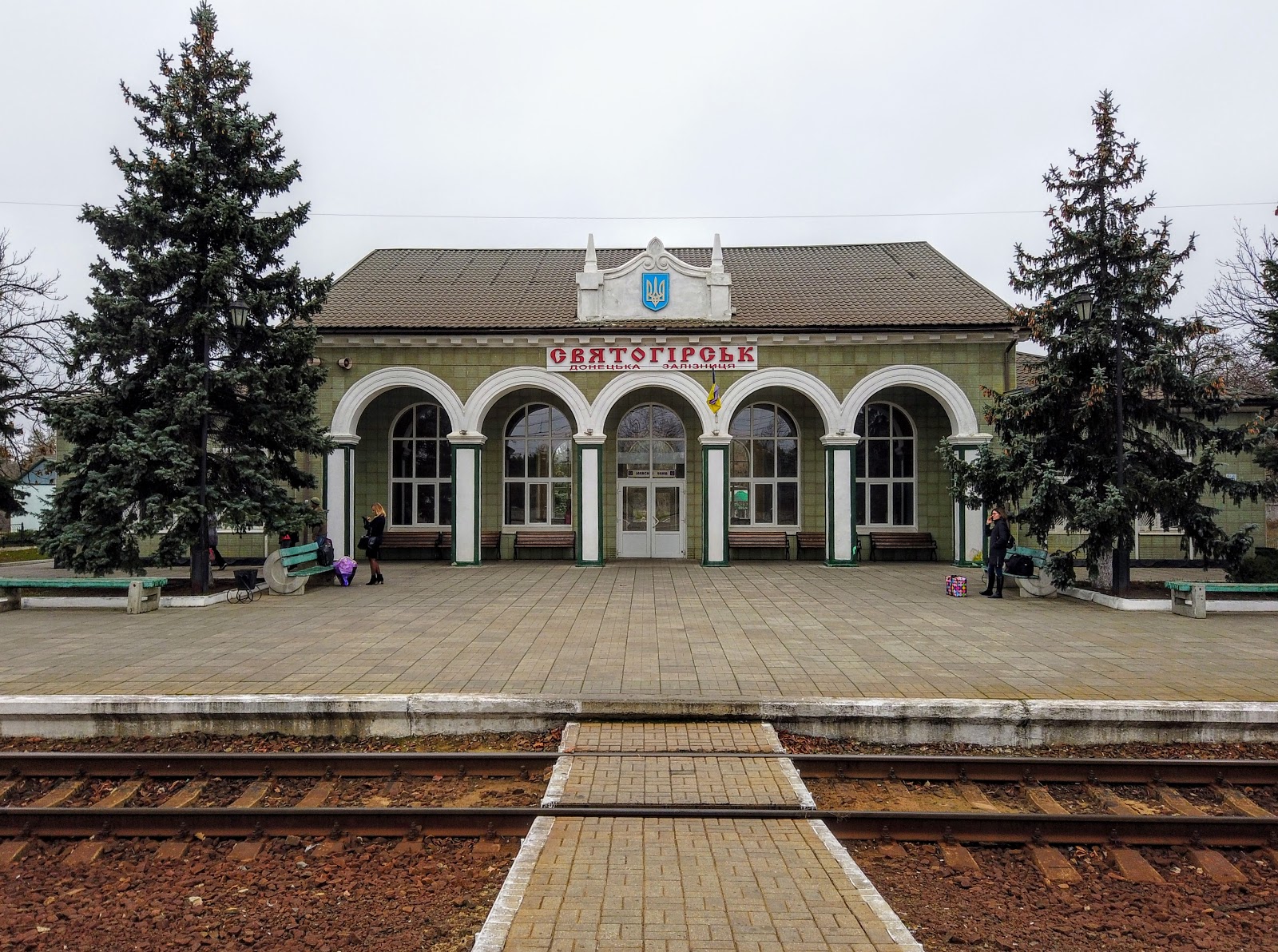
My excursion to the northernmost city of Donetsk region began at the railway station. Sviatohirsk station was opened in 1911; you can get here by train from Kyiv, Dnipro, Lviv, Ivano-Frankivsk, Kharkiv, Bakhmut. Suburban trains run through the station from Izium, Kramatorsk, Fenolna, Lyman, Kharkiv.
Sviatohirsk. Donetsk region. Railway station
From the station to the city limits — 2,700 metres, to the Holy Dormition Lavra — 6,500 metres. There is a bus link with the city centre, but about an hour remained before the bus left, so it was better to walk through the green woodland, breathe in the healing scent of pine and admire the autumn forest.
The road from the railway station to the city
Along the road near the station, a mushroom market has set up on its stalls. This autumn is warm, and from the thickets you can hear the voices of numerous gatherers of the forest's gifts.
At the forest edge lie buried 151 Red Army soldiers who fell in 1942-1943. Behind the memorial slab, checkered bags and some belongings had been dumped. When I asked the mushroom pickers whether someone had really piled their things on a war memorial, they answered that a woman lives there.
The road is paved, the verge is sandy, and walking it is a sheer pleasure.
Observation tower of the Holy Mountains research department
Signpost of the Holy Mountains research department
Sviatohirsk is a spiritual centre, a resort and tourist zone, a historical and archaeological monument. The city lies within the Holy Mountains National Nature Park, which includes natural monuments and reserves.
Signpost of a recreation base
'Protect the forest' stand at the Holy Mountains research department
The forests, the river and the chalk mountains encouraged the building of recreation bases and children's camps. Some of the health resorts have recently changed their names, owners and clientele of holidaymakers. First around the bend is the 'Shokolad' children's camp, a former pioneer camp named after Titov that belonged to the Old Kramatorsk Machine-Building Plant.
The 'Shokolad' children's camp
The once-popular 'Shakhtar' sanatorium emptied out with the collapse of the coal industry and was left with unfinished, abandoned buildings.
Bus stop near the closed 'Shakhtar' sanatorium
The sculpture of a miner shown at the coalface during a moment's rest reminds us that the treatment of occupational diseases on ten-per-cent trade-union vouchers has remained in the distant past.
Sculpture of a miner near the closed 'Shakhtar' sanatorium
For the metallurgists, the recreation base with its wooden cottages was the best in the world.
The 'Metalurh' recreation base
An educational institution that had its own rest house in Sviatohiria was considered prestigious.
The 'Lisova' recreation base of DonNUET
Schoolchildren and preschoolers took their health cures in classes, groups and collectives at numerous camps and dachas.
The 'Iskorka' children's camp
The 'Romashka' children's dacha
After closing in 2014-2015, most of the health resorts have reopened for holidaymakers, but some of them need investors and reconstruction. Unexpectedly, amid the pine branches, there rose the figure of a geologist on a pedestal of stones from local quarries. The sculpture of a mineral prospector was erected on the grounds of the abandoned 'Kristal' children's camp, which belonged to the geological administration. Exactly the same monument stands in Bakhmut by the Donetskheolohiia state geological enterprise.
Monument to a geologist
The settlement at the foot of the Holy Mountains arose in the 16th century, while the settlement of Banne, founded on the lands of Prince Potemkin, received city status in 1964. The private-sector houses are complemented by a few five-storey buildings.
A multi-storey building on Ivan Mazepa Street
With a population of 4,500, the city becomes crowded with the influx of tourists and thanks to the pilgrims.
Sculpture of a pilgrim at the crossroads on Ivan Mazepa Street
The Siverskyi Donets is the most important blue artery of the Donbas and a supplier of fresh water. The beach and entertainment venues are set up on the left bank of the winding river, opposite the Holy Dormition Lavra.
On the bridge, densely hung with newlyweds' padlocks, the violinist Tetiana Mykhai has for several years now been lending a musical enchantment, and her virtuoso playing can be heard all over Sviatohiria.
The Orthodox shrine stands to the right of the bridge. A well-kept path up and down the mountains begins at the entrance to the lavra, but I turned left towards Tetianivka, named in honour of Tetiana Golitsyna, wife of Prince Alexander Potemkin, a participant in the war of 1812.
The road to Tetianivka
Sanatorium buildings and modern cottages were long ago built on the aristocrats' lands.
Zarichna Street. A former sanatorium building
The dirt road gradually gains height.
Roads in the village of Tetianivka
The steepness and slope of the terrain in snowy weather have been favoured by skiers.
Forests in the Holy Mountains
On the plot of land that Empress Catherine gave to her favourite Grigory Potemkin, the count built a house of natural stone. After nationalisation, the noble estate housed an orphanage, but in the 1930s it was looted and burned. Recent excavations have uncovered the remains of the buildings' foundations. Dense thickets of shrubbery on the cliff hide the ruins of the aristocratic estates from prying eyes.
The viewing platform used to be visited by graduates of the last century when they came to meet the dawn.
An abandoned viewing platform in the Holy Mountains
No tourist trails are beaten to the not-quite-highest peak of Sviatohiria, and to survey the area people use the height on which the monument to Artem stands. The Soviet revolutionary was immortalised in concrete by the sculptor Kavaleridze in 1927. The 22-metre statue is entered in the register of national cultural heritage, which protected the sculpture from decommunisation. The characteristic quotation on the monument's pedestal, "The spectacle of disorganised masses is unbearable to me", underscores the peculiarities of building Soviet society.
Monument to Artem
Comrade Artem rises above the lavra and above all the landmarks of the national nature park. If clouds and fog do not get in the way, a wonderful panorama of Sviatohiria opens from here in every season.
National nature park, historical and architectural reserve 'Holy Mountains'
The city authorities plan to improve the resort's infrastructure considerably by building a stadium, a water park and hotel complexes. To great regret, it will be impossible to carry out a wholesale reconstruction of Sviatohirsk without disturbing the places of prayer and the protected zone, in which rare plant species grow.
Historical and architectural reserve 'Holy Mountains'
The Holy Mountains truly are a holy place. In July-August 1943, fierce fighting for the liberation of the northern Donbas took place around Sviatohirsk. The memorial complex was erected in honour of more than 2,000 liberating soldiers.
National nature park. War memorial
Next to the place of worship, trade is organised in religious symbols, ceramics from Sloviansk, souvenirs made not in our country, and herbal tea gathered not in the Sviatohirsk forests, as well as drinks and pies. According to a seller of tinctures, our ancestors did not drink alcohol and lived to a hundred.
Historical and architectural reserve 'Holy Mountains'. Market by the memorial
If you walk about 500 metres along the mountain ridge, then at the crossing of the roads you will see a monument in the shape of a charred oak with a high-relief of Volodymyr Kamyshev. The artillery spotter directing fire at enemy positions was mortally wounded on a tall oak, from which the soldier relayed the location of the Hitlerite troops that had taken up defence in the Sviatohirsk forests in the summer of 1943.
Monument to Volodymyr Kamyshev
On the level ground of Sviatohiria, on the site of a cemetery church blown up in 1947, the All Saints Skete was founded in 2000. In 2004 the wooden church in honour of All Saints was consecrated.
You can descend from the height to the churches of the Holy Dormition Lavra along steep hillsides or by an orderly path laid with concrete slabs. The gentle descent-ascent is laid on the slope of a chalk mountain that juts out in boulders of the bedrock of the Cretaceous period. In part the cliff is reinforced by a brick retaining wall, but for the most part the fastenings are the roots of centuries-old trees.
The holy monastery was visited, and the beauties of Sviatohiria admired, by F. Tyutchev, M. Tsvetaeva, I. Bunin and I. Repin. A. P. Chekhov stayed at the lavra hotel in 1887 and saw the holy land like this: "huge white mountains on which, breaking through and overhanging one another, oaks and giant pines cluster, nightingales sing, cuckoos call ...".
Bins are set out along the whole route, but they are almost empty, because the sightseers are not used to behaving in a civilised way on the grounds of the historical and architectural reserve.
The descent ends by the hotel for pilgrims and the chapel-entrance to the labyrinths of caves.
Historical and architectural reserve 'Holy Mountains'. The hotel and the holy churches of the monastery
Further on stands the underground church of the Venerable Anthony and Theodosius of the Kyiv Caves, with the tombs of the Princes Golitsyn and the noble Ilovaisky family, who owned the lands of the Donbas.
Church of the Venerable Anthony and Theodosius of the Kyiv Caves, with the tombs of the Princes Golitsyn
At the main entrance to the holy monastery, visitors are met by stern guards with the look of Cossacks and by loud touts calling them to a tour of the cave complex.
The churches, hotel, refectory and lavra museum — buildings of the 19th century with the status of monuments of history and architecture.
Holy Dormition Lavra. Refectory and museum
Holy Dormition Lavra. Treasury building
The monastery was founded in 1624. The Potemkin princes had an enormous influence on the building of new churches, brethren's quarters and a refectory, and on the arrangement of the cave shrines. In Soviet times the place of prayer was turned into a rest house, and the churches were converted into a cinema and dormitory buildings. After the shrine was returned to believers, the Holy Dormition Sviatohirsk Monastery received the status of a lavra.


No comments:
Post a Comment
Leave your impression