Tatariv. A Carpathian Resort, Tourist Centre, and Popular Health Retreat
Tatariv is a well-known Hutsul village in the Nadvirna district of Ivano-Frankivsk region. The village stretches out in branch-hamlets and homestead-kolybas with breweries and cafes along the Prut River from Mykulychyn to Yablunytsia and Vorokhta. Back at the end of the 19th century, the area was known as a low-mountain balneological climatic resort and was listed in European travel guides. In modern Ukraine, the natural landscapes of Tatariv are known to experienced travellers and novice tourists, lovers of cycling and hiking trips, mushroom pickers and gatherers of forest berries. Even some of the powerful have chosen the valleys and slopes of Tatariv's hills for their residences and dachas.
The village is located at an altitude of 750 metres within the Carpathian National Nature Park and is protected from cold winds by beech and coniferous forests and by mountain peaks.
Tatariv, Nezalezhnosti Street
The Tatariv hosts offer guests wellness tubs and vats, trout fishing, and ski-equipment rental. Comfortable estates and cafes with menus based on Hutsul recipes await guests at every step.
Tatariv. Resort services
The toponym is connected with Tatar raids. According to legend, one day a local lad beyond the forest noticed an enemy army approaching and hurried to warn his fellow villagers of the danger. A forest nymph (mavka) was in love with the boy and, in tears, turned to her father, the almighty king of the forest, to save her beloved and the settlement. The king of the forest heeded his daughter and cast his crown to the ground, where it turned into impassable mountains and protected the villagers from the infidels.
Tatariv. Wooden sculptures
Tatariv. A hotel
Tatariv. A chapel
Tatariv. The school
Tatariv has been reachable by rail since 1894. In 2024, passenger trains stop at Tatariv station, coming from Kyiv, Kharkiv, Ivano-Frankivsk, Sumy, Odesa, Rakhiv. The railway history of the Tatariv area is presented on stands near the village council. The exhibition is dedicated to the "Chervona Ruta" diesel train and the landmark station building. The text is in Ukrainian and English. The railway station was built in the Austrian style and has the status of an architectural monument.
Tatariv. The railway history stand
Tatariv. The railway station
From Tatariv start ascents of the mountains Khomiak, Yahidna and other peaks of the Gorgany and Chornohora ranges; also, from Tatariv tourists head to the Narinets waterfall and the Zhenetskyi Huk. For its turbulent character, the Prut is called "fiery".
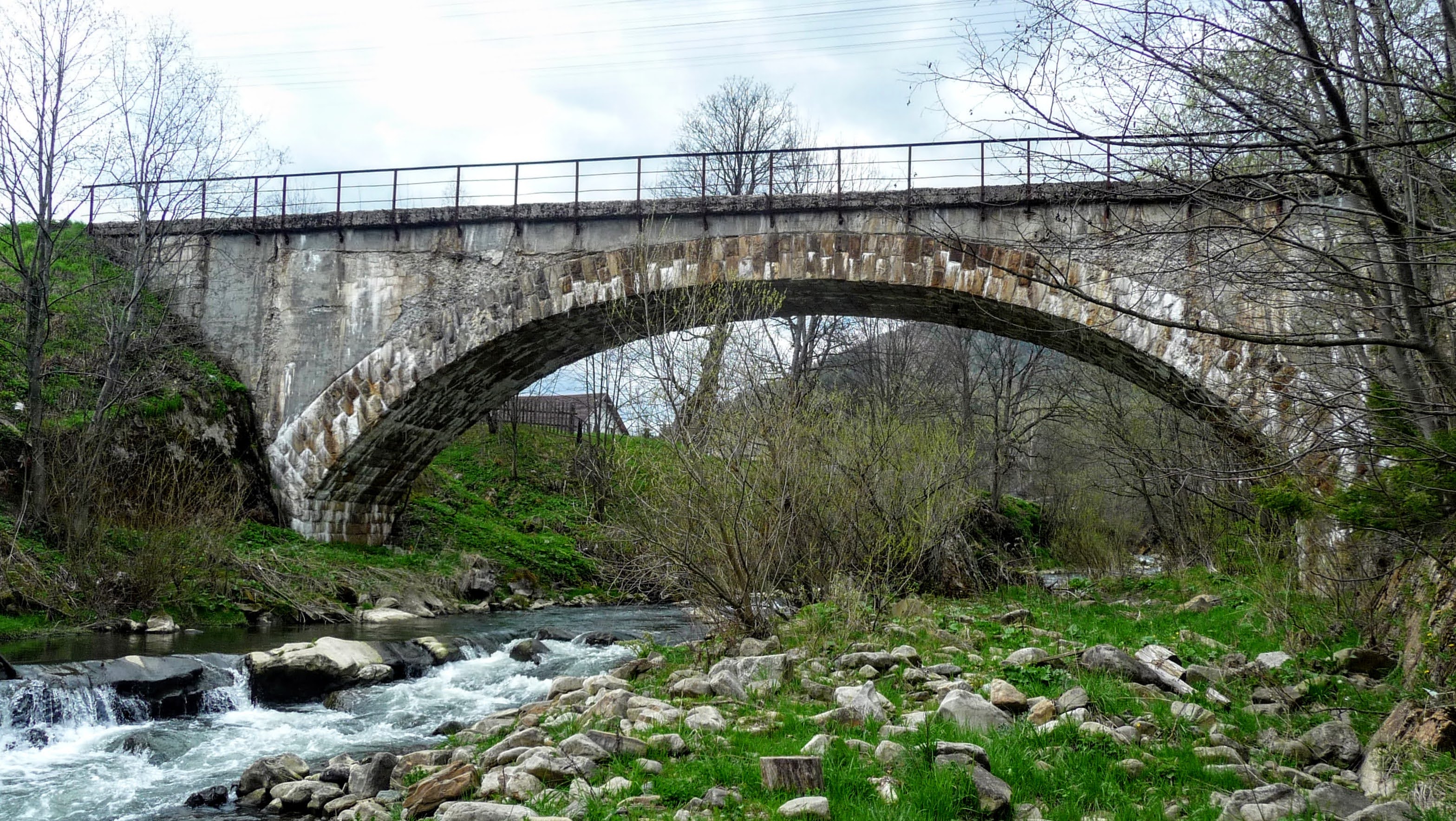
In the southern part of the village, the swift current of the mountain river shows its untamed character, approaching the high left bank and turning sharply to the right, then to the left again. This stretch of the watercourse, about 700 metres long, is called the Yablunytsia rapids, where the river makes cascading leaps over stone boulders. From the western side, the Prutets Yablunytskyi merges with the Prut, confirming the joy of the meeting with turbulent leaps and splashes.
Tatariv. The confluence of the Prutets Yablunytskyi and the Prut. An arched bridge
Downstream, in the central part of the village near the Church of St. Demetrius, you can admire another gift of nature, where the Prut forms a still pool. The high right bank is decorated with coniferous forest, and over the section with riffles and bends, which is called "Makitra" here, a steep ridge with rock outcrops looms.
Tatariv. The Prut, rapids
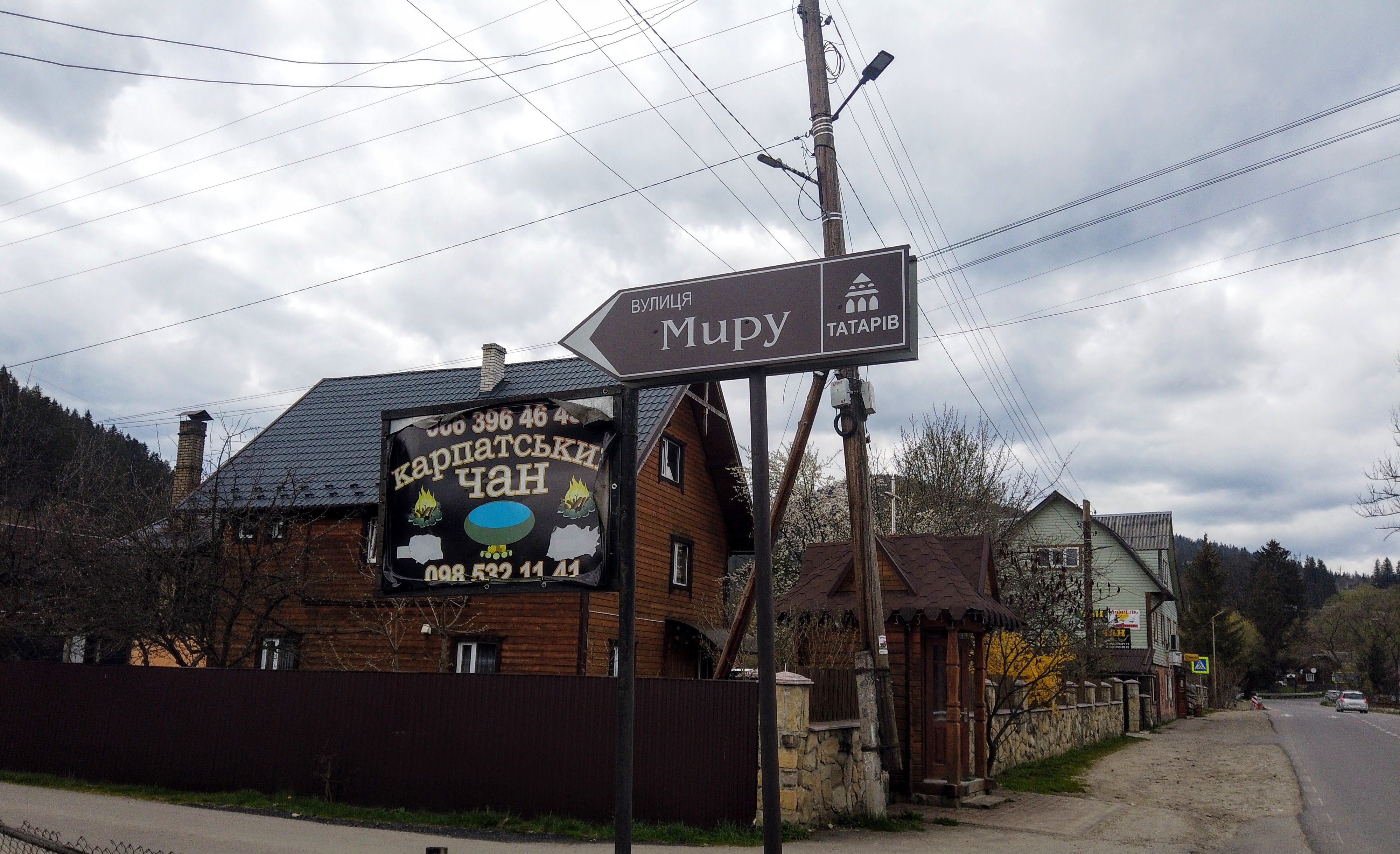
The streets in the village are winding and branch out across the slopes. The central road, Nezalezhnosti Street, is more than 10 kilometres long and is a section of the H 09 highway of national importance, which links the Ivano-Frankivsk and Zakarpattia regions.
Tatariv. Streets and residential buildings
In the centre of Tatariv, near the main highway, stands a wooden church with the protected status of an architectural monument of national significance. The church was built in 1896-1880 to the design of the architect F. Menchynskyi and consecrated in honour of the great martyr Demetrius of Thessaloniki. The church was built of spruce on a stone foundation in the Hutsul style. Cruciform in plan, the structure has arched passages between its five log sections. In the Soviet period the church was closed. After the shrine was returned to the faithful and repaired in 2017, the tin roofing was removed and it was re-covered with shingles. The church preserves painting in natural pigments, created in the 19th century. The two-tiered bell tower, square in plan with an eight-walled second tier, is crowned by an octagonal roof.
Tatariv. The Church of St. Demetrius of Thessaloniki
The Hutsuls live in harmony with nature, know their history, and preserve folk traditions and ancient customs. The Museum of History and Antiquities of Tatariv is a page of the cultural and historical heritage of this Carpathian village, whose recorded history begins in 1671. The unique collections can be viewed in the museum, located at 23 Nezalezhnosti Street in the centre of culture, leisure, youth, and sports. Near the cultural institution is a monument to the national poet Taras Shevchenko.
Tatariv. The centre of culture and leisure. Monument to T. H. Shevchenko
The museum's collection sheds light on the everyday life of Tatariv's residents from its origins to the present. The director of the cultural centre and, at the same time, the keeper of the museum's treasures, Mrs Maria, tells about the history of the institution's founding and the features of the ethnographic exhibition. The museum's founders collected photographs, documents, and antiquities, and since 2020 visitors have had the opportunity to explore the local history exposition. The symbolic parlour displays samples of Hutsul clothing, footwear, musical instruments, household items, ceramic and wooden dishware, furniture, and so on. At the table, gazda dolls in festive attire give a hospitable welcome. The holy images are decorated with rushnyky made by local craftswomen. The child's cradle is especially touchingly arranged.
Tatariv. The Museum of History and Antiquities of Tatariv
Among the cultural heritage of Tatariv one can count the kirkut, the burial place of the Jewish population. On the left bank of the Prut, on a rise, several horizontal slabs without inscriptions and many fragments of gravestones have survived. The remains of the matzevahs have sunk into the ground and become overgrown with thick grass. It is impossible to establish the date the necropolis was founded or the dates of burials. In 2022, the Ivano-Frankivsk Orthodox Jewish religious community unveiled a memorial sign in the form of a black marble stele in the centre of the cemetery. The inscription is in Yiddish, Ukrainian, and English.
Tatariv. The kirkut
Tatariv, a health resort and tourist centre, attracts travellers at any time of year with its emerald mountains, healing air, swift rivers, safe routes, and Hutsul hospitality.






No comments:
Post a Comment
Leave your impression