
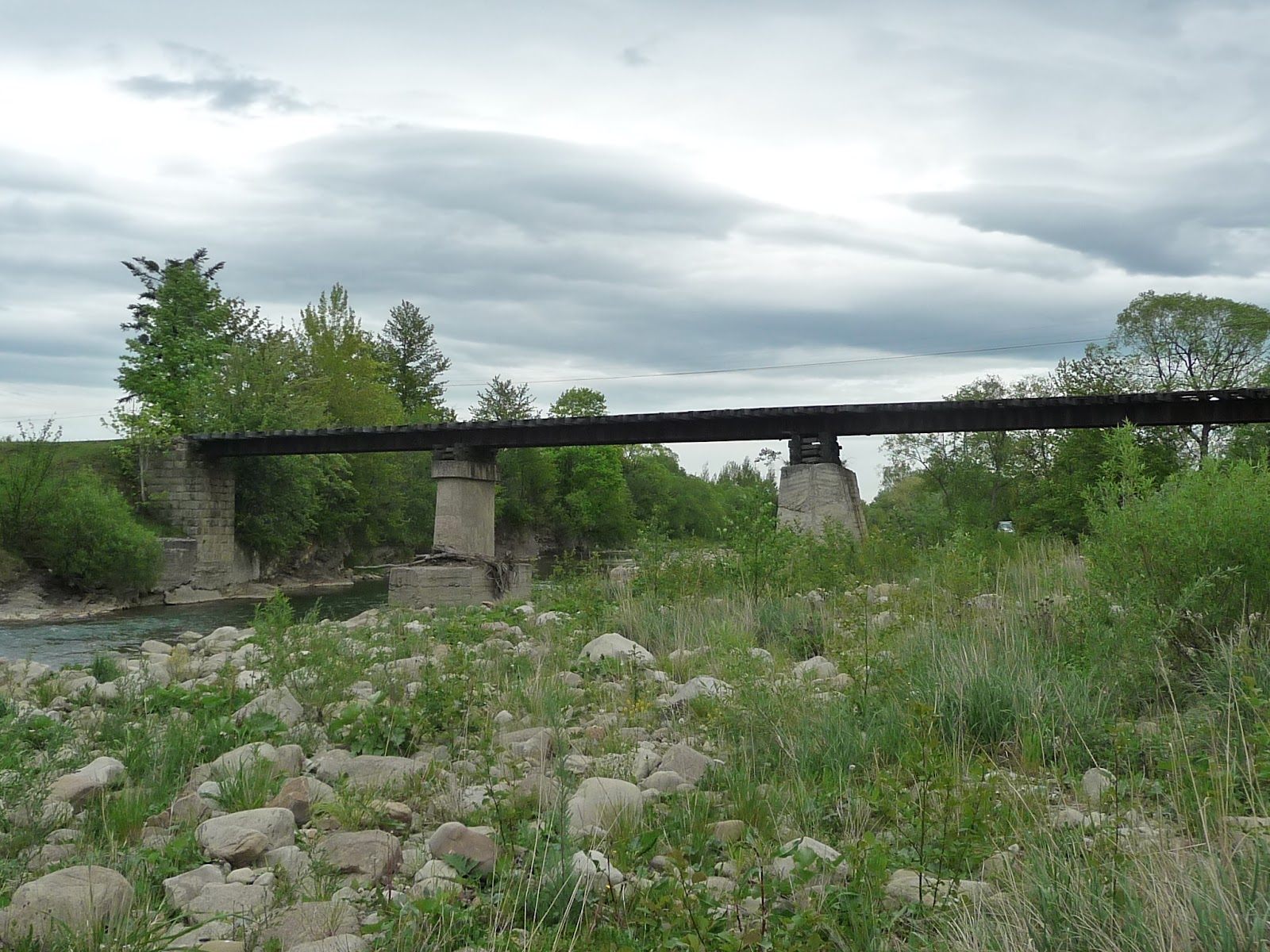
I too decided to see the wonderful views of Subcarpathia and to ride on this unique train, which is already extremely rarely encountered and almost never used in Ukraine. On that Sunday in May there was a holiday — Mother's Day. The whole railway crew — the driver, the conductor and the guide — congratulated the mothers present. It is very pleasant that in these parts there is such a respectful attitude to all mothers. The whistle sounded. Two small carriages, with windows without glass for the convenience of viewing the surroundings, filled at once with passengers according to the seats indicated on their tickets. We crossed the river Svicha by a bridge. Then the route ran along the village of Staryi Mizun, right past the houses and vegetable gardens, and the residents waved to us warmly. The speed was 10 kilometres an hour. It felt as if you were riding in some cartoon steam engine from Romashkovo. Under the rhythmic swaying of the toy train, you can barely manage to turn your head in time to admire the evergreen forests, the flowering meadows, the canyons and the waterfalls. And you also want to remember the guide's account of the history of the narrow-gauge railway, built at the end of the 19th century to transport valuable timber. At first the timber was floated down the river, which in the process overflowed and flooded the dwelling houses. The owner of the sawmill, Baron Popper, was forced to build a horse tramway — a railway where the traction was provided by horses. Now only a small part remains of what was once a widely branching line, whose track gauge is 750 mm. On weekends the train becomes a tourist one and takes townsfolk to where 'there is no asphalt, and where the grass is green'. And here is a clearing that seems green — it is the Shyrkovets hanging bog, a hydrological natural monument of national significance. The plants that grow on this quagmire are listed in the Red Book of Ukraine. Black storks nest here.
The guide did not let us grow bored and suggested we make a wish when we crossed the river Mizunka by the bridge. The bridge turned out to have no railing; it seemed as if the sleepers were turning over beneath the carriages and that the streams of the full-flowing river would reach the open windows. Later our guide told us of his wish — that we would cross the mountain river without trouble.

During a stop we went down to the "Horianka" spring, the water in which has a taste of oil. Of course, like all springs of healing water in the Carpathians, it possesses rejuvenating properties. Boyko legends say of it that the women who live in these parts are incredibly enchanting. The men in our group too gladly tasted the little water that gives beauty and youth, and then dashed off to the field kitchen set up in the open air, where you could sample the local moonshine, infused on roots, little fir sticks and some fly agarics. By a private house, huge pies with wild berries were on sale, and sandwiches — here they are called, in the French manner, kanapky. The elderly host asked jokingly: "Aren't you afraid you'll meet Banderites in the forests?" Of course, everyone laughed and thanked him for the inexpensive and tasty snack.
The driver sounded the horn and the tourists took their seats again. The conductor helped the women into the carriages. The next stop was by the former "Mizun" and "Dzherelo" sanatoriums. Once, cosmonauts underwent rehabilitation here. Now these health resorts are empty, because the flood of 1998 destroyed the utilities. For a small fee, travellers stop over on the grounds for the night.


By the sanatorium there is a lake.

While those who wished bought souvenirs and teas of dried Carpathian herbs and berries, I went up onto the suspension bridge. True, a crowd then rushed on, and everyone began to rock the already far-from-sturdy bridge.


The most interesting stop is by the Mizun waterfalls, formed by a great number of rapids and a swift current of water falling at various angles and from various heights. The most daring even bathed in the crystal-clear water. The rest simply jumped over the slippery stones in search of a good shot for photos that could later be shown off on social networks.

At this spot the train makes some manoeuvres and gives the signal to depart. And one so did not want to leave, but every fairy tale comes to an end — and we really had seen fairy-tale-beautiful places. On the way back the excursionists shared their impressions, and I share my wonderful impressions with you.

No comments:
Post a Comment
Leave your impression