In the settlement of Vyshnivets in the Ternopil region, a magnificent palace has survived, built in the Classicist style with Baroque elements.

The palace, its owners and its residents have a long and fascinating history, which began back at the end of the 15th century, when Prince Mykhailo Vyshnevetsky built a defensive castle on the high bank of the river Horyn. Here, in the ancestral nest, begins the chronicle of the mighty line of the Vyshnevetsky princes. In 1640 Yarema Vyshnevetsky considerably strengthened the castle, building bastions and a monastery that formed part of the defensive system. But these measures did not save the fortification from being seized by the Cossacks during the uprising of 1648 and from being ravaged by the Turks after the signing of the Treaty of Zboriv.

Literally from the ashes the castle was revived by Mykhailo Servatsiy, the last representative of the Vyshnevetsky line, who gave it the luxury of a French-style residence without stripping it of its defensive role. A vast park was laid out and a church was built.

After Servatsiy's death in 1744, the estate passed to the Vyshnevetskys' close relatives — the Mniszech family. Thanks to their generosity and enlightenment, Vyshnivets became a cultural centre. An eighty-metre mirror hall, a theatre hall, a hunting hall, a picture gallery, sculptures, refined interiors, antique furniture and tableware — these are far from all that appeared in the palace during its ownership by the new masters. The vestibules were laid with 40,000 ceramic tiles, each with a unique design. The roof was an unusual blue colour. The library of 22,000 folios was the largest collection of rare copies in Europe. Sadly, a large part of the books has been lost. Some literary relics are kept in the National Library in Kyiv and in the All-Ukrainian Historical Museum.

In the 60 years before the First World War, the palace changed hands nine times. After the war, reconstruction was carried out by the Kyiv architect V. Horodetsky. Before the Second World War, the remaining valuables were taken away to Moscow.
During the war, the palace housed the Gestapo and the gendarmerie.

From 1963 the estate became an architectural monument, but that did not stop various institutions from operating here. The premises were occupied by a garment factory, a vocational school and other organisations. Only with the proclamation of Ukraine's Independence in 1993 were research works carried out, and the castle became a branch of the State Historical and Architectural Reserve in Zbarazh. In 2005 it became part of the "Castles of the Ternopil Region" National Reserve. Repairs are under way, exhibits are being restored, and the grounds are being put in order. There are always many visitors in the museum.
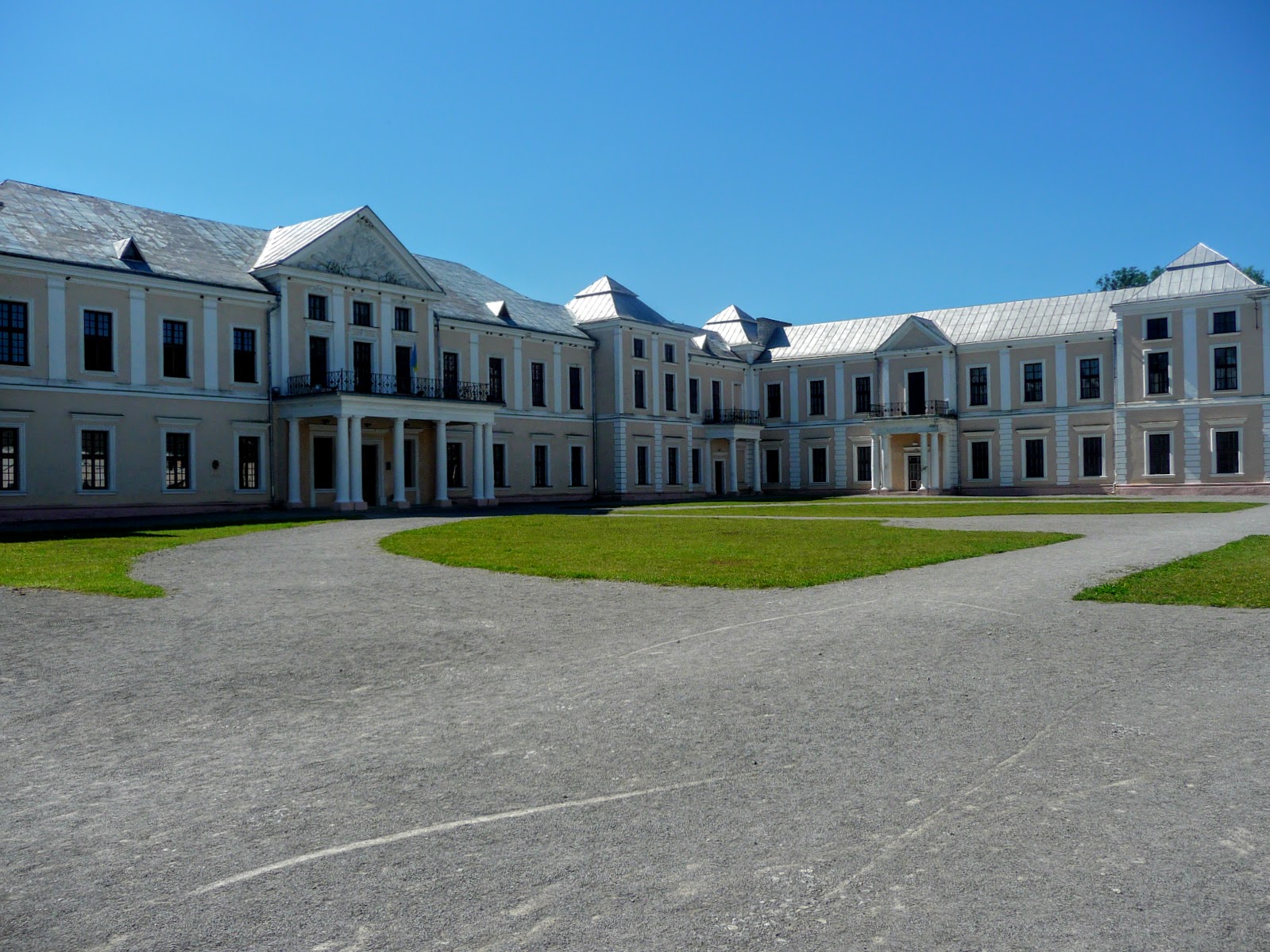
Passing through a filigree arch and then through a white pylon, you come upon a U-shaped palace of a delicate peach colour.


The square in front of the palace is divided up by paths and green lawns.

The pediment is decorated with stucco depicting cupids and muses holding the family coat of arms.

Opposite the palace are the former outbuildings, a stable and a residential house for the servants, which had 70 rooms.

The castle's present-day interiors are brought as close as possible to the atmosphere of the years when the estate was called the Volhynian Versailles.


And it was the French writer Honore de Balzac who called it that. It was in this very castle that his feelings for Ewelina Hanska were born — she who became his muse and his wife.


The staircase to the upper floor was altered as a result of remodelling. But it must surely have looked no less elegant.


The picture gallery displays portraits of historical figures.


Dmytro Vyshnevetsky was born here in 1517 and became a Cossack leader; he built a fortress on the island of Khortytsia and, with his small detachment, held the Tatar-Turkish army back from crossing the Dnipro.

In the era of the Time of Troubles, one of history's most adventurous couples met here — False Dmitry I and Marina Mniszech. In 1605 they were betrothed in the Church of the Dormition of the Most Holy Mother of God beside the castle.


The palace keeps icons restored by the master Maginsky.


From the balcony a view opens onto Vyshnivets, which for centuries was an arena of military action.


The Church of the Dormition of the Most Holy Mother of God, built in 1530, has survived all the hard times — perhaps because the founders of the estate, the Vyshnevetsky princes, are buried in its yard.

The museum holds exhibitions of contemporary professional artists and amateurs.


The 18th-century park, laid out in the English style, has the status of a monument of architecture and town planning. Now the avenues are overgrown with self-seeded growth and the steps have worn away. And once aristocrats strolled here, resting on the benches and in the gazebos.


The trees are mute witnesses to the palace's secrets. One of them was planted by Countess Ursula Mniszech, a lady of the court. The beech absorbed all the good qualities of its mistress — beauty and romance.

This bench is famous because T. H. Shevchenko was seen here surrounded by local residents during his stay in Vyshnivets in 1846 as a member of the Kyiv Archaeographic Commission. Having heard the story of the castle owner's cruel treatment of the peasants during a game of chess, in which the pieces were serfs whose fate depended on the player's skill, the poet sang the song "Oh, woe to that gull!" In memory of the Kobzar's stay at the palace, a memorial plaque has been placed by the entrance.

At various times the castle was visited by Peter I, Paul I, Ivan Mazepa, Mykola Kostomarov, Lesya Ukrainka and many other distinguished figures. And each of them had their own story and their own secrets.
Vyshnivets Castle occupies one of the leading places in the golden reserve of the cultural heritage of the Ternopil region and of Ukraine. The castle festival is on 14 October, the Feast of the Protection of the Most Holy Mother of God. I thank the organisers of the excursion and the guide Maryana for her interesting account. I greatly enjoyed my trip to this wonderful place, and I share my impressions.
Coordinates: 49 ° 53’56.76’’N, 25 ° 44’20.4’’E
You can get there from the bus station in Ternopil. Buses run often. The distance is 47 km. The journey takes 1 hour.
Address: the town of Vyshnivets, 5 Zamkova Street
+380 3550 3 12 34, +380 67 304 19 49
Open: 08:00-17:00
Website of the "Castles of the Ternopil Region" National Park:
http://nzzt.com.ua/news.php
Tourism department of the Ternopil Regional Administration:
tel. +380 352 43 42 31; +380 67 688 50 13.
Ternopil, Hrushevskoho Street, 8

No comments:
Post a Comment
Leave your impression