The Lviv region has a rich cultural heritage — architectural monuments alone number about 8,500. The centuries-old history of Halychyna is not forgotten; it is preserved, and its glorious past is a source of pride both in the cities and in the small towns. In the village of Ruda, in the Zhydachiv district, in 2004 the first museum in Ukraine dedicated to Ivan Vyhovsky was opened, devoted to the hetman of the Zaporozhian Host and to the history of the Cossacks.
 |
| Ruda. The museum of Ivan Vyhovsky |
Why, in this small village with a population of about 800, is the memory of the voivode of Kyiv and personal scribe of Bohdan Khmelnytsky treated with such care?
Let us walk along Tsentralna Street, which stretches for 2 kilometres through the whole village.
 |
| Ruda. Tsentralna Street. The village council |
 |
| Ruda. Tsentralna Street |
The Berezhnytsia river, with its picturesque banks, divides it in half into a northern and a southern part.
 |
| Ruda. The Berezhnytsia river |
Once in these parts they took from the marsh soil bearing iron ore and smelted iron from it.
 |
| Ruda. Tsentralna Street. A residential building |
 |
| Ruda. Tsentralna Street. An administrative building |
 |
| Ruda. Tsentralna Street |
So arose the name of the locality. In the 12th-14th centuries there was a fortified hillfort by the river. In 1623 the town of Ruda, along with the status of a city, received Magdeburg rights and became the centre of the surrounding villages. On a height noble landowners raised a castle, surrounded by a deep moat with water. A bridge thrown across it led to the manor.
 |
| Ruda. The bridge over the moat to the former lordly manor |
From the second half of the 17th century, for centuries, the masters in Ruda were representatives of the Ukrainian noble Vyhovsky family. Of the stronghold, which served as the ancestral nest of the masters for over 400 years, nothing has remained — only the moat and the mute witnesses of the past, the age-old oaks.
 |
| Ruda. The age-old oaks on the former lordly manor |
From the beginning of the 19th century until the Second World War the estate belonged to the Ukrainian Petruskyi family. The last lord left the buildings of his patrimony, which now house the teaching blocks of the Ruda school.
 |
| Ruda. A building of the former lordly manor |
 |
| Ruda. A building of the former lordly manor |
 |
| Ruda. The school on the grounds of the former lordly manor |
 |
| Ruda. A teaching block of the school in the former lordly house |
By the village council a monument to this political and state figure has been set up, where the hetman is depicted with a mace and the Treaty of Hadiach. Under that fateful agreement the Cossacks went over to the side of the Polish-Lithuanian Commonwealth in the confrontation between Russia and Poland. The monument to this head of state of Dnieper Ukraine was unveiled in 2007 during a festival of Cossack song.
 |
| Ruda. The monument to hetman Ivan Vyhovsky |
Another memorial sign recalls the event of the celebration of the village's 600th anniversary.
 |
| Ruda. A memorial sign for the 600th anniversary of the village |
The wooden church of the Nativity of the Most Holy Mother of God dates to 1833 and was built on the site of its predecessor. After repairs the sanctuary was clad in a modern plastic shell, but it has not lost its status as an architectural monument of local significance. In the church a document was kept which testified that the land for its building had been allotted in 1774 by the landowner Kostiantyn Vyhovsky.
 |
| Ruda. The church of the Nativity of the Most Holy Mother of God |
The square-plan stone bell tower has announced the service since 1903.
 |
| Ruda. The church of the Nativity of the Most Holy Mother of God. The bell tower |
The old residents of the village maintain that Ivan Vyhovsky was at first buried in the cemetery by the church, and at the beginning of the 20th century his name, written in Cyrillic, could still be read on the gravestone.
 |
| Ruda. A wayside chapel |
The location of the hetman's grave has not been identified by historians for three centuries now and is the subject of scholarly dispute. According to one version, Vyhovsky is buried in the Maniava Skete, as he indeed indicated in his will — that his body be buried in the Great Skete, in the crypt of the church of the Exaltation of the Holy Cross.
 |
| The Maniava Skete. Ivano-Frankivsk region. A bust of hetman Ivan Vyhovsky |
But which skete did the representative of this Orthodox noble family mean in his last will? Some researchers suppose that it could have been the now-ruined Yusyptytsi skete of the 13th-16th centuries, which stood near the village of Yosypovychi, 5 kilometres from Ruda. Vyhovsky often visited Ruda, and the likelihood of his attending a service in the church of the Exaltation of the Holy Cross in Yosypovychi is very great. Other sources consider the resting place of Vyhovsky to be the ancestral estate in Ruda. The hetman's son Yevstakhii, fearing possible desecration of the graves of his kin, reburied his father and other relatives on the grounds of the estate.
 |
| Ruda. The Vyhovsky oak on the hill |
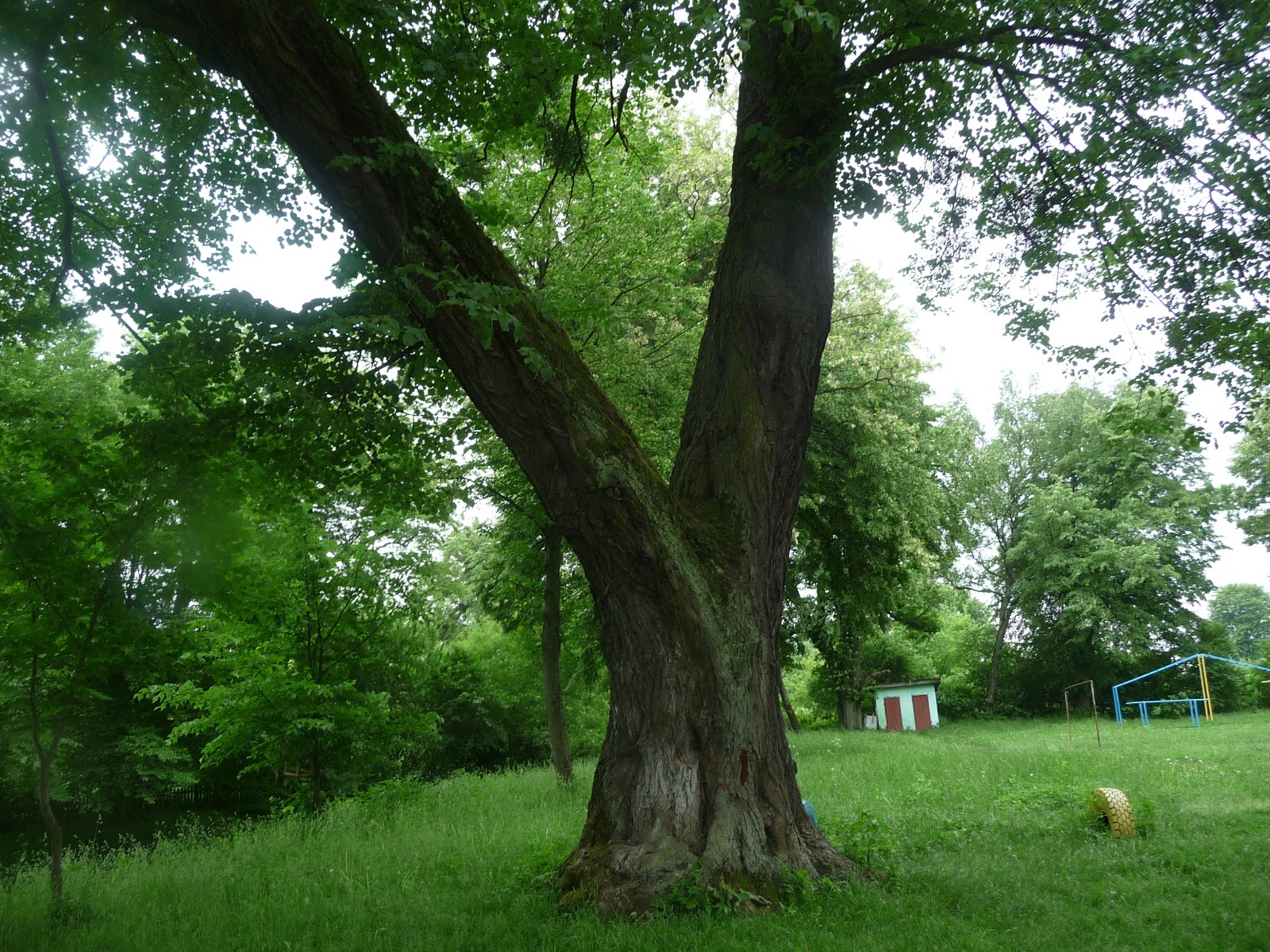
The mound, heaped up to a height of 4 metres beneath the spreading crown of a three-hundred-year-old oak, is indeed the tomb of the Vyhovskys. This living monument of the famous family already bears traces of damage, and it is impossible to carry out archaeological research among the roots of the mighty tree.
 |
| Ruda. The Vyhovsky oak — a nature monument |
 |
| Damage to the oak |
In the glade by the oak solemn events are held, and the museum staff will be sure to bring visitors here.
 |
| Ruda. The stage by the Vyhovsky oak |
The museum exposition was opened on the initiative of the eminent founder of a multitude of museums, B. H. Voznytsky, in the former house of the estate steward.
 |
| Ruda. The museum of the hetman of Ukraine Ivan Vyhovsky |
 |
| Ruda. The museum of the hetman of Ukraine Ivan Vyhovsky |
A large part of the exposition is devoted to the Cossacks and to the liberation struggle for the independence of Ukraine, from the times of the Zaporozhian Sich down to the 1950s.
 |
| Ruda. The museum of Ivan Vyhovsky. A watchtower |
 |
| Ruda. The museum of Ivan Vyhovsky |
 |
| Ruda. The museum of Ivan Vyhovsky. A cannon |
The diplomat and military commander Ivan Vyhovsky followed in the footsteps of his predecessor Bohdan Khmelnytsky, trying to keep friendly relations with the neighbouring states, allowing no advantage to any of them.
 |
| Ruda. The museum of Ivan Vyhovsky. A lifetime portrait of the hetman. Artist unknown |
 |
| Ruda. The museum. The Duma about Bohdan. Artist L. Servetnyk-Yurchuk |
In 1657 he signed a treaty with Sweden, which was of a defensive character and defined the borders of Ukraine.
 |
| Ruda. The museum of Ivan Vyhovsky. Exhibits |
It is considered Vyhovsky's merit that he restored the alliance with the Crimean Tatars.
 |
| The museum of Ivan Vyhovsky. Milestones of history. The Cossacks. Artist D. Stetsko |
 |
| Ruda. The museum. The Battle of Khotyn. 1621. Artist O. Klymko |
This fighter against the dominion of Muscovy won a brilliant victory over the hundred-thousand-strong Muscovite army near Konotop.
 |
| Ruda. The museum. A portrait of I. Vyhovsky. Artist L. Medvid |
 |
| Ruda. The museum. The Battle of Khotyn |
Vyhovsky was shot in 1664 and went down in history as the first hetman of the Cossack state to die for the independence of Ukraine.
 |
| Ruda. The museum. A bust of hetman I. Vyhovsky |
A large collection of canvases of the 17th-20th centuries by foreign and domestic authors has been gathered.
 |
| Ruda. The museum. Portraits of the hetmans P. Polubotok, I. Briukhovetsky, I. Skoropadsky |
 |
| Ruda. The museum. Portraits |
 |
| Ruda. The museum. Portraits of the hetmans P. Orlyk and I. Mazepa |
 |
| Ruda. The museum. A portrait of Ivan Danylovych, the first owner of Ruda. 17th c. A copy |
One of the rare paintings is a portrait of the hetman's second wife, Olena Stetkevych, daughter of the voivode of Minsk. The widowed scribe was refused by the girl's father, but he did not despair; with the help of a thousand Cossacks he carried off the beauty and brought her to Kyiv with honours, showered her with gifts and offered her his hand and heart.
 |
| Ruda. The museum. A portrait of Olena Stetkevych, wife of Vyhovsky. A copy of a canvas by an unknown 17th-c. artist. |
The museum keeps sacred exhibits.
 |
| Ruda. The museum of Ivan Vyhovsky. A holy image of the Mother of God |
The oak doors of the Vyhovsky family church from the village of Yosypovychi, with a donative inscription of 1712 by the hetman's daughter-in-law Tereza Zavadska.
The cross of the wooden church of the Nativity of the Most Holy Mother of God, built in 1740 by the hetman's grandson Kostiantyn Vyhovsky.
Also displayed are household and cultural objects found during excavations on the grounds of the castle.
 |
| Ruda. The museum. A memorial plaque, set up in 1883 on the Roman Catholic church in Zhydachiv in honour of the victories of Jan III Sobieski |
Museum opening hours: 10:00-16:00. The day off is Monday.
You can get there by bus from the district centre
Zhydachiv or from Stryi in the direction of Zhydachiv. The bus stops by the museum.
One can also get there by the suburban train
Stryi-Khodoriv to Hnizdychiv station and walk 1,600 metres to the village of Ruda, taking in the Kokhavyna landmarks along the way:
the Redemptorist monastery, founded in the 18th century on the site of the apparition of the icon of the Kokhavyna Mother of God; a healing spring on the site of the apparition of the Most Holy Mother of God.
 |
| Ruda. The museum of Ivan Vyhovsky. An information stand with the landmarks of the Zhydachiv district |
Address: the village of Ruda, Zhydachiv district, Lviv region, Tsentralna Street.
Coordinates: 49°18'53"N 24°5'40"E




No comments:
Post a Comment
Leave your impression