A thunderstorm and bad weather made it impossible to walk around Kropyvnytskyi. Somehow I had to flee the endless downpour. The nearest bus service to Bobrynets and a more favourable weather forecast prompted a trip into the backwoods of the Kirovohrad region. And although a fine drizzle and slush pursued me throughout the whole three-hour excursion, I still managed to see a great deal and to get acquainted with the sights of the former county town, founded by Cossacks in 1767.
 |
| Bobrynets. Kirovohrad region. The Holy Ascension Cathedral |
The architectural dominant is the Ascension Cathedral, located in the centre of the town, and its domes are visible from all sides of the district centre.
The church was laid down in 1898 in the middle of the crowded market square, where fairs were held four times a year. At first the area fenced off for construction was sown with rye, in order to clean the site and test it for healing power. And when the plot turned green, construction began. The church was erected with the funds of parishioners and patrons; bricks tested for strength came from the best manufacturers. This was the last project of the architect Yakiv Pauchenko, who, being gravely ill, did not abandon the fruit of his inspiration and gave it all his strength. The first service took place in 1912 and was interrupted in the godless times, when the domes and gilding were removed and the shrine was turned into a warehouse.
On the southern side of the cathedral a park was laid out, established in the 19th century.
In this place, in the 18th century, Jewish Christians equipped a well 22 metres deep. This natural monument was called the "Living Cycle of Water" for its inexhaustible source of healing water.
During the years of the Nazi occupation the fascists buried their soldiers here. In honour of the liberators of Bobrynets, in March 1944 a reinforced-concrete figure of a soldier and memorial slabs were installed.
In the branches of the bushes and trees, a lonely park sculpture of the post-war period was lost. Such statues, which have no great artistic value, were mass-produced throughout the vast country and were made not from marble by sculptors, but from concrete by works foremen. To reinforce the margin of strength at the join between the statue and the pedestal, the girl holds a sheaf of wheat ears.
In 1965, for the 125th anniversary of the theatrical figure M. L. Kropyvnytskyi, the residents planted 125 oaks, inscribed on the UNESCO list, and gave the green tract the name of their famous countryman.
 |
| The Kropyvnytskyi Park. The bust of M. L. Kropyvnytskyi |
The artist Ilya Repin expressed himself thus about the cradle of Ukrainian theatre: "The realistic Ukrainian theatre was born not near Kyiv and not near Lviv, but beneath the haystacks of free, steppe Bobrynets." Bobrynets is not rich in historical monuments, but four of them are connected with the names of the luminaries of theatrical art — Marko Kropyvnytskyi and Ivan Karpenko-Kary.
Let us walk along one of the oldest streets of the town, which leads to the Church of St Nicholas and to the river, and see what has survived in the town from which came the masters inspired by Melpomene.
 |
| Bobrynets. Mykolaivska Street |
The streets in Bobrynets are straight and perpendicular to one another; signs with the names of the streets and the numbers of the houses have been put up, and it is easy to find one's way.
 |
| Mykolaivska Street |
 |
| Narodna Street |
On Mykolaivska Street it is quiet and calm, there are few cars, and a small part of it is an exclusively pedestrian zone. The houses on the central city thoroughfare are for the most part single-storey, but solid and neat, painted in various colours.
Not one house resembles another; all have individual decoration and a special brick ornament.
In one of the present-day hospital buildings, in the 19th century, was located the zemstvo court, in which the future outstanding theatrical figures worked as clerks.
 |
| Mykolaivska Street. The district hospital |
In house No. 56, in the former hall of the Nobility Assembly, the performances of M. L. Kropyvnytskyi's theatrical troupe were staged.
 |
| Mykolaivska Street, 56. The former House of the Nobility Assembly. The State Treasury and the notary's office |
The celebrities studied in the 1860s at the county school.
 |
| Mykolaivska Street, 60. The former county school. The teaching building of Educational Complex No. 2 |
This educational institution was completed by the well-known cameraman and director, a native of Bobrynets, Petro Yukhymovych Todorovsky.
Now the building belongs to School No. 2.
 |
| Bobrynets. Gymnasium No. 1 |
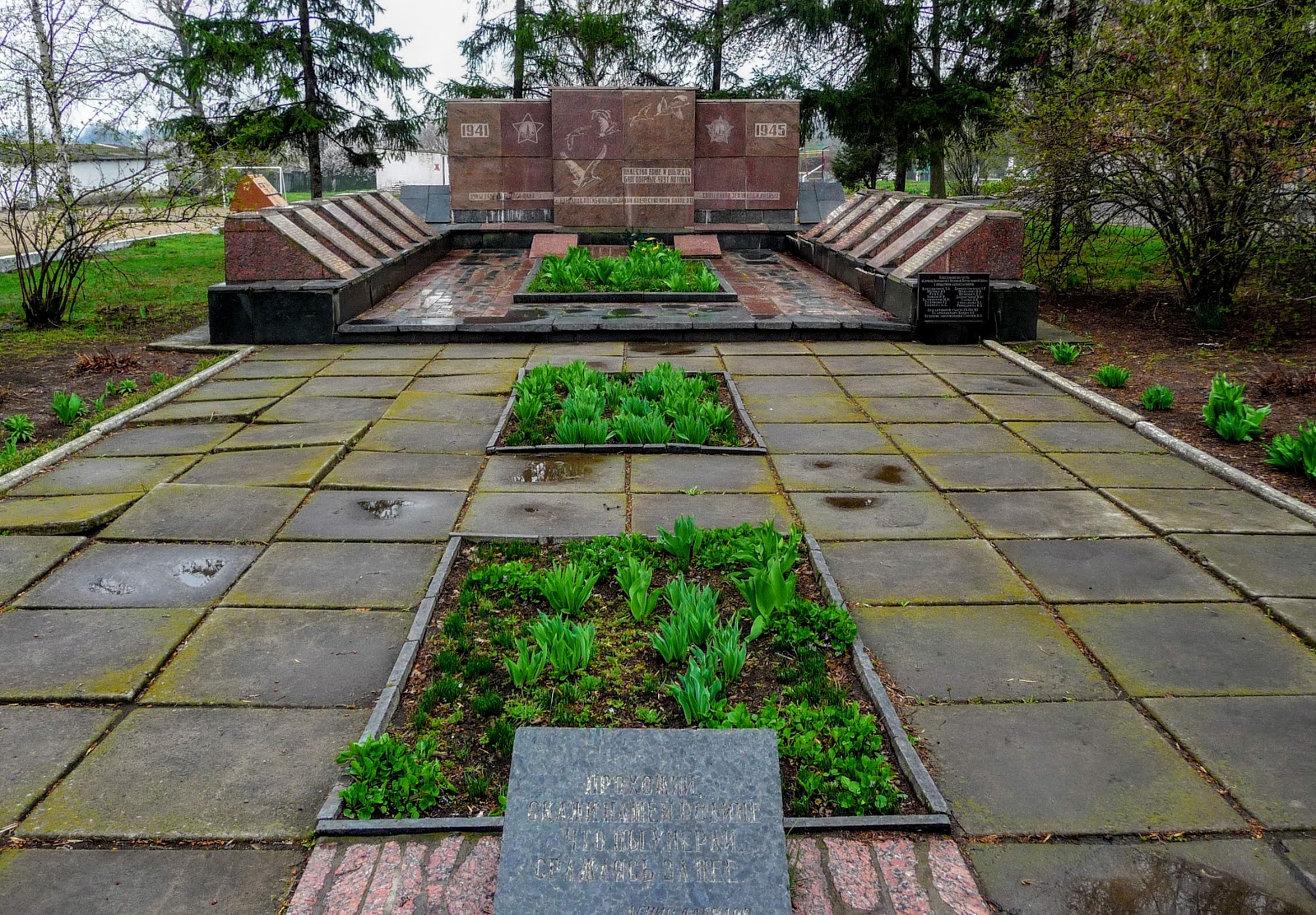
In memory of the pupils and teachers who died on the fronts of the Second World War, a memorial has been installed in the school yard.
And here is another specimen of the brick framing of the street windows. Unfortunately, one window has already lost its over-window and window-sill, and the door its entrance portals.
 |
| Bazarna Street. A residential building |
The building of the former hotel, girdled with a brick ornament, dates from the end of the 19th century.
 |
| Mykolaivska Street, 76 |
The House of Culture is housed in two separate two-storey buildings, but ones built right up against each other. The old one was erected in 1895, the new one in the 1950s. The latter was luckier with its renovation.


In the old building is the district museum named after M. Smolianchuk. And although I am always short of time, I still try to drop into museums for a few minutes, in order to learn more about the history of the settlements I visit. I was met by the director of the museum, Ruslana Hennadiivna, a very beautiful young woman, welcoming and erudite. This guardian of the museum's treasures gladly told the story of the museum's origin and of its special features. The central place is occupied by the exhibition dedicated to M. L. Kropyvnytskyi and I. K. Tobilevych (Karpenko-Kary). Personal belongings, books, photographs and articles of the famous countrymen are presented for the visitors' attention. Collections of paintings, wares and embroidered shirts made by local craftsmen have been gathered.


Of great interest is the information gathered about the revolutionary Leon Trotsky, who was born not far from Bobrynets. His father, David Bronstein, owned lands, factories and shops in the district. Trotsky learned to speak Ukrainian earlier than Russian. The future organiser of the October coup translated the works of Krylov and Lermontov into Ukrainian and wrote his own verses. The personality of the ideologist of Trotskyism has interested foreign visitors to the museum.
As I have long noticed, museum workers in small towns are very beautiful people, enthusiasts of their cause, spiritually rich and loving of their land. Having thanked Ruslana Hennadiivna for the instructive conversation and the pleasant acquaintance, I continued my acquaintance with the town.
Across the road, opposite the House of Culture, the Youth Leisure Centre has been opened. The young people of 1860-1870 began their working lives in this building of the former town hall.
In Bobrynets, conditions have been created for the development of creative abilities, and yet another hearth of culture is on the other side of Mykolaivska Street, 50 metres from the first.
 |
| Mykolaivska Street, 49. The School of Arts. The former CPSU district committee |
The building of the centre of children's and youth creativity appeared in 1894 and has the status of an architectural monument.
The house in which the outstanding figure M. L. Kropyvnytskyi lived in 1850-1856 has also survived.
Next to this historical monument rises the Holy St Nicholas Church, the oldest in the Kirovohrad region. The shrine was built in 1853 on the site of a wooden predecessor. Famous parishioners prayed in the church, and Kropyvnytskyi and Tobilevych sang in the choir and took part in the services.
In oblivion and desolation stands one of the synagogues of Bobrynets, an architectural and town-planning monument of the 19th century. The metal dome has become covered with rust, the windows are broken, the fence has been dismantled and the territory is overgrown with saplings.
In Soviet times the prayer house was given over to the Pioneers, and a children's institution was opened in it for bringing up adolescents in the spirit of Marxism-Leninism. Later the building of the Jewish Christians' assembly was occupied by inspectors of the traffic police.
 |
| Mykolaivska Street. A former synagogue |
A few more houses for the collection, along Mykolaivska Street.
The road went steeply downwards, descending to the river.
From the shoreline stretch vegetable gardens, and beyond them the homesteads.
Once the Bobrynka was a full-flowing river, along which Cossacks, traders and conquerors transported their goods. From generation to generation, legends are passed down about lost and hidden treasures that lie on the riverbed and in secret lagoons.
The Mykolaivskyi bridge is held up by supports of stone quarried in the local granite quarry.
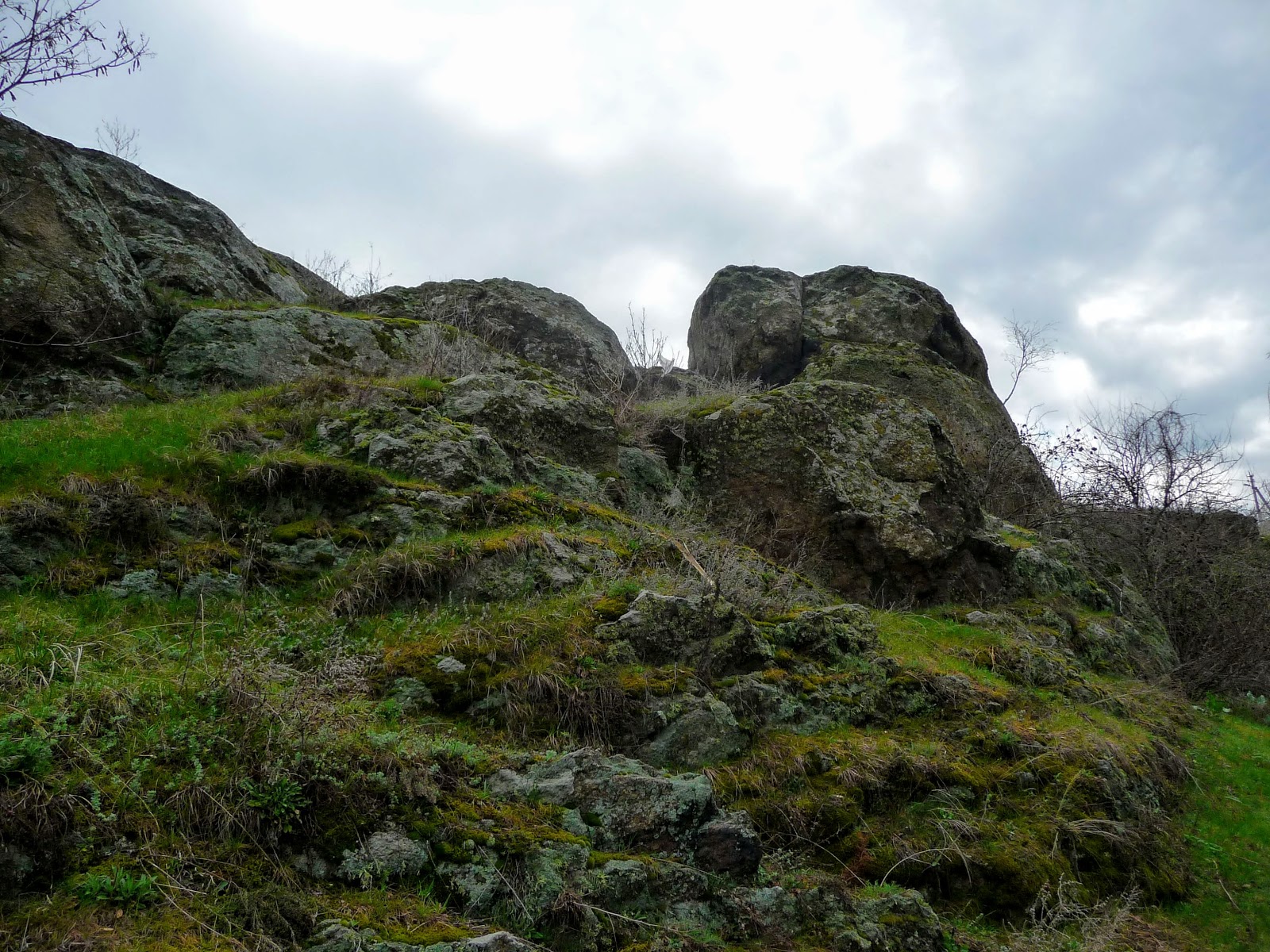
Agglomerations of stone monoliths stretch along the river for several kilometres, and in the water they form rapids and small waterfalls.
The garden of stones has been declared a natural monument, and each granite "flower" has its own unique outline.
This little corner of paradise has been favoured by amphibians, birds and plants, some species of which are listed in the Red Book of Ukraine.
It is so pleasant by the river, but one must return to the bus station. A steep climb up Berehovyi Lane, with a view of the stunning landscapes.
Voznesenska Street is just as quiet and deserted, paved with stone.
The Bobrynets police occupy a building in white and blue tones and with incomparably fine decoration.
 |
| Voznesenska Street. The police department |
There was little time, but it was impossible not to turn onto Shevchenko Street, having noticed an interesting building. What was it? A Jewish school? Everything is closed, abandoned, and there is no one to ask.
Opposite is a two-storey building resembling a storehouse.
I return to Voznesenska Street and examine a former synagogue, in which today sporting champions are brought up.
 |
| Voznesenska Street, 56. The children's and youth sports school. A former synagogue |
Pretty administrative buildings and residential houses with windows onto the street have preserved a patriarchal idyll.
 |
| Voznesenska Street, 50. The laboratory |
 |
| Voznesenska Street, 44. The centre for the administration of labour and social protection of the population |
And here is the market, with a historical building that burned down in July 2018 — the former shop of David Bronstein, an illiterate landowner and merchant, the father of a revolutionary of world renown. The media reported that the firefighters put out the blaze almost by hand, as the fire hoses turned out to be full of holes and unfit for firefighting.
The shops are located close to one another around the perimeter of the market, and the red rooster could have destroyed the other old trading monuments as well.
 |
| The market. The shops |
On the way to the bus station, a few more stops for photographs. The stadium adjoins the church yard right up against it.
The agricultural technical college, built in 1936, bears the name of Vasyl Poryk, a participant of the Resistance movement in France during the Second World War, who studied at this institution.
A few more bright little houses for the memory, and forward at a quick pace to the bus station, where the bus to Kropyvnytskyi is already waiting.
There is a bus service to the regional centre several times a day, plus buses from Mykolaiv that stop here.
The walk around the town turned out unexpectedly easy, positive, informative and memorable.






No comments:
Post a Comment
Leave your impression