Myrhorod — a resort in the Poltava region with a welcoming and kindly name — has been hospitably greeting holidaymakers for more than a hundred years now. The well-known lines of the Ukrainian poet Pavlo Tychyna, "Myrhorod is not the same now, the Khorol river is not the same", can be linked to the positive changes in the amenities of this health resort.
 |
| Myrhorod, Poltava region. The embankment of the Khorol river |
Nature has endowed one of the most popular resorts of Ukraine with healing water and picturesque landscapes.
And the fame of the Ukrainian water-cure clinic began with a strange and fateful incident. At the beginning of the 20th century the wells in the town grew shallow, and in 1912, on Soborna Square, a fountain smelling of hydrogen sulphide gushed from a new alternative borehole. The authorities intended to close the source of this water unfit for consumption, but the local doctor Ivan Zubkovsky decided to find out the chemical composition of the underground stream that had burst to the surface.
At the Odesa Scientific Society, to which the enterprising and caring physician sent samples, they confirmed the medicinal properties of the chloride-sodium and chloride-carbonate-sodium water. Its properties are close in composition to the world-famous waters of Baden-Baden in Germany.
 |
| The mineral water pump room |
Even before the revolution the medical management gave orders to sell the medicinal water on draught. It was doctor Zubkovsky who initiated the construction of the water-cure and mud-bath clinics, for which he is rightly considered the founder of the resort.
 |
| The memorial plaque to doctor I. A. Zubkovsky |
The outstanding physician was awarded the title of Honorary Citizen of Myrhorod, and an exhibition of the People's Museum of the History of the Resort is dedicated to him.
 |
| The monument to the founder of the resort, I. A. Zubkovsky |
 |
| The People's Museum of the History of the Resort |
The healing effect of the unique little water on the health of those suffering from gout and rheumatism contributed to the popularity of the Myrhorod resort, and for its expansion the local elite gave over their mansions with parks. The Soviet authorities did not renounce the bourgeois health factory: two more boreholes were drilled and new buildings and clinics were built.
 |
| The mineral water pump room |
At the end of the 1930s more than 10 thousand citizens of the country of the Soviets strengthened their health here.
After the devastating Nazi occupation the resort was gradually restored, more boreholes were drilled, its specialisation expanded, and diseases of the nervous system, of the gastrointestinal tract and diabetes were treated.
In the 1960s-1970s, one after another, multi-storey buildings of modern sanatoriums were erected.
 |
| The "Raiduzhnyi" sanatorium |
In 1976 the "Myrhorod" sanatorium complex, with a department for patients with diabetes, was put into operation.
 |
| The "Myrhorod" sanatorium |
In 1983 the "Poltava" sanatorium received holidaymakers.
 |
| The "Poltava" sanatorium |
In five comfortable buildings beside the Khorol river stands the sanatorium of the same name.
 |
| The "Khorol" sanatorium |
Holidaymakers can take treatment together with their children at the "Berezovyi Hai" sanatorium.
 |
| The "Berezovyi Hai" sanatorium |
In recent years, private hotels and health centres have been receiving holidaymakers.
The once 8-storey "Ukraina" hotel could not accommodate everyone who wished to stay, and in the yard a site with camping facilities was set up for the temporary accommodation of guests. A change of owners and economic crises led to the building falling into disuse and ruin.
 |
| The "Ukraina" hotel |
The sanatorium buildings are drowning in the greenery of a park with a total area of 45 hectares.
Wondrous plants have adorned the green tract, and overseas birds live in the aviary.
 |
| The aviary |
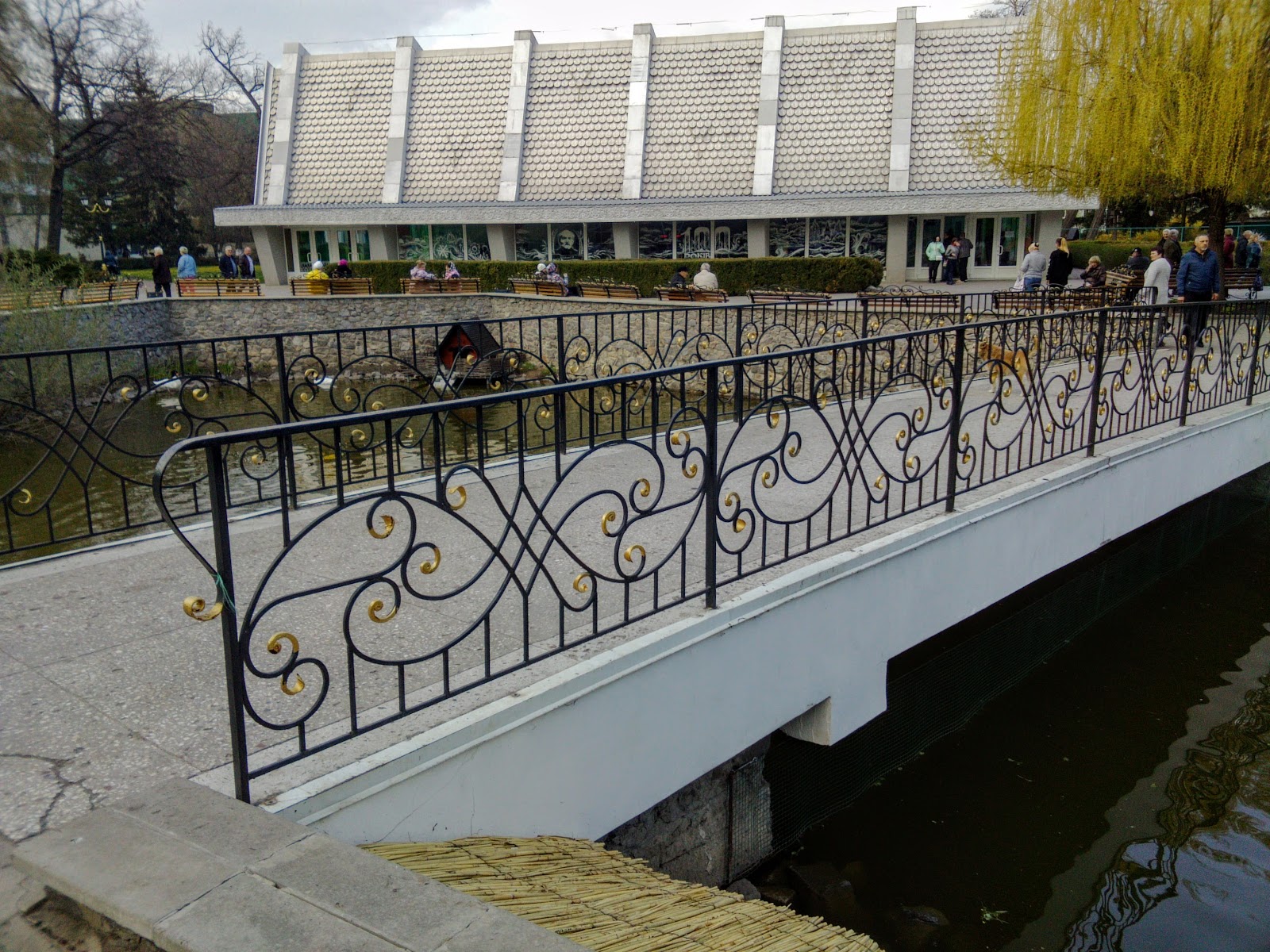
The resort complex is located on the banks of the Khorol and is connected by a pedestrian bridge, from which holidaymakers love to be photographed against the backdrop of the river.
 |
| The bridge over the Khorol river |
In summer a well-kept beach is provided and a boat station operates. The "Raiduzhnyi" sanatorium has its own exit to the shore of Myrhorod's blue artery. If you cross the river by the suspension bridge, you can take a walk through the coniferous-and-deciduous landscape park "Berezovyi Hai".
 |
| The "Berezovyi Hai" landscape park |
On the grounds of the resort stands the Dormition Cathedral, built in 1887 on the site of a previous wooden church.
 |
| The Dormition Cathedral. 1887. |
A unique ceramic iconostasis, made by the pupils and teachers of the Myrhorod School of Artistic Crafts, is now within the walls of the arts and industry college.
In the palace of culture, performers of the Ukrainian stage appear with a concert programme.
 |
| The city palace of culture |
 |
| The resort palace of culture |
The favourite places of rest for holidaymakers are by the fountains.
By the pump room, the neighbours Ivan Ivanovich and Ivan Nikiforovich met.
In the souvenir shop, magnets, booklets and memorable gifts are offered as keepsakes of this little corner of paradise.
Dance evenings are held on the summer stage, whose facade is decorated with a depiction of a musical and dance suite in the national style.
The residential buildings and the dining hall of the resort are brightened with vivid mosaic panels depicting literary characters of the Ukrainian classics.
Wooden sculptures of famous characters from Gogol's works have adorned the resort park.
The great M. V. Gogol, a native of these places, who glorified the "wondrous town of Myrhorod", was immortalised on the street of the same name for his 200th anniversary.
A three-metre monument to the genius stands beside a small pond, which has received the name of the "Myrhorod puddle" from the collection "Mirgorod".
The "wondrous puddle, beautiful puddle" has been favoured, and the atmosphere of a patriarchal little town created, by sculptural compositions from the classic's tales. Vakula offers his beloved Oksana the little slippers with gold that the tsarina gave him.
The landowners Ivan Ivanovich and Ivan Nikiforovich take offence and do each other petty harm.
The cunning and sly Solokha seduces her admirers.
The manipulator Khlestakov, "a young man of about twenty-three, slim and thin", takes bribes from the officials. Before the plump Patsiuk stands a bowl of magical varenyky, which fly into his mouth of their own accord.
Besides the mineral water, this bountiful land is famous for its agricultural achievements and grain-growing.
 |
| The bread factory |
Pottery-making has been known in the Poltava region since ancient times, and the first school in Ukraine to train ceramics specialists and drawing teachers was opened in 1896 in Myrhorod.
Over its 125 years of existence, the M. V. Gogol Arts and Industry College has trained thousands of unsurpassed artists and master ceramists, whose works are known throughout the world.
 |
| The M. V. Gogol Arts and Industry College |
On the house where the former director of the institution, the well-known architect and art historian O. H. Slastion, and the founder of the resort, doctor I. A. Zubkovsky, lived, their memorial bas-reliefs have been installed.
Many well-known personalities are connected with Myrhorod. In 1845 T. H. Shevchenko created here one of his most significant works — the poem "The Great Vault" — and painted Myrhorod landscapes. The monument to the Kobzar rises at the intersection of streets named after the two prophets of Ukrainian literature — Gogol and Shevchenko.
 |
| The monument to T. H. Shevchenko |
Only a hundred metres from the monument stood the homestead of the Ukrainian prose writer and playwright Panas Myrny. The memorial plaque from the commemorative sign in honour of the countryman has been moved to the facade of a residential building, and the monument to the writer has been installed in the yard of the school that bears his name.
 |
| The commemorative sign on the site of Panas Myrny's homestead |
Several buildings in the district centre of the Poltava region have the status of an architectural monument.
 |
| The former boys' gymnasium. 1908-1910. |
 |
| The former House of the Nobility Assembly. 1909. The Centre of Aesthetic Education |
 |
| The former City Duma. 1912. The district administration |
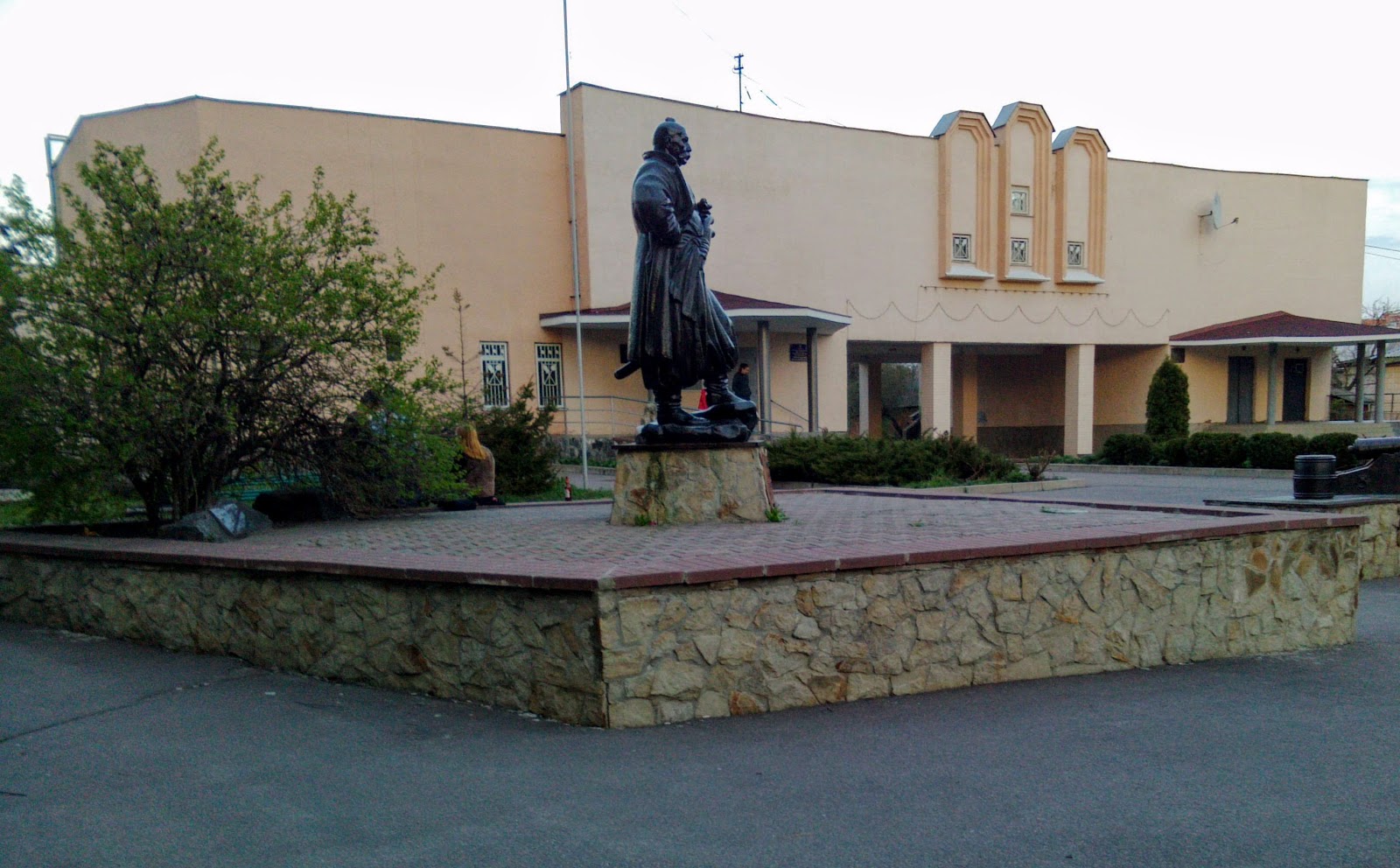
You can learn more about the resort and the town in the local history museum (Nezalezhnosti Street, 2).
 |
| The local history museum and the monument to the Myrhorod Cossacks |
Holidaymakers and tourists in these parts can visit
the Dibrivka stud farm, founded in 1888 by Prince Romanov, examine the complex of 19th-century buildings and see the process of training the horses.
 |
| Dibrivka. Myrhorod district. The stud farm |
20 kilometres from Myrhorod lies the famous village of
Velyki Sorochyntsi, the birthplace of M. V. Gogol and the venue of the famous fair.
 |
| Velyki Sorochyntsi. Myrhorod district. The M. V. Gogol Museum-Estate |
You can reach Myrhorod by train from
Kyiv,
Lviv, Kharkiv,
Kostiantynivka,
Bakhmut. At the railway station, Gogol himself greets and sees off everyone.
 |
| Myrhorod. The railway station and the monument to M. V. Gogol |
From the regional centre of Poltava a suburban train runs to Myrhorod.
 |
| Myrhorod. The railway station |
 |
| The railway station. The ceramic decoration of the waiting hall |
Coordinates of the Myrhorod resort: 49°58'15"N 33°36'53"E






No comments:
Post a Comment
Leave your impression