 |
| Pokrovsk. Donetsk region. The monument to M. D. Leontovych |
In Tulchyn, the composer's birthplace, a bust of him has been installed; in Pokrovsk Leontovych is immortalised in the form of a two-metre bronze sculpture. The composition is completed by a model of the Hryshyne railway station, the notes of "Shchedryk" and images of the coal giants, the Krasnolymanska and the Sviato-Pokrovska mines.
 |
| Pokrovsk. The monument to M. D. Leontovych. The model of the Hryshyne railway station |
On the facade of the railway station a memorial bas-relief of the author of the Christmas carol has been placed, a street has been named in his honour, and since 1977 the music school has borne Leontovych's name.
 |
| Pokrovsk. The memorial plaque-bas-relief in honour of M. D. Leontovych |
So what connects this miners' town with the author of the widely known choral works?
 |
| M. D. Leontovych (1877-1921) — composer, conductor, teacher |
In 1904 a post as a singing teacher at the railway school at Hryshyne station (now Pokrovsk) was found for the graduate of the theological seminary, where he had successfully studied church singing and the playing of many instruments.

 |
| Pokrovsk. The former railway school |
The young teacher founded a workers' choir and taught the railwaymen choral singing, the skills of which they honed at meetings and strikes. The heightened attention of the police towards the choirmaster forced Leontovych to return to his native parts in 1908. But the years of work with the choir of the striking Hryshyne trackmen were not in vain. The brilliant composer went on working on "Shchedryk" and on other Ukrainian song folklore, turning folk tunes into real masterpieces. The best-known New Year hit has been performed in 140 languages of the world in various styles and has made the Ukrainian composer famous among the wide public and in the musical community. The melody of this carol-shchedrivka has been used in flash mobs and advertisements, has sounded in films and cartoons, in cover versions and music tracks, for more than 100 years now.
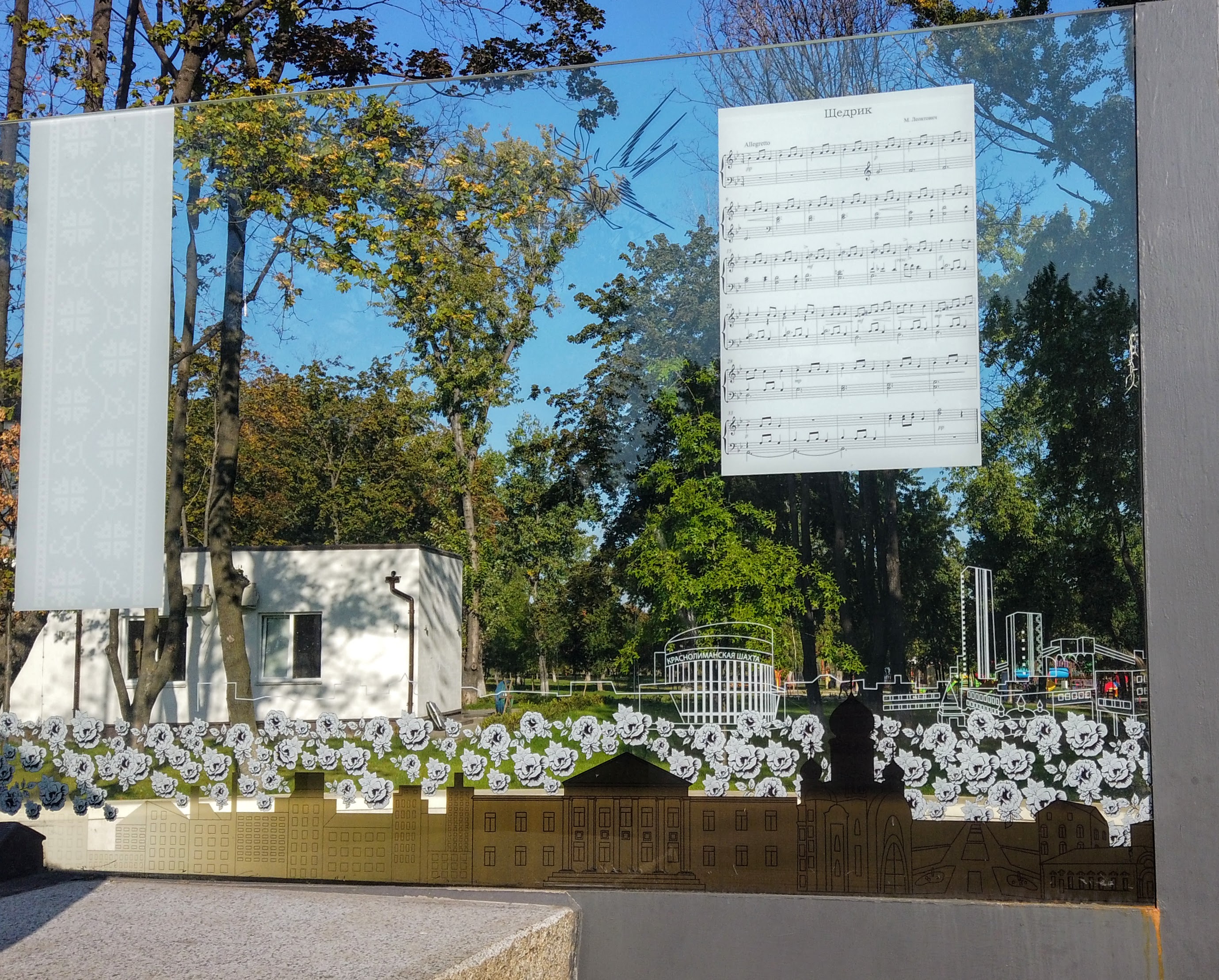 |
| Pokrovsk. The monument to M. D. Leontovych. The score of "Shchedryk" |
The two-class railway school where Leontovych taught still belongs to the railway department. In this building, put up in 1902, where future trackwalkers, engine drivers and locomotive-repair craftsmen received their trade, there were classrooms, a staff room, a boiler room and the administrator's office. The building has not been used for its intended purpose for many years and needs repair. At present a workmen's rest room has been fitted out in it, and the woman who opened up one of the oldest buildings of Pokrovsk for me complained that people keep coming and coming and taking photographs, and that is as far as it goes.

 |
| The abandoned building of the railway school of 1902. Shmidta St. |
An old little board in a wooden frame, more like a shop sign than a memorial marker, testifies that the Ukrainian composer was here in 1904-1908 as a music teacher.

 |
| The memorial plaque on the building of the former railway school where M. D. Leontovych worked |
In the opinion of local historians and historians of the town, it would be fitting to create in this solidly built house a museum of the Pokrovsk railway station, where there would undoubtedly be an exhibition devoted to Leontovych's work.
 |
| One of the oldest buildings of Pokrovsk. The former railway school |
Mykola Dmytrovych worked on "Shchedryk" throughout his whole creative life, editing the composition several times. The Ukrainian musical brand was first heard almost 100 years ago, in 1921, at Carnegie Hall in New York. The Pokrovsk authorities plan to create on the remains of the burnt-out Myr cinema a cultural and museum complex "Shchedryk", which will resemble the New York concert hall.
 |
| Pokrovsk. The burnt-out Myr cinema |
The complex of cultural-space objects is to include a laser fountain with a visualisation of historical events, a memorial marker to Oleksandr Koshyts, the conductor of the Ukrainian Choral Chapel, a residential complex "Shchedryk-City" and other incredibly ambitious things, turning the town of miners and railwaymen into the tourist and cultural centre of the Donbas.
 |
| The memorial marker "The Rusk Bowl" — a copy of the wooden rusk bowl made by the composer's father. |
How the projects will be carried out in practice, time will show. And for now the stone by the entrance to the Yuvileinyi park has been a reminder since 2018 that "In the town of Pokrovsk the museum 'Shchedryk' will be created".
 |
| The memorial marker about the creation of the "Shchedryk" museum in Pokrovsk |
This story is also available in Ukrainian: М. Д. Леонтович і Покровськ. Пам'ять про композитора і його «Щедрик»

No comments:
Post a Comment
Leave your impression