 |
| Semenivka, Lviv region. The church of St Michael. 1718 |
The church was built of pine on an oak foundation and was first consecrated in honour of the Dormition of the Most Holy Mother of God. In the 20th century the building gained its domed tops, the stone floor, which absorbed moisture, was replaced with wooden flooring, and stained-glass pictures appeared in the windows.


 |
| Semenivka, Lviv region. The church of St Michael, an architectural monument |
Next to the little old two-tiered bell tower stands its new stone neighbour.
 |
| Semenivka. The church of St Michael. The bell tower |
We continue our acquaintance with Semenivka's cultural heritage moving from the north-eastern edge to the south-west along Taras Shevchenko Street. The main street is asphalted, and buses run along it from Lviv and Pustomyty to Shchyrets and back. Storks fly right overhead and nest on the poles beside people's homes.


 |
| Semenivka. Taras Shevchenko Street |
The homesteads are full of flowering greenery, and the apple branches bend to the ground under their fruit.


 |
| Semenivka. Homesteads |
Beside the old orchard, an Orthodox church of the holy prophet Elijah and a three-tiered bell tower were built in 1997.
 |
| Semenivka. The church of St Elijah. 1997 |
In 1906 the opening of the school was attended by Franz Ferdinand, heir to the throne of the Austro-Hungarian monarchy. The school building still serves its purpose.


 |
| Semenivka. The school. 1906 |
Above the school a mighty guardian spreads its crown – a symbol of longevity, wisdom and faithfulness. The oaks were planted in the 1920s by Józef Terech, headmaster of the school in the Austrian and Polish periods. On retiring, the teacher moved to his son in Przemyśl. Under the Hitlerite occupation he was arrested and deported to Auschwitz, where he perished. That the tree had a history was clear and could be felt without prompting, but sadly the Semenivka residents I met, and the shoppers in the nearby store, could tell me nothing about the green giant, and the shopkeeper advised asking the school's headmistress ("she must know"), who lives in the new building.
 |
| Semenivka. The oak by the school |
A telling inscription on the shop quotes a song by Kuzma Skryabin: "The moon has fallen, the room is dark. How good that you have learned to keep silent."
 |
| Semenivka. The shop |
In 2005 a sculpture of the Most Holy Mother of God the Protectress was set up in the centre of the village, with an appeal to posterity: "That our truth may not perish, that our word may not die." The monument was designed by Rostyslav Lakh, a graduate of the local school.
 |
| Semenivka. The sculpture of the Most Holy Mother of God in the village centre |
The history of Semenivka inseparably binds the fates of the Poles and Ukrainians who lived in the village from early times. The church of St Martin was founded in 1721 by the Potocki family, as the family's Pilawa coat of arms above the portal recalls. The image of an axe testifies that the first owner of these lands was a German, Kunat of the Topór arms. The architecture of the Semenivka shrine resembles the Jesuit church in Lviv. In the 1990s a storm destroyed the tower on the church roof, and it could not be restored.


 |
| Semenivka. The church of St Martin. 1721 |
Behind the church lies the Catholic cemetery, with gravestones of the 19th and early 20th centuries.


 |
| Semenivka. The cemetery |
A stone cross, erected by fellow villagers in 1994, recalls the tragic events of 1944 in Ukrainian-Polish history, when Ukrainians were shot by the Home Army.
 |
| Semenivka. The stone cross in memory of the tragic events of 1944 |
In the second part of God's acre, among the newer burials, a cemetery chapel of the early 20th century survives and is used for rites to this day.


 |
| Semenivka. The cemetery and the chapel |
Semenivka stretches along the channel of the Shchyrka and of the Stavchanka that flows into it (the Dnister basin). The first mill in the village is documented in 1515. On the way out of the village, by the poultry farm, a three-storey stone water mill, later converted to electric drive, awaits its fate and a discerning benefactor. The internal equipment has been dismantled; the flume with its water-flow regulator, the wheels and the other mechanisms are gone, but the building could still serve Semenivka's economy — after all, the village is not one of those dying settlements with little prospect.
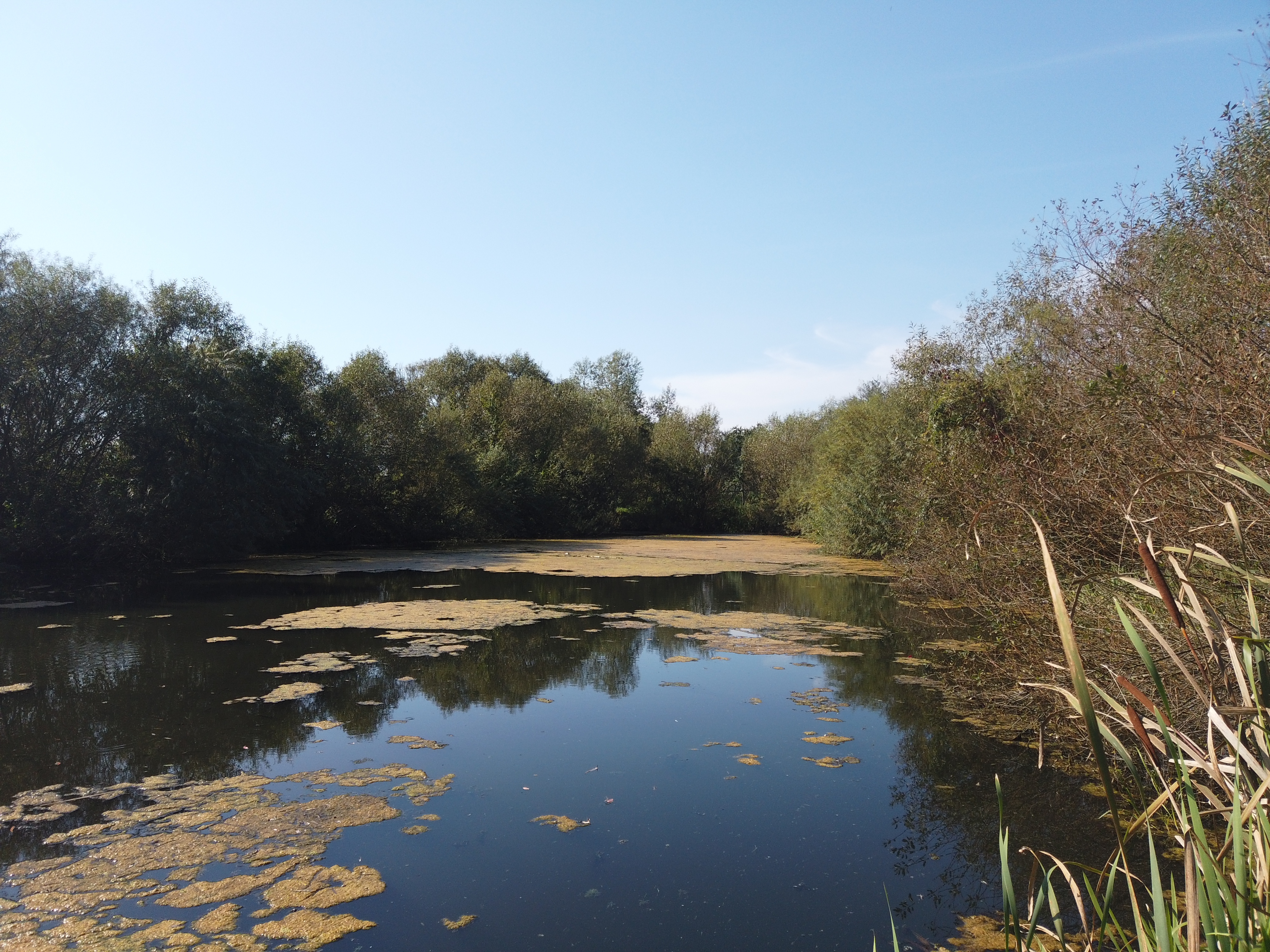 |
| Semenivka. The Shchyrka river |
 |
| Semenivka. The abandoned water mill |
From the mill it is only about a kilometre to Shchyrets II station, and you can return to Lviv by the Chop-Lviv local train or by a regular bus.
This story is also available in Ukrainian: Хто куди, а я в Семенівку!

No comments:
Post a Comment
Leave your impression