In Nezhukhiv, in the Stryi district of Lviv region, there is a wooden Church of the Intercession of the Most Holy Mother of God, built in 1875.

The village lies 4 kilometres from Stryi, and I set off there by bus.

My fellow passengers turned out to be students returning home after their classes. These future teachers were studying the work of A. S. Pushkin, and they had to prepare their homework in Russian. They were discussing the details and the plan of the work, some rules of spelling.
Judging by their conversation, the young people speak Russian quite decently, and their knowledge is good too. And they do like the classic's works. I too recalled the lines of the poet, who travelled
That day I was to have a walking hike, and, stepping off at the stop in the centre of the village, I at once saw the Orthodox Church of the Intercession of the Most Holy Mother of God, consecrated in 2012.


There is a Greek Catholic community in the village. Believers of all denominations walk in an ecumenical procession of the cross through the village streets with prayers for peace in Ukraine.
The outpatient clinic shares its premises with the veterinary clinic.

The village council occupies a small building, on the wall of which a memorial plaque has been fixed for the 200th anniversary of T. H. Shevchenko.

I have seen ones like it in almost every village on my travels. Another plaque testified to the raising, in 1990, of the state flag of Ukraine for the first time in the Stryi district. I know that in the Lviv region historical facts are always remembered, and one can often come across such markings of memorable events.

As I was taking photographs, a man and a woman were going into the village council, administration staff most likely. I asked how best to reach the church and whether there were any other monuments in the village. The man told me a little of the history of the village, which is more than 600 years old. The name comes from those distant times when, during the Tatar-Mongol invasion, many people hid in the mountains. But some stayed on in the village, surrounded by forests. Those desperate and fearless folk were called nezhakhivtsi (the fearless ones). Hence the name of the place too, Nezhukhiv.
During the world wars, major fighting always unfolded in these parts. Three kilometres from here there is a military burial ground from the First World War. A pity one cannot take everything in at once. Perhaps I shall be in this area again later, and then I will be sure to see it. The Second World War memorial stands across the road from the village council. On the monument are carved the surnames and ranks of the fellow-villagers who fell at the front.

Nearby is a monument to the Fighters for the Freedom of Ukraine.

By the monuments a man was mowing the grass. I asked him to step aside for a moment so that I could photograph the village landmarks. He agreed, of course, but asked, a little offended: 'What, am I no longer fit to be in a photo?' Now I regret not making a portrait sketch of this resident of Nezhukhiv. But I do try to keep people out of the frame.
In this fine building the children of Nezhukhiv receive their education.

To the Church of the Intercession of the Most Holy Mother of God, built in 1875 by the efforts of twelve village families, I walked another 300 metres or so along a path.

The entrance to the church yard was open, and there was no one around.

The shrine has now been restored, gleaming in the sun with the metal covering of its roof and domes.
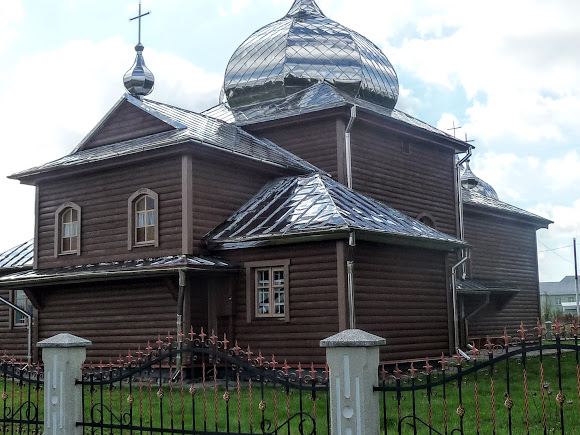
But these drastic changes have not prevented the church from holding the status of an architectural monument of local significance.

The bell tower is new, erected in 2004.

On the church grounds a symbolic grave has been raised to the Fighters for the Freedom of Ukraine.

I went through the wicket gate into the cemetery.

There stands a monument to the soldiers of Austria-Hungary buried here during the First World War. The installation work was carried out on the initiative and at the expense of the Austrian Black Cross, a public organisation that searches for and restores military burials.

I came out onto the street through another wicket gate and hurried off to catch the electric train, because I wanted to visit a few more interesting places that day. About 15 minutes were left, and the distance was more than a kilometre through unfamiliar territory. Passing by the church, I saw a priest hurrying towards it. He blessed me. A pity he had not come earlier, or I could have gone inside the church.
The road through the village is good, but little streams cross it often. The water must lie close to the surface. Walking over the little bridges is even more fun; the important thing is to spot where the crossing over the watercourse is. Along the way I saw a sculpture of the Mother of God on a household plot. The area around is fenced off, but there is a wicket gate from the street; you can go in and sit for a while on the bench.

It sometimes happens that I am lucky when the electric trains run late, and that was just what I was counting on. There is a single-track railway near Nezhukhiv station, so the electric train was giving way to a passenger train heading to Stryi. While still on the platform I managed to admire the Subcarpathian expanses and to sum up this short little trip, whose impressions I am sharing with you.

The village lies 4 kilometres from Stryi, and I set off there by bus.

My fellow passengers turned out to be students returning home after their classes. These future teachers were studying the work of A. S. Pushkin, and they had to prepare their homework in Russian. They were discussing the details and the plan of the work, some rules of spelling.
Judging by their conversation, the young people speak Russian quite decently, and their knowledge is good too. And they do like the classic's works. I too recalled the lines of the poet, who travelled
"Now in a carriage, now on horseback,
Now in a kibitka, now in a coach,
Now in a cart, now on foot."
That day I was to have a walking hike, and, stepping off at the stop in the centre of the village, I at once saw the Orthodox Church of the Intercession of the Most Holy Mother of God, consecrated in 2012.


There is a Greek Catholic community in the village. Believers of all denominations walk in an ecumenical procession of the cross through the village streets with prayers for peace in Ukraine.
The outpatient clinic shares its premises with the veterinary clinic.


I have seen ones like it in almost every village on my travels. Another plaque testified to the raising, in 1990, of the state flag of Ukraine for the first time in the Stryi district. I know that in the Lviv region historical facts are always remembered, and one can often come across such markings of memorable events.

As I was taking photographs, a man and a woman were going into the village council, administration staff most likely. I asked how best to reach the church and whether there were any other monuments in the village. The man told me a little of the history of the village, which is more than 600 years old. The name comes from those distant times when, during the Tatar-Mongol invasion, many people hid in the mountains. But some stayed on in the village, surrounded by forests. Those desperate and fearless folk were called nezhakhivtsi (the fearless ones). Hence the name of the place too, Nezhukhiv.
During the world wars, major fighting always unfolded in these parts. Three kilometres from here there is a military burial ground from the First World War. A pity one cannot take everything in at once. Perhaps I shall be in this area again later, and then I will be sure to see it. The Second World War memorial stands across the road from the village council. On the monument are carved the surnames and ranks of the fellow-villagers who fell at the front.

Nearby is a monument to the Fighters for the Freedom of Ukraine.

By the monuments a man was mowing the grass. I asked him to step aside for a moment so that I could photograph the village landmarks. He agreed, of course, but asked, a little offended: 'What, am I no longer fit to be in a photo?' Now I regret not making a portrait sketch of this resident of Nezhukhiv. But I do try to keep people out of the frame.
In this fine building the children of Nezhukhiv receive their education.

To the Church of the Intercession of the Most Holy Mother of God, built in 1875 by the efforts of twelve village families, I walked another 300 metres or so along a path.

The entrance to the church yard was open, and there was no one around.

The shrine has now been restored, gleaming in the sun with the metal covering of its roof and domes.

But these drastic changes have not prevented the church from holding the status of an architectural monument of local significance.

The bell tower is new, erected in 2004.

On the church grounds a symbolic grave has been raised to the Fighters for the Freedom of Ukraine.

I went through the wicket gate into the cemetery.

There stands a monument to the soldiers of Austria-Hungary buried here during the First World War. The installation work was carried out on the initiative and at the expense of the Austrian Black Cross, a public organisation that searches for and restores military burials.

I came out onto the street through another wicket gate and hurried off to catch the electric train, because I wanted to visit a few more interesting places that day. About 15 minutes were left, and the distance was more than a kilometre through unfamiliar territory. Passing by the church, I saw a priest hurrying towards it. He blessed me. A pity he had not come earlier, or I could have gone inside the church.
The road through the village is good, but little streams cross it often. The water must lie close to the surface. Walking over the little bridges is even more fun; the important thing is to spot where the crossing over the watercourse is. Along the way I saw a sculpture of the Mother of God on a household plot. The area around is fenced off, but there is a wicket gate from the street; you can go in and sit for a while on the bench.

It sometimes happens that I am lucky when the electric trains run late, and that was just what I was counting on. There is a single-track railway near Nezhukhiv station, so the electric train was giving way to a passenger train heading to Stryi. While still on the platform I managed to admire the Subcarpathian expanses and to sum up this short little trip, whose impressions I am sharing with you.
This story is also available in Ukrainian: Нежухів на Стрийщині

No comments:
Post a Comment
Leave your impression