To see all the castles of the 'Golden Horseshoe of the Lviv Region', from
Olesko we went to Pidhirtsi in the Brody district.
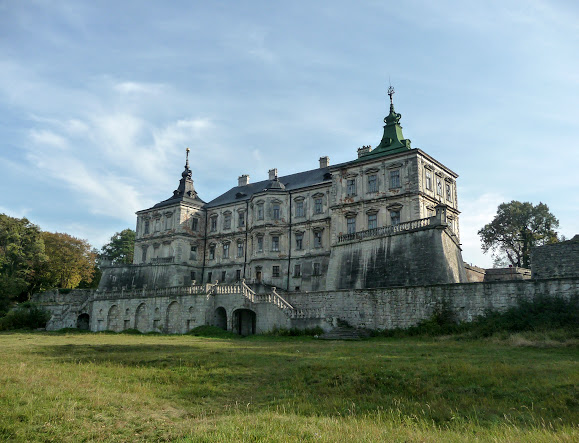 |
| Pidhirtsi Castle |
Pidhirtsi Castle is very famous — we have heard about it more than once and seen it in many television programmes and films. For many centuries now it has never ceased to fascinate with its grandeur. And it makes one bitter that this historical and architectural masterpiece is gradually falling into ruin, though some restoration work is under way.
What cataclysms this stronghold has not had to endure. Built in the middle of the 17th century, the castle served as an outpost. Wars, sieges, changes of power and owners, plundering, destruction — all this is the great and hard history of the building, as part of the history of this Subcarpathian land.
The peculiarity of this architectural pearl is that the castle combined the features of a Renaissance palace and a defensive fortress.
On three sides the castle is surrounded by a moat faced with stone and a line of earthen fortification.
Watchtowers have survived on the bastions.
A castle cannot exist without a well.
Entry to the fortress was made through a gate with two columns, across a stone bridge.
These stone slabs remember the clatter of the carriages of European monarchs and grandees, who came for grand receptions, parades and splendid balls.
Up the steps the aristocrats climbed to terraces with balustrades and sculptures.
The architectural refinement is emphasised by various decorative details: highly artistic moulding, bas-reliefs and sculptures of atlantes on the side pavilions.
After the Second World War a tuberculosis sanatorium was set up in the castle. Well, what else could the culture officials think up, once all the palaces came to belong to the people? After the fire there is no access to the inner rooms, but glancing through a window I saw not palatial interiors at all, but white hospital walls.
In the 1990s the director of the Lviv Art Gallery, M. Voznytskyi, made enormous efforts to save the monument from further ruin. Notably, the complex is on the world list of cultural sites requiring detailed and urgent restoration.
Who did not plunder the treasures of the palace! Only an insignificant part of the various collections can be seen in some museums in other countries. Of the former luxury one can judge from the photographs in the historical hall.
And what is a castle without ghosts? Numerous experts among photographers and psychics have recorded the presence of a ghost, known here as the White Lady. About 400 years ago the owner of the castle, Count Rzewuski, out of jealousy and senility, killed and walled up his young wife. Mercenary interests were the undoing of the girl who had married a rich old man, and now she wanders the halls, begging for a Christian burial.
But we noticed nothing mystical. We strolled with a feeling of hope that, thanks to the restoration work, one of the most beautiful castles in Europe will after all be saved.
Once a wonderful garden-and-park ensemble — now in desolation. One very much wishes that order were restored here too, for this is the only park in Ukraine in the Italian style. The 500-year-old lime trees can be embraced only by several people joining hands.
 |
| Pidhirtsi Castle. Centuries-old trees |
Along the park avenue we came up to the working Roman Catholic church of St. Joseph, built in the 1750s.
 |
| The church of St. Joseph |
The place of worship, in the form of a rotunda, is adorned with Baroque-style sculptures of saints.
 |
| The church of St. Joseph |
 |
| The church of St. Joseph |
I especially liked the colonnade at the entrance. It is 14 massive limestone columns, built in 2 rows.
 |
| The church of St. Joseph |
The castle complex includes the building of a former coaching inn, on the facade of which a sundial can just barely be made out.
 |
| The coaching inn |
At the castle the administrator advised us to drop in at the monastery: 'Go, take a look at another historical monument, it's only 1 km from here.' To the working Greek Catholic Annunciation Monastery of the Order of St. Basil the Great it was a little more than 2 km, but the road is decent, and there are signposts at the turns. On the grounds of the shrine, built in the middle of the 18th century on the site of one destroyed by the Mongol-Tatar horde in the 13th century, we met only a single novice.
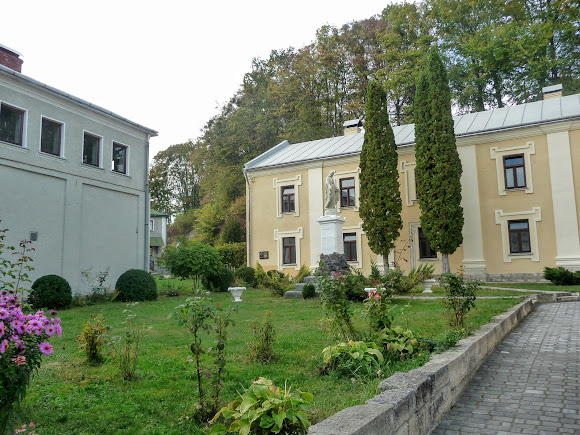 |
| Pidhirtsi. The Annunciation Monastery |
 |
| Pidhirtsi. The Annunciation Monastery |
In Soviet times a tuberculosis institution was housed here. The finest architectural monuments, given over to the treatment of the sick, played no part whatsoever in lowering the rise of the disease or reducing the number of sufferers.
In the 1990s the monastery and the church of St. Onuphrius were returned to the faithful. A sundial with Roman numerals on the wall of the church showed roughly the correct time. In the monastery, in 1889, I. Ya. Franko worked with manuscripts, in whose honour a memorial plaque has been set up.
 |
| The church of St. Onuphrius |
Having drawn some healing water from the holy spring, we turned back towards Lviv, admiring along the way the colours of the golden autumn, which had lightly touched the tops of the Subcarpathian forests.
 |
| The holy spring |
 |
| Pidhirtsi. The Annunciation Monastery of the Order of St. Basil the Great |
The Pidhirtsi castle complex is in the village of Pidhirtsi, Brody district, Lviv region.
Tel.: +380 3266 30740, +380 322 72-39-48
Coordinates:
49°56’33"N 24°59’2"E


No comments:
Post a Comment
Leave your impression