Pidhirtsi Metamorphoses. Collective-Farm Sheds to Palace
When people mention Pidhoretsky Palace, they often think of the castle in the Brody district. But the Stryi district also has its own Pidhirtsi, with a little pearl of its own.
The village lies ten kilometres from the district centre, and I began my journey at the road junction on the Stryi turn-off, with a detour into the village of Slobidka.
A stele with the coat of arms of Stryi at the road junction
Slobidka. A roadside cross.
Slobidka has around a thousand inhabitants, yet the shops they built here were enormous.
It has its own library with the lovely name "the people's parlour".
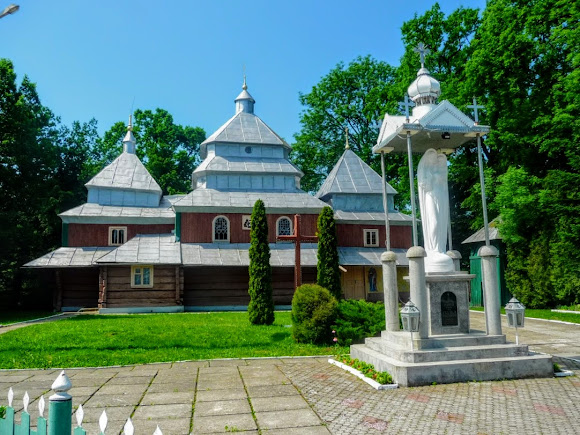
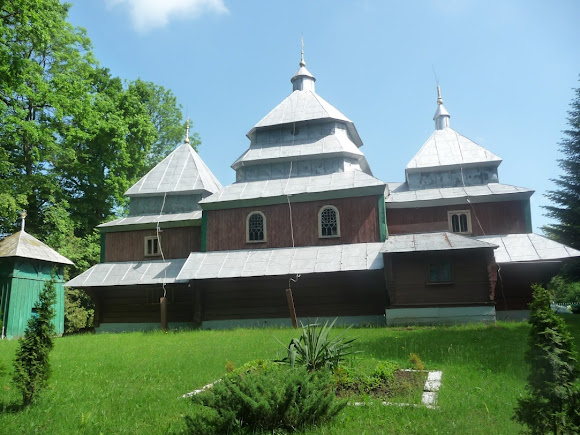
The Orthodox Church of the Nativity of the Most Holy Mother of God was built in 1905 and stands right above the road.
Opening the wicket gate, I found myself straight away on the porch of the locked church.
After a few steps I stopped, hearing a rude shout: "And just what do you want there?" A man riding past on a bicycle introduced himself as the head of the community. There were bossy notes in his voice, and the meaning was "what business have you here?" I tried to explain that I had come to see the wooden church. Since there is no priest, let him, as the community head, allow me to photograph the shrine. Surely one may step into a churchyard at the bidding of the soul? All over the world people freely photograph churches.
No, this parishioner insisted on my being turned off the church grounds. In all the history of my travels this is the only case of hostility from local people.
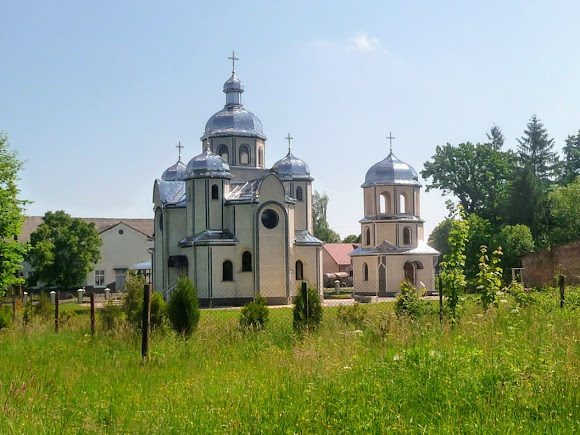
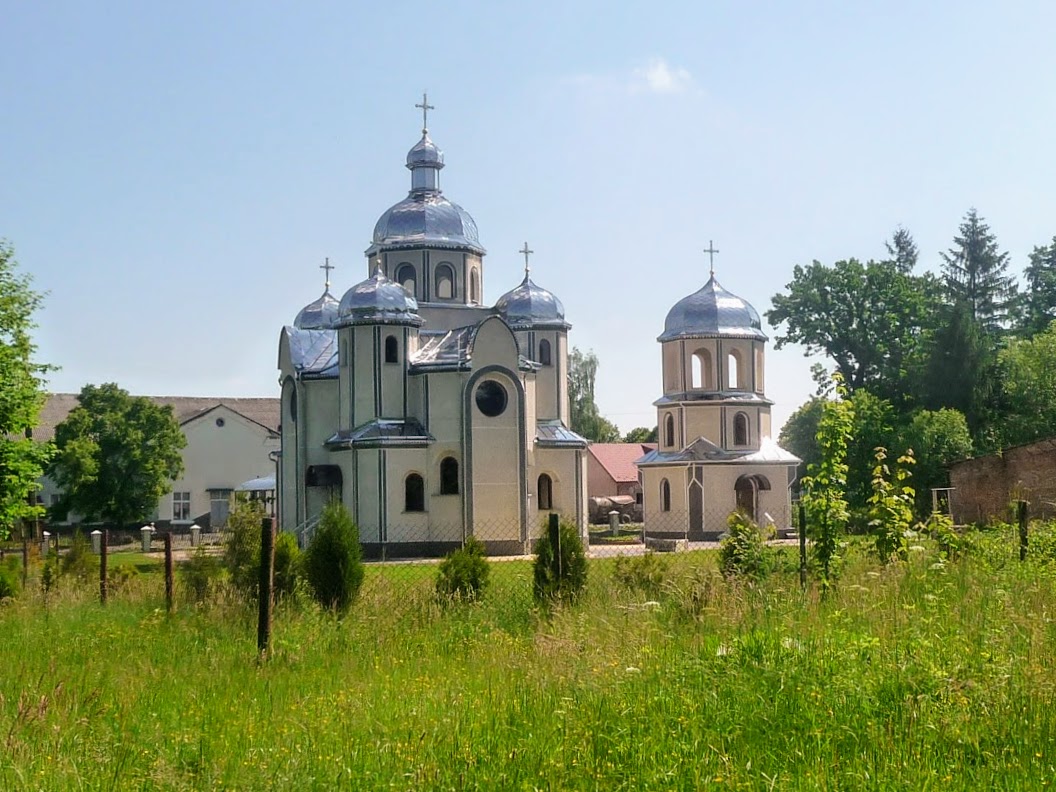
To see the Greek Catholic church, also consecrated in honour of the Nativity of the Most Holy Mother of God, which gleamed with its new domes, I no longer went near it but photographed it from beyond the fence.
With my mood a little spoiled, and having said goodbye to inhospitable Slobidka,
Slobidka. A house by the highway.
I headed off to Pidhirtsi.
But that is only the saying; the tale is yet to come.
A bus bound for Dashava was passing along the road; it picked me up, and my gloomy mood vanished at once. That day was the last bell at the schools, and everywhere I met children dressed in national costume, together with their parents and teachers. A lot of youngsters were riding on the bus, and they gave up their seats to me at once. The older girls were in festive dresses. It turned out they were graduates of the Pidhirtsi boarding school, and the last bell for them is a fine send-off into a happy future. I asked them about choosing a profession, whether it is hard to settle on a college. A very beautiful girl named Yuliia answered that her friends would go on to study in Stryi, for where one is born, there one is of use.
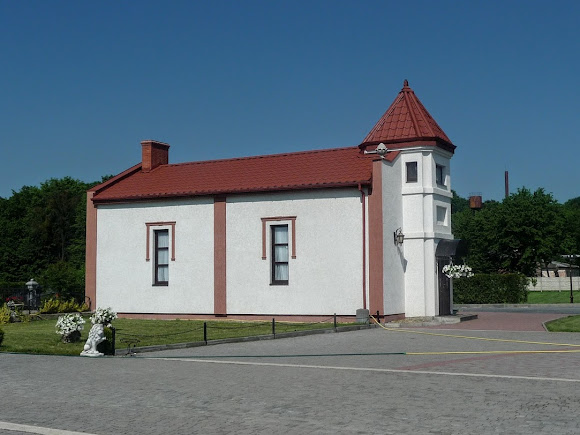
Getting off at the stop next to the sign "Pidhoretsky Estate", I walked through the open wicket gate at the entrance, which was guarded only by two sculptures of lions.
I studied the buildings, wondering which of them was the palace.
The whole grounds were literally ablaze with the many colours of flowers and exotic plants.
Over the weir on the stream, quaint little bridges are thrown across,
and in the man-made pond there lives a real princess.
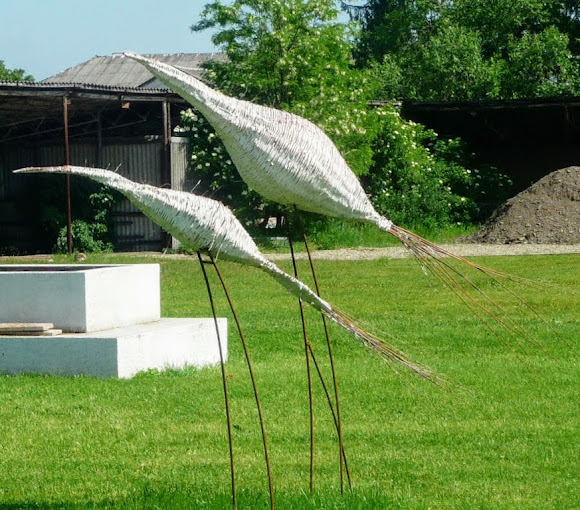
Such wickerwork ornaments I had never seen before.
The "Girl with a Jug" fountain was not working, but the clock showed the exact time.
On one of the flower beds a man was transplanting flowers, and I went up to him to find out what this place actually was.
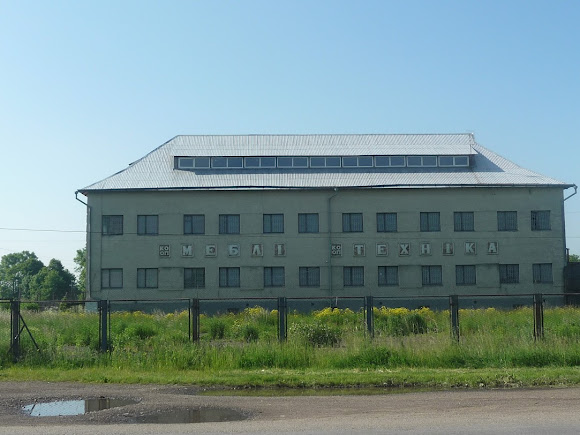
Vasyl told me that all these buildings were once the collective farm's tractor brigade.
With the collapse of the organisation of farm labour, the buildings fell into decay, until some enterprising people put everything in order and opened a hotel-and-restaurant complex in the former warehouses and vehicle workshops.
This establishment is very popular in the district.
I looked into the restaurant. Could you ever have guessed that these premises once held the collective farm's sawmill?
This whole fairy tale was like a summer royal residence.
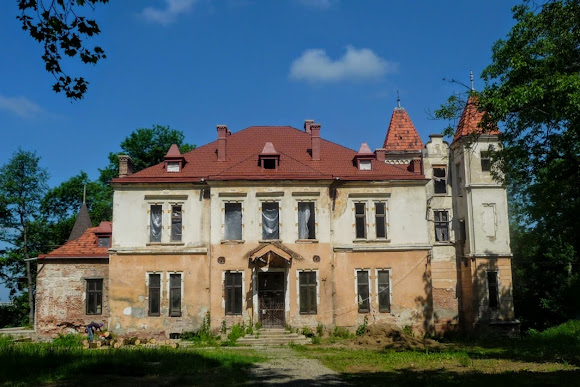
But where was the winter one? To reach the real palace I had to walk 250 metres, and the sight of it stirred quite the opposite feelings.
The mansion was rebuilt at the end of the 19th century from a fortified castle, which in the 17th century King Jan Sobieski gave to his rescuer in the battle with the Turks, the Hungarian nobleman Pechar. The last owner, Baron Brunicki, added two wings and corner towers.
As in every castle, here too there was an underground link with the outside world. Tall enough for a carriage to pass through, the secret passages came up to the surface three kilometres away, in the village of Strilkiv.
Water was supplied to the upper floors from a water tower. There was a lift. The palace was famed for its exquisite furnishings. In one drawing room the ceiling was a vast aquarium. During the First World War the palace was damaged, but the interiors on the ground floor survived until 1939. The furniture, the oriental carpets and the works of art, of course, vanished without a trace.
After the Second World War the building housed a boarding school for people who had lost their sight in combat. The former aristocratic residence became a home and a place of learning not only for children but also for adults who had not managed to finish school before the war. They were blind and partially sighted pupils from all over the Soviet Union.
In the 1970s the school moved into a new building.
The Pidhirtsi special boarding school
In the era of change, all the palazzos were taken over by prisons, TB clinics and hospitals for alcoholics. In Pidhirtsi the aristocratic mansion came to belong to a fish farm. In the cellars, carp fry were raised in concrete tanks. Damp and mould ate away at the walls, turning the Renaissance palace into a ruin.
Now private investors are restoring the monument. Remarkably, all the ceilings and the door and window openings have survived in their original form. It is expected that a museum will open here.
The former outbuildings of the manor estate
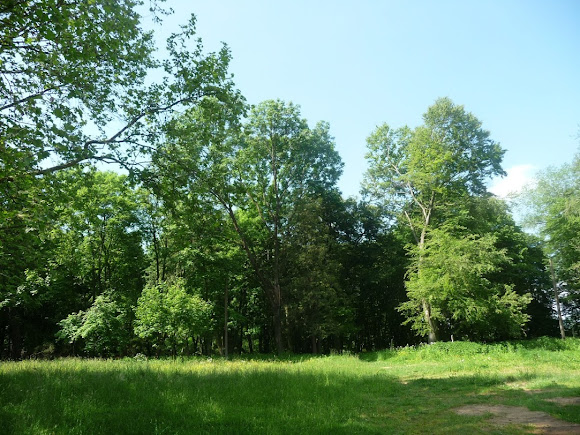
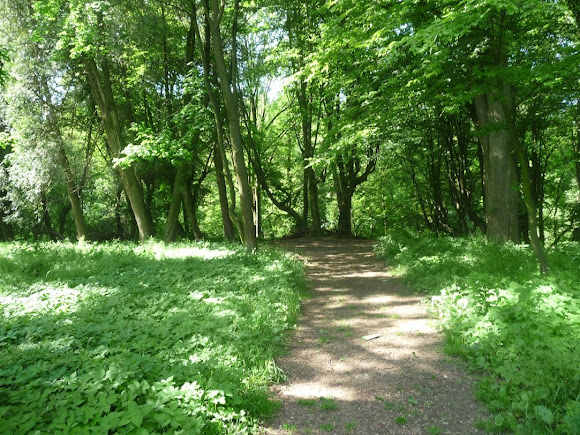
Next to the palace, in the 19th century, a park of several hectares was laid out.
It is considered to have been the first arboretum in Galicia. Today this site of landscape gardening art of national importance is in a pitiful state, although it is supposedly under state protection.
The sculptures have vanished, the avenues are overgrown, and among the rare trees a sports ground has been set up. I did not come across the magnolias, tulip trees and sequoias, but I was enraptured by the beauty and grandeur of a 500-year-old plane tree.
All five of its trunks, spreading out in different directions from the root, are of the same thickness.
That it is called "Five Fingers" I was told by some boys who were smoking behind the former outbuildings of the manor estate (their school-leaving certificate all but in their pockets).
Like every castle, the Pidhirtsi one has its own legend. In 1648 the nobility hid from the army of Bohdan Khmelnytsky in Stryi. Prince Jablonowski fled too, at that time the owner of the castle, leaving behind his wife, who was 32 years younger. The frightened woman wandered through the forest, weeping. She met a Cossack, who called the lady a living rose. In the morning Prince Jablonowski came upon the couple in love. The Cossack was killed, and the princess was never seen again. Local people maintain that her restless soul roams the park, and that on the oak staircase in the palace a ghost of a woman in white has been seen and the creak of the steps has been heard.
I did not go into the old castle, since repair work is under way there, and instead I continued my tour with a walk around Pidhirtsi.
The post office in an old building
The village was founded in the 15th century.
The Pidhirtsi primary school. The former manor school.
There are around 1,000 inhabitants.
A monument to the working woman of the village
The last owner of the lands and master of the palace, Baron Brunicki, was a scholar, a traveller and a collector. It is known that he passionately loved strawberries. The queen of berries is well grown here, and the plantations of the fragrant fruit have survived to this day. The baron was the patron of the local Church of the Descent of the Holy Spirit. The village's coat of arms depicts the palace and the church, entwined with a little strawberry bush.
The baron is buried in the neighbouring village of Strilkiv.
In Pidhirtsi the village council building is very small.
The village council
But on a sculpture of the Kobzar the villagers did not stint. When I see how villages and towns cherish the memory of our national poets, I recall the words of an elderly lady from Lysiatychi: "Every village has a monument to Shevchenko or Franko".
The new church in Pidhirtsi was built recently.
I was about to photograph it when I saw a priest coming towards me, smiling at me already from afar. Father Bohdan gave his blessing and suggested I walk to the wooden Church of the Descent of the Holy Spirit, whose 200th anniversary was marked in 2010.
Father Bohdan was hurrying to the school for the last-bell celebration, but he gave me his time, opened the church and told me about the shrine, which has the status of an architectural monument of national importance.
The church was moved here from Zhulyn, when a Roman Catholic church was built there.
During the persecution of the Greek Catholic Church, the priest Father Vasyl adopted Orthodoxy, thereby saving the church. And yet it was closed from 1961 to 1988. The faithful walked to the services in neighbouring villages.
In 1990 it was reconstructed: the walls were raised and the structure was lifted on jacks.
The iconostasis was borrowed from Roman Catholic churches.
Betrothed couples prefer to marry in the old, prayer-hallowed church.
And with that my trek came to an end. I met wonderful people and learned a great deal about this Subcarpathian village and its landmarks.
I thank all its residents for their warmth. I liked Pidhirtsi very much, and I share my impressions with you.
















No comments:
Post a Comment
Leave your impression