Every resident of our country knows and has heard of Velyki Sorochyntsi. Every year here, in the heart of Ukraine, a trade and cultural mass event is held — the national Sorochyntsi Fair. This village in the Poltava region was made famous by the work of Mykola Vasyliovych Gogol, who was born here. His whole life is filled with myths and mysteries, and his birthplace still remains a riddle. Gogol scholars claim that the spring flood, as of 1 April 1809, washed out the roads and carried away the bridges, and the infant came into the world in a wagon train, as befits a future traveller. But the residents of the writer's little homeland refute this version and are convinced that Nikosha's mother, who had already lost two children, came to doctor Trokhymovsky in good time. What does the cradle of the most enigmatic writer of Ukrainian and Russian literature look like now?
 |
| Velyki Sorochyntsi, Poltava region. The M. V. Gogol Literary Memorial Museum |
A rainy April morning in 2019. From Myrhorod the bus rushed to the famous village in 45 minutes and stopped at the entrance on the eastern side, where the grounds of the Sorochyntsi Fair are located — the most famous in Ukraine since the 19th century.
 |
| Velyki Sorochyntsi. The entrance to the grounds of the Sorochyntsi Fair |
Over the last 20 years, merchants from near and very far abroad have been coming to the marketplace, renovated and tidied up.
On the 16-hectare Zhabokrytskyi Square, where once there was a swamp and an unheard-of invasion of frogs, a miniature Ukrainian village with cottages, a church and a windmill has been created next to the trading rows.
At the end of August, for five days, everything here seethes, roars, sings, moves, is sold and is devoured. The remaining 360 days the gates are locked, the bazaar is deserted and quiet — not even the singing of amphibians can be heard.
The fairground borders a sanatorium boarding school, one of whose buildings was constructed in 1905 for a teachers' seminary.
The institution was famed for the level of training of its seminarians; musical and poetry evenings were held in it, and it had its own church.

The building has not lost its grandeur, and I very much wanted to see the school from the inside. By the entrance sat a stern doorkeeper, Halya; I asked permission to speak with the school's management and to peek at least into the corridor, and also to enter the clergy museum created in the boarding school and to look at the picture gallery. Halya ordered me to wait where I was and went up to the top floor, but soon returned with a categorical "No, you may not." I had travelled 500 kilometres and walked in the rain — surely I could see the classrooms of the historic building for just a minute, with one eye? The doorkeeper was implacable. It is wonderful that the children are supervised, but museums and landmarks should not be classified sites. It was good that they did not chase me off the grounds, and I continued to examine the architectural monument from the school yard.

On the facade the construction date has survived, and the felled tree could have been a contemporary of the famous native son, who is immortalised in the form of a sculptural image on a pedestal.
The small bust of the writer looks very organic against the backdrop of the neoclassical building. It is surrounded by a flower bed with an openwork fence, which the boarding-school staff use for parking bicycles.
Between the new building and the canteen there are carousels, a bench and a ladder made of tyres. The cover of the manhole located on the playground poses a danger to children.
The sports ground is equipped with a flagpole, a pedestal for the winners and a bowl for the Olympic flame.
I think that the pupils of the sanatorium school ought to have quality, reliable sports complexes, sandpits, slides, equipment, horizontal bars, play apparatus. All the more so since, 150 metres from the school, well-off and enterprising people gather at the country's largest fair — people who could provide charitable help.
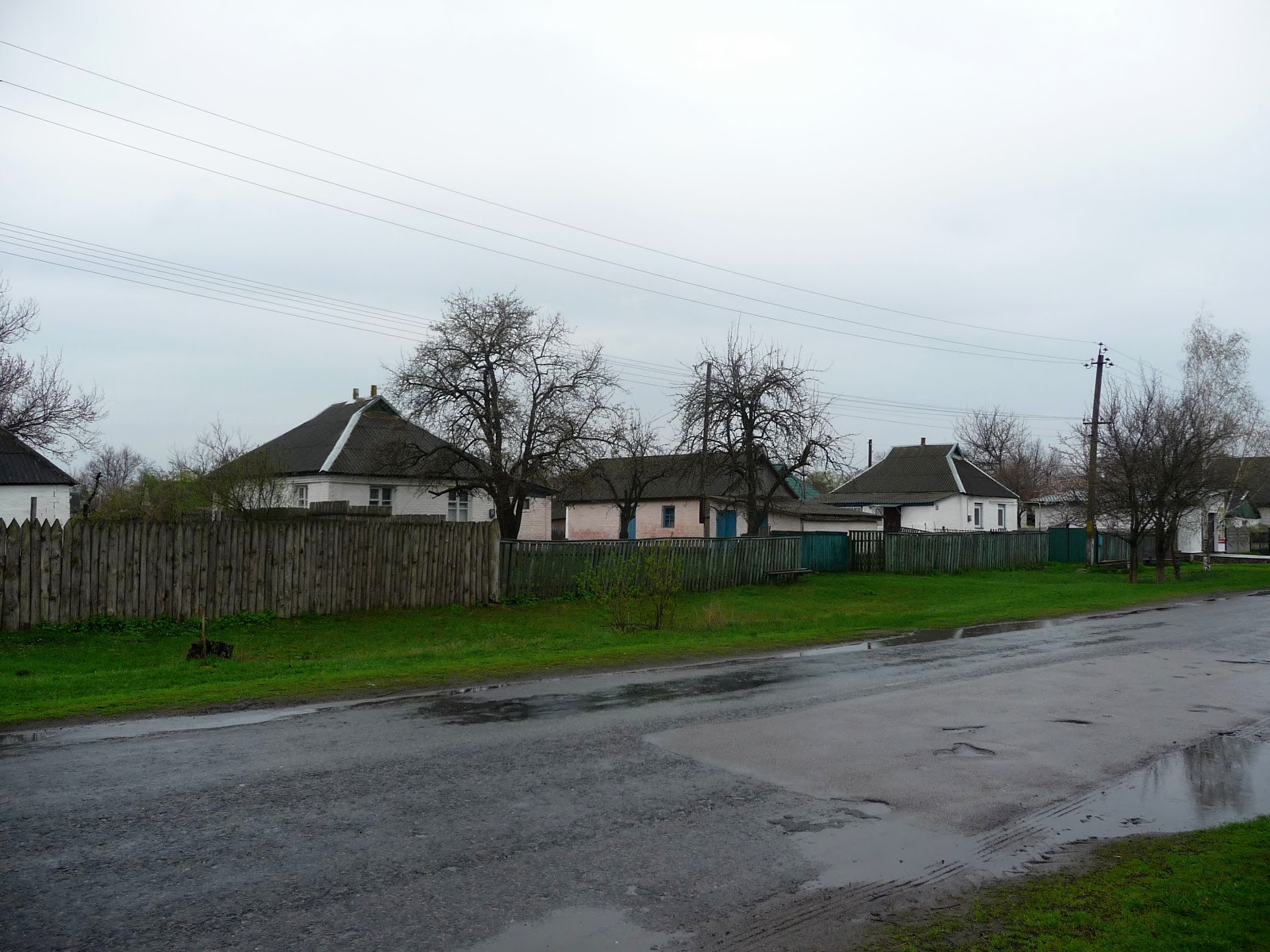
I continued my acquaintance with the Cossack village, which arose in the mid-17th century, along Myrhorodska Street towards the centre. There is no pavement, the rain did not stop and the wind did not die down.
Mykola Vasyliovych, an eternal wanderer through towns and villages, described roads very symbolically in his works — dirty, disordered, with hummocks and holes, bends and ruts. It is along such roads that traders from all over the country and overseas merchants come to the festive trading of national significance.
There are more than twenty commemorative signs and memorial plaques in the village. On the eastern outskirts you are met by a five-metre bronze monument to the underground fighter and collective-farm chairwoman Olha Bondarenko, shot by the Hitlerites together with her family and a group of activists in 1941.
A native of Velyki Sorochyntsi, the Bolshevik internationalist Andriy Chumak escaped tsarist penal servitude by emigrating to America with his three children and his wife.
Perhaps the heroes of the revolution and the war lived in these houses, now ruined and abandoned. Or maybe the heroes of "The Sorochyntsi Fair" — Solopiy Cherevyk with Khivrya and Hrytsko with Paraska — drove past these cottages.
Gogol knew the way of life and the traditions of the people, tried to change the peasants' lives, felt their sufferings, loved the land and nature. It is a great pity that on the fertile Poltava soil, which the Hitlerites carried away by the wagonload, it is not becoming any easier for the peasants to work. Many abandon their native homes and leave for neighbouring states.
At a fork in the roads, a water tower has risen since 1927, with a tank of 140 thousand litres' capacity and a diameter of 6 metres. The first rural water main in Ukraine appeared in Velyki Sorochyntsi. The water flowed by gravity through cast-iron pipes along three branches.
In 1911 a monument was opened to the genius and connoisseur of life, the great Gogol. The sculptor Ginzburg depicted the satirist and playwright seated, gazing perceptively at the world around him while with his right hand he records his observations. A very beautiful sculpture, but the red posts behind the pedestal do not fit the overall perception of the composition.
Having admired the monument, I turned onto the street named in honour of the brilliant writer. The village council and the house of culture are housed in one two-storey building, from the end of which wooden figures greet you.
The characters are recognisable and accurately convey the temperament of the heroes of the story "The Sorochyntsi Fair".
Onto an ordinary two-storey building, faced with tiles, they added a wooden veranda with carved posts and opened a local-history museum. For the first time I saw a museum whose day off is Wednesday — and that day was, it is not hard to guess, precisely Wednesday.
A bust of a fellow villager, the poet, playwright and translator Volodymyr Samiylenko, has been set up in a small public garden.
Not only in Myrhorod, but in Velyki Sorochyntsi too, there is a puddle of its own.
A few pieces of infrastructure — a former department store, a hairdresser's, shops.
The roadside cafe offers khachapuri and lavash, though one would rather have varenyky and halushky.
The statue was pulled down, but a gloomy pedestal of considerable size has remained.
A decorative fence with views of rural landscapes shields the battered road, part of the T1719 highway.
A small brick building with an arched little window and a grated entrance has hidden itself alone on the wasteland amid the ruins. This is the former cellar of Danylo Apostol's palace.
An architectural monument of the early 18th century does not look neglected; the walls are whitewashed, the grate locked.
In house No. 34 is the Gogol Literary Memorial Museum.
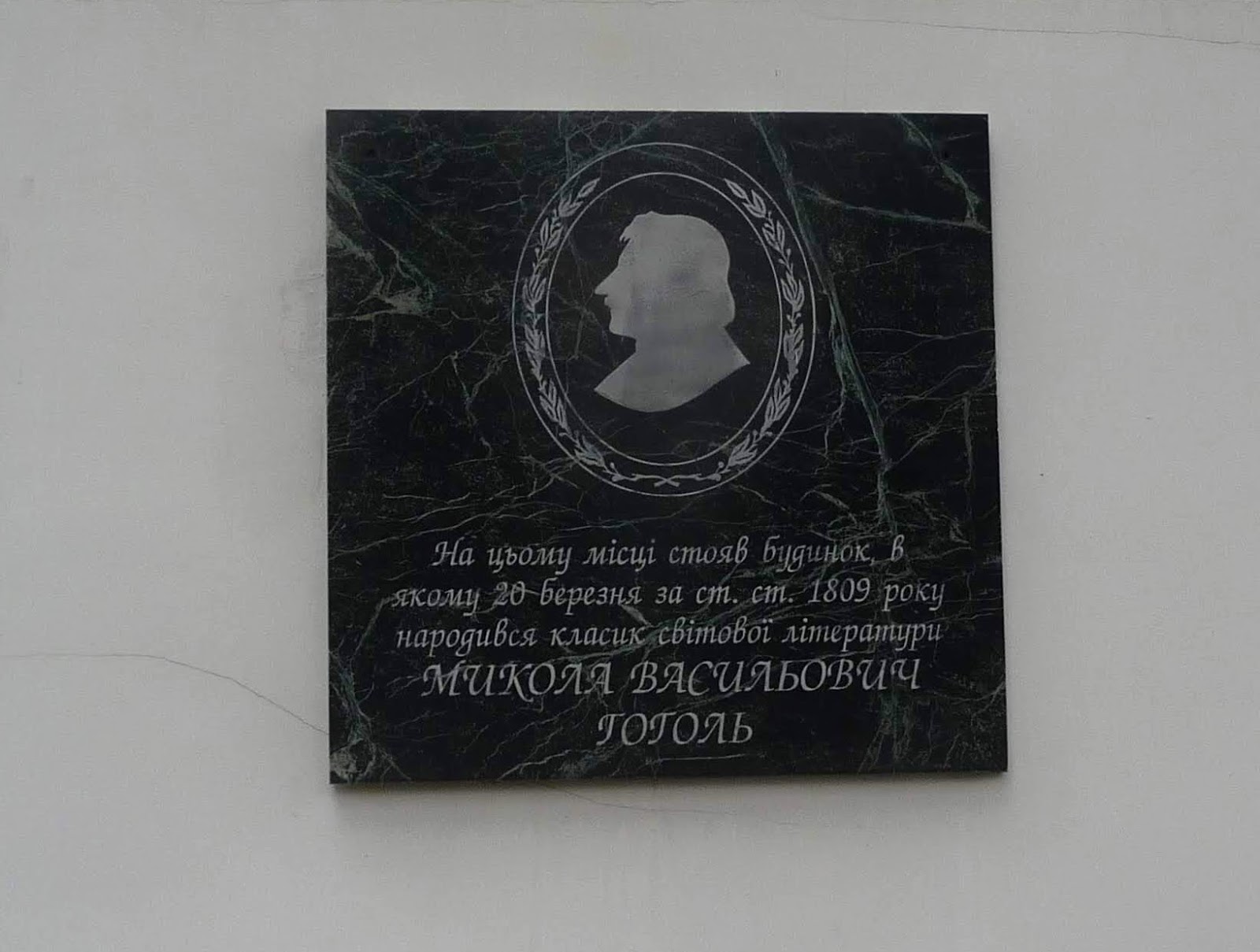
As is well known, Mykola Vasyliovych had no house of his own and lived now with relatives, now with friends. In the house of doctor Trokhymovsky, where the classic was born, a museum to the writer was founded in 1929. In 1943, during their retreat, the Hitlerites destroyed the mansion. In the post-war period the museum resumed its work in a building erected on the site of the previous one.
The keepers of the museum collections are especially proud of unique exhibits — Gogol's personal belongings, with which he travelled the Near East and Europe. Unfortunately, rare editions of the genius's works were irretrievably stolen.
Mykola Vasyliovych was baptised in the Saviour-Transfiguration Church, erected in 1732 with the funds of the hetman of the Zaporozhian Host, Danylo Apostol.
This is a true architectural pearl of Velyki Sorochyntsi. The shrine became the burial vault of the family of the Myrhorod colonel, and a bust of the founder of the noble Muravyov-Apostol line and a bronze kobza have been set up next to the church.
The walls of the church were not painted. The parishioners' attention is focused on the unique iconostasis, 22 metres wide and 17 metres high, on which 100 canvases of the 17th century depicting the faces of saints are placed. This example of Cossack Baroque may be photographed only from the outside; inside it is categorically forbidden — perhaps because thefts of church property have occurred.
The bell tower was built by descendants of Apostol who live in Switzerland.
A whitewashed house with a red roof belongs to the church parish. What was in it earlier could not be established — perhaps a zemstvo school or a hospital.
Leheyda Street led me to the already fourth Velyki Sorochyntsi museum, in which five Ukrainian cottages and objects of folk life are gathered.
On the grounds of the hotel-museum "Gogol's Khutir", the atmosphere of the great writer's works and the flavour of a Poltava village have been created.
At the ethno-estate you can dine in a tavern. On the menu are dishes of the national cuisine cooked in a stove, and folk songs sound, performed by ensembles of the Myrhorod area.
Here you can meet literary characters, pay a visit to the master of the house, spend the night in a wattle-and-daub cottage. There is a feeling of having landed in an amazing story, with mysticism in the spirit of the tales "Viy" and "Christmas Eve".
Velyki Sorochyntsi has bus connections with Myrhorod and Poltava. The bus departs for Myrhorod at 10:35 and 16:35.
Coordinates of the village centre: 50°1'26"N 33°56'34"E
 |
| Velyki Sorochyntsi. Myrhorod district, Poltava region |






No comments:
Post a Comment
Leave your impression