In 2019 the city of Pinsk was declared the cultural capital of Belarus — a district centre of the Brest region with a population of 138 thousand people. How is the cultural heritage, the language and the distinctive traditions preserved; how do the streets and landmarks of the unofficial capital of Polissia look through the eyes of a woman from neighbouring Ukraine? How does a guest feel in one of the largest cities of the blue-eyed republic, and what is there of interest here for the tourist?
 |
| Pinsk. The railway station |
It is no secret that most Ukrainians have formed stereotypes about the cultural and economic development of their northern neighbour, not always in favour of their own homeland. Is that so? I will tell you my impressions. As the theatre begins with the cloakroom, so a journey begins with the train. The carriages of train No. 372 Lviv-Mohyliv are cleaned to a shine, like the deck of a ship.

For the checking of documents at the Ukrainian border the train did not stop. Before passing the Belarusian border, the conductors announced a general reveille, as in the army. The inspection of belongings and the checking of passports were carried out during the stop. The queens of the carriages were present at this and looked unwelcoming and even stern the whole way. The Belarusian carriage attendants did not pass the test of politeness. On leaving a train, at the exit I always say to the conductors, "Thank you", and the employees of Ukrzaliznytsia invariably reply with a smile, "Have a good journey". The employees of the "chyhunka" let my thanks pass by their ears.
Having got off at Lunynets, I reached Pinsk in comfort by suburban train.
 |
| The suburban train Lunynets-Brest |
During the journey across the expanses of Belarus, such concepts as order, cleanliness and neatness did not disappear from view for a single moment. Belarusians know and cherish the history of their land. The first written mention of Pinsk dates to 1090.
 |
| The memorial sign about the year of the founding of Pinsk — 1097 |
Memorial signs testify to the location of the ancient hillfort and citadel.
 |
| The remains of the moats and ramparts |
 |
| The memorial sign on the site of the ancient hillfort |
 |
| The memorial sign on the site of the citadel. Here the town on the Pina begins |
The historic core of Pinsk is occupied by the central city square, reconstructed in a mixed style of pseudo-Baroque and hi-tech for the traditional Dozhynki-2014 festival.
The replacement of the trylinka paving tiles and the cladding of the balconies of the Khrushchyovkas with mirrored panelling were not received with delight by all the residents.
On Lenin Square, with the monument to the leader on a massive pedestal, mass events and public celebrations take place.
Early in the morning on a weekday the square is quiet and deserted; Belarusians wake up later than the inhabitants of Ukrainian cities.
Librarianship appeared in Pinsk in the chronicle era, at the monasteries and churches. Since 1989 the central library, with a collection of 200 thousand volumes, has occupied a large building and has several branches.
With amateur arts everything in Pinsk is at the highest level. In the city House of Culture there work a mass of folk and model ensembles, a brass band and interest clubs. Festivals, concerts, performances and celebrations of anniversary dates are held in the city constantly.
The monument to bread is a tribute of respect and gratitude to the country's grain-growers.
 |
| "Rye bread, wheaten, fragrant — the greatest wonder of the ages. To the grain-growers of the lifelong calling, honour and our love." |
An information board with a map of the city and the marking of its landmarks is a guide for the traveller.
 |
| Tourist information |
Not in every city will you come across a sign pointing to the directions and distances to the European capitals.
 |
| The sign of the distance to the European capitals |
In Pinsk 186 objects have cultural and historical value; on their facades memorial plaques have been installed indicating the date of the building's construction.
 |
| Lenin Square, 12. 1917. |
 |
| The former Bernardine monastery, 19th century. |
I saw many other beautiful buildings in atmospheric places, which have no status of architectural or historical monument but, in my view, convey the spirit of the town on the Pina.
The former Jesuit collegium is a masterpiece of architecture of the 17th century, in which the children's art school and the Museum of Belarusian Polissia have been housed.
For the flourishing of young talents and their further development in the creative direction, special educational institutions have been created — art and music schools and a college of arts.
 |
| Music School No. 1 |
 |
| The art school |
The street clocks show the exact time.
 |
| The former collegium. The street clock |
 |
| Polesie University. The street clock |
The well-kept public gardens are green oases, places of rest and an adornment of the industrial city.
 |
| The entrance to the Children's Park |
 |
| A park sculpture |
From the square begins Lenin Street — one of the oldest city thoroughfares, modernised into a space for pedestrian strolls. About
the Pinsk pedestrian zone you can read here.
The other streets of Pinsk are also attractive to tourists and are distinguished by their decor, their plasticity and their lighting. There are not enough Wi-Fi zones, which in Ukraine are at every step in public places.
 |
| Kostiantyn Zaslonov Street, 15. Before the revolution — the Minsk Commercial Bank |
 |
| Lenin Street, 39. The education department. Before the revolution — the Nobility School. The first gymnasium |
 |
| Pershotravneva Street, 25 |
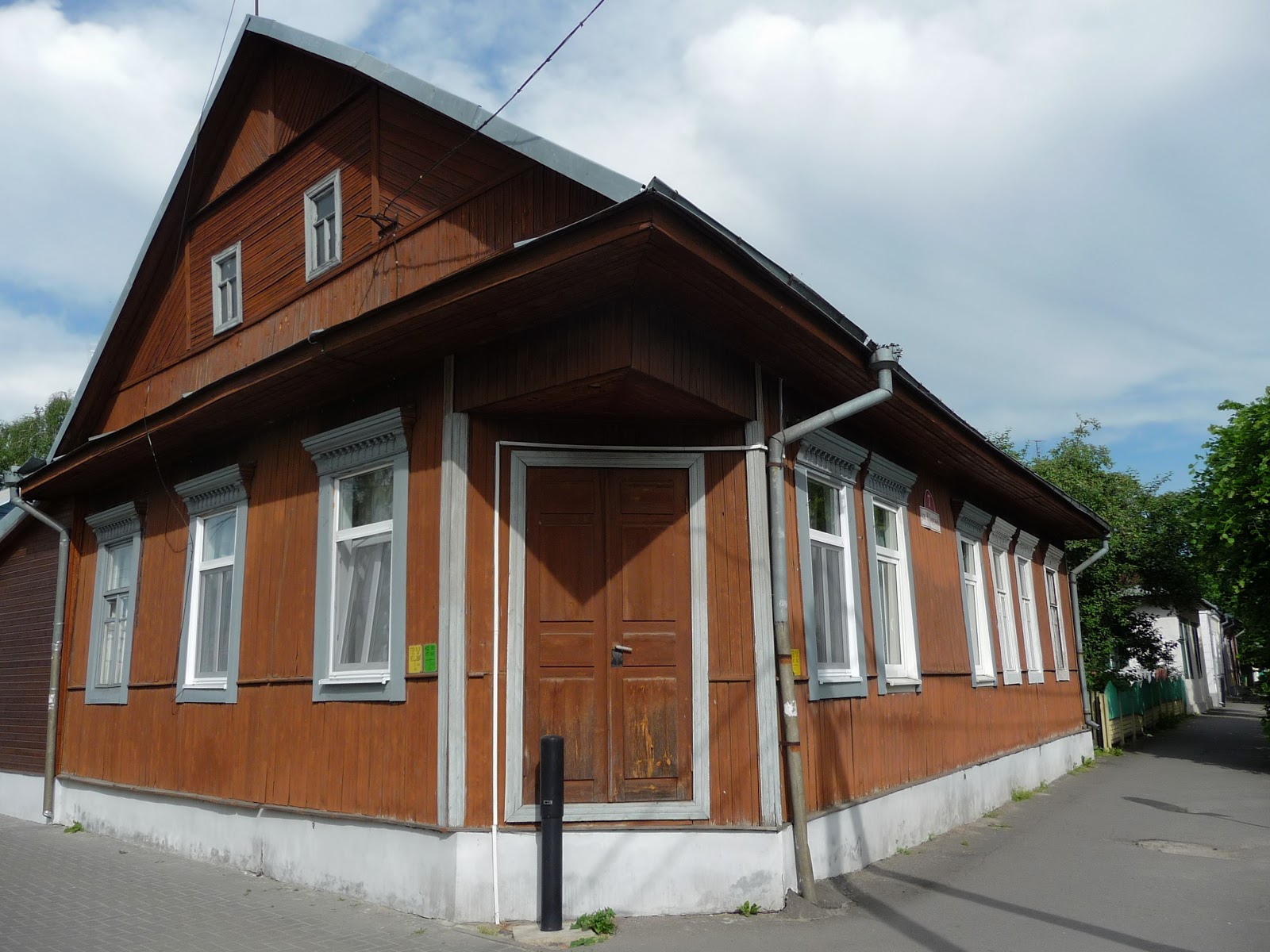
All of them are well kept, the roads are repaired, and the buildings with facades painted in various colours are not cluttered with snack-bar extensions or hung with intrusive advertising. The wooden buildings do not look like ruins and give the Polissian town a special colour.
 |
| Pinsk. Wooden buildings |
Dnieper Flotilla Street, a former embankment, is named in honour of the legendary flotilla that was based in Pinsk.
 |
| Dnieper Flotilla Street. Polesie University |
 |
| Dnieper Flotilla Street. A residential building |
 |
| Dnieper Flotilla Street. A restaurant. The former starostvo |
 |
| The Polesian lion |
 |
| Dnieper Flotilla Street. The former "Bristol" hotel |
 |
| Dnieper Flotilla Street. The city administration |
 |
| Dnieper Flotilla Street. The "Pripyat" hotel |
On Berestska Street is located the oldest woodworking enterprise of Belarus, "Pinskdrev". One would like the leader in the production of elite furniture, popular also in Ukraine, to set up the production of wooden souvenirs. Little boxes, toys, stationery and kitchen utensils, made from production waste, could remind travellers of their stay in Polissia.
Tchaikovsky Street was once a moat of the fortress that stood on the site of the present-day Lenin Square.
Gorky Street was called Dominican Street until 1939.
 |
| Gorky Street. An insurance company |
 |
| Gorky Street. A residential building |
 |
| Gorky Street, 1. A residential building |
The two-storey buildings are joined by galleries, in which arches have been formed for passage.
Creative.
At the beginning of the street there turned out to be a water-draw pump with tasty water, which for a traveller is always very important. True, a man from the neighbouring house said that the "fantal" would soon be closed, since it is a free consumption of natural resources.
 |
| Gorky Street. The water-draw pump |
A well-kept source of healing moisture was encountered on Pershotravneva Street.
On the corner of Korzh Street and Vira Kharuzhei Street, in the building of a pre-revolutionary casino, the Polesie Drama Theatre is located. In the repertoire of this laureate of republican festivals are plays by Belarusian classics, works by contemporary authors and children's shows.
 |
| The Polesie Drama Theatre and a playbill |
Next to the theatre a public garden with wooden sculptures of fairy-tale characters has been laid out.
 |
| Pinsk. A public garden with wooden sculptures |
The former name of Radianska Street was Bernardine Street. Residential and commercial buildings are marked with plaques with the status of republican cultural heritage.
 |
| Radianska Street. The city organisation of the "Red Cross" |
 |
| Radianska Street. Residential and commercial buildings |
Kirov Street, in the Polish period, was named in honour of the 84th Regiment of Polesian Riflemen.
 |
| Kirov Street. Residential and commercial buildings |
Komsomolska Street: whatever the building, it is a work of art.
 |
| Komsomolska Street. A residential building |
 |
| Komsomolska Street. The military enlistment office |
 |
| Komsomolska Street. The military enlistment office |
 |
| Komsomolska Street, 1 |
Without doubt, the state of general cleanliness is the result of great labour, but you will not see rubbish trucks with bags spilling over the sides, street cleaners raising dust, gathered little heaps by the roads or cigarette packets thrown past the bins. The proverb "It is clean not where they clean, but where they do not litter" is about Belarusian cities, and Ukrainian ones cannot yet reach up to them.
 |
| Berestska Street, 11 |
 |
| Pershotravneva Street, 26 |
Such symbols of socialist realism can no longer be seen anywhere in Ukraine.
 |
| The hammer and sickle for the 50th anniversary of October |
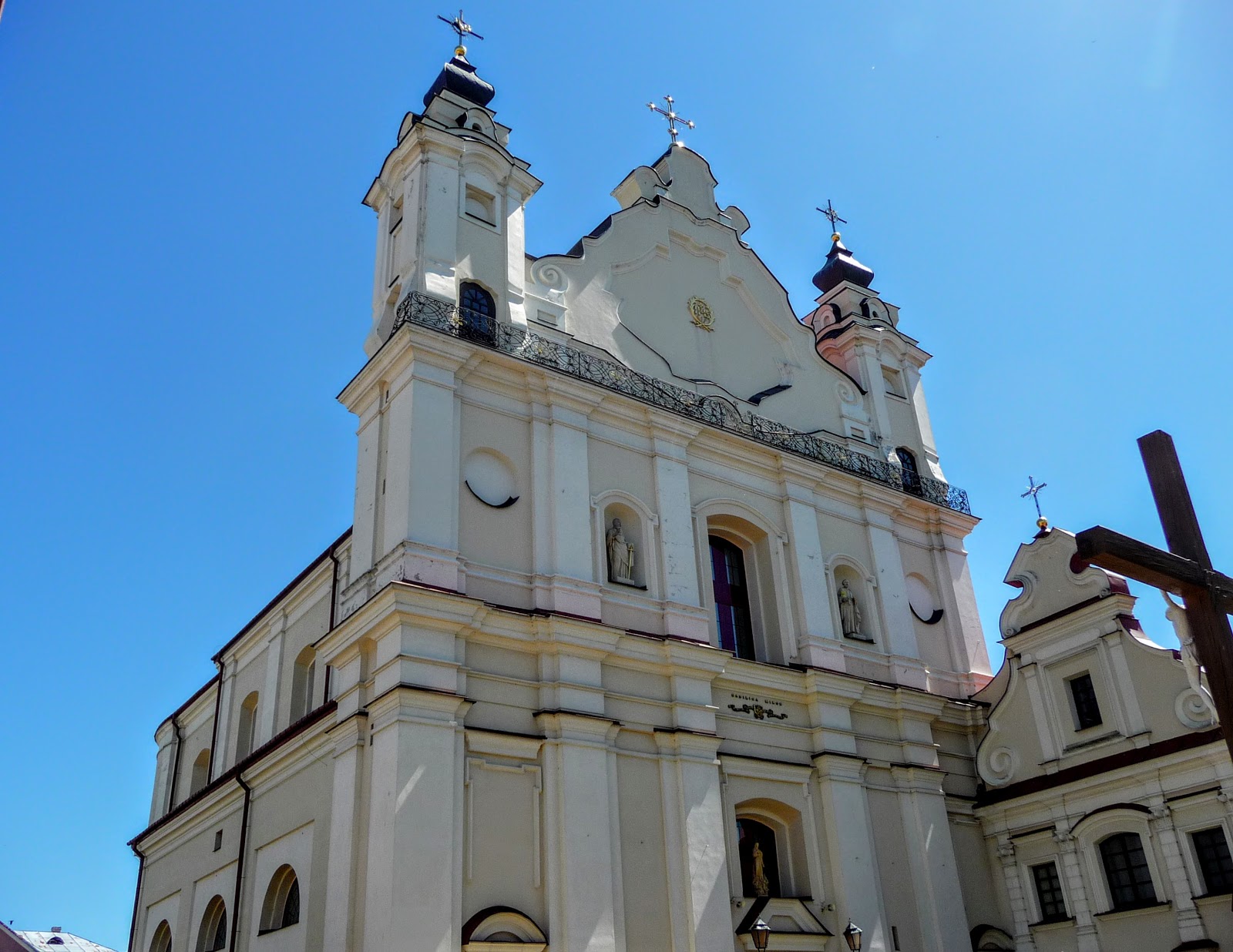
Pinsk is the centre of Catholic and Orthodox dioceses. I counted more than a dozen churches of various religious denominations. The doors of the shrines are open to all who wish to cleanse their soul, although there was no service.
 |
| The Cathedral of St Theodore Tyron |
 |
| The Church of St Charles Borromeo. A concert hall |
 |
| The Cathedral of the Holy Great Martyr Barbara |
 |
| The Roman Catholic Church of the Assumption of the Holy Virgin Mary |
 |
| The Holy St Barbara Church. A former Roman Catholic church of 1786 |
 |
| The synagogue |
In Pinsk there are several educational institutions where the young generation receives professional education.
 |
| Polesie University |
The multi-storey buildings of the campus of Polesie University do not resemble ordinary dormitories. The architecture of the residential complex is in harmony with the buildings of old Pinsk.
 |
| Polesie University. The campus |
Like mushrooms after rain, new residential buildings are growing. The many-coloured facades gave the microdistrict the name Raiduzhnyi.
 |
| The new microdistricts |
The Pina is the blue artery of the Polissian capital. About the river, the embankment, the boat trips, the bridge and the port you can read here.
With public transport in Pinsk everything is also excellently organised: you can reach any point of the city with a short interval between services, and no overcrowded marshrutkas are to be seen. In the many-coloured articulated trolleybuses produced by the tram and trolleybus factory "Belkommunmash", a female voice announces the stops and the main sites on this section of the route in Belarusian over the audio system.
Unfortunately, this is the only place where one can hear the sound of the language of the siabry. Signs, advertisements and announcements are made in Russian. The Belarusian language is understood by all but is practically not used in conversation.
 |
| A commercial building |
 |
| Lenin Street, the pedestrian zone |
The motor roads in Belarus deserve odes and dithyrambs.
 |
| Berestska Street |
The discipline of the pedestrians draws attention. Even on quiet secondary streets and with a complete absence of cars, people cross the road strictly on the green light. The culture of behaviour of drivers and pedestrians in Belarus is much higher than in Ukraine.
In communication Belarusians are more reserved than Ukrainians. I thank the siabry for their hospitality and welcome, but I will note that in state institutions, at the post office, at Beltelecom, in the shops, on transport and at the bus stops they are not so friendly and smiling, but more responsible and composed than my compatriots.
 |
| The chapel is a reminder of the destroyed architectural masterpieces: the Roman Catholic Church of St Stanislaus, the Holy St Theodore Cathedral and the synagogue. |
From all that I saw, I will sum up: the district centre of Pinsk, a city of regional subordination, is closer to the European level of culture than the same administrative units in Ukraine. But it is important not only to find differences and dissimilarities, but to learn the good from one's neighbours.
 |
| The railway station |
The stork is a harbinger of happiness and well-being, a living talisman, a bird especially revered among the Slavic peoples. May the symbol of rebirth, of spring and of kinship unite our countries on the path towards rapprochement, mutual understanding and peaceableness.
 |
| A storks' nest near Lenin Square |
I wish the people of Pinsk to preserve the status of their city as the cultural capital of Belarus.






No comments:
Post a Comment
Leave your impression