The Taras Shevchenko Station is one of the oldest railway junctions connecting the south, east and west of Ukraine with Kyiv. This hub harbour for trains is located in the town of Smila in Cherkasy region and belongs to the Odesa Railway.
Smila. The T. Shevchenko railway station. The North Station
The distance to Kyiv is 216 kilometres.
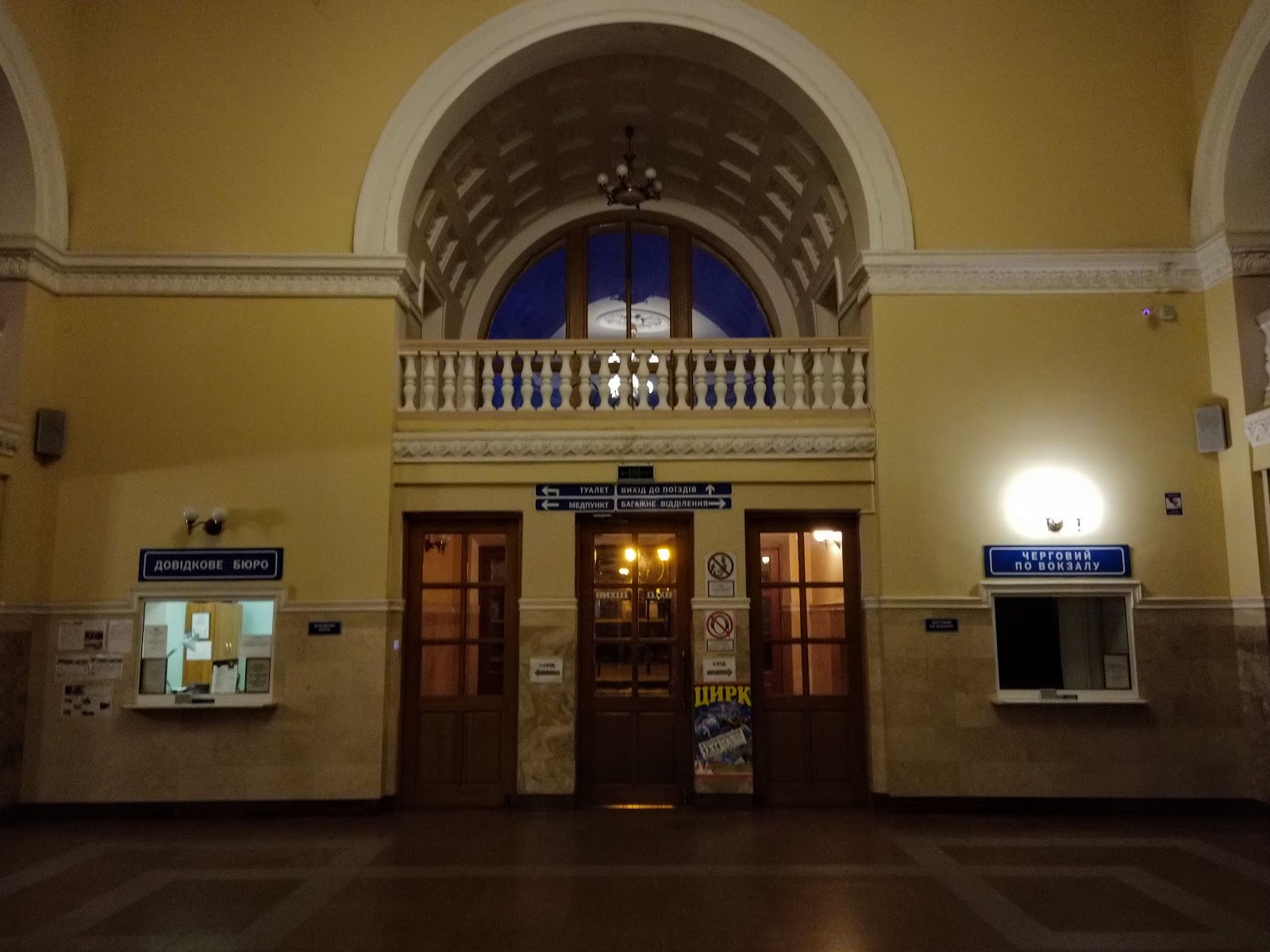
Passenger trains heading north — namely to the capital — stop at the North Station. The pre-revolutionary building houses service premises and has no waiting hall. Passengers can sit on a bench by the station or by the roadside cafe.
The North Station from the platform side
The station was founded in 1872 on the initiative of a purposeful landowner, sugar manufacturer and, concurrently, Minister of Railways of the Russian Empire, Count V. O. Bobrynskyi.
The South Station from the station square side
Thanks to this far-sighted director of railway policy and zealous entrepreneur, a railway branch was laid through Smila that linked two mainlines — the Kyiv-Berestia and the Kharkiv-Mykolaiv. Traffic opened in 1876.
The North Station from Pivnichno-Vokzalna Street
To service the railway, a depot, workshops and warehouses were built.
The railway depot
The present-day depot has existed since 1933.
The carriage depot
Trains pass through the station from Uzhhorod, Lviv, Truskavets, Ivano-Frankivsk, Rivne, Kovel, Zaporizhzhia, Berdiansk, Mykolaiv, Odesa, Kherson, Novooleksiivka, Henichesk, Dnipro, Mariupol, Pokrovsk, Cherkasy, Moscow. Until 2014, trains on the Crimean and Caucasus routes stopped here as well.
The northern platforms
The station bore Bobrynskyi's name until 1936. Then the communist authorities renamed the railway facility in honour of the party propagandist Postyshev. Soon the organiser of the Holodomor in Ukraine and of the Stalinist terror himself became a victim of the repressive machine. For a short while the station bore the name of the People's Commissar for Internal Affairs, Yezhov, shot on charges of plotting a coup d'etat. In two years the station changed its name twice, and then the authorities decided to name the large railway junction in honour of the national poet who was born in the Cherkasy region and whose childhood was spent 60 kilometres from Smila. Since 1940 the station has borne the name of Taras Shevchenko. In 1956 a monument to the classic was erected on the station square by the South Station.
The T. Shevchenko Station. The monument to Taras Hryhorovych Shevchenko
The Cherkasy region is not only a beet-growing breadbasket and a land of Shevchenko places, but also an ancient land of Cossack glory. In March 1918, near Bobrynska, a battle took place between the Cossack force of Otaman Yakiv Vodianyi and the 8th Russian Army led by Muravyov. In honour of the Cherkasy men's victory, a memorial marker with images of the heroes has been set up at the site of the historic event.
The memorial marker to the events of 1918 by Bobrynska station
An overpass 340 metres long hangs above the track facilities.
For all the know-it-alls of industrial zones, the bridge opens up a view of the station's units and the production buildings of the electromechanical plant — in the past the railway-car and locomotive workshops, founded with the ready hand of Count Bobrynskyi.
The production buildings and the transport shop
The overpass is used by residents of the trackside settlement on the northern side of the station.
The overpass across the northern tracks
A service building
Since the end of the 19th century, those who built and serviced the railway facilities have lived here. The former workers' dormitories of pre-war construction still serve as housing for the track workers.
Vasylia Stusa Street. A dormitory
Here the toilers of the steel mainlines mastered their professional skills.
Vasylia Stusa Street. The teaching block of the vocational school
Unfortunately, some teaching blocks have emptied and are falling into ruin.
Vasylia Stusa Street. The abandoned teaching block of the railway vocational school
In a four-storey building of red brick, pupils with hearing impairments received their education.
Vasylia Stusa Street. The abandoned school for the deaf
Since 1937 the Smila combined heat and power plant has supplied electricity to the steam-locomotive and railway-car repair workshops of the electromechanical plant.
Vasylia Stusa Street. The Smila CHP plant
From the North Station to the South Station one has to cover a distance of about 350 metres. There is no overpass across the southern platforms, and a passenger has to wait several minutes if freight trains are passing along the track.
The old railway building on the southern platforms
Here stop the majority of the diesel trains that run to Myronivka, Pomichna, Cherkasy, Znamianka, Viska, Tsvitkove, Khrystynivka, Uman and Hrebinka.
The southern platforms
The railway tracks come right up to the building of the linear police department.
The southern platforms. The linear police department
The South Station building was erected in 1952 to a design by the architect Hranatkin.
The T. Shevchenko Station. The South Station
The facade and the interior premises are decorated in an original way.
The station's founder, Count Volodymyr Oleksiiovych Bobrynskyi, has not been forgotten either.
The South Station. The memorial plaque with a bas-relief in honour of the station's founder, Count V. O. Bobrynskyi
In the waiting hall the cleaning women were putting things in order and at the same time driving out ticketless vagrants with their mops. In the evening packs of stray dogs run about the platforms.
In the small station square, a throng of traders in all sorts of odds and ends forms during the daytime. Peasants from the nearest villages come to the market by diesel train with their garden produce, along with residents of Smila after cheap vegetables and fruit. During the day no sellers of pies or other food are to be seen on the platforms. But in the evening crowds of peddlers make it hard to reach the suburban and long-distance trains.
The South Station. Trading on the station square
A memorial steam locomotive is the chronicle and the prestige of an enterprise.
The southern platforms. The memorial steam locomotive
In 1976, for the 100th anniversary of the opening of the Taras Shevchenko Station, a Su-216-32 locomotive built by the Kolomna works in 1940 was installed on the southern platform. An old carriage houses the museum of the history of the Shevchenko railway junction. How the museum operates is unknown — there is no information plaque.
The memorial steam locomotive and the museum of the history of the Taras Shevchenko railway station
To everything I saw, let me add that the trains arrive at the station on time and depart without delay.
A diesel train. The T. Shevchenko Station — Cherkasy




No comments:
Post a Comment
Leave your impression