Where do you find the biggest sweet cherries with their glossy cheeks, the earliest strawberries, plums and apricots with an inimitable taste and aroma? Melitopol delights all of Ukraine with an abundance of tasty and wholesome fruit. In June the "ChereshnEve" festival is traditionally held, where Melitopol's calling card is presented in the most unexpected guise — as a liqueur, a painting, an unusual dish.
The Greeks, famous travellers and myth-makers, called this locality of fertile lands and mild climate "Honey". What does the cherry capital of Ukraine look like? What can you see on the town's streets if you have a little time to spare? Two or three hours are not enough to get to know Melitopol, but even in a short time you can see a good deal of interest and form an impression of this district centre of Zaporizhzhia region.
 |
| Melitopol. The railway station |
The industrial, educational, transport and cultural centre of south-eastern Ukraine was founded in 1784 and over its history has developed in every direction. A trip by train to
Henichesk and to
the Arabat Spit passes through the Melitopol railway station, which opened in 1874.
For the town's 200th anniversary, a memorial steam locomotive was installed on the grounds of the locomotive depot as a tribute to the station's historic past.
 |
| The memorial steam locomotive Yen 721-23. Built in 1933 in Luhansk |
Melitopol has about 330 toponymic sites. Bohdan Khmelnytskyi Avenue lies on the M-18 motorway and part of the European route E-105.
 |
| Bohdan Khmelnytskyi Avenue |
The town has no trolleybus or tram network; a trolleybus service was planned but never realised. Travel around the town is by converted Mercedes Sprinter cargo minibuses.
The avenue received its name after repeated renamings and mergers with other old streets during the celebration of the 300th anniversary of the Pereiaslav Council in 1954.
 |
| Bohdan Khmelnytskyi Avenue. The monument to the underground resistance fighters |
Administrative buildings, commercial enterprises and residential houses line the main thoroughfare.
 |
| Bohdan Khmelnytskyi Avenue, 20. Teaching Block No. 9 of TDATU |
 |
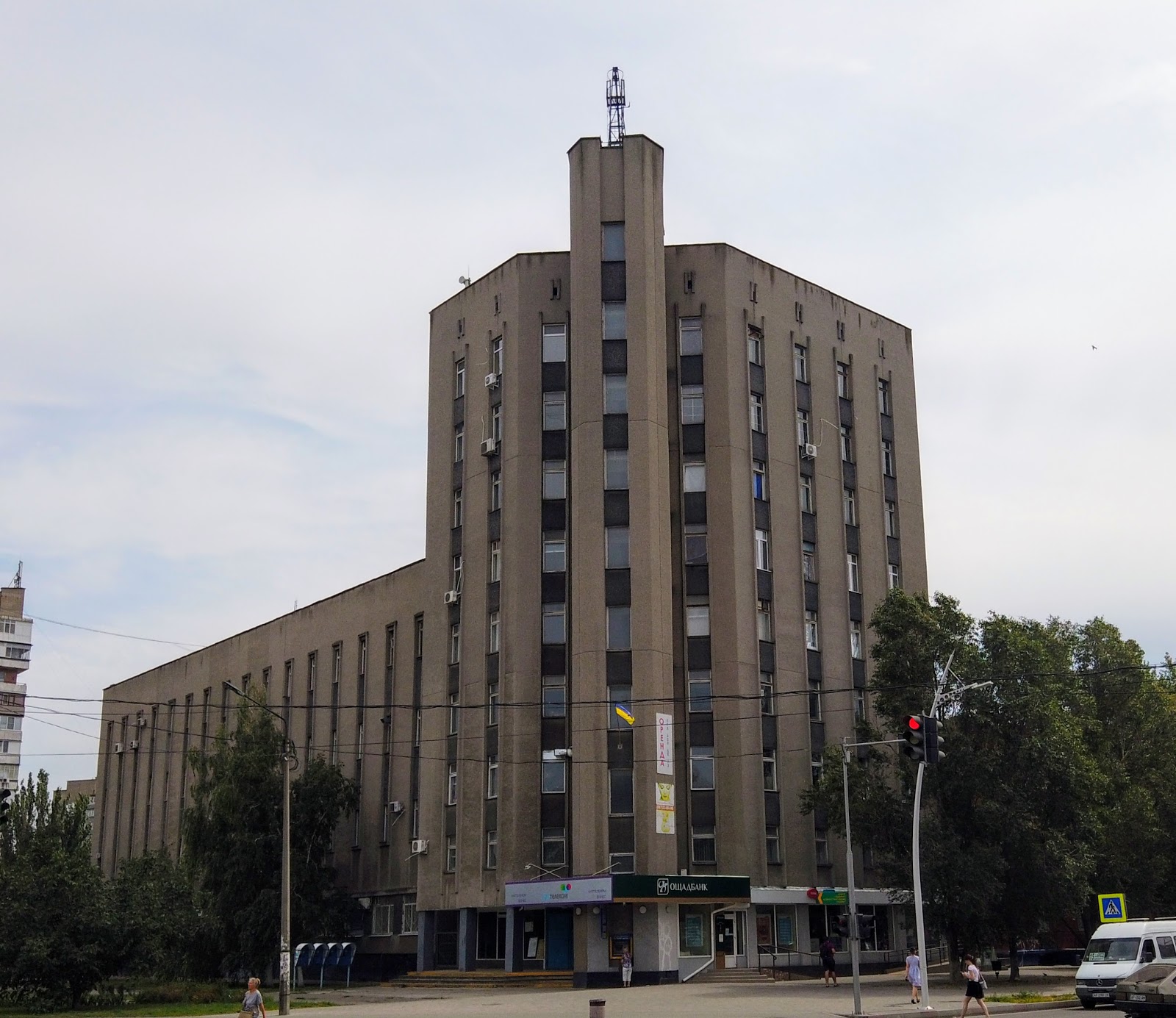
| Bohdan Khmelnytskyi Avenue, 15. Ukrtelecom |
 |
| Bohdan Khmelnytskyi Avenue. The SBU |
Unfortunately, the brick buildings of the post-war period are disfigured by advertising and signboards.
Melitopol is not rich in architectural monuments; most of the pre-war buildings were destroyed and rebuilt. One of the most beautiful and oldest buildings, the house of the merchant Khristov from the end of the 19th century, is occupied by the "Passage" trading house. The external promotion of commercial establishments has disfigured the facade of this historic monument.
 |
| Bohdan Khmelnytskyi Avenue. The "Passage" trading house |
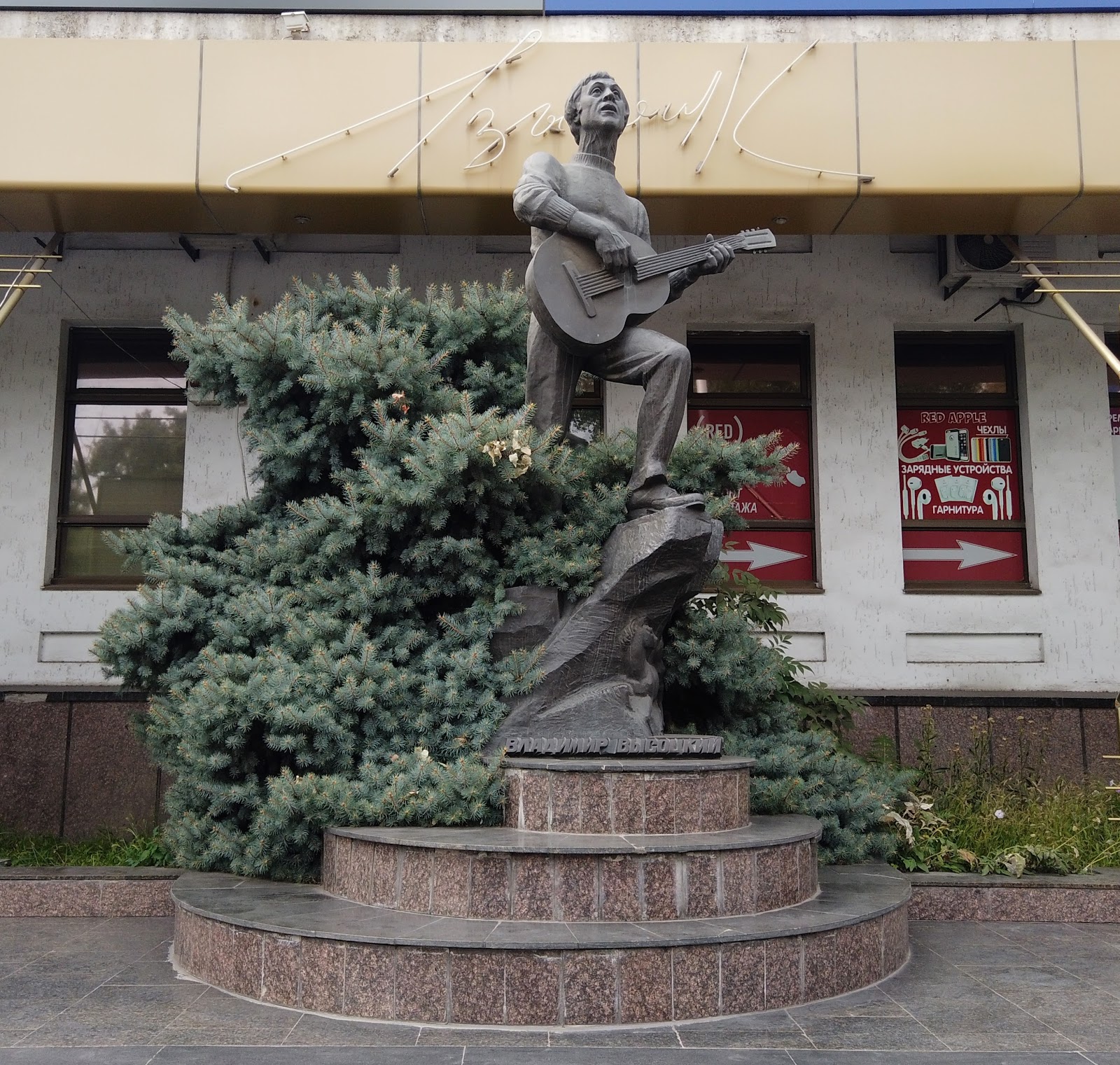
Against a backdrop of trade-lure advertisements stands the first monument in the CIS to the bard Vladimir Vysotsky, whose concert here in 1978 played to a full house.
 |
| Bohdan Khmelnytskyi Avenue. The monument to V. S. Vysotsky |
The avenue holds several educational institutions where one can obtain secondary vocational and higher education.
 |
| The main building of TDATU |
The Tavria State Agrotechnological University was founded in 1874 and is one of the leading educational institutions of south-eastern Ukraine. The main teaching building is decorated with columns, a capital, a portico and an original railing on the roof.
 |
| Bohdan Khmelnytskyi Avenue. The main building of TDATU |
By the entrance stands a monument to graduates of the university: the Hero of the Soviet Union M. S. Maliuha and the innovative agricultural-firm director, Hero of Ukraine D. K. Motornyi.
 |
| Bohdan Khmelnytskyi Avenue. Busts of D. K. Motornyi and M. S. Maliuha |
The ten-storey Block No. 2 was put into service in the 1980s. The mosaic panel on a professional theme has been disfigured by aerosol frescoes.
 |
| Bohdan Khmelnytskyi Avenue. Block No. 2 of TDATU |
A specialist's diploma in hydro-reclamation and the mechanisation of agriculture is obtained at the technical college at 44 Khmelnytskyi Avenue.
 |
| Bohdan Khmelnytskyi Avenue, 44. The technical college of hydro-reclamation and the mechanisation of agriculture |
The most active part in the town's cultural life is taken by students of the Melitopol College of Culture, which since 1930 has trained musicians, choreographers, masters of decorative and applied art, and librarians.
 |
| Bohdan Khmelnytskyi Avenue, 41. A sculpture by the College of Culture |
 |
| Bohdan Khmelnytskyi Avenue, 41. The College of Culture |
On the grounds of city clinical hospital No. 1, the former zemstvo hospital founded by Doctor Andrii Korvatskyi, the old buildings of the medical departments have been preserved.
 |
| Bohdan Khmelnytskyi Avenue, 46. Hospital No. 1. The blood transfusion station |
 |
| Bohdan Khmelnytskyi Avenue, 46. Hospital No. 1. The admissions department |
 |
| Bohdan Khmelnytskyi Avenue, 46. Hospital No. 1. The surgical department |
 |
| Bohdan Khmelnytskyi Avenue, 46. Hospital No. 1. The laboratory |
 |
| Bohdan Khmelnytskyi Avenue, 46. Hospital No. 1. A closed department |
 |
| Bohdan Khmelnytskyi Avenue, 46. Hospital No. 1. Bricked-up windows |
On the pedestal of the monument to the surgeon who opened the first city hospital, his services are noted as a researcher of the healing properties of water, a founder of horticulture and a pioneer of planting sweet cherries on the sands of the Melitopol area. The monument to Andrii Vasyliovych Korvatskyi stands not on the hospital grounds but by the College of Culture.
 |
| The monument to Andrii Vasyliovych Korvatskyi, founder of the first city hospital |
The chapel, dating from 1903, was used in Soviet times to store medical instruments. After its restoration in 2000, the prayer house was returned to believers.
 |
| The hospital grounds. The Chapel of St. Luke of Crimea. 1903. |
Beyond the hospital fence begins Melitopol's main park, created in the 1920s. This green oasis has the status of a monument of landscape-garden architecture and bears the name of Maxim Gorky. The writer of the working people has nothing to do with the town, but a golden bas-relief of the stormy petrel of the world revolution is mounted on a stela by the park entrance.
 |
| Gorky Park. The signpost and the stela with the bas-relief of Maxim Gorky |
Sculptural depictions of the classics of Ukrainian and Russian literature have formed an avenue of the writers' brotherhood.
 |
| The Sun of Russian poetry beside an inflatable attraction |
 |
| The prophets — M. V. Gogol and T. H. Shevchenko |
 |
| The iconic Soviet poet V. V. Mayakovsky |
 |
| The Stonemason, I. Ya. Franko |
The park was created to a design by the chief forester of the Starobediansk forestry, Ivan Alekseiev, whose memory the people of Melitopol preserve in the name of the street named after him and in kind words on a memorial plaque.
 |
| Gorky Park. The memorial plaque in honour of the park's founder, I. O. Alekseiev |
In the largest man-made green expanse in the town, the rides operate and conditions have been created for residents to relax.
In the north-western part of the park stands gymnasium No. 10, which occupies the building of the former children's railway station built in 1937.
 |
| Ivana Alekseieva Street, 3. Gymnasium No. 10 |
Another favourite place to spend free time is Victory Square, which borders Khmelnytskyi Avenue.
 |
| Victory Square |
By the sculpture of the national poet, rallies and poetry events are held.
 |
| Victory Square. The monument to T. H. Shevchenko |
The town's largest palace of culture bears the name of Taras Shevchenko.
 |
| Victory Square. The T. H. Shevchenko Palace of Culture |
The mosaic on the facade of this cultural hub is in need of restoration.
 |
| The T. H. Shevchenko Palace of Culture. The mosaic panel |
After reconstruction the square has blossomed with the variety of its paving tiles and the diversity of its rose bushes.
The working fountain and the renovated arch were a pleasant sight.
 |
| Victory Square. The arch |
Repair work is under way on the stairs leading to Chernyshevskoho Street.
With no hope of restoration, the production buildings of the bankrupt distillery are falling into ruin on Monastyrska Street, 1a, adjoining the avenue. Once one of the main sources of the town budget, it produced high-quality goods, a variety of soft drinks and spirit for the front; now this ghost of a plant in the town centre attracts only lovers of abandoned buildings.
 |
| Monastyrska Street, 1a. The abandoned production buildings of the distillery |
In the south of this street, in 1995, the first Orthodox monastery in the Melitopol and Zaporizhzhia eparchy was opened, in honour of St. Sabbas the Sanctified.
 |
| Monastyrska Street, 45. The Monastery of St. Sabbas the Sanctified |
The cloister was founded on the site of an old, neglected cemetery church. In time the brotherhood and the faithful grew, and the need arose to build a new prayer house. Around the old church a new one with three altars was raised; on the monastery grounds appeared the brothers' quarters, a baptistery, a refectory, a hotel, and the Church of the Presentation of the Most Holy Mother of God.
 |
| The Monastery of St. Sabbas the Sanctified. The Church of the Icon of the Mother of God "Behold My Humility" |
The Church of the Transfiguration of the Lord and new brothers' quarters are being prepared for consecration.
 |
| The Monastery of St. Sabbas the Sanctified. The Church of the Transfiguration of the Lord |
At the monastery there operate a narcological rehabilitation centre, a Sunday school, a gym and an icon-painting workshop.
 |
| The Monastery of St. Sabbas the Sanctified. The administrative building, the library |
 |
| The Monastery of St. Sabbas the Sanctified. The hotel, the Sunday school |
That is all I managed to see in 2 hours in the town where the European routes cross. It remains to thank the people of Melitopol for their hospitality, the gifts of their orchards and their tasty bread. I would like to wish the cherry capital of Ukraine goodness, peace, prosperity and high harvests.






No comments:
Post a Comment
Leave your impression