The tourist sites of Brailiv are among the winners of the regional contest 'The 7 Wonders of the Vinnytsia Region'. I arrived by suburban train at this small settlement, located forty kilometres from Vinnytsia and seven from the junction station of Zhmerynka. The railway in these parts was laid at state expense — and colossal super-profits were made from it — by the railway magnate Karl von Meck. The financial tycoon acquired the town in 1867, owned a brick factory and a sugar factory here, did not stint, and built in Brailiv a snow-white palace in which his enterprising wife, the mother of 18 children, unfolded her patronage of the arts.
 |
| Brailiv. The palace of Nadezhda von Meck. Brailiv Vocational Lyceum |
The aristocratic chambers that connected the patroness of the arts with the composer Pyotr Tchaikovsky lie in a spot far from the noisy railway line, just as the millionairess wished. On the way to the palazzo, let us look at the other historical and architectural landmarks concentrated in the eastern part of the settlement, and they are better reached not from the Brailiv station but from the Kozachivka railway platform.
Beyond a maize field a panorama of Brailiv opens up, and from the location of the churches, whose domes rise above the buildings, a preliminary route for the future excursion takes shape.
An asphalt road with a descent to the river leads to the settlement, and the distance to the bridge is two kilometres.
 |
| The bridge over the Riv River |
People have settled since ancient times on the banks of the Riv River, which flows through the settlement in a winding ribbon from west to east. From the name of the left tributary the Braha, which flows into the Riv near Brailiv, the name of the 15th-century settlement was born.
 |
| The Riv River. The Holy Trinity Roman Catholic church |
In the Middle Ages the lands were claimed by Turkish troops and by the Polish-Lithuanian Commonwealth. In 1635 the Bratslav Voivodeship founded a women's monastery on the bank of the river.
 |
| The Riv River. The Holy Trinity Monastery |
In 1767, during the period of the might of the monastic Trinitarian order, Polish magnates erected a majestic church with a bell tower in the Baroque style.
A quadrangle of monastic buildings is attached to the church.
With the arrival of the power of the Russian Empire in Podillia, the monastery became Orthodox.
 |
| Holy Trinity Monastery. Well and pump room |
 |
| Holy Trinity Monastery. Gate of the 19th century. Architectural monument |
The Bolshevik authorities closed the Holy Trinity Monastery, and a dance floor was set up in the church, with a shooting gallery in the altar. A vocational school and a tourist base occupied the premises of the place of prayer. With the return of the shrine to believers in 1989, spiritual life returned to the monastery.
 |
| Holy Trinity Monastery. Church grounds |
 |
| Holy Trinity Monastery. Vegetable garden |
The Catholic church, built in 1879 — by one account on the site of an old castle — has also been restored after being forgotten.
By the entrance to the Holy Trinity Roman Catholic church, outwardly resembling a town hall in the towns of Galicia, sculptures of saints are set.
 |
| Holy Trinity Roman Catholic church. Sculptures of the holy apostles Peter and Paul |
 |
| Holy Trinity Roman Catholic church. Sculptures of saints |
The juice-and-fruit-drink factory, which in the period of its fruity heyday occupied the neighbouring premises of the church, is itself now at the stage of bankruptcy and ruin.
The Orthodox Sts Peter and Paul Church was built in the 19th century, and a parish school was opened at it. Despite its status as an architectural monument, the church underwent an unsuccessful restoration, with the addition of a gilded bell tower and the replacement of the windows with plastic ones.
 |
| Sts Peter and Paul Church |
At the end of Monastyrska Street, on which several religious buildings are located, a cemetery chapel has been restored. In the cemetery, to the left of the chapel are the burials of Catholics, to the right — of the Orthodox.
To see another Orthodox church, consecrated in honour of St. John the Theologian, I had to walk along narrow crooked lanes parallel to the bed of the Riv River and through neglected homesteads.
 |
| The road to Moskalivka |
The church was opened in the 19th century. Like the other sacred buildings in Brailiv, it is tightly surrounded by residential buildings. Stone masonry is combined with brick. The building is framed with a brick ornament of two shades, and the window reveals are done in the same technique. The church is crowned with a gilded dome in the shape of an umbrella, while the built-in bell tower has a tented finish, which gives the structure a special individuality.
 |
| Moskalivka. Church of St. John the Theologian. 19th century |
The centre of the settlement is its numerous little shops, a post office, a market and the settlement council.
Among the buildings of the Soviet period, Jewish houses, former hotels and trading stalls have been preserved.
 |
| Monastyrska Street. A former Jewish house. A shop. |
The Jewish school has not lost its educational purpose; a creativity house for schoolchildren and youth has been housed within its walls.
There is no Jewish community in the settlement; the buildings of the synagogue and the Talmud Torah have been turned into the service premises of the 'Brailivchanka' garment factory.
The enterprise opened in 1937, works on customer-supplied raw materials, and cannot be called competitive.
Once, in the 'Druzhba' cinema, the factory workers enjoyed the masterpieces of world and Soviet cinema. The sign has vanished, there are no posters, and this hearth of culture looks ascetically restrained.
Around Brailiv are spread green expanses of forest and the 'Volodymyrska Dubyna' landscape reserve, with cliffs and springs of drinking water.
In the settlement, small green zones with war memorials and memorial signs have been created.
 |
| Public garden. Memorial cross to a Cossack company |
The young saplings in the public garden, laid out in honour of the fellow-countryman poet Volodymyr Zabashtansky, are still only gathering strength.
It is important not only to plant the birches for the sake of a planned solemn date, but also to see that the plants develop and become mighty trees, like those in the estate park of Nadezhda von Meck.
The wife of the capitalist who built more than 14,000 kilometres of railway in Russia was renowned for her patronage of impoverished talents. The compassionate patroness corresponded with P. I. Tchaikovsky for 14 years; 1,200 letters in all were written, and they are all filled with care and concern for the genius of music. So that the author of the musical works would not burden himself with teaching but concentrate exclusively on creativity, the patroness of the arts invited him to the estate, created ideal conditions for living and working, and fulfilled all his wishes.
In 1878-1880 Pyotr Ilyich repeatedly stayed in Brailiv, wrote works to commission, shared his plans and impressions in letters, and received rewards, but never once met his benefactress.
At the estate the author of world masterpieces wrote the opera 'The Maid of Orleans', pieces for violin and 7 romances. In this period, when the composer and conductor was inspired by the Podillia landscapes, the opera 'Eugene Onegin' and other wonderful works were created.
 |
| The estate of Nadezhda von Meck. Memorial plaque in honour of P. I. Tchaikovsky |
In memory of the unusual friendship of Nadezhda von Meck and P. I. Tchaikovsky and of the composer's stay in Brailiv, a museum was created in 1979 by the teachers of the lyceum that occupies the greater part of the palace. In four halls are presented scores, lifetime editions of the classic, musical instruments, furniture and memorial items. Entry to the museum without a guided tour is 10 hryvnias, photography 30 hryvnias.
It is known that in the palace the French impressionist composer Claude Debussy taught music to the large family; Nadezhda von Meck called him 'the dear little Frenchman' and withdrew her patronage because of the foreigner's frivolous infatuation with one of her daughters.
From the 1930s the aristocratic residence was occupied by an auto-and-tractor school. Now it is a vocational lyceum where fitters, drivers and electricians learn their trades.
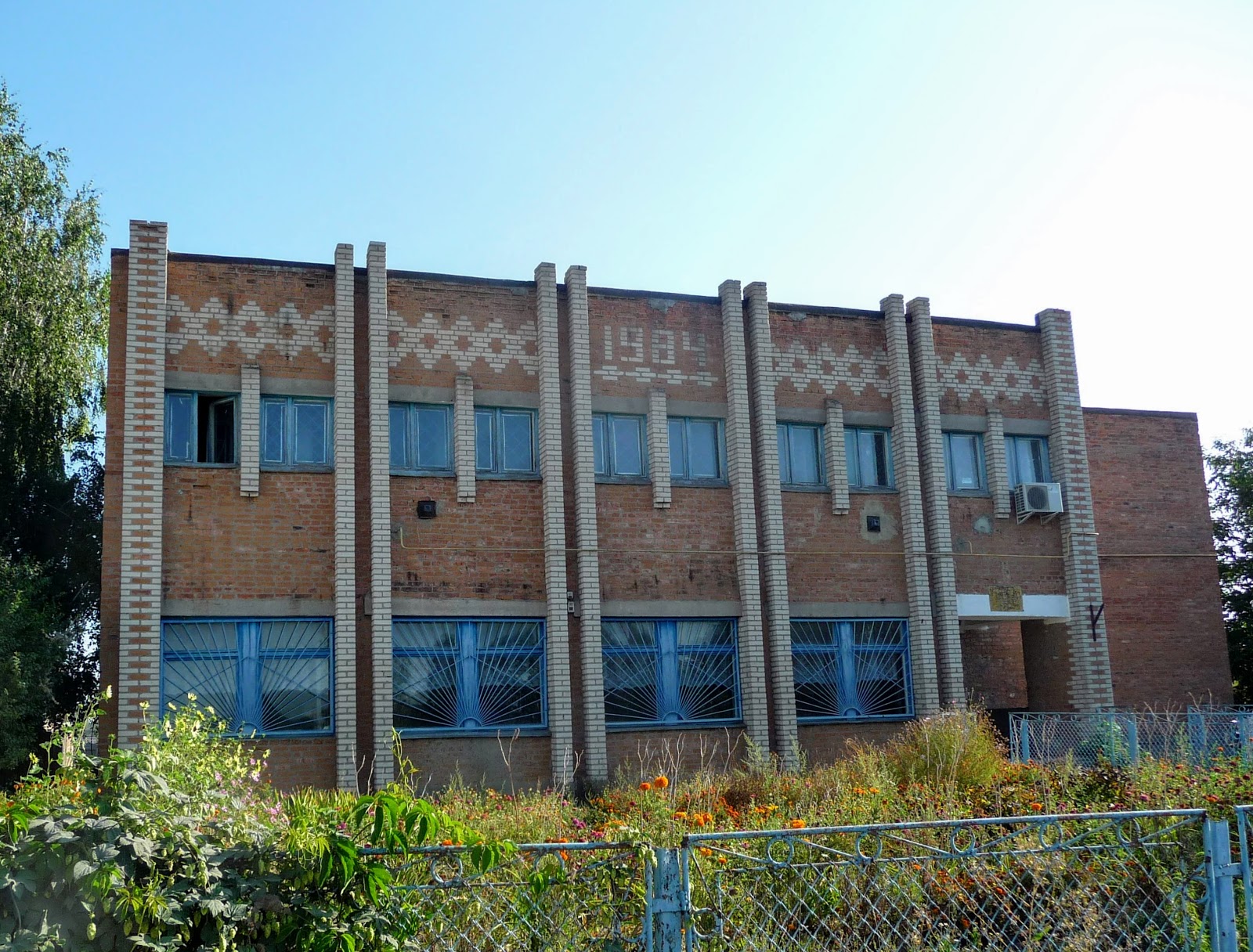
For the teachers, a two-storey residential building was built in 1936. It is a pity that, along with the symbols of socialist labour, the figures of the building's construction date were also knocked off.
 |
| The estate of Nadezhda von Meck. Building for the lyceum teachers. 1936 |
To this day, the entrance gate and a granite bridge with an openwork railing over the lake, created in the 19th century by the enterprising mistress, have survived.
The picturesque pond needs to be cleared out.
The entrance to the old park is open; newlyweds are sure to visit it to video-record their wedding ceremony. Unfortunately, some relict trees are sick and drying up, and they have to be cut down.
At the exit from the estate, across the road, stands a school. In one of the teaching buildings, in 2008, the literary-memorial museum of V. O. Zabashtansky, a Ukrainian poet and translator, was opened. In the schoolyard a monument to the man of letters has been set up, and on the facade of the museum there is a memorial plaque with a bas-relief of Volodymyr Omelianovych.
 |
| Schoolyard. Monument to V. O. Zabashtansky |
 |
| Literary-memorial museum of V. O. Zabashtansky. Memorial plaque and bas-relief of the poet |
A native of Brailiv, in his young years he worked in the Donbas and, as a result of an industrial accident, lost his sight and both hands. Zabashtansky devoted his life to poetry and was awarded the Shevchenko Prize. On the fellow-countryman's birthday, the settlement holds the literary festival 'The Poetic Autumn of Volodymyr Zabashtansky', with the awarding of a prize named after him to young talents that have been discovered. Unfortunately, I could not put a few questions to the keepers of the museum's treasures. During working hours the museum staff turned out not to be at their workplace. The outer door was open and the inner one closed, so the photo was taken through the glass.
No explanatory note, along the lines of 'Back in 15 minutes', and no phone number of the museum curator was to be found. In the neighbouring shop they told me that a mother and daughter work there. Whom do museums exist for, if even a rare visitor is not awaited in one?
The climb to the 'Kozachivka' stopping point took 35 minutes, given the hot day.
The suburban train Koziatyn-Zhmerynka and back runs several times a day. The bus from Vinnytsia and back runs at intervals of 1.5-2 hours, 7 times a day. To the district centre of Zhmerynka a bus goes every hour.
Coordinates of the von Meck estate: 49°6'8"N 28°10'12"E






No comments:
Post a Comment
Leave your impression