Like rays from the sun, the streets of Myropillia radiate out from the market square, where weekly fairs once bustled. Each street ended in a church. After the revolution, nationalisation, dekulakisation, Bolshevik reforms and the destruction of the spiritual heritage, the town turned into a village with a considerable decline in population. The only church that survived the upheavals of the 20th century is St. Nicholas Church in the Studenok suburb on Sumska Street.
Myropillia. Sumy region. St. Nicholas Church. 1885
The majestic building is visible for several kilometres all around.
Sumska Street. St. Nicholas Church. 1885
The chronicles testify that a church already stood on this spot in the middle of the 17th century, from the time Myropillia was founded by settlers from a town of the same name in Volhynia. The wooden chapel burned down, as did most such buildings at that time. The new church, erected in 1885, was consecrated, like its predecessor, in honour of St. Nicholas.
In the 1930s, during the period of the mass liquidation of Orthodox shrines, there were plans to blow up the church, but the executors of these barbaric instructions managed to destroy only the northern (left) side chapel.
The restored left side chapel
Old-timers recall that the building was saved by the chairman of the collective farm, who used the premises to store grain. The communist rulers had not provided storehouses to shelter the harvest, and the place of prayer turned into a warehouse.
Graves of priests and a memorial sign to the residents who suffered in the years of hardship
The church had a large courtyard; now the shrine is tightly surrounded by residential buildings.
It is difficult to establish who was the architect and the builders of this unique structure, but the high skill of the 19th-century builders is worth noting.
Over its 130-year history and the upheavals connected with it, the building's foundation and the surviving walls have kept their integrity.
The church is of stone, three-altared, plastered, cross-shaped in plan and joined with the bell tower.
The arms of the cross on the north and south have semicircular projections.
Three entrances are located on the western side — through the bell tower and the arms of the cross. The arched window openings stand out from the plane of the wall thanks to brick framing.
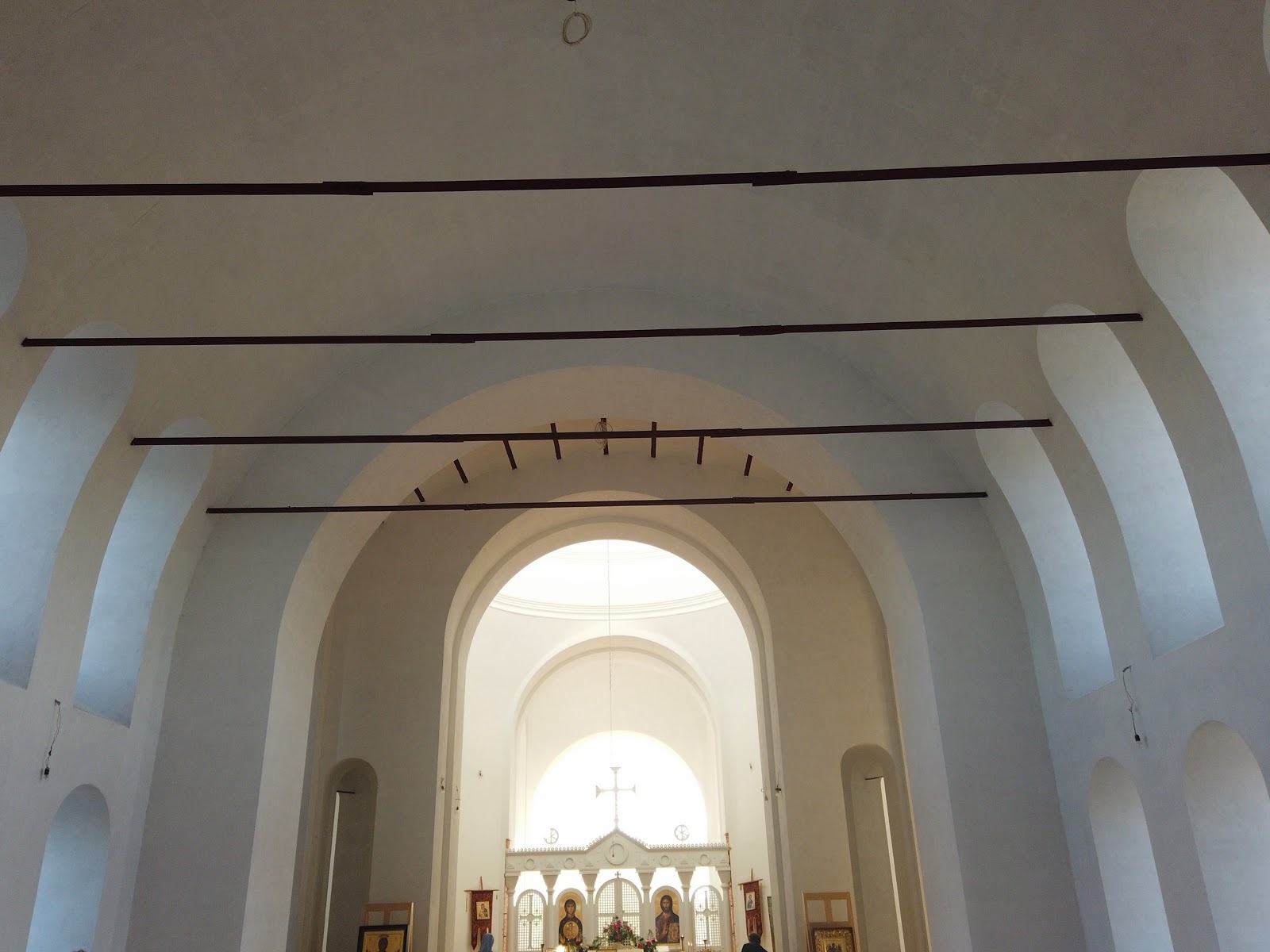
The ceilings are arches with metal beams.
A special majesty is given to the building by the fifty-metre bell tower, the tallest in the Sumy eparchy.
Five tiers, decreasing in volume and in height, are crowned with a dome. The first tier on three sides, and the second on four, are decorated with two pairs of columns each and porticoes. The third and fourth tiers are decorated with pilasters.
Bell tower. Internal staircase
In the 1990s, through the efforts of the community and with the help of donors, the revival of the shrine began.
For the spiritual needs of the villagers during the restoration of the church, a warm church was built in 1997 in the name of the icon of the Mother of God 'Joy of All Who Sorrow'.
Church in the name of the icon of the Mother of God 'Joy of All Who Sorrow'. 1997
St. Nicholas Church is distinguished by its large size, and the restoration of the voluminous structure took 20 years.
St. Nicholas Church
The northern side altar has been completely rebuilt and the roof repaired.
The walls have been plastered and whitewashed.
There was no floor; now it is covered with parquet boards over an area of 1,000 square metres.
Through the efforts of the parishioners, the monastery yard has filled with the ringing of bells.
One of the bells was purchased with his own funds by the superior of the St. Nicholas monastery, Archimandrite Smaragd.
At the St. Nicholas episcopal monastery compound, a school of bell-ringers has been organised, and festivals of masters of the bell-ringing art are held, to which participants come from other regions. Guests who arrived from China admired the high skill of the bell-ringers.
A Sunday school for children and adults has opened at the monastery. Those who wish can attend a chess club and a foreign-languages circle, and a library of spiritual literature has been assembled.
The monastery grounds are gradually being put in order; an entrance gate has been built, and decorative plants and flowers are being planted.
The residents grow vegetables in the monastery garden, and part of the harvest is sent to the Sumy Theological Seminary. From the grown produce, the cook Maria prepares tasty dishes in the refectory, with which pilgrims are sure to be treated.
View of the warm church, the monastery courtyard and the refectory
The believers and the brethren of the monastery compound will still have much to do in the process of repair and restoration work. The community is not so large; in all of Myropillia there are just over 2,000 residents. The village is remote from the regional centre, and the parishioners do not have the means to complete the repair and arrangement of the monastery.
It is necessary to acquire an iconostasis, icon lamps and other church utensils.
In the century before last, Myropillia merchants and enterprising traders built eight churches in Myropillia. Perhaps modern businessmen, the owners of shopping centres, will recall the spiritual traditions of their predecessors in the trade and pay attention to this miraculously preserved monument of history and architecture, which needs the support of patrons and benefactors.
You can reach the monastery by bus from the central bus station of Sumy. The first departure is at 4.45. From Myropillia to the regional centre, buses run every hour or hour and a half.




No comments:
Post a Comment
Leave your impression