Why do trips to not very popular tourist places attract travellers more and more? In little-known corners there are as yet no artificially created spectacular attractions, no distracting stage sets to tangle the tourist in their nets. In Kramatorsk, connoisseurs of architecture will find much of interest in the town's cultural heritage of the interwar period and in the post-war "Stalin-era" blocks, and will see some historical monuments that appeared with the industrial rise of this administrative centre of Donetsk region.
 |
| Kramatorsk. Donetsk region |
Any town begins with its railway station. From the Kramatorsk station, opened in 1868, trains run to
Kyiv,
Ivano-Frankivsk, Odesa, Kharkiv. The facades of the station building of 1952 are adorned with bas-reliefs bearing railway symbols and with street clocks that remind you how fleeting time is.
 |
| Kramatorsk. The railway station. 1952 |
From the Station Square the roads open into the historic centre of the town.
 |
| Kramatorsk. Shkilna St., 2. 1955 |
 |
| Kramatorsk. Shkilna St., 1. 1938 |
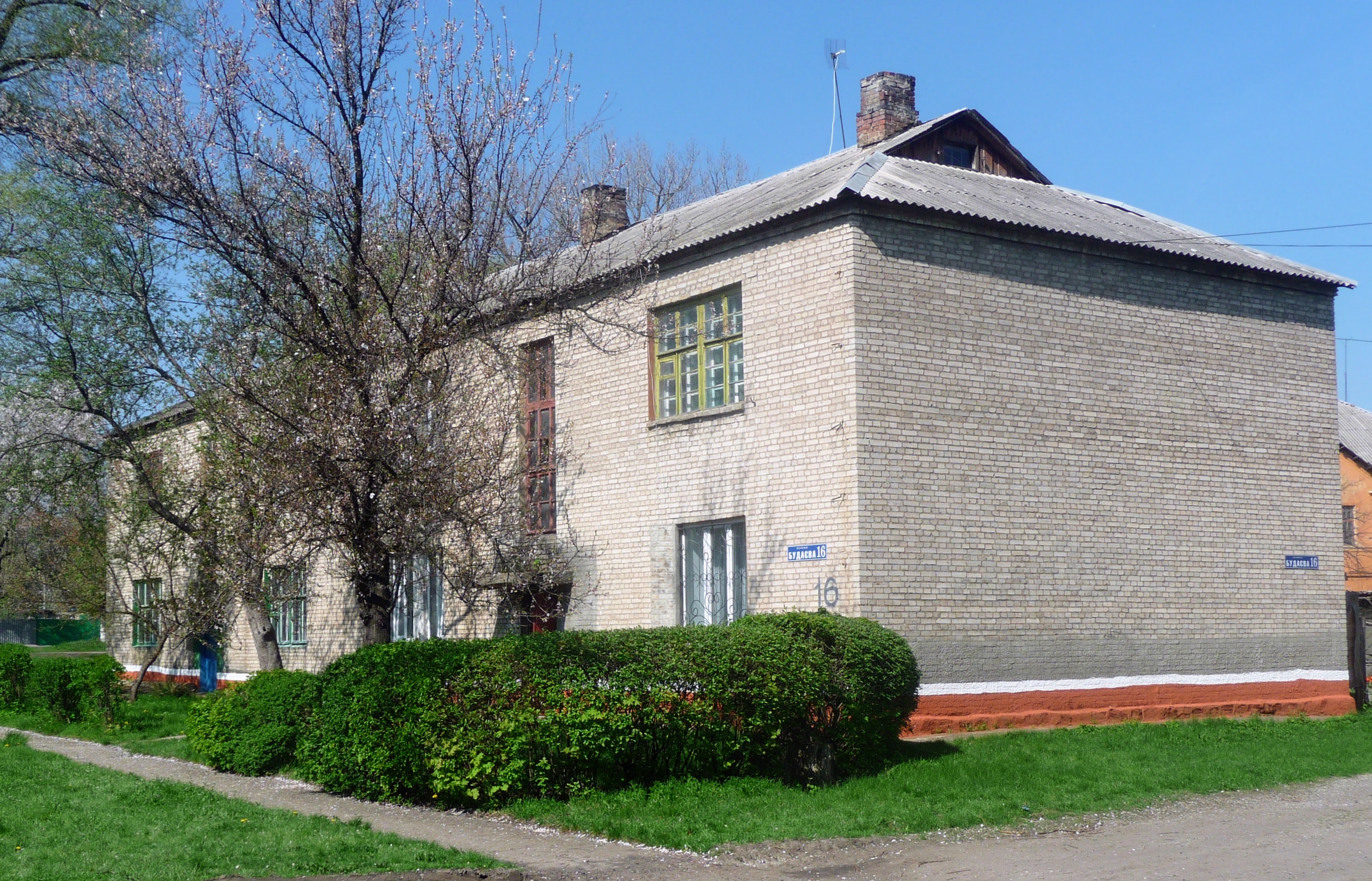
On Shkilna Street, part of the Dobropillia-Lyman motor road, and on Triumfalna Street, the residential development of the 1930s-1950s is on display.
 |
| Triumfalna St., 3. 1951 |
 |
| Kramatorsk. A branch of school No. 6 |
School No. 11 opened its doors in 1935, and at first only girls studied in it.
 |
| Kramatorsk. Triumfalna St., 9. School No. 11. 1935 |
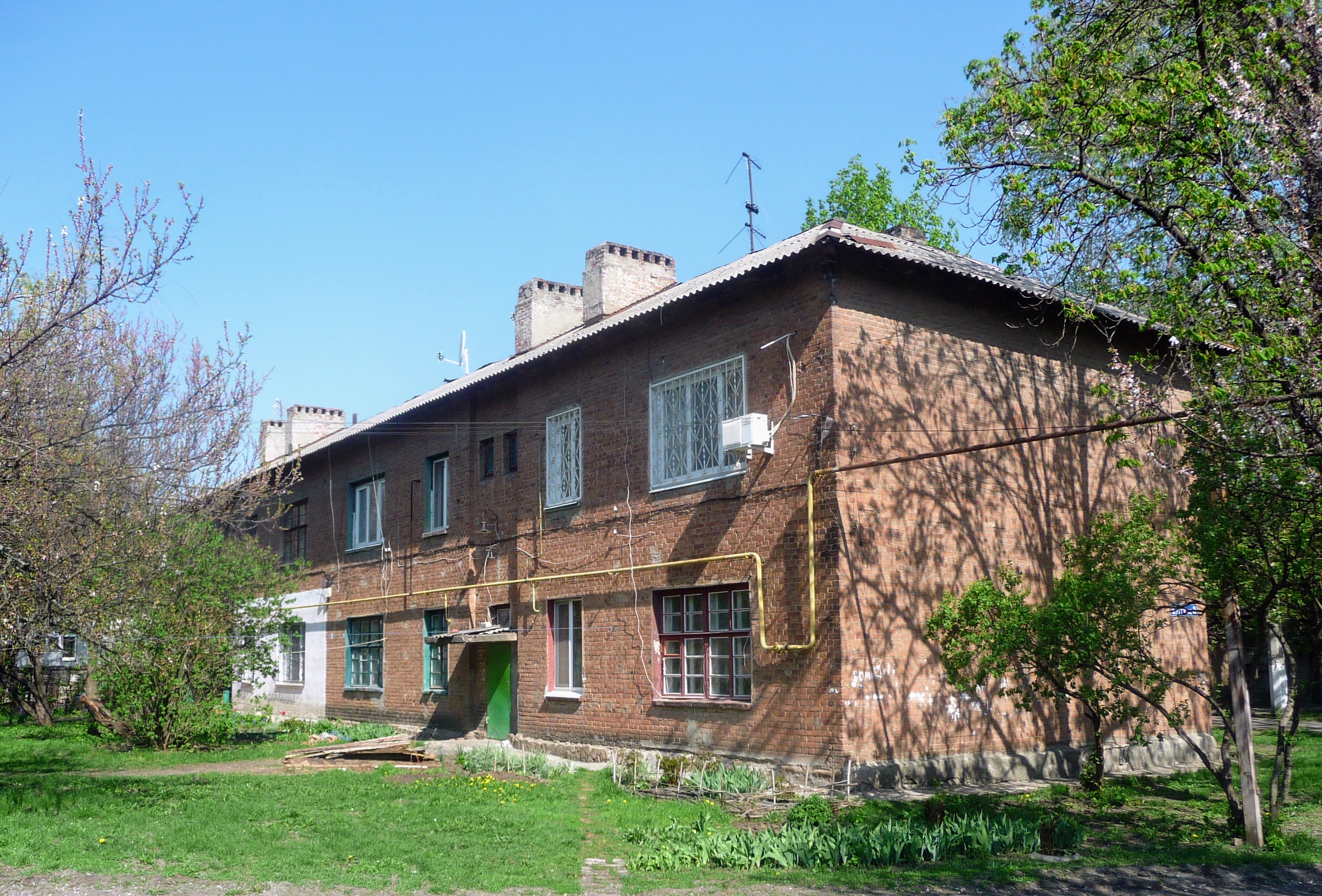
In Kramatorsk the Stalin-era blocks are non-standard and have their own peculiarities, but the unusual private villas deserve attention as well. One of the most notable sights of Kramatorsk is the former villa in which Emil Protze, head of the commercial department of the KMO works, lived. Later the building housed the NKVD, the Gestapo, the passport office and, from 1963, a militia/police station.
 |
| Kramatorsk. The Protze villa. Early 20th century |
In Tykhyi Lane rises the so-called house-observatory. In 1926 a home was built for the Kramatorsk doctor Volodymyr Lenkevych, who was keen on astronomy and watched the heavenly bodies from its tower.
 |
| Kramatorsk. The house-observatory. 1926 |
The palace of culture bears the name of the famous local son Leonid Bykov, who began his artistic career here.
 |
| Kramatorsk. The Leonid Bykov House of Culture. 1944-1946, 1954 |
The talented director and actor finished school No. 6, which opened in 1936 on Velyka Sadova Street.
 |
| Kramatorsk. School No. 6. 1936 |
On the corner where Velyka Sadova meets Metalurhiv Avenue stands a building put up in 1939 in the constructivist style. It is called the "American" one because American specialists supposedly lived in it.
 |
| Kramatorsk. Velyka Sadova St., 73/2. 1939 |
The Soviet avant-garde style is shown by the buildings of the 1920s on Metalurhiv Avenue and on the streets that cross it.
 |
| Metalurhiv Ave., 18 |
 |
| Metalurhiv Ave., 16 |
 |
| Metalurhiv Ave., 9 |
 |
| Hanny Tyshchenko St., 14 |
 |
| Hanny Tyshchenko St., 15. The former girls' school, later school No. 4. 1928 |
 |
| Sportyvna St., 14 |
 |
| Metalurhiv Ave., 5 |
 |
| Mykoly Dereviatnyka St., 2 |
 |
| Metalurhiv Ave., 8. 1923 |
 |
| Kramatorsk. The residential development of the Old Town |
On some of the buildings the old little number plates have survived.
 |
| Metalurhiv Ave., 20. The old house number |
The avenue ends in a public garden into which four more small streets run like rays.
 |
| Kramatorsk. The residential and public development of the Old Town |
The little star thus formed is framed in an arc by Raiduzhna Street with its two-storey buildings and blooming front gardens.
 |
| Kramatorsk. The residential development of the Old Town |
On this street stands one of the oldest schools of Kramatorsk. Columns with capitals lend solemnity and grandeur to the building of 1930.
 |
| Kramatorsk. Raiduzhna St., 13. School No. 1. 1930 |
You can continue your education at the machine-building college situated nearby, opened in 1937. In the pre-war years this was the only technical educational establishment where cadres were forged for the town of machine builders.
 |
| Kramatorsk. The machine-building college. Velyka Sadova St. 1931 |
Between the temples of learning stands a Christian temple, the former Tsementnyk club with a lyre on its attic, built in 1955.
 |
| Kramatorsk. Dmytra Mazura St. The former club of the cement works. 1955 |
To get across to the Church of the Intercession, you have to cross Dmytra Mazura and Likarniana streets.
 |
| Kramatorsk. Dmytra Mazura St., 72 |
 |
| Kramatorsk. Likarniana St., 49 |
The old (western) part of the Orthodox church was erected in the post-war years. The construction was completed in 2008.
 |
| Kramatorsk. The Church of the Intercession of the Most Holy Mother of God. Likarniana St. |
At the beginning of Dmytra Mazura Street a two-storey stone house built in 1915 has survived. The premises that have clung on to the monument have spoiled the authenticity of the building.
 |
| Kramatorsk. The former library of the KMZ works. 1915 |
If you cross the railway at this spot, you can still see an abandoned two-storey house in which the famous blast-furnace engineer Mykhailo Kurako lived in 1902-1906.
 |
| Kramatorsk. The Kurako house |
In an even more pitiful state is the first block of flats in Kramatorsk, intended for railwaymen. It was built in 1880 with the funds of a joint-stock company headed by the Russian industrialist and patron S. I. Mamontov. That is why the building was called the "Mamontov house".
 |
| Kramatorsk. The ruins of the Mamontov house. 1880 |
From the overpass above the railway you can see the surviving production building of Kramatorsk's first industrial enterprise, a works producing lime and alabaster.
 |
| Kramatorsk. The former Sterzer works |
The former Lutheran kirche deserves more careful treatment. After 1923 the religious building housed a children's technical station, the Ukrainian Society of Hunters and Fishermen (UTMR) and a driving school.
 |
| Kramatorsk. Triumfalna St., 11. The former Lutheran kirche |
A more respectful attitude is needed by the historical monument at Sakhalinska Street, 10. In the former noble
nest of the Korshun family six children were born. One of them, Stepan Korshun, was a well-known hygienist and professor, a victim of Stalin's repressive policy.
 |
| Kramatorsk. Sakhalinska St., 10. The Korshun house |
There are as many as two such manors on the lists of the town's cultural heritage; the second,
the Bantysh house, is in Komyshuvakha.
 |
| Komyshuvakha. The Bantysh estate |
In the industrial town many green areas, parks and public gardens have been created.
 |
| Kramatorsk. The park in memory of the fallen soldiers. A little fountain in the shape of a squirrel |
The Bernatskyi Garden covering 55 hectares, was founded in 1913 and has an interesting cultural and sporting history.
 |
| Kramatorsk. The Bernatskyi Garden |
Of late, reconstruction has considerably changed the green areas and the main square of the town.
 |
| Kramatorsk. Myru Square |
On Myru Square stands a large public cultural centre, the NKMZ Palace of Culture and Technology.
 |
| Kramatorsk. The NKMZ Palace of Culture and Technology. 1950-1965 |
The Sotsmisto district has a planned ensemble development, beginning in 1929.
 |
| Kramatorsk. Marata St., 7. 1935 |
 |
| Kramatorsk. Marata St., 8. 1937 |
In 2019 the facades of the almost 90-year-old buildings were adorned with murals executed by foreign monumental artists. The renewed street was given the name
"the Street of Murals".  |
| Kramatorsk. Marata Street — the street of murals |
What else can you visit on arriving in the town on the Kazennyi Torets? I advise you to take a walk through the nature-reserve area of
the Kramatorskyi regional landscape park and to see the geological monuments with their outcrops of chalk rock, the pine plantations in the virgin steppe and the panorama of Kramatorsk from the heights of the Bilenke section.
 |
| The Kramatorskyi RLP |





No comments:
Post a Comment
Leave your impression