Bilhorod-Dnistrovskyi is famous for the largest and most ancient fortification in Ukraine —
the Akkerman Fortress. But the town has plenty of other notable landmarks too.
 |
| Bilhorod-Dnistrovskyi, Odesa region |
Bilhorod-Dnistrovskyi has its own history and architectural character, which took shape over the centuries. I began my acquaintance with the town after a tour of the fortress. At the start of Hretska Street, onto which I came out from the Kiliia Gate, stands one of the town's leading enterprises.
 |
| Bilhorod-Dnistrovskyi. Hretska Street |
The Belsta shoe factory turns out products that are in great demand.
For the enterprise's workers and for tourists, tasty pirozhki with a variety of fillings are sold for just 5 hryvnias apiece.
 |
| The Belsta factory. Pirozhki for the workers and tourists |
Behind the walls of the production buildings a venerable shrine nestles.
 |
| The Church of St John the Baptist. 14th c. |
Founded by the Greeks in the 13th-14th centuries, the Church of St John the Baptist was rebuilt at the end of the 14th century out of limestone.
 |
| The Church of St John the Baptist. 14th c. |
The small church rises on the steep bank of the estuary, on the site of an old, partly rock-cut cemetery.
 |
| The Church of St John the Baptist. 14th c. |
In the courtyard of the Greek church, in the 14th century, was buried the national saint and heavenly patron of the Principality of Moldavia, John of Suceava.
 |
| The chapel of St John of Suceava on the grounds of the Greek church |
The relics of the great martyr were reburied in Suceava (Romania), and a chapel was built on the site of the grave.
 |
| The chapel of St John of Suceava on the grounds of the Greek church |
Across the road, almost out of sight, stands the Greek church's contemporary — the Armenian church.
 |
| The Church of the Dormition of the Most Holy Mother of God (the Armenian Church). 14th c. |
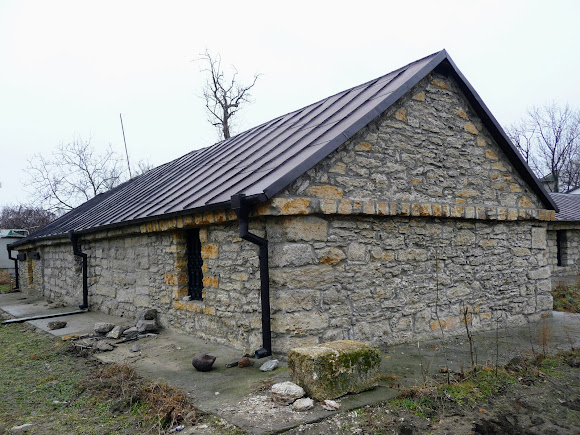
It is built in the shape of a cross and has a squat appearance, because in the Middle Ages, when the Golden Horde and the Turks held sway, Christian churches were not allowed to be built higher than the mosques.
 |
| The Church of the Dormition of the Most Holy Mother of God (the Armenian Church). 14th c. |
After the Second World War a museum was housed in the church building, and later an archaeological organisation.
 |
| The Church of the Dormition of the Most Holy Mother of God (the Armenian Church). 14th c. |
The building was turning into a ruin.
 |
| The Church of the Dormition of the Most Holy Mother of God (the Armenian Church). 14th c. |
Since 2013 the shrine has been under restoration.
 |
| The Church of the Dormition of the Most Holy Mother of God (the Armenian Church). 14th c. |
I asked a workman for permission to enter. They opened the wicket gate for me and let me go only onto the grounds of the church, where the archaeologists had placed a Sarmatian crypt, found in 1989 in a sand quarry and built in the 3rd century AD.
 |
| A Sarmatian crypt on the grounds of the Armenian church |
The stone slabs of dressed limestone are set on edge without mortar and covered with two more in the form of a gable roof. The structure resembles a house of cards. An altar was discovered beside it, which is now kept in the local history museum.
 |
| A Sarmatian crypt on the grounds of the Armenian church |
One would wish that the restoration of the church not damage the ancient paintings and the inscriptions carved on the khachkars in the 10th century. Judging by the fact that the crypt has been stacked with roof tiles, as if it were a shed, the repair crew's attitude to the historical past cannot be called careful.
 |
| Kutuzova Street and the fence of the Armenian church |
The ancient Greeks founded the antique city of Tyras in the 7th century BC.
 |
| The shore of the estuary |
One era gave way to another, but in the times of the Roman, Ottoman and Russian empires, the Golden Horde and the Principality of Moldavia, the city was called the White one.
Its distinctive position on the bank of the Dniester estuary added the second part of the name, defining its location.
 |
| The shore of the estuary |
The siege of the fortress, wars and the change of masters did not favour the preservation of historical monuments.
 |
| Steps down to the estuary |
Many modern buildings are built on the foundations of their predecessors.
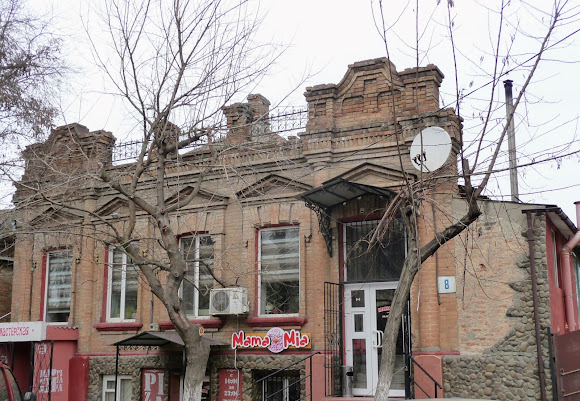 |
| 8 Moskovska Street. End of the 19th c. |
 |
| 64 Soborna Street |
 |
| 21 Hretska Street |
A characteristic feature of the town's block layout is that the streets radiate out from the Akkerman Fortress like rays.
For the most part they are lined with single-storey houses, some with second storeys built on top.
In a building constructed at the beginning of the 19th century, A. S. Pushkin stayed in 1821. He met the fortress commandant, Colonel Kurte, and his friend Raevsky.
 |
| The house where A. S. Pushkin stayed |
 |
| The house where A. S. Pushkin stayed. A memorial plaque in honour of the poet |
Mykhailivska Street, on which the mansion of the engineer Orban was built in 1936 in the neo-Romanesque style, was called 'the street of happiness'.
 |
| Mykhailivska Street — the Street of Happiness |
The now-empty premises served as both an exhibition hall and a medical centre. The fact that it is an architectural monument of local significance is marked nowhere, and passers-by could tell me nothing about it either.
 |
| Mykhailivska Street. The Orban mansion. An architectural monument. 1936 |
The former Harmsen mansion now houses the Centre for Children's Creativity.
 |
| The Harmsen mansion. An architectural monument. 1936 |
The plaque indicating its status as an architectural monument was removed during repairs, and the Centre's employee could not recall what had been written on it, nor the date of construction — 1936.
 |
| The Harmsen mansion. An architectural monument. 1936 |
Evidently, for the development of the children's creative abilities, a place was found beside the Centre for the rubbish bins.
 |
| The Harmsen mansion. An architectural monument. 1936 |
The treasury always gets the best historical buildings.
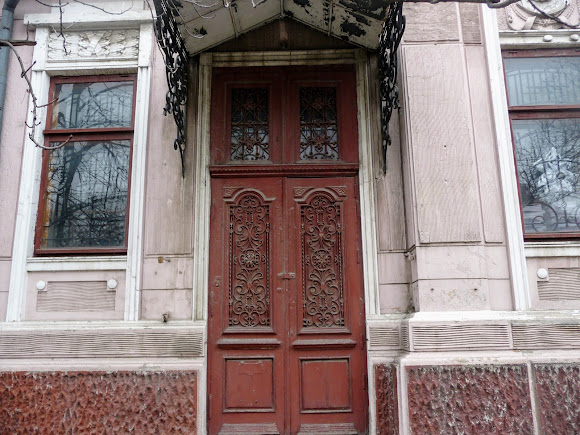 |
| The Treasury. An architectural monument |
 |
| The Treasury. An architectural monument |
The central library is located in the 19th-century Kogan house.
 |
| The library. An architectural monument. 19th c. |
A unique building, the mansion of the justice of the peace Yaroshevych, built in 1890, is in a dilapidated state.
 |
| The Yaroshevych mansion. An architectural monument. 1890 |
I wanted to find out more about it, but the people living nearby know nothing about the architectural monument.
 |
| The Yaroshevych mansion. An architectural monument. 1890 |
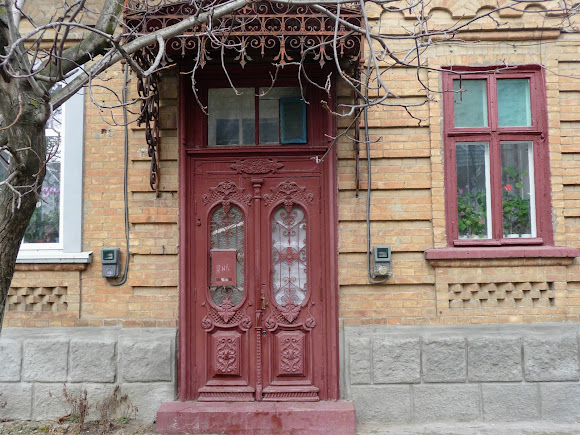
The residents of the merchant's house, however, kindly shared what information they had about their pre-revolutionary building, with its preserved oak doors and wrought-iron gates, and allowed me to photograph it.
 |
| A residential house on Pushkina Street |
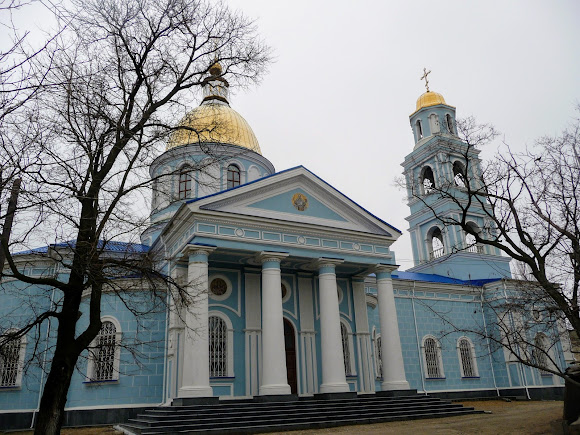
The Holy Ascension Cathedral rises in the very centre of the town.
 |
| The Holy Ascension Cathedral. 1832 |
The cathedral was erected in 1832 with the townspeople's donations, on the site of an old Turkish cemetery. Local residents brought the building stone over the course of 30 years.
 |
| The Holy Ascension Cathedral. 1832 |
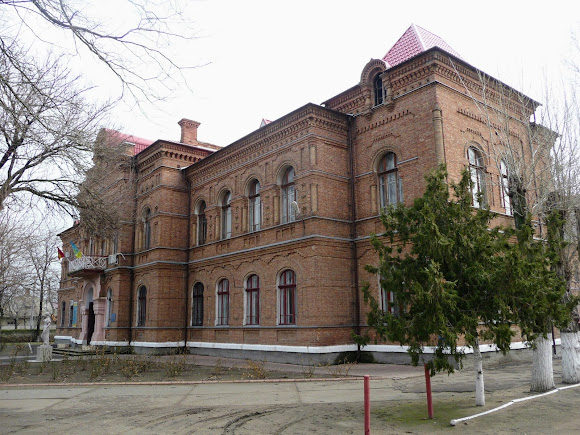
The most beautiful buildings are the creations of St Petersburg architects.
 |
| The pedagogical college. 1900. An architectural monument |
The former boys' gymnasium, erected in 1900, has not lost its educational direction, and future teachers study here even now.
 |
| The pedagogical college. 1900. An architectural monument |
 |
| The pedagogical college |
In the public garden with a fountain and sculptures, situated beside the pedagogical college, the trees have whimsical shapes.
 |
| The pedagogical college. The public garden |
The former zemstvo council, built at the turn of the 19th and 20th centuries, is the alma mater of agriculture students.
 |
| The former zemstvo council |
At the beginning of the 20th century the head of the zemstvo was Purishkevich, one of the organisers of the murder of Grigori Rasputin. During the Second World War the building housed the headquarters of the Romanian military. A bomb from a Soviet bomber destroyed the interior decoration, which could no longer be restored.
 |
| The former zemstvo council. The agricultural technical college. An architectural monument |
Beside the technical college is another mansion with a red tiled roof, but it stands empty and is being overgrown with wild grape.
 |
| A house on Pershotravneva Street |
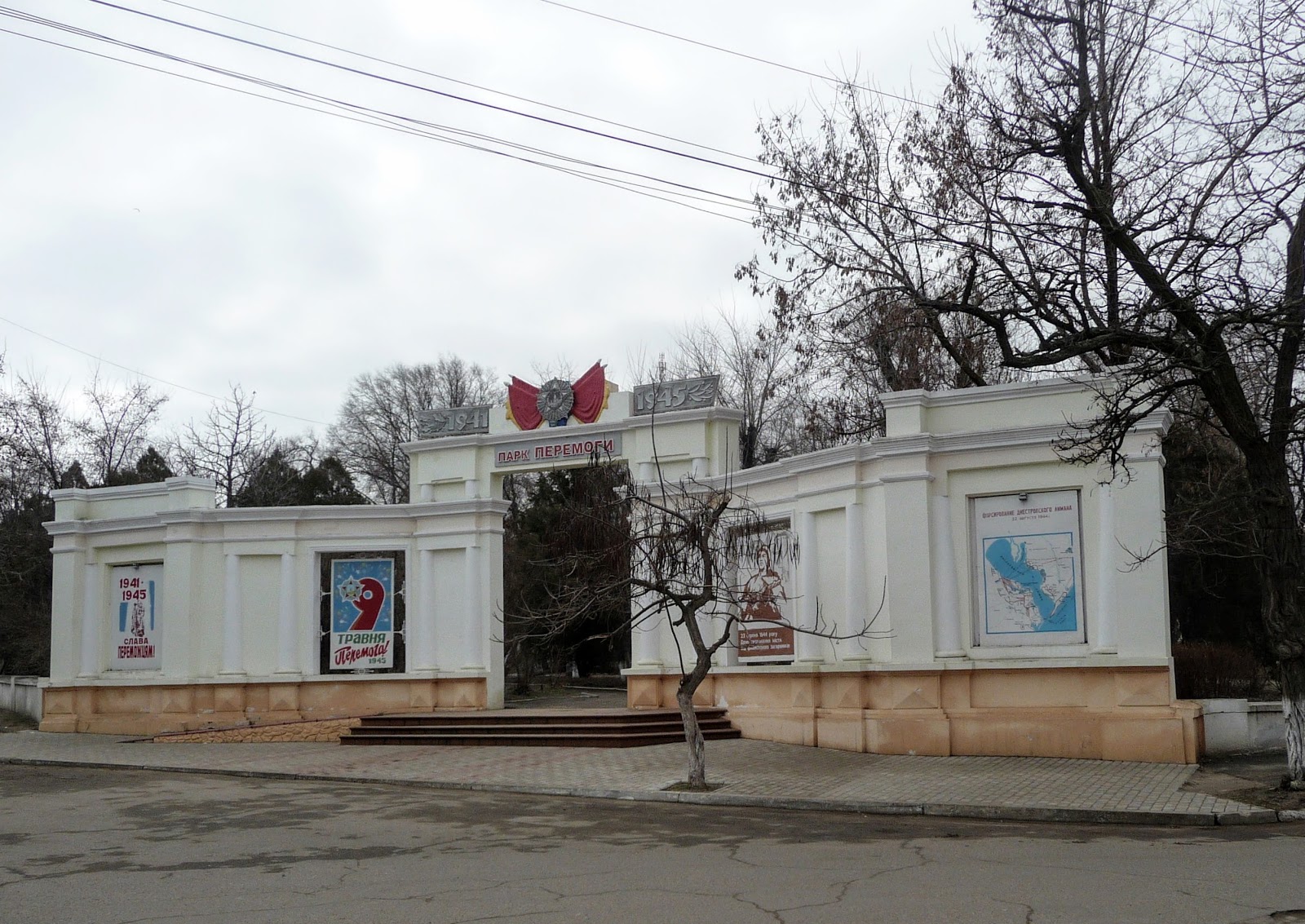
The town has several parks, whose entrances are adorned with monumental gates and arches.
 |
| The entrance to Victory Park |
 |
| The entrance to Mykhailivskyi Square |
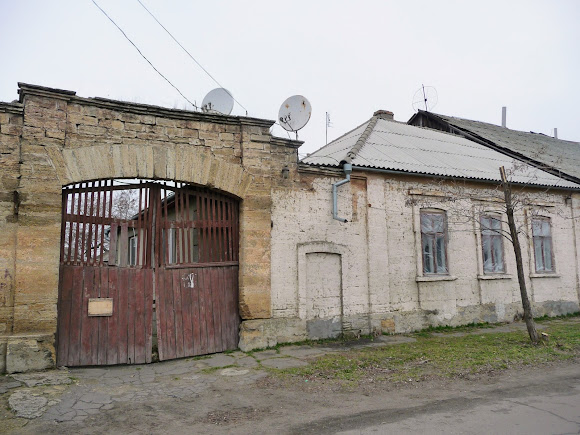
Private houses too have large, massive gates.
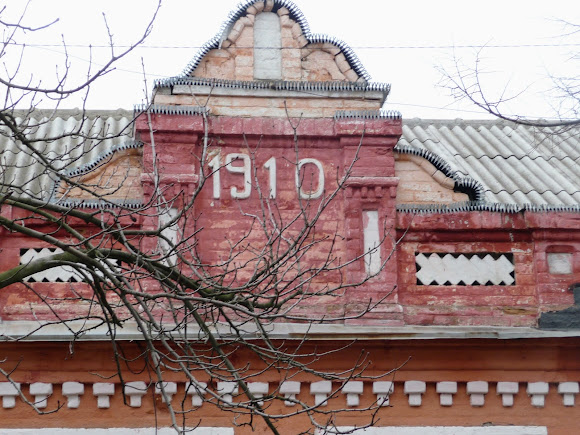
On the facade of the military enlistment office, a number has survived with the date of construction — 1910.
 |
| The military enlistment office. 1910 |
The town has many war memorials and monuments to well-known figures.
 |
| A monument to T. H. Shevchenko |
 |
| A golden monument to A. S. Pushkin |
What I liked most was the sculptural portrait of our writer Lesia Ukrainka.
 |
| A monument to Lesia Ukrainka |
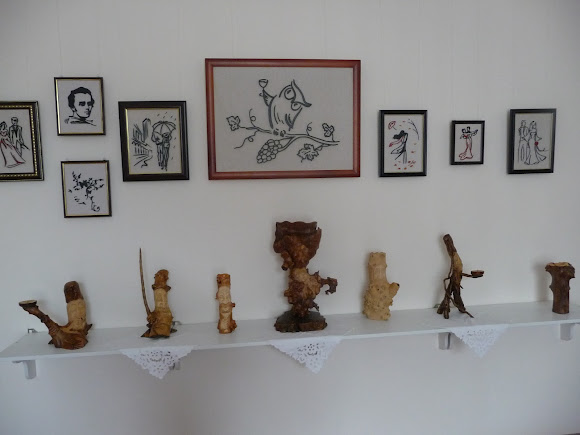
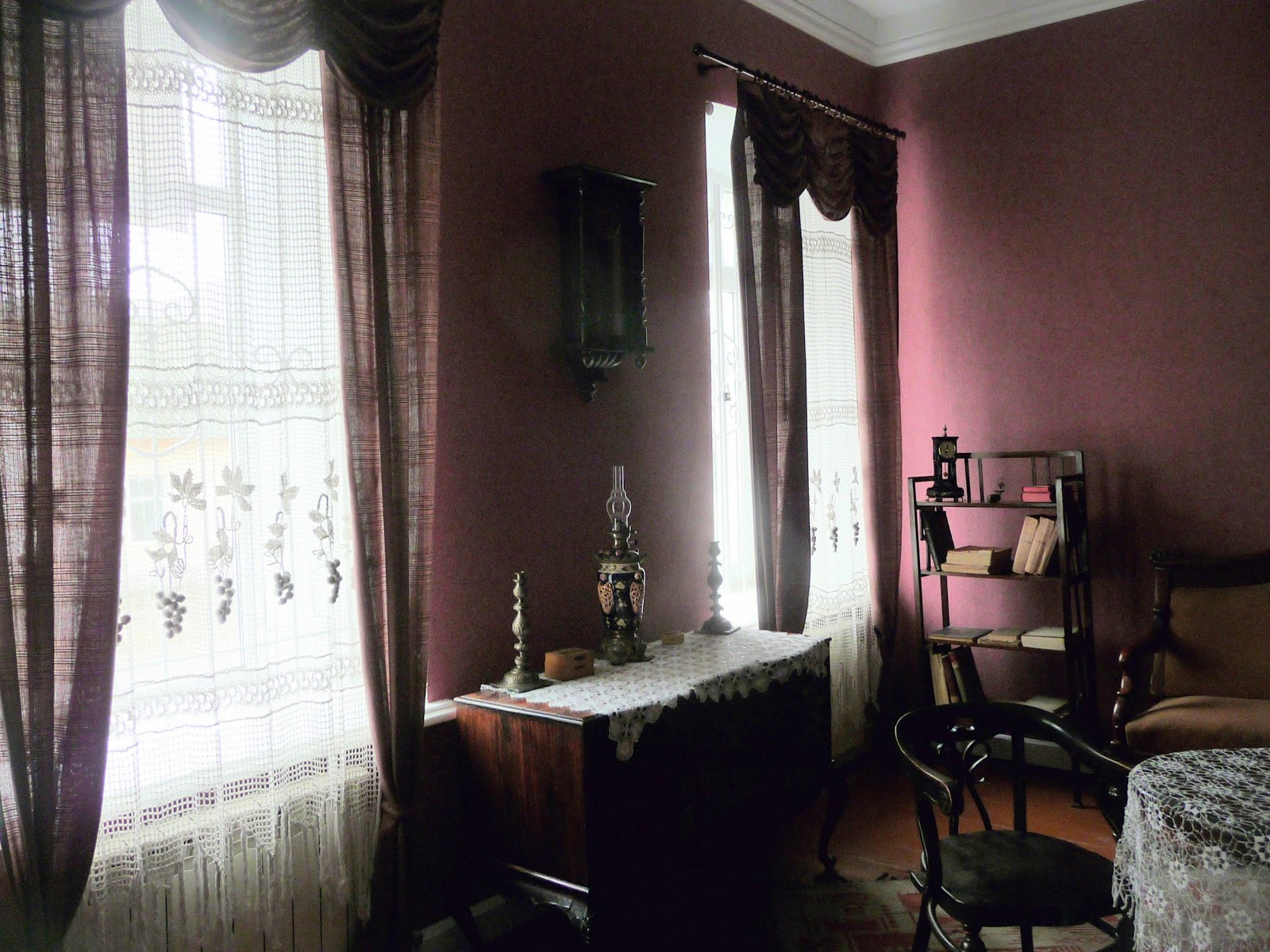
Details of the history of Bilhorod-Dnistrovskyi can be learned at the local history museum, the former mansion of the merchant and mayor Femilidi.
 |
| The Local History Museum. An architectural monument |
In the ethnographic department there are displays introducing the culture of the peoples of this multinational town.
You can stop for the night at the Rus Hotel.
 |
| The Rus Hotel |
An ordinary five-storey hotel, inherited from Soviet times, when groups from all over the USSR travelled about as if on a conveyor belt.
 |
| The Rus Hotel |
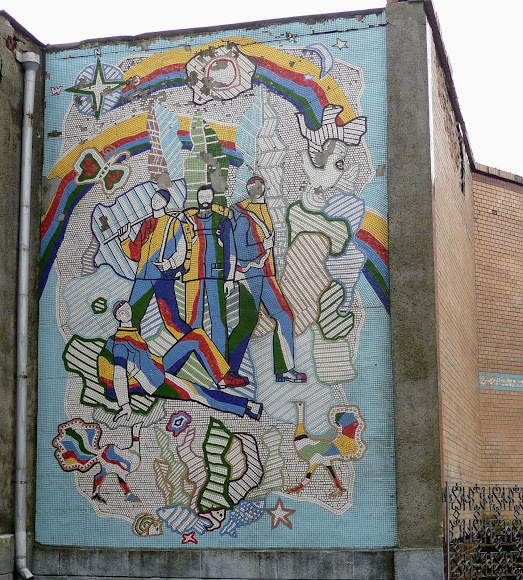
As a reminder of those times, there is a mosaic image of holidaying tourists on the facade of the building.
 |
| The Rus Hotel. A mosaic panel |
You can get to Bilhorod-Dnistrovskyi from
Odesa by suburban train or by road in less than two hours.
Five or six kilometres before the town you can visit the Centre of Wine Culture in
Shabo.
 |
| Bilhorod-Dnistrovskyi. The town council |











No comments:
Post a Comment
Leave your impression