There is a belief that the Donbas land is an agglomeration of industrial towns, terrikons and factory chimneys that place a man-made burden on the environment. How wrong are those who think that Ukraine's industrial heartland has no places for tourists. The most famous are the national
nature park "Sviati Hory", the Lyman Blue Lakes, the chalk mountains,
the Bilokuzmynivka rocks.
Fifteen kilometres from
Kramatorsk there is a unique corner where the beauty of natural landscapes comes together with a place for townsfolk to rest, the history of the region, an architectural monument, tales of astonishing destinies, incredible legends and even mysticism.
 |
| Komyshuvakha. Kramatorsk city council. Donetsk region |
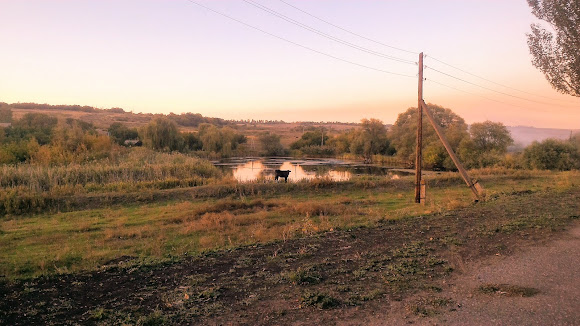
In the protected tract of Komyshuvakha rises a river of the same name. Its banks and the slopes of the winding ravines are covered with woodland and carpets of wild flowers. A commonwealth of oaks, ashes, elms, maples and lindens ionises the air of the 200,000-strong city and lowers the temperature in the sweltering summer. At the river's source lies a small settlement, given its name by the tract and the river — Komyshuvakha.
 |
| Komyshuvakha. Kramatorsk city council. Donetsk region |
On its outskirts, on the shore of a picturesque lake, a landowner's estate has survived. "Survived" is putting it grandly, for much has been destroyed, yet attempts to revive the noble nest are in evidence.
 |
| Komyshuvakha. The Bantysh estate. Reconstruction |
Locals call the mansion "the haunted house". For many years a phantom has wandered the estate, descending to the lake, searching for a little bridge and vanishing.
In the 1970s and 1980s the building housed the international student camp "Globus" for the recreation of foreign students. In the summer a camp was organised for the town's senior schoolchildren, who combined their summer holidays with agricultural work on the local collective farm. It was in this period that the most legends were born, passed from mouth to mouth to this day.
Having made their modest contribution to the hard peasant task of raising the harvest, the inquisitive schoolchildren tried to unravel the riddles of the mysterious manor house. The daring explorers slipped into the boiler room and inspected the labyrinths of wine cellars stretching several dozen metres down to the lake.
 |
| Komyshuvakha. The Bantysh estate. 1890s. Reconstruction |
One of the teenagers managed to speak with a woman in black attire who came to the lake and gazed for a long time at the mirror-smooth surface of the water, at the manor house and at the oak planted, according to noble tradition, in honour of an heir's birth. From her account the schoolchildren learned that once, in the middle of Swan Lake, a gazebo had stood on piles. Aristocrats liked to rest in it, and servants brought them dishes across a footbridge.
 |
| Komyshuvakha. The Bantysh estate. Swan Lake |
After the revolution of 1917 the estate was nationalised and a children's home was set up here. The homeless waifs ransacked the family crypt and ran about with a human skull. They say they even played football with it. Supposedly the ghost can find no peace in the other world and roams its domain demanding, "Give me back my head!".
So who were the masters of that mysterious house?
 |
| Komyshuvakha. The Bantysh estate. 1890s. Reconstruction |
It is known that in 1718 the Moldavian boyars the Bantyshes, one of whose daughters was married to the Moldavian ruler Prince Cantemir, received a reward from the generous Emperor Peter I. Members of this untitled Russian family became owners of the fertile lands.
Kramatorsk local historians have established that the lands in Komyshuvakha were the dowry of Olha Ivanivna Khlopova (1837-1889), wife of Oleksandr Fedorovych Bantysh (1828 -?). The couple had four sons. Ivan died in 1881. Antiokh — the Izium marshal of the nobility — was killed in Kharkiv in 1900. Vasyl and Fedir could have inherited the estate after their parents' death.
Fedir Oleksandrovych Bantysh (1865-1919) — a kammerjunker and state councillor; he served in the Odesa Dragoon Regiment and was the Izium district marshal of the nobility. In 1908-1911 he was governor of the Kherson region. Later, by invitation, he became governor of Irkutsk, where he supported the workers at the gold mines. In 1919 he was shot by the Cheka in Kharkiv together with his son.
Vasyl Oleksandrovych Bantysh (1858-1915) — a landowner educated abroad, a public figure and member of the Third State Duma for Kharkiv province. He died at his Komyshuvakha estate. It was previously thought that Vasyl was unmarried, yet the local historian Viktor Ivanov managed to find an announcement in which Bantysh's wife reported his passing. Perhaps the lady in mourning dress was that very mysterious woman by the lake.
 |
| Vasyl Oleksandrovych Bantysh (1858-1915) |
Local historians found in the archives the correspondence of the Izium Land Department of the RKKD Council with the Serhiivka volost executive committee on the organisation and activity of the commune "Kronstadt", set up on Bantysh's former estate, which includes a petition by the hired hands addressed to the head of the "bureau of communists": "... The mistress Bantysheva threw us overboard from the aforementioned estate. We have not been paid for our labour ... But the lady did, after all, agree to give us half of our earnings." Who was this lady? Another mystery. The old residents of the settlement remember that the last landowner left the noble nest and went abroad in Soviet times.
After the collective farms collapsed and the camp closed, the building fell into desolation. It now stands on the grounds of the Visitor Centre of the regional landscape park "Kramatorskyi", where you can enjoy the natural beauty, visit a mini-zoo, and take a boat ride on that same lake where the blue-blooded once rested in the gazebo.
 |
| Komyshuvakha. Visitor Centre of the regional landscape park "Kramatorskyi". Mini-zoo. Deer |
 |
| Komyshuvakha. Visitor Centre of the regional landscape park "Kramatorskyi". Mini-zoo. Wolf |
 |
| Komyshuvakha. Visitor Centre of the regional landscape park "Kramatorskyi". Swan Lake |
The lake is not called Swan Lake for nothing, since mute swans long ago made this place their own. After a pack of feral dogs tore the beautiful birds to pieces, a pair of their kin acquired charming offspring, and the swans once again became the general favourites of the Visitor Centre.
 |
| Komyshuvakha. The Bantysh estate. Swan Lake |
It was intended to create a museum of nature in the Bantysh mansion. Steps were taken to restore the building, but without the conclusion of an expert commission the reconstruction was carried out unprofessionally.
 |
| Komyshuvakha. The Bantysh estate. 1890s |
The house was built in the 1890s from layered sandstone. The brick trim was made of bricks produced in Druzhkivka. The elegance of the manorial dwelling is emphasised by the grand porch and the veranda. The walls, the masonry, the coffered ceiling, the floors, the artistic stucco moulding and the cornice mouldings have preserved their authenticity.
 |
| Komyshuvakha. The Bantysh estate. 1890s |
It is very important that the revival of Komyshuvakha's gem proceed step by step, thoughtfully and on many levels. Even if the secrets of the palazzo cannot be unravelled, it absolutely must be repaired and granted the status of a historic building. You can get from Kramatorsk to Komyshuvakha by marshrutka no. 7.
I thank the Kramatorsk local historians Viktor Ivanov and Volodymyr Kotsarenko for the information about the Bantyshes and the landowner's house.
 |
| Komyshuvakha. Plan of the Visitor Centre grounds |
Coordinates:
48°38’10 "N 37°26’48"E


No comments:
Post a Comment
Leave your impression