There are quite a few villages in Ukraine named in honour of the bearers of one of the most widespread names. Thanks to the enterprising and hard-working pioneers with the name Ivan, settlements and farmsteads named in memory of their founders appeared on the uninhabited lands in all the regions of our state. The village of Ivanivka in the Pokrovsk district of the Donetsk region is the centre of a village council to which small settlements are subordinated: Vesele, Vovche, Yevhenivka, Lysyche, Lozuvatske, Novotoretske, Prohres, Svyrydonivka, and Serhiivka.
 |
| Ivanivka and the Ivanivka village council. Pokrovsk district, Donetsk region. |
Ivanivka is located 28 kilometres from Pokrovsk in the western part of the district. The first settlers appeared in this locality 110 years ago. In 1910, carrying out the decree of the initiator of the agrarian reform, the head of the tsarist government Stolypin, the native residents of Hrodivka, founded by Zaporozhian Cossacks, received land allotments as their property in the area of the Berestova gully. The resettlers did not move far from their homeland; 5-10 kilometres from their native domain, over the years 1910-1924, they created new farming holdings.
 |
| Ivanivka. Pokrovsk district. Tsentralna Street |
In the steppe zone, in the valleys of small rivers, the aforementioned villages appeared one after another. The peasants worked the fertile lands, engaged in animal husbandry and the growing of cereal crops. The central estate of the Illich collective farm was located in Ivanivka.
 |
| Tsentralna Street. The village council |
Now, apart from the name of the farm, the owners, the technologies, and the leading crops have all changed.
 |
| Tsentralna Street. The former "Kolos" shop |
The fields are all ploughed and sown with sunflower, rapeseed, and barley. The social and cultural life of the villagers has changed too. A few years ago the school closed, in which only 2 classes functioned. The pupils' level of knowledge did not meet the existing educational standards, and a decision was taken to disband the institution and transfer the schoolchildren to the Hrodivka school.
The former House of Culture was reformatted into a centre of culture and leisure. It was not possible, during the quarantine period, to establish how the people of Ivanivka spend their leisure.
 |
| Tsentralna Street. The centre of culture and leisure |
This hearth of culture is adorned by a large mosaic panel depicting young agrarians against a backdrop of the symbols of socialist realism. The specialists of the agrarian-industrial sector look confidently into the future, holding in their hands the tools of labour — the sickle and the hammer — and relying on a programme whose founder has been painted over in the course of decommunisation.
 |
| The centre of culture and leisure. The mosaic |
Beside the centre a children's play complex has been installed and a small public garden laid out. In every village the memory of the soldiers who were fellow villagers, and of the liberators from the Nazi occupation in September 1943, is immortalised. In the Second World War 488 countrymen took part, 275 of whom died at the front.
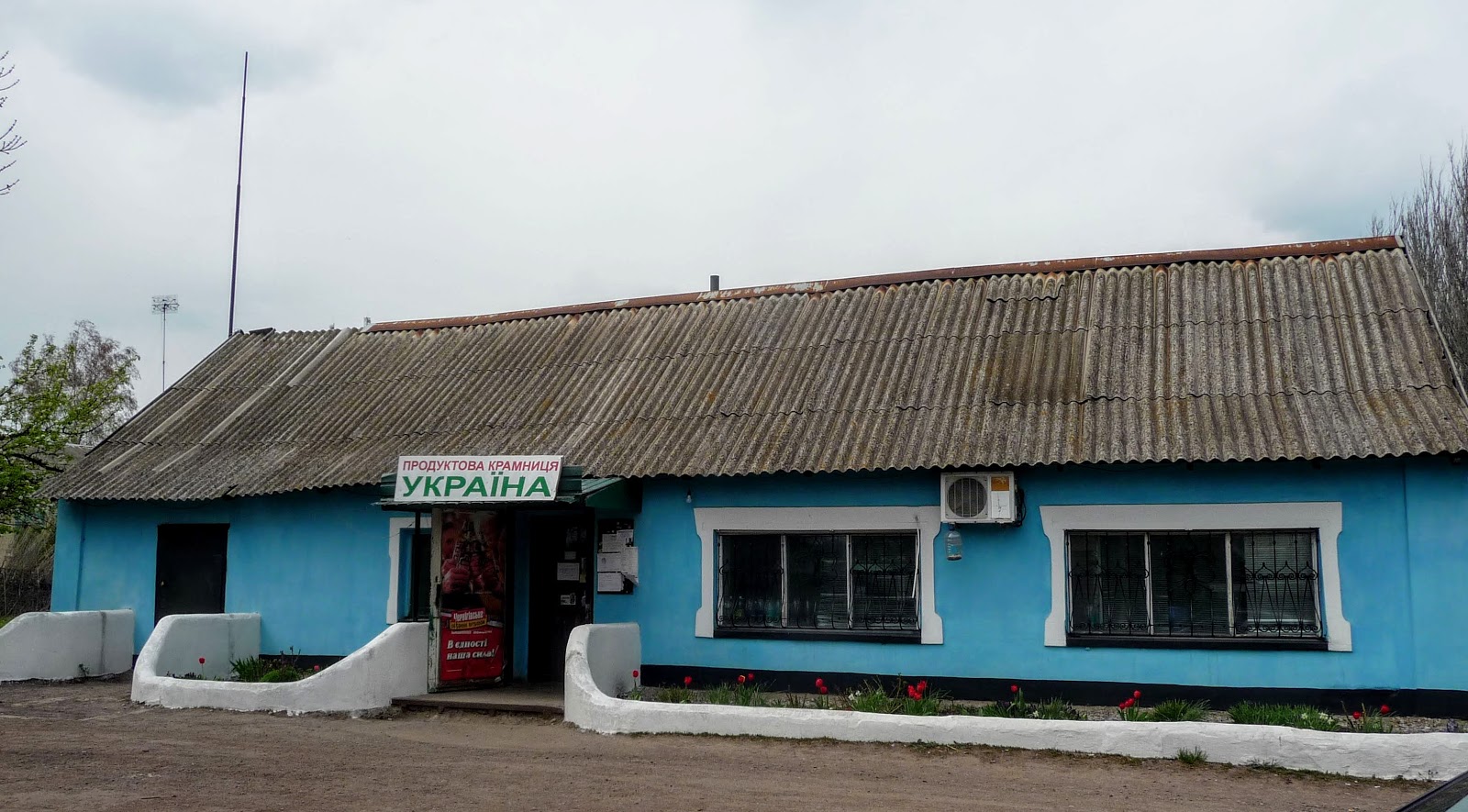
In Ivanivka there is a paramedic station and a grocery shop.
 |
| Tsentralna Street. The paramedic station |
 |
| Tsentralna Street. The "Ukraina" grocery shop |
The Church of the Holy Forerunner is housed in the adapted premises of a residential building.
 |
| Tsentralna Street. The Church of the Holy Forerunner |
Two kilometres from Ivanivka, on the slope of the Kholodna gully, lies the village of Vesele. No doubt, 100 years ago its founders were life-lovers and merry souls, who did not grieve, felt joyful sentiments, and placed great hopes on the development of their place of residence, naming it optimistically Vesele ('Merry').
 |
| Vesele. Stepova Street |
The village has two streets — Stepova and Polova.
 |
| Vesele. Stepova Street |
 |
| Vesele. Polova Street |
More than half of the houses stand empty or are in ruins.
 |
| Vesele. Stepova Street. A 100-year-old house of adobe, faced with brick and covered with roof tiles |
A contemporary of the century-old houses and of the village has spread its branches on a rise.
 |
| Vesele. The oak |
Not every local-history museum has in its displays statues of Polovtsian warriors, which guarded the sanctuaries of our ancestors across the lands of South-Eastern Europe. And in Vesele a stone idol of the 9th-13th centuries greets rare travellers beside a private homestead, whose owner found this monument of Polovtsian culture in the ploughland many years ago.
 |
| Vesele. Stepova Street. A Polovtsian stone woman |
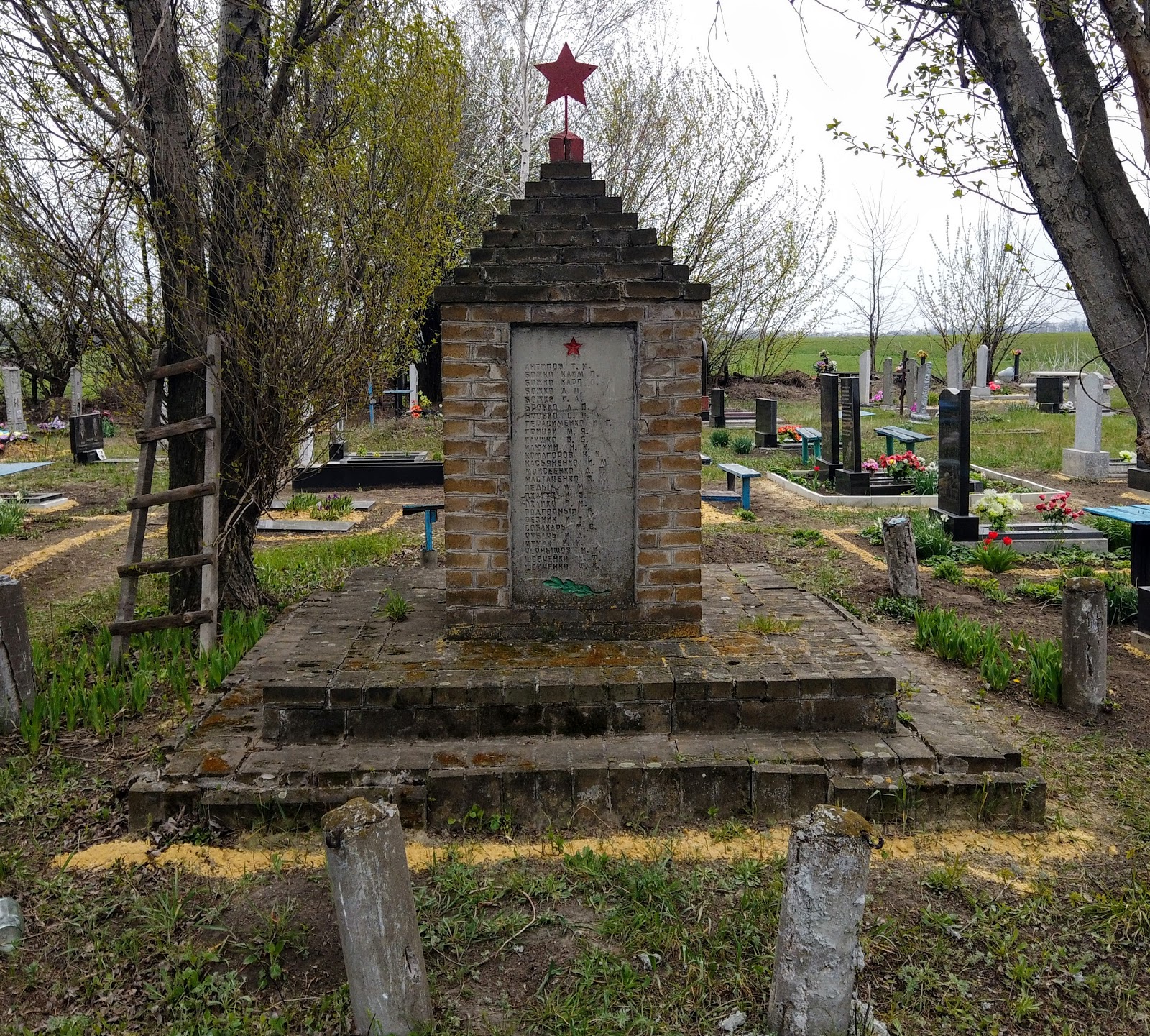
There is no shop in the village; a grocery van comes 3 times a week. Until 1970 there was a primary school in the village; now not even ruins remain of it. Four schoolchildren study in Hrodivka, and a bus comes for them. In the village cemetery there is a communal grave of Red Army soldiers. The monument, in the form of a pyramid on a pedestal, is built of brick and crowned with a red metal star.
 |
| Vesele. War memorial |
The village is located on the slopes of the Kholodna gully, at the bottom of which a stream flows.
 |
| Vesele. The Kholodna gully |
Several ponds have been created in the course of the water flow.
Recreation areas have been arranged on the bank.
Some of the water bodies are stocked with fish and are popular with fishing enthusiasts.
The westernmost pond is closed to entry, with a prohibiting sign on the barrier: "Private territory".
Prohres is the second settlement in the village council by population size after Ivanivka.
The village is better known by the name of the fruit orchard that supplied fruit produce across the whole country — Lozovatskyi. The entry sign near railway halt No. 9 has preserved the name, but the orchards no longer bring the harvest of former times.
All the fields in the surrounding area are sown with cereals and sunflower.
In Prohres the streets are asphalted and have signposts. On the central Gagarin Street there is a kindergarten, an outpatient clinic, and a shop.
In every village of the Ivanivka council, memorial signs have been installed in honour of the soldiers of the Second World War. In Prohres the names of the fallen soldiers who were fellow villagers are immortalised.
Only in Prohres can you see a sculptural depiction of a predatory mammal — not a cartoon or fairy-tale character, but a she-wolf, thanks to whom the river received its name —the Vovcha River.
The sources of this lowland river of the Dnipro basin, whose name means 'Wolf', are located between Prohres and the small village of Vovche. Protecting her cubs from a hunters' battue, the grey and toothy beast began to dig a pit in order to hide the little ones from destruction. From the pit, water unexpectedly gushed, flooded the ravine, and flowed as a stream, turning into a full-flowing river and saving the wolves.
 |
| Prohres, Pokrovsk district. The source of the Vovcha River |






No comments:
Post a Comment
Leave your impression