 |
| Dmytrivka. Dnipropetrovsk region. Church of the Nativity of the Most Holy Mother of God |
I knew nothing about the preparations for the jubilee, and in fact almost nothing about the ancient village — I had only come across information about one of the oldest mills in the Dnipropetrovsk region, which had not ceased working. To see the century-old flour mill in action, I set off for Dmytrivka on the Pokrovsk-Lozova suburban train. At first I was alone in the carriage. The conductor was glad to see a passenger and even greeted me, which does not happen often. At siding No. 5, and further on in Slovianka and Mykolaivka, railway workers boarded, heading off to carry out their work assignments at the halts. I knew about the short platforms, but the specifics of the dimensions had slipped my mind. The suburban train fell about a metre short of the platform, and I had to plunge into the prickly weeds, and then look for a way out of them, because the meagre passenger flow does not manage to trample down the thistles.
 |
| Halt 80. The Pokrovsk-Lozova suburban train |
A feat is not born at once, and to reach the mill I had to walk through the whole village, winding about, studying the terrain, and lingering along the way. Dmytrivka is located on the left bank of the Samara River, a tributary of the mighty Dnipro.

 |
| The Samara River near Dmytrivka |
Straightening its bed, the water flow formed oxbow lakes and estuaries in these parts, which in dry years turned into terraces and marshy tracts.

 |
| Oxbow lakes on the Samara River near Dmytrivka |
Reeds and weeds grow in the bends, and the supports of the single-track bridge have ended up in a green ravine.
 |
A road bridge with horizontal beams and triangular struts, 175 cm high, links Dmytrivka with Katerynivka and lends a special charm to the riverside.

 |
| Road bridge over the Samara River near Dmytrivka |
A pedestrian taller than 175 cm passes through with a bowed head.
What nature does not do to a person! The floods and inundations did not allow even streets to be formed in the river's floodplain, and so some of the village roads are built with curves and changes in elevation.


 |
| Dmytrivka. Village streets |
A road of international importance, the M-04, runs through the village. Buses pass through Dmytrivka to Dnipro, Pavlohrad, and the neighbouring Donetsk region.


 |
| Dmytrivka. The M-04 road |
The homesteads are drowning in orchards and flower gardens.


 |
| Dmytrivka. Village streets |
An unprecedented harvest of plums and cherry plums saturated the air with a pleasant aroma, and the fruit bent down the branches and carpeted the yards and paths with yellow and blue clearings.

 |
| Who wants plums, cherry plums, mirabelles? Come and get them, help yourselves |
The population is mainly engaged in domestic smallholding and works at the coal enterprises of the Western Donbas.


 |
| Dmytrivka. Mykolaivka ATC |
Friendly, hospitable people live in the village, and I particularly want to note the good manners and courtesy of the younger generation. All the children the traveller met were the first to say hello.


 |
| Dmytrivka. Village houses |
On the school building it says: "School of the Future".

 |
| Dmytrivka. The school. Memorial plaque to I. I. Tymoshivskyi |
One of the graduates of the village school was Volodymyr Mykhailovych Saihak, an academician of the Tsiolkovsky Academy of Cosmonautics. For many years the fellow villagers did not suspect what their countryman did after graduating from Dnipropetrovsk University. This native of a village on the Samara worked on the creation of ballistic missiles in Samara on the Volga (formerly Kuibyshev), in the design bureau headed by S. P. Korolov. Working in the rocket and space industry, V. M. Saihak recommended that the best pupils of the school choose a profession in this same field. The longest village street (4,300 metres) is named in honour of Academician Saihak. A memorial bas-relief plaque has been installed on his home.
 |
| Dmytrivka. Memorial plaque to Academician V. M. Saihak |
The centre of the village — the church, shops, post office, museum, park, and a stage for festive events.
 |
| Dmytrivka. Park and stage |
In the park stands a monument to the fallen soldiers and the heroes of the Civil War.
 |
| Dmytrivka. War memorial |
In all, I counted 4 war memorials in the village; on the approaches to the Dnipro, the bridgeheads were won in fierce battles in September 1943.

 |
| Dmytrivka. Communal graves |
The first church was built in 1781 and consecrated in honour of St. Demetrius. Now the village Church of the Nativity of the Most Holy Mother of God is located in the premises of a former club. For more than 20 years Father Alim has been in charge of the parish. In the church yard a three-tiered gate belfry has been erected.

 |
| Dmytrivka. Church of the Nativity of the Most Holy Mother of God |
The territory is fenced with a wrought-iron fence that has survived from the destroyed church. In atheist times the fence was used by the collective-farm MTS, and the metal crosses were cut off it.
 |
| Dmytrivka. The fence on the church territory |
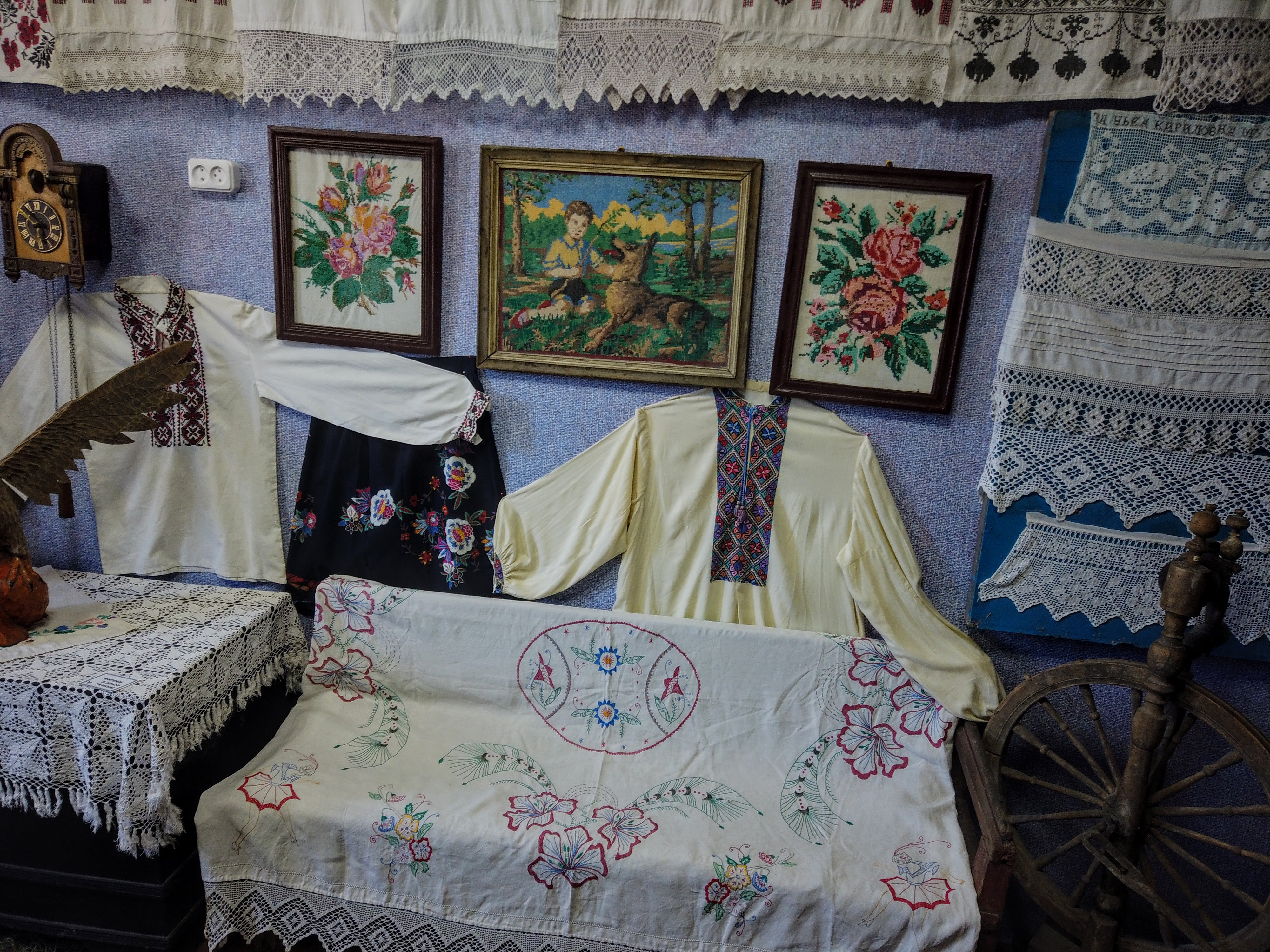
You can acquaint yourself with the history of the village and view unique displays in the museum, which is housed on Academician Saihak Street in the former building of the village council. The museum's collection illuminates the everyday life of the residents of Dmytrivka from its origins to the present day.
Dmytrivka is glorious both for its past and for its present. For many years the initiators of the creation of this cultural and educational institution studied its history, and enthusiasts gathered photographic materials, documents, and information about their families and fellow villagers. In the recreated svitlytsia and the museum halls are displayed samples of traditional folk clothing, tools, household objects, crockery, furniture, and so on.


 |
| Dmytrivka. Museum of the village's history |
The keeper of the museum's treasures and the village's cultural heritage, Lidiia Vasylivna Kolesnyk, gives captivating tours. According to the museologist, the mill towards which I had been measuring out my steps for 4 hours in a row was built at the beginning of the 20th century. Its owner was Greek by nationality. After nationalisation, the flour-milling enterprise belonged to the Chkalov collective farm and was re-equipped as an oil mill. Farms from all over the district brought seeds to Dmytrivka, and the produce was of high quality.
I had about another kilometre to go to reach this village workhorse, but half of the way I again covered through the thickets. A village woman living at the end of the street showed me a short route across the meadow. She had evidently not walked to the mill for a long time, and I had to trace labyrinths in the dense growth that had formed on the bottom of a dried-up marsh with tussocks and pits. Even the cows had found nothing useful for themselves there and had not cropped the grass.
 |
| Dmytrivka. The old bed of the Samara |
At last I finished, but on the doors of the oil mill hung a padlock, and I did not manage to get onto the grounds or into the building. Working hours in the workshop are until 2 p.m. and had ended 20 minutes earlier. Most likely the enterprise is temporarily closed, awaiting the new harvest, for the sunflower harvest had not yet begun and last year's stocks of the oil crop had already been processed. A millstone lying alone by the roadside recalled the former flour-milling purpose. I cleared the millstone of grass and earth in order to photograph the former breadwinner.

 |
| Dmytrivka. The oil mill and the millstone of the former mill |
The excursion to Dmytrivka came to an end; the trip was interesting and instructive, for on journeys you learn much more than from books or the media, and, most importantly, you come to know yourself. The road, the search, and observation teach a great deal and grant an enormous life experience.
This story is also available in Ukrainian: Дмитрівка. Від витоків до сучасності. Музей історії села

No comments:
Post a Comment
Leave your impression