By the entrance, on the fenced-off grounds, a memorial stone was erected in 2018 with inscriptions in Hebrew, Yiddish, English and Ukrainian.
 |
| Nadvirna. The memorial stone at the Jewish cemetery |
The entrance is through a metal gate from Vyzvolennia Street.
 |
| Nadvirna. Entrance to the kirkut |
The cemetery is drowning in thickets, yet there are no flower beds here. No one picks the ripe fruit from the old apple tree, and it has strewn the paths between the graves. The apple is an ancient symbol of life and immortality, and also a symbol of Mother Earth.

The Jewish burial ground was founded at the turn of the 16th-17th century and began to take shape at the same time as the settlement was created. The Jewish population of Nadvirna at times reached 50-60%. The Nadvirna synagogue was built from the same stone as the Church of the Assumption of the Blessed Virgin Mary (1599) and the walls of Pniv Castle (16th century), and it stood in the central part of the town. Several Hasidic dynasties arose in Nadvirna, and one of the suburbs of Tel Aviv bears a name that sounds like Nadvirna. It was in the old part of the necropolis that there were burials of those killed during the uprisings of Severyn Nalyvaiko and Bohdan Khmelnytskyi. The Jewish cemetery counted up to 1,000 monuments, though the burials may be far more numerous. Not all Jews had the means and the ability to pay for a headstone. Some layers of the poorer population were buried in common graves. During epidemics the dead were buried in trenches, and for the sake of disinfection the pits were filled with lime, which is why the kirkut is also called an okopyshche, a trench-ground.

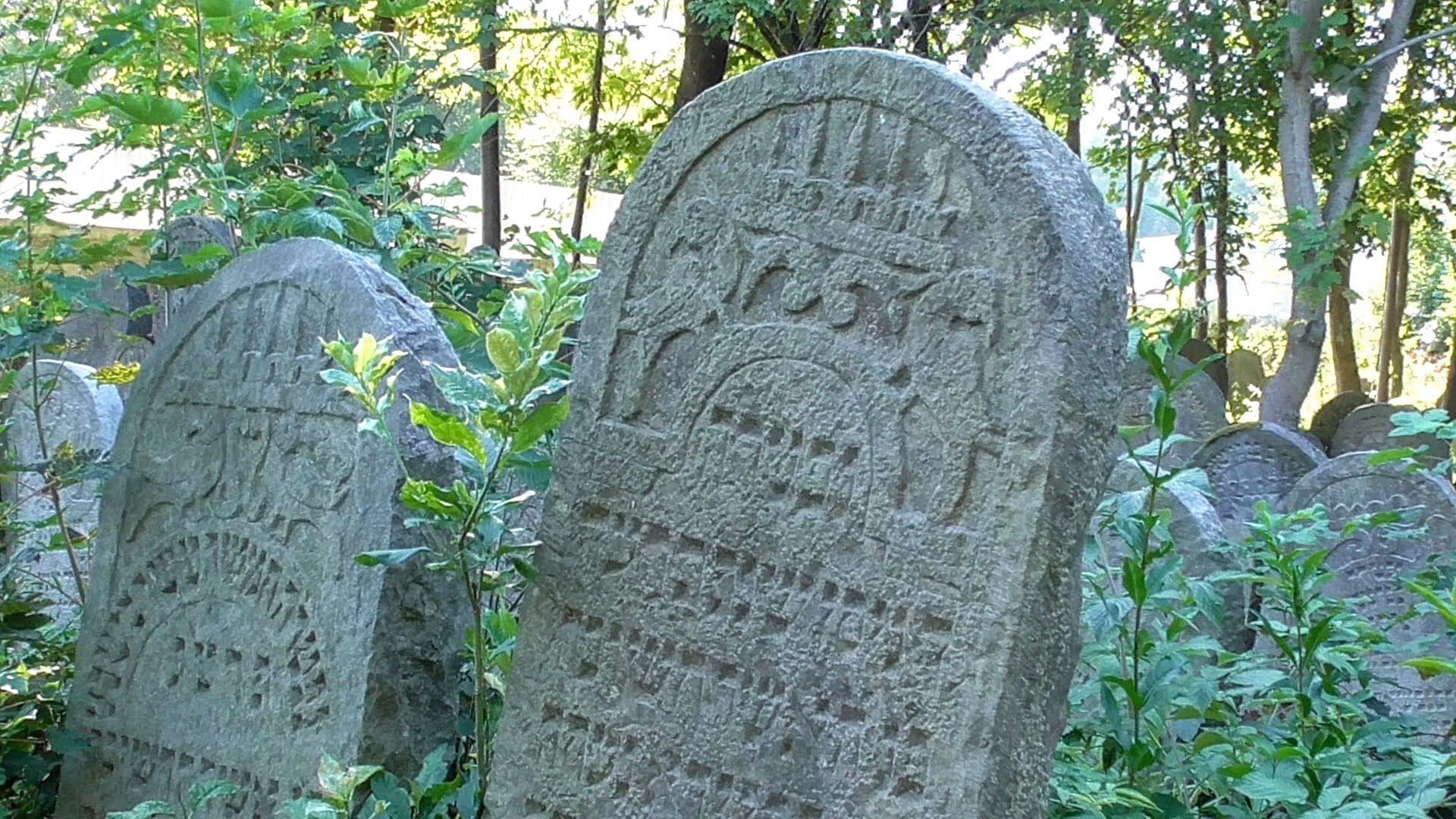
Somewhere in the bushes there is a stone marker dated 1649 - this is the oldest burial; the last inscription on the matzevot is from 1941. The cemetery was in use until the Second World War. In 1941 the Jews of Nadvirna were herded into a ghetto, their valuables taken, then they were driven to Stanislaviv (Ivano-Frankivsk) and shot. The Hitlerites had a policy of destroying Jewish traditions and laws. In the 1980s part of the cemetery was damaged by municipal repair works. Onlookers gathered to watch the technical process of an excavator turning over the soil, and witnesses to the event remembered the inscription on one of the headstones - 1595. The oldest portal, bearing the number 1709, has now survived. On most of the sandstone gravestones names and stylised drawings are carved in Hebrew.
 |
| Nadvirna. Bas-reliefs on the matzevot |
The monuments have no portraits or sculptural compositions; the slabs depict hands folded in blessing, floral ornament, animals and candelabra. The menorah is an ancient symbol of Jewish religious attributes.
 |
| Nadvirna. The kirkut. Depiction of a menorah on a matzeva |
The encoded inscriptions point to the piety, religiousness and good deeds of the deceased. The stone carvers used quotations from the holy books. Each bas-relief has its own meaning, each gravestone is a work of art, a page of a book with the chronicle of a life, bearing the characteristic features of those buried. The matzevot were made by stonemason craftsmen of a high professional level. Some of the headstones have subsided or been toppled by bad weather and time.

 |
| Nadvirna. Headstones at the Jewish cemetery |
The centuries-old history of the kirkut conceals many stories and legends, and the thickets and the grave-like silence create an atmosphere of sorrow. They say that somewhere there is a double headstone with an original inscription that testifies to the burial of lovers. According to the tale, after a sudden downpour and a devastating flood, a young man and a girl were found dead on the bank, lying hand in hand, as if not even death could part them. People recall that during the Austrian period the empire's gendarmes did not dare to search for lawbreakers on the cemetery grounds.
 |
| Nadvirna. The kirkut |
Recently two sandstone tombs have been restored, where the great scholars of the Torah, Rabbi Mordechai (Mordechaili) and Rabbi Aaron Leib, are buried.
.JPG "Nadvirna. The kirkut. An ohel with the burial of a dynasty of tzadikim") |
| Nadvirna. The kirkut. An ohel with the burial of a dynasty of tzadikim |
The necropolis is located almost in the centre of Nadvirna beside Ivan Franko Park. The entrance is from Vyzvolennia Street.
This story is also available in Ukrainian: Надвірна. Єврейський некрополь. Місто мертвих не включають у туристичний маршрут

No comments:
Post a Comment
Leave your impression