Documentary evidence mentioning Loieva dates back to the second half of the 17th century. In the 18th century the village had a filial church that belonged to the parish in Nadvirna. Its successor, built in 1835, has survived to our day. The shrine stands in the southern part of the village, and from the halt it was another 2 km to reach it.
 |
| Loieva. The Strahora ridge |
Minibuses from Ivano-Frankivsk to Bukovel or Yaremche are common enough, but it is worth taking the diesel train to the passenger platform to see a piece of Austrian railway heritage. The station was built in 1895 together with the railway line between the Deliatyn and Nadvirna stations. This station building of the Lviv Railway, which faithfully served the railway for about 100 years, now stands unused and is falling into ruin through natural disasters and with the help of human greed. In Soviet times the workers of the steel line decided to decorate the so-called Alpine-type station with ceramic tiles and even laid out, alongside the station name, a communist slogan in Russian. Later the inscription "Glory to the CPSU" was changed to "Glory to Ukraine", but that did not help the railway palace survive. The roof caved in, the ceilings rotted, the doors and windows were smashed, and the sturdy building turned into a ruin. The station could be one of the appealing tourist spots in Loieva and across the whole Ivano-Frankivsk region, yet so far it has not earned the attention of the authorities or the efforts of the local government. The passenger halt is not even equipped with a bench, but nearby a stone arched bridge thrown across the single-track railway deserves attention.


 |
| Loieva. The abandoned railway station |
A dirt road leads from the ghost station to the centre of the village – this is Vasyl Stus Street. The homesteads are drowning in flowers, and some have signed up to the green tariff by installing solar panels.


 |
| Loieva. Vasyl Stus Street. Residential buildings |
A typical old wooden Hutsul house is adorned with an inspiring patriotic inscription: "A Free Ukraine. We are with God".

 |
| Loieva. A Hutsul house |
The Loieva lyceum occupies a two-storey building from the 1950s, and the old school building serves as an auxiliary wing. The school has a well-equipped sports ground.


 |
| Loieva. The lyceum and the sports ground |
Loieva is divided into eastern and western parts by the H 09 Mukachevo–Ivano-Frankivsk–Lviv motorway, across which I continue my acquaintance with the Carpathian village.

 |
| Loieva. The H 09 motorway and a shop by the road |
In the very centre of Loieva rises the new Church of the Resurrection of the Lord, painted in blue, white and sky-like tones. The church is crowned with gilded cupolas, which are seen ever more often and abundantly in the rural communities of the UGCC. Metal stairs lead up to the two-tier bell tower.


 |
| Loieva. The Church of the Resurrection of the Lord. UGCC |
In the churchyard, a symbolic grave has been raised to the Fighters for Freedom in Ukraine, and a memorial cross has been set up to fellow villagers who died at the hands of NKVD henchmen.
 |
| Loieva. The memorial sign to the Fighters for Freedom in Ukraine |
The village house of culture has not closed its doors during the war and continues to run its amateur-arts clubs, attended by the young talents of Loieva and displaced children.

 |
| Loieva. The village house of culture and the memorial cross by the club |
On the main street, renamed in honour of Mykhailo Hrushevsky, you need to turn right by the chapel.
 |
| Loieva. Hrushevsky Street. A chapel |
In the shade of centuries-old trees stands the Church of the Transfiguration of the Lord, with the status of an architectural and cultural monument.
Built in 1835 in the Hutsul style, it is cruciform in plan, with a widened central log frame and shortened side frames.


 |
| Loieva. The Church of the Transfiguration of the Lord. UGCC. 1835 |
The house of prayer has been covered with sheet metal, with only the lower part clad in boards.
 |
| Loieva. The heritage church. 1835 |
On the central part sits an octagon with a dome, and smaller cupolas crown the church on four sides. All the end walls have small doors, so that parishioners enter the church with a bow. The church's contemporary, the two-tier heritage bell tower, is also protected by the state. Fire-fighting equipment is kept in a small single-storey building.


 |
| Loieva. The Church of the Transfiguration of the Lord. The bell tower and an outbuilding |
The Transfiguration church is surrounded by an old cemetery with stone and wooden crosses whose inscriptions have been washed away by the rains and smoothed by the winds. Birds have built a nest on the church cross, symbolising benefaction and the continuation of life.


 |
| Loieva. The grounds of the Church of the Transfiguration of the Lord |
The church grounds are well kept, with benches and many flowers. The churchyard is cared for by parishioners and nuns from the Congregation of the Sisters of the Holy Resurrection, who have settled in a typical little Hutsul house on the opposite side of the street.

 |
| Loieva. Hrushevsky St. |
A bus stop is also a calling card of a settlement, carrying a lot of information. This passenger shelter, set on a busy highway, was once decorated with a mosaic depicting flowers and forest birds. The shabby structure for sheltering from bad weather looks unappealing and needs immediate repair, with the mosaic pictures preserved.
 |
| Loieva. The bus stop |
The northern edge of neighbouring Deliatyn was now just a stone's throw away, and I carried on heading south to the Liubizhnia passenger platform.


 |
| Loieva–Deliatyn. Residential buildings by the H 09 road |
Everyone knows – and I have already noted more than once – the uniqueness of the roadside chapels in Carpathian villages. Doors always open for the traveller, tidiness and refined interiors are the main distinctions of these little shrines.


 |
| Loieva–Deliatyn. Chapels and sculptures of the Mother of God |
Large and small shops with the usual range of goods are decorated by the Hutsuls with wooden sculptures and other original touches, which gives the outlets national colour and attracts customers.

 |
| Deliatyn. A shop |
The Church of the Most Holy Trinity is used by the Greek Catholic community.
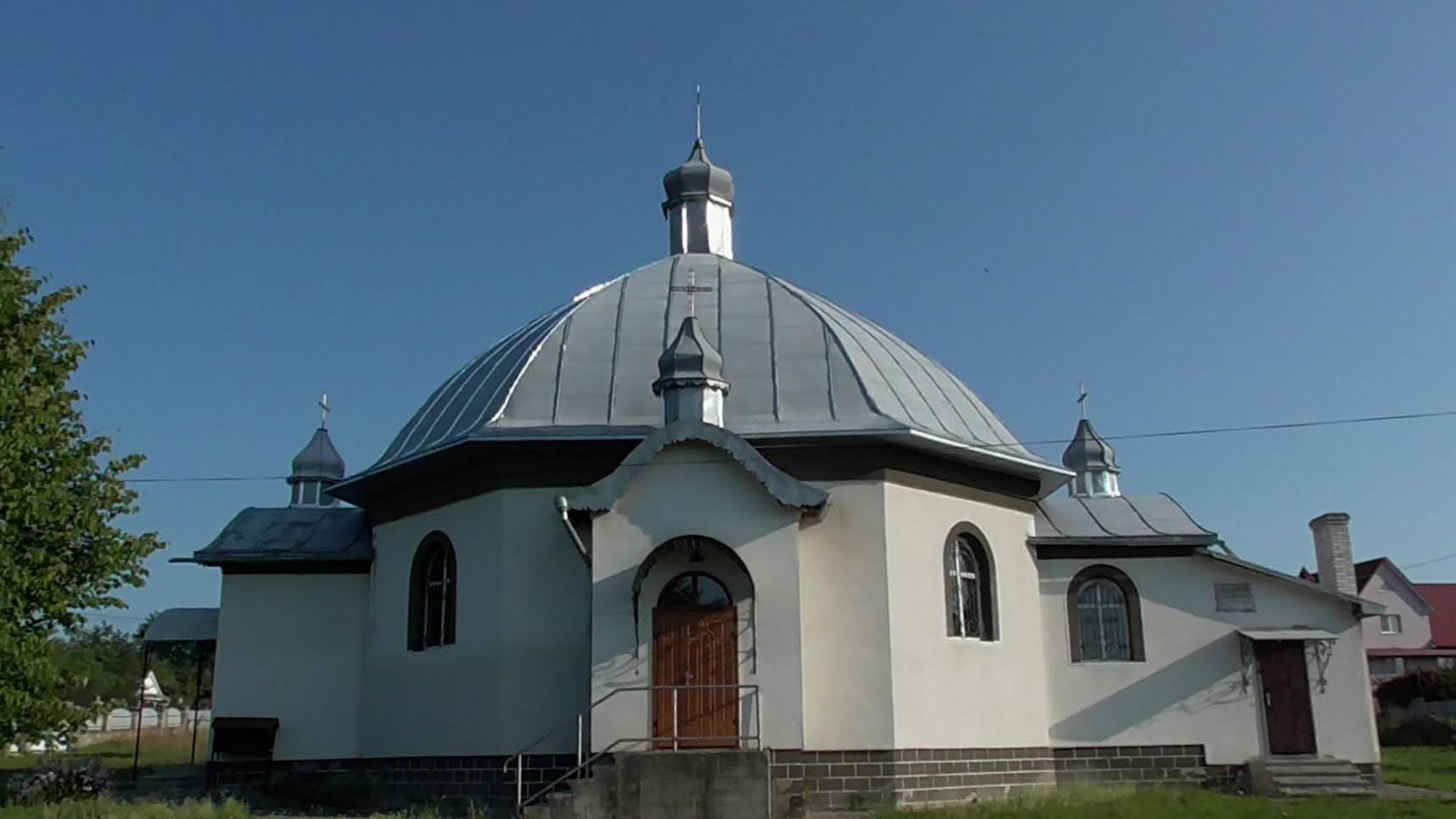 |
| Deliatyn. The Church of the Most Holy Trinity |
A memorial sign to the Fighters for Freedom in Ukraine and a symbolic mound. Somewhere here you need to cut the corner and turn right towards the Liubizhnia railway platform.
 |
| Deliatyn. The memorial sign to the Fighters for Freedom in Ukraine |
The path led to a ravine through the shrubs, and then was barely visible along a stream through the trampled grass.
 |
| A riot of colour in the marshy lowland |
Then the path jumped up onto a steep hill, the southern foothill of the Strahora ridge, from which the northern part of Deliatyn could be seen. The panoramas take your breath away and will not let the traveller go, but you have to catch the diesel train, and there is still a fair way to walk over the hills to the railway.

 |
| Deliatyn. A view of the northern outskirts |
The scattered houses on the slopes of the mountain ranges do not form straight streets, so the distance can grow longer as you manoeuvre between homesteads along a stony road. The railway in this area is not known for being straight; on the contrary, the arcs and curves of the track lend train journeys a picturesque, dynamic quality. And a walk along the sleepers is sure to lead to the halt.


In 2 hours 20 minutes I had covered about 8.5 kilometres along a dirt road, the verge of an asphalt road, a forest path and the sleepers. The Liubizhnia passenger stop has one platform and a canopy with a bench for waiting for the rolling stock. The Ivano-Frankivsk–Vorokhta diesel train arrived almost on time, delayed by only 15 minutes, which in these times is understandable and to be expected. The main thing is that convenient passenger transport is running and the railway workers conscientiously do their job for the benefit of passengers.


 |
| Deliatyn. The Liubizhnia halt |

No comments:
Post a Comment
Leave your impression