 |
| Shchyrets, Lviv Oblast. Zolota Hora. The Church of the Nativity of the Most Holy Mother of God. 16th century |
What have we heard about Shchyrets? Some will recall the "Shchyrets sausages" brand and the railway station of the same name on the Lviv–Stryi line. Shchyrets keeps many stories, legends and secrets, including tragic ones. It was here that the old routes from the Subcarpathian salt works to Volhynia and Hungary crossed. According to local historians, the toponym derives from the word "Shchr", "Shchyr" – "Trinity": the dogma of the divine triunity, which was depicted in the form of a trident. The three religious buildings in Shchyrets had a defensive purpose, withstood invasion and have survived to our time. Everyone driving along the Lviv–Drohobych road or travelling by rail sees, on the south-eastern edge of Shchyrets, a mountain on which the cupola of the Church of the Nativity of the Most Holy Mother of God gleams golden, and the mountain is called Zolota (Golden).
 |
| Shchyrets. Zolota Hora |

 |
| Shchyrets. On Zolota Hora |
 |
| Shchyrets. The Shchyrka River |
In ancient times the height was called Monastery Hill or Castle Hill, which points to the presence of a monastery or a fortified castle. According to legend, golden relics are hidden beneath the shrine – a belt, a plough and a shchyr. The founding of the fortress-church reaches back into hoary antiquity, and artefacts found by archaeologists during excavations attest to a structure existing in the Old Rus period. In 1241 the stronghold was surrounded and destroyed by the Mongol-Tatars. Through underground passages the enemy broke into the refuge where the townsfolk were sheltering and slaughtered them all. Later, a three-domed church with wooden cupolas was built on the foundation of the shrine.
Conquerors destroyed the church, burning and ruining it. The last reconstruction took place in 1893 to a design by the Galician architect Vasyl Nahirny, for which he received negative reviews from critics. Building a single-domed church changed the original appearance of the historic structure.


 |
| Shchyrets. The Church of the Nativity of the Most Holy Mother of God. An architectural monument |
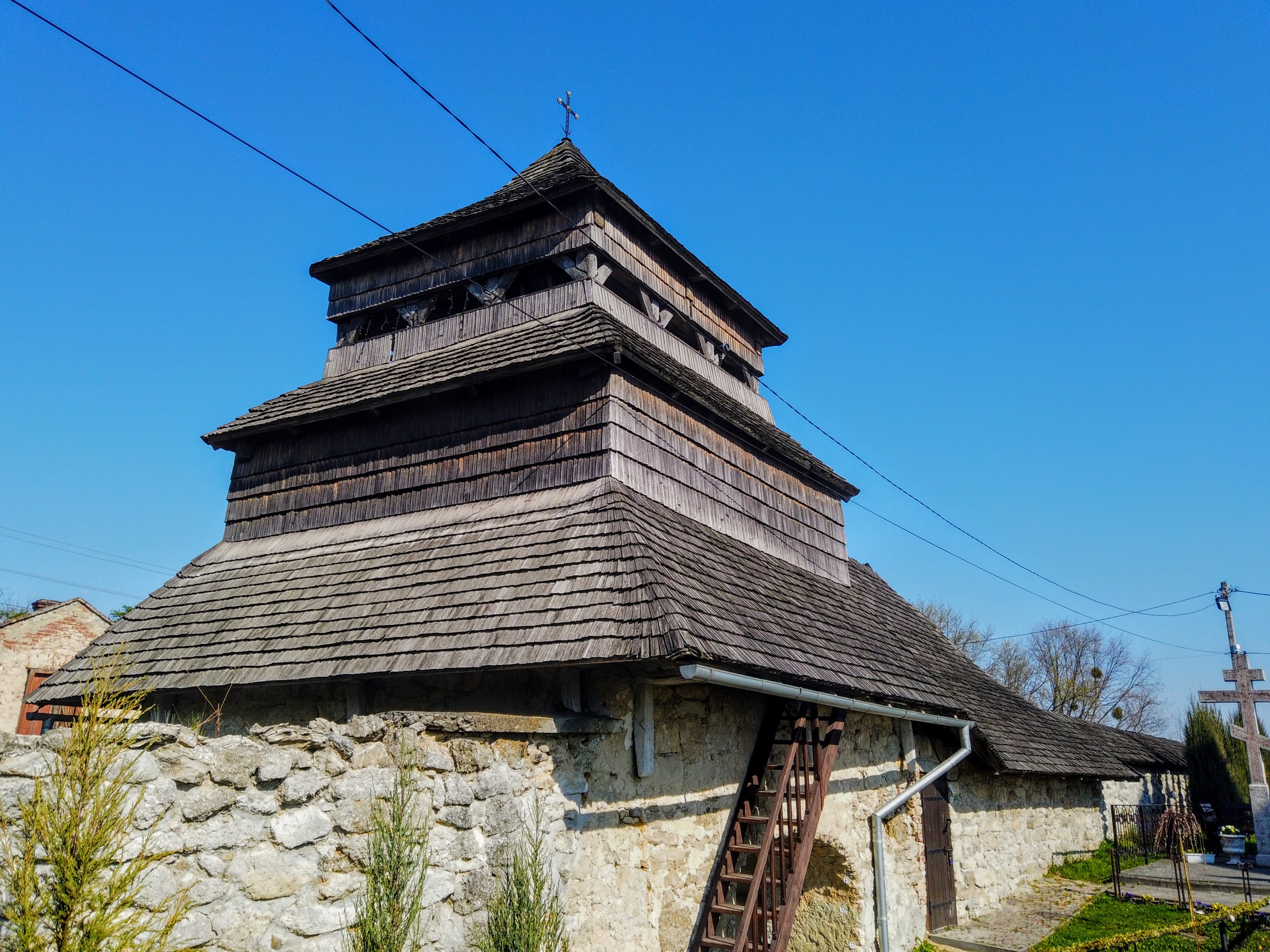
The unchanged parts of the church complex are the loopholed walls that enclose the churchyard and the gate bell-tower of natural stone with a shingle roof.


This sturdy two-tier structure with an arched portal and buttresses deserves special attention. The lower tier is of masonry, the walls reaching a metre and a half thick. Stairs lead up to the bells on the wooden upper tier. Locals say that the buttresses once bore an inscription with the date "1700".



 |
| Shchyrets. The defensive walls and the gate bell-tower |
The tower on the south-eastern corner was formerly used as a chapel.


 |
| Shchyrets. The corner tower-chapel |
During the First World War, a bomb blast opened up underground labyrinths that the monks had used to travel between monasteries. Unfortunately, no documentary evidence of the history of this 16th-century architectural monument has survived, but scholars' research of Zolota Hora continues. This sacred place attracts travellers and pilgrims. In 2022 the construction began of the stations of the Lord's Way of the Cross, which led Him to Golgotha.
 |
| Shchyrets. The Way of the Cross |
Together with the Church of the Nativity of the Most Holy Mother of God, a spiritual triangle is formed – also part of the cultural heritage – by the 16th-century stone Church of the Most Holy Trinity with its wooden bell tower and 18th-century stone fence.

 |
| Shchyrets. The Church of the Most Holy Trinity and the bell tower. An architectural monument |
and the Church of St. Stanislaus. This Catholic fortified church has been known since 1400, but it burned down in 1517 during a Tatar invasion. It rose from the ashes more than once together with the town. In 1888 the building was reconstructed and its interiors were painted. In 1912 the last rebuilding took place, strengthening the church's vaults and adding buttresses and an apse. Stone sculptures adorn the gate bell-tower. Services in the church did not cease even in atheist times.


 |
| Shchyrets. The Church of St. Stanislaus and the gate. An architectural monument |
A ring for tethering horses has survived on the church fence, and a horse-drawn carriage can still be seen today on the central streets of the town.

 |
| Shchyrets. Near the Church of St. Stanislaus |
The historic heart of the town includes Market Square, surrounded by administrative, residential and commercial buildings. In the centre of the square a small park has been laid out with flower beds and a children's playground.


 |
| Shchyrets. Market Square |
Some shops and stone houses belonged to the Jewish community, which was exterminated by the Nazis during the Holocaust. At the northern foot of Zolota Hora, the old matzevot at the kirkut preserve the memory of people who took part in the public and cultural life of the town and made their valuable contribution to its development.

 |
| Shchyrets. The kirkut |
A stone cross bearing an image of a skull and bones recalls the deliverance from serfdom under the lords.
 |
| Shchyrets. The cross commemorating the abolition of serfdom |
At the crossroads, a monument to the national poet-prophet was erected in 1992 by the People's Sculptor of Ukraine I. M. Samostos.
 |
| Shchyrets. The monument to T. H. Shevchenko |
In the courtyard of the Roman Catholic priest, the NKVD tortured residents of Shchyrets – students and the intelligentsia. Today, in the premises of the former stable, a museum has been created in memory of the victims of Stalinist repression. The exhibitions present photographic documents and objects dedicated to those who were tortured and to the liberation movement of the Shchyrets patriots.


 |
| Shchyrets. The Museum in Memory of Political Repression |
The grounds have been tended by the town community; a chapel and a memorial stele have been erected in honour of those killed by the NKVD.

 |
| Shchyrets. The chapel |
 |
| Shchyrets. The memorial sign in honour of the fallen patriots |
Visitors are invited to view the ethnographic room, where collections of everyday household objects have been gathered: a bed, a cradle, a chest, a bambetel (a folding bench-bed). The parlour holds icons, embroidered towels and shirts, cast-iron irons, a weaving loom, a hand mill, a sewing machine, a washboard, dishes and other items once used in the household. I express my gratitude to the keeper of the museum collections, Stefaniya Pavlivna Derevatska, for the tour and her hospitality.


 |
| Shchyrets. The ethnographic exhibition |
Lovers of modern art should visit the museum of Osyp Kurylas, a painter and graphic artist, a native of Shchyrets.
You can reach Shchyrets from Lviv by bus or by the suburban train Lviv–Truskavets, Lviv–Mukachevo, Lviv–Lavochne.
This story is also available in Ukrainian: Що ми знаємо про Щирець? Оборонні церкви, музей та інші пам'ятки

No comments:
Post a Comment
Leave your impression