I have already grown so used to being in new places every day that I cannot afford to lose a single hour. If there is not enough time for far-off trips, I try to see something new for myself nearby. I set off on foot to the village of Lysovychi in the Stryi district from Morshyn.

I will not repeat myself and describe what I saw as I passed through Bania Lysovytska. Once these two villages were a single whole; in 1990 each became a separate administrative unit. But I did step into the Church of the Nativity of the Most Holy Mother of God, which stands on the outskirts of Bania Lysovytska and belongs to the Greek Catholic community.
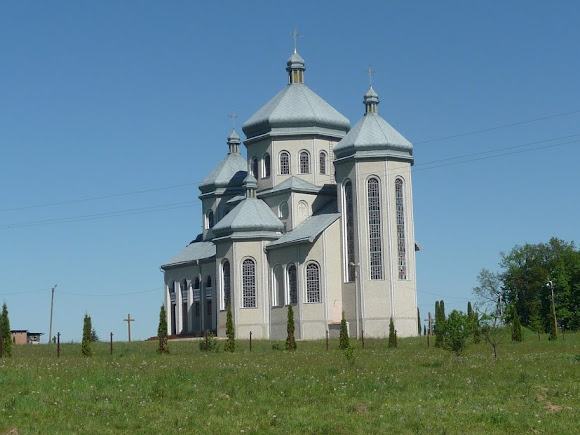
The church was built in 2000. By the entrance, a sculpture of the Mother of God greets visitors with a blessing.
From here, from the heights, the streets of Lysovychi are clearly visible, but the nearness is deceptive.
I had already walked 3 kilometres when a cart drawn by two horses caught up with me. The driver turned out to be an acquaintance who worked for the forestry service and was carting round timber. What else would a forester be hauling? Yosyp offered me a lift. Sitting on the logs is not very comfortable, but it is still better to ride than to walk under the scorching sun. During that short spell of travelling by horse-drawn transport I tried to pick up the skill of driving. I was entrusted with the reins and the whip, and I drove a little on my own, without help or prompting. I cannot say that I liked it very much, but it stayed with me.
That is how I got almost to the church, walking another 300 metres or so on foot.

The wooden Church of the Epiphany of the Lord stands within the same fenced grounds as the new Church of St Demetrius of Thessalonica, built in 1996 by the village community.

When I was looking for the gate, a man came out of the neighbouring house and asked whether he could help with anything. This resident of Lysovychi told me about the church, built in 1712. For more than 250 years it stood without repair and was almost falling apart. Services were held by candlelight, without electricity.

Earlier the bell tower stood over the gate, and entry to the grounds was made through it. In the 1970s a major renovation was carried out, during which church books with records from 1710 were found. According to another version, the year of construction is 1750. But the villagers still hold to the earlier date and in 2012 celebrated the 300th anniversary of the shrine.

Quite recently the roof was re-covered with shingles, preserving the authenticity of the structure.
My companion and his wife invited me in as a guest. Here it is traditional to offer a guest coffee rather than tea. I cannot fail to note the hospitality of the Galicians, who often invited me into their homes. I thanked them; unfortunately, I am always short of time, in a hurry, wanting to see more. Now, once I retire, I will visit old acquaintances one day at a time — it will be enough to fill a whole year.
In the church courtyard yet another local resident came up to me, probably deciding that I needed something explained. He greeted me, and once again I met an interesting storyteller. It turns out that the church did not close after the war and is the oldest of the active wooden churches in the Stryi area. Older still is only the one in Strilkove the St Nicholas Church of 1650, but there services are held only on the church's patronal feast day.

On my travels I have often met simple people who are rich in spirit, who know the history of their village or town, who can lay it out and tell interesting local-history details. And I learned so much about Lysovychi from Myron, who had been mowing the grass by the church beforehand. It might seem that he had prepared for the conversation specially. Of course, that is not so. I noticed long ago that here people take an interest in the history of their homeland and try to preserve it.
The village has been known since the 14th century. It suffered greatly during World War I, and most of it burned down along with the arable land. Fierce fighting took the lives of the Ukrainian Sich Riflemen; their graves are by the highway. I had been there earlier, when I was returning from Bolekhiv and saw the stone crosses that had replaced the earlier birch ones.

Myron also told me about an old house that is about 200 years old. Its last mistress was repressed by the Stalinist regime and exiled to Siberia, from where she never returned. No one lives there now, but the building has not been abandoned, dismantled or destroyed. And this, too, confirms the respect for the past. The villagers use the premises as a storehouse and a workshop. I walked over and photographed this little house.

Then I walked about 1.5 kilometres to the school. Sometimes children from the two villages ride to lessons by bus.

I had had occasion to be at this school for the "Farewell to the Primer" celebration. I was invited by Olena, a resident of Bania Lysovytska, to the celebration for her first-grader daughter Ania. It was not an ordinary event but a real concert of the young talents of the Lysovychi school. There were so many spectators — relatives, teachers, schoolchildren — everyone was congratulating the first-graders. I especially liked the dance of the girls in national costumes with embroidered towels. Bravo! I also want to note the effort of the teacher, who at the end of the celebration announced that the video of the solemn event would be on the school's page on "Odnoklassniki" that very evening. This is very commendable and speaks of the attentiveness and sincerity of the educators.
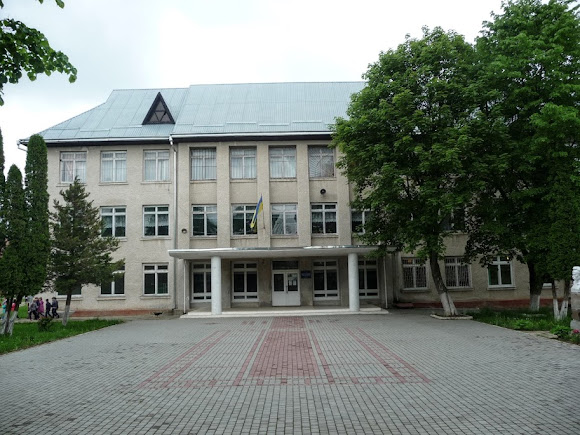
By the school, as by many other educational institutions, a monument to I. Ya. Franko has been erected.

Next to the school stands a building called "Kompleks". I used to think it was some kind of agricultural complex. In essence it is a social and cultural centre, which houses the village council, the People's House, and a shop with a pharmacy. There was even room for a nightclub. In a word, a complex of all services and entertainment for the residents of Lysovychi.

The Holodomor of 1932—1933 did not affect the residents of Western Ukraine as severely as it did their compatriots from the Central and Eastern parts. But here the memory of the tragic events is kept; the evidence is a birch cross on the hill.

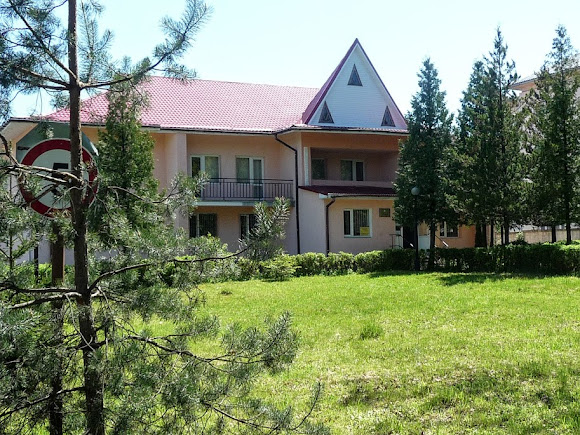
On the territory of Lysovychi, surrounded by tracts of forest, stands the "Prykarpatska Vatra" sanatorium. I have heard only positive reviews of it. As the saying goes, sun, air and water — and I would add the forest and a friendly atmosphere — are the main factors of recovery.
Back to Morshyn I set off along the "Lviv — Ivano-Frankivsk" highway, having gone around the village and stopping by a roadside chapel, of which there are very many here. But this one, with its sculptures, I liked more.

Lysovychi resembles other Subcarpathian villages, yet it is nevertheless special, and above all, the people living in it are simply extraordinary. I gladly share such wonderful impressions with you.

I will not repeat myself and describe what I saw as I passed through Bania Lysovytska. Once these two villages were a single whole; in 1990 each became a separate administrative unit. But I did step into the Church of the Nativity of the Most Holy Mother of God, which stands on the outskirts of Bania Lysovytska and belongs to the Greek Catholic community.

The church was built in 2000. By the entrance, a sculpture of the Mother of God greets visitors with a blessing.
From here, from the heights, the streets of Lysovychi are clearly visible, but the nearness is deceptive.
 |
| Lysovychi. A sculpture of Jesus Christ by the road |
That is how I got almost to the church, walking another 300 metres or so on foot.

The wooden Church of the Epiphany of the Lord stands within the same fenced grounds as the new Church of St Demetrius of Thessalonica, built in 1996 by the village community.

When I was looking for the gate, a man came out of the neighbouring house and asked whether he could help with anything. This resident of Lysovychi told me about the church, built in 1712. For more than 250 years it stood without repair and was almost falling apart. Services were held by candlelight, without electricity.

Earlier the bell tower stood over the gate, and entry to the grounds was made through it. In the 1970s a major renovation was carried out, during which church books with records from 1710 were found. According to another version, the year of construction is 1750. But the villagers still hold to the earlier date and in 2012 celebrated the 300th anniversary of the shrine.

Quite recently the roof was re-covered with shingles, preserving the authenticity of the structure.
My companion and his wife invited me in as a guest. Here it is traditional to offer a guest coffee rather than tea. I cannot fail to note the hospitality of the Galicians, who often invited me into their homes. I thanked them; unfortunately, I am always short of time, in a hurry, wanting to see more. Now, once I retire, I will visit old acquaintances one day at a time — it will be enough to fill a whole year.
In the church courtyard yet another local resident came up to me, probably deciding that I needed something explained. He greeted me, and once again I met an interesting storyteller. It turns out that the church did not close after the war and is the oldest of the active wooden churches in the Stryi area. Older still is only the one in Strilkove the St Nicholas Church of 1650, but there services are held only on the church's patronal feast day.

On my travels I have often met simple people who are rich in spirit, who know the history of their village or town, who can lay it out and tell interesting local-history details. And I learned so much about Lysovychi from Myron, who had been mowing the grass by the church beforehand. It might seem that he had prepared for the conversation specially. Of course, that is not so. I noticed long ago that here people take an interest in the history of their homeland and try to preserve it.
The village has been known since the 14th century. It suffered greatly during World War I, and most of it burned down along with the arable land. Fierce fighting took the lives of the Ukrainian Sich Riflemen; their graves are by the highway. I had been there earlier, when I was returning from Bolekhiv and saw the stone crosses that had replaced the earlier birch ones.

Myron also told me about an old house that is about 200 years old. Its last mistress was repressed by the Stalinist regime and exiled to Siberia, from where she never returned. No one lives there now, but the building has not been abandoned, dismantled or destroyed. And this, too, confirms the respect for the past. The villagers use the premises as a storehouse and a workshop. I walked over and photographed this little house.

Then I walked about 1.5 kilometres to the school. Sometimes children from the two villages ride to lessons by bus.

I had had occasion to be at this school for the "Farewell to the Primer" celebration. I was invited by Olena, a resident of Bania Lysovytska, to the celebration for her first-grader daughter Ania. It was not an ordinary event but a real concert of the young talents of the Lysovychi school. There were so many spectators — relatives, teachers, schoolchildren — everyone was congratulating the first-graders. I especially liked the dance of the girls in national costumes with embroidered towels. Bravo! I also want to note the effort of the teacher, who at the end of the celebration announced that the video of the solemn event would be on the school's page on "Odnoklassniki" that very evening. This is very commendable and speaks of the attentiveness and sincerity of the educators.

By the school, as by many other educational institutions, a monument to I. Ya. Franko has been erected.

Next to the school stands a building called "Kompleks". I used to think it was some kind of agricultural complex. In essence it is a social and cultural centre, which houses the village council, the People's House, and a shop with a pharmacy. There was even room for a nightclub. In a word, a complex of all services and entertainment for the residents of Lysovychi.

The Holodomor of 1932—1933 did not affect the residents of Western Ukraine as severely as it did their compatriots from the Central and Eastern parts. But here the memory of the tragic events is kept; the evidence is a birch cross on the hill.

On the territory of Lysovychi, surrounded by tracts of forest, stands the "Prykarpatska Vatra" sanatorium. I have heard only positive reviews of it. As the saying goes, sun, air and water — and I would add the forest and a friendly atmosphere — are the main factors of recovery.


Lysovychi resembles other Subcarpathian villages, yet it is nevertheless special, and above all, the people living in it are simply extraordinary. I gladly share such wonderful impressions with you.
This story is also available in Ukrainian: Лисовичі. Практично передмістя Моршина

No comments:
Post a Comment
Leave your impression