Discovering Kherson region for myself and having been in
Henichesk, on
the Arabat Spit, on
Biriuchyi Island and in
the Oleshky Sands, I wanted to get acquainted with the capital of this wondrous land.
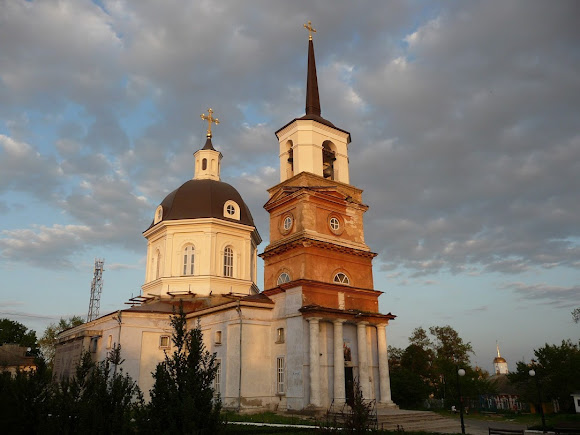 |
| Kherson. The Holy Dormition Cathedral. 1798 |
The Black and Azov Seas,
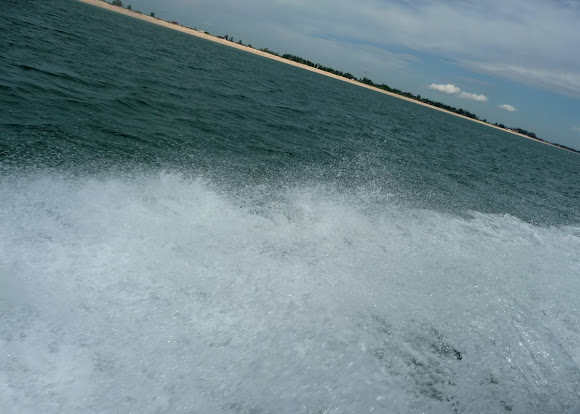 |
| Kherson region. The Arabat Spit. The Sea of Azov |
the Dnipro and other rivers,
 |
| Kherson. The Dnipro |
estuaries and islands,
 |
| Kherson region. Biriuchyi Island |
forests and semi-desert,
 |
| Kherson region. The "Oleshky Sands" sand massif |
steppes and national parks
 |
| Kherson region. The steppe |
— the list of the Kherson region's natural riches could go on. With no doubt that a stroll through the regional centre would also be interesting and eventful, I began it from Ushakova Avenue.
 |
| Ushakova Avenue |
The peculiarity of the main thoroughfare is that the avenue is not crossed by streets; rather, they begin from it and divide the city's historic core into blocks.
 |
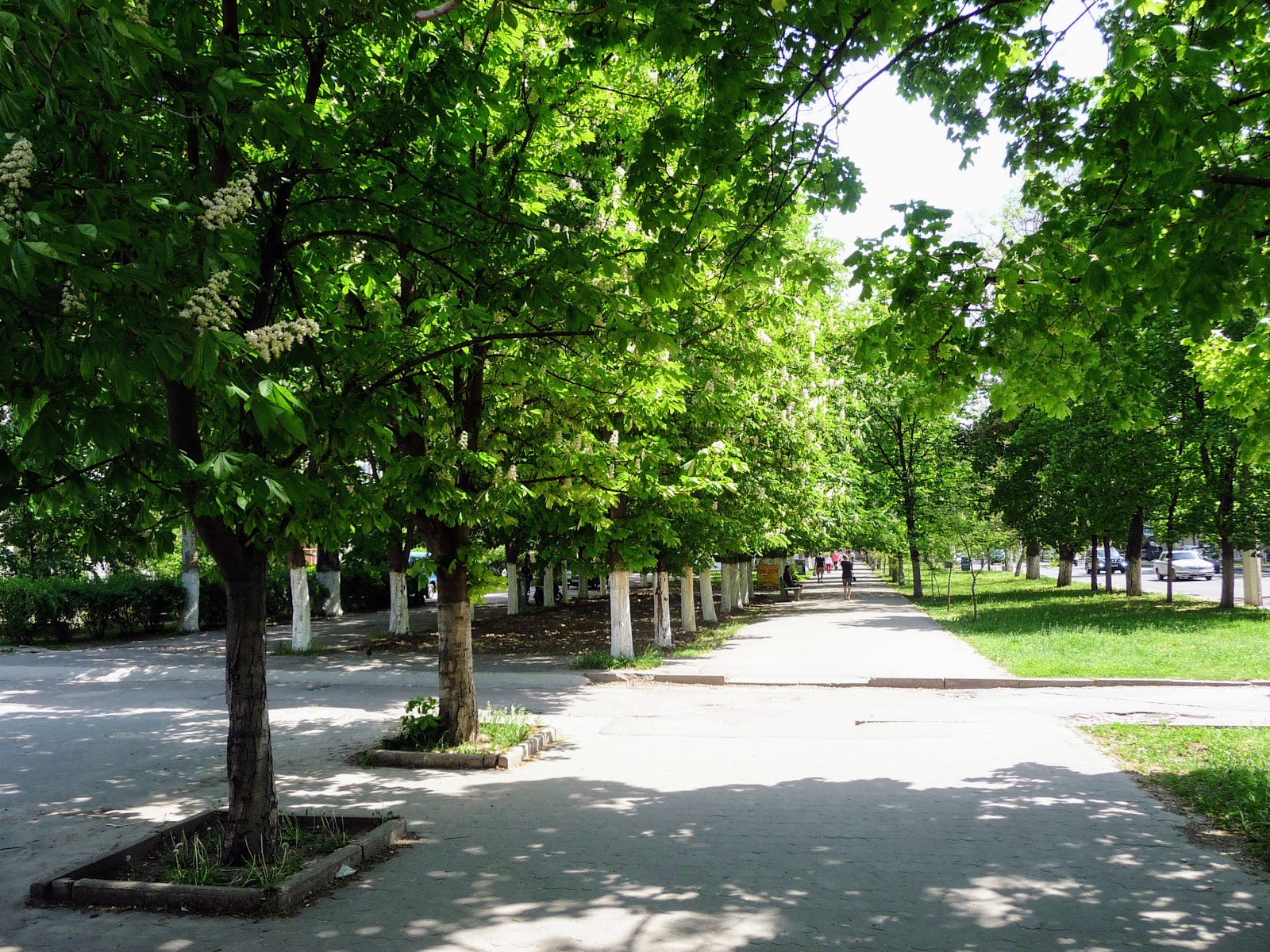
| Ushakova Avenue. Chestnut trees in May |
One can note straight away that the dryness of the climate has not affected the green framing of the streets, and the spreading crowns of the chestnut trees not only adorn the urban landscape but in May can be a blossoming calling card of Kherson.
 |
| Ushakova Avenue. Chestnut trees in May |
The All Saints Orthodox Church was built in the first decade of the 19th century and has never been closed.
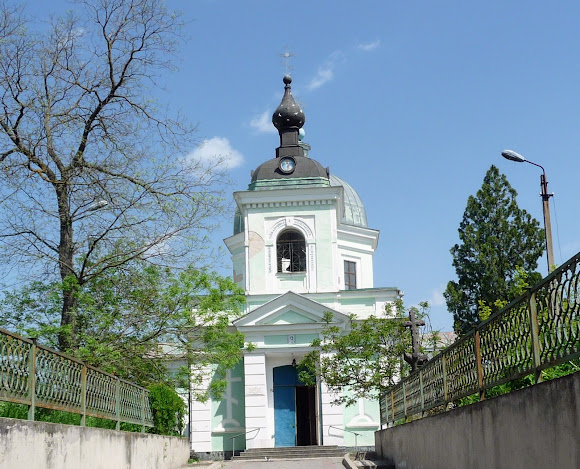 |
| The Church of All Saints. 1808 |
It is the architectural dominant of the necropolis, where gravestones from the 18th century have survived, and Cossack graves sit side by side with the burials of the nobility, the clergy, the merchant class and the peasantry.
 |
| The necropolis |
A monument to the philanthropist John Howard was made of durable Inhulets stone and erected in 1820 by decree of Emperor Alexander I. The Englishman cared about prisoners in various countries.
 |
| The monument to John Howard. 1820 |
While inspecting the conditions in which prisoners were held in Russia, the prison reformer fell ill with typhus and died in Kherson. Knowing nothing about the monument with the sundial mounted on it, I asked a lad working at a nearby car wash in whose honour the snow-white stele stood. The friendly Kherson local gave the first and last name correctly and added that Howard had sought methods of combating infectious diseases.
The Temporary Representative Office of the President of Ukraine in the Autonomous Republic of Crimea is located on Ushakova Avenue in building No. 42.
 |
| The Temporary Representative Office of the President of Ukraine in the Autonomous Republic of Crimea |
On Svobody Square sit the district and regional state administrations.
 |
| Svobody Square. The District State Administration |
 |
| Svobody Square. The Regional State Administration |
The restored "Ukraina" cinema resembles a pre-revolutionary picture house through the paired columns by the entrance, which very often lend a solemn air to the buildings of Kherson.
 |
| Svobody Square. The "Ukraina" cinema. A former picture house |
The emerald-coloured clinical hospital was built in 1914 and holds the status of an architectural monument.
 |
| The clinical hospital. 1914. An architectural monument |
For almost 110 years the Kherson Music College has been a centre of the city's musical education and cultural life.
 |
| The Music College |
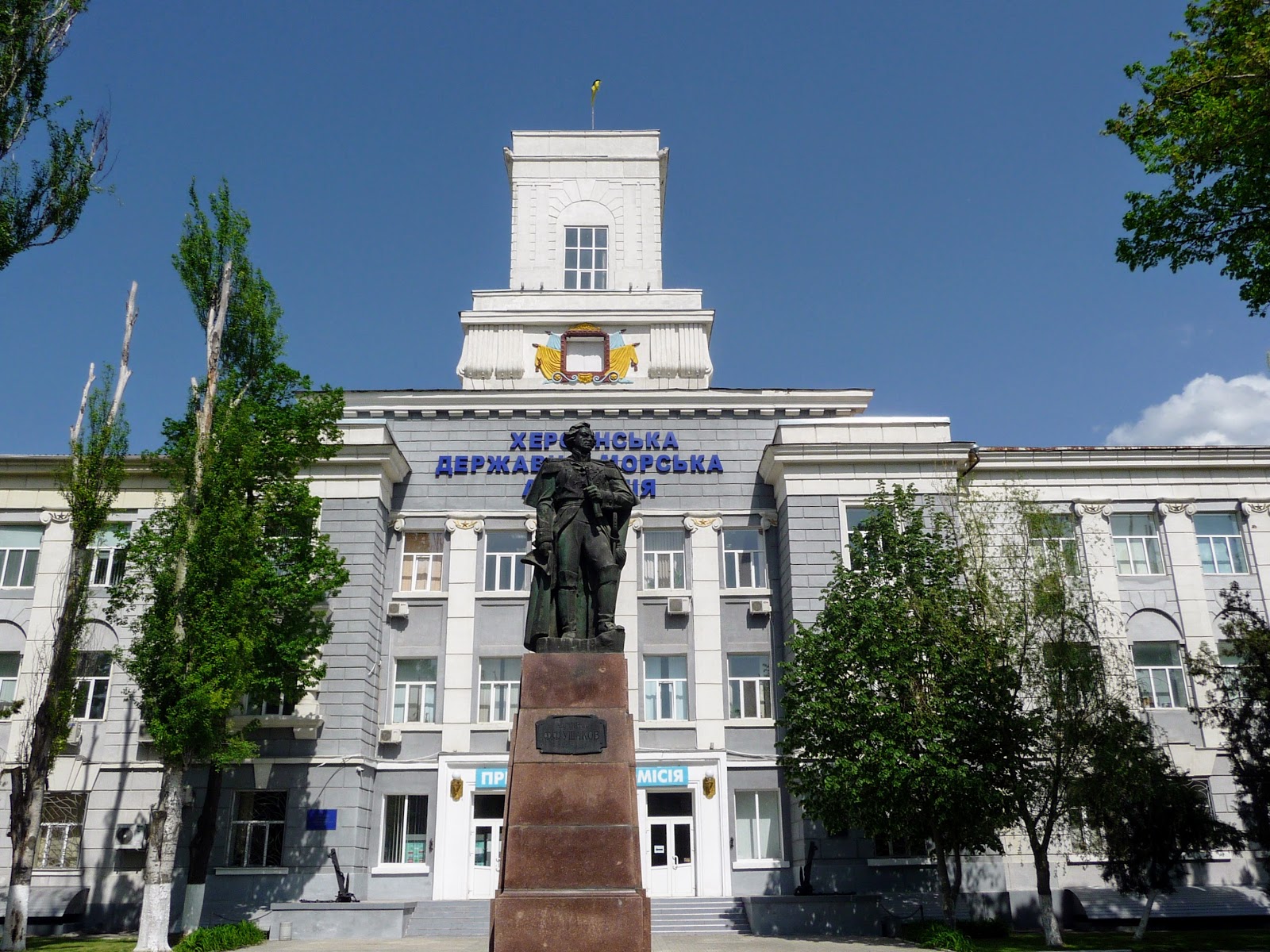
The Maritime Academy trains specialists for the sea and river fleets. By the entrance stands a monument to Admiral F. F. Ushakov, after whom the avenue is named.
 |
| The Maritime Academy and the monument to F. F. Ushakov |
A creative centre works to develop the tourism and local-history abilities of the young generation.
 |
| The Centre for Tourism and Local-History Creativity of Schoolchildren |
I saw about 10 plaques bearing the image of an owl and a QR code, fixed on the pavements near the landmarks.
 |
| Plaques on the pavements near the landmarks |
Probably, in order to study the city's memorable places, quests or some kind of tournaments are held. But neither the schoolchildren nor the older generation could tell me what the graphic signs on the pavements mean.
 |
| Plaques on the pavements near the landmarks |
The Culture Department of the Regional State Administration occupies a historic 19th-century building.
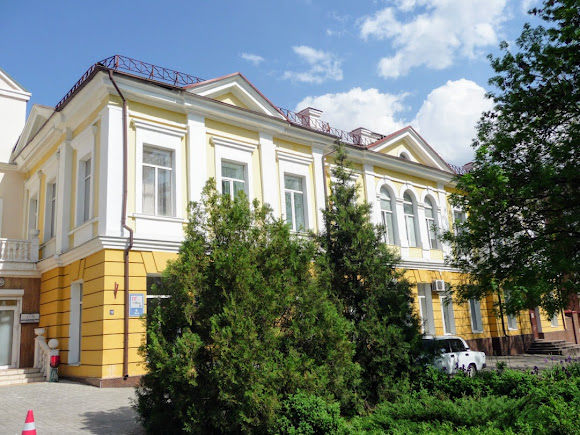 |
| The Culture Department of the Regional State Administration. An architectural monument. 19th c. |
If in
Dnipro,
Odesa,
Lviv and
Mykolaiv I came across enormous sculptural lions, then miniature sphinxes — for the first time.
 |
| The Culture Department of the Regional State Administration. A bench with sphinxes |
Kherson is a sea and river port, and the anchors by the Nautical School, founded almost 200 years ago, remind us of this.
 |
| The Nautical School |
 |
| The Nautical School. An anchor |
On Perekopska Street the plane trees take up the green relay.
 |
| Perekopska Street. Plane trees |
I very much liked that the city has many parks and public gardens, flowering and exotic plants.
 |
| Kherson green, Kherson in bloom |
The entrance to the T. H. Shevchenko Park from both sides is through a colonnade arch.
 |
| The colonnade arch. The entrance to the T. H. Shevchenko Park |
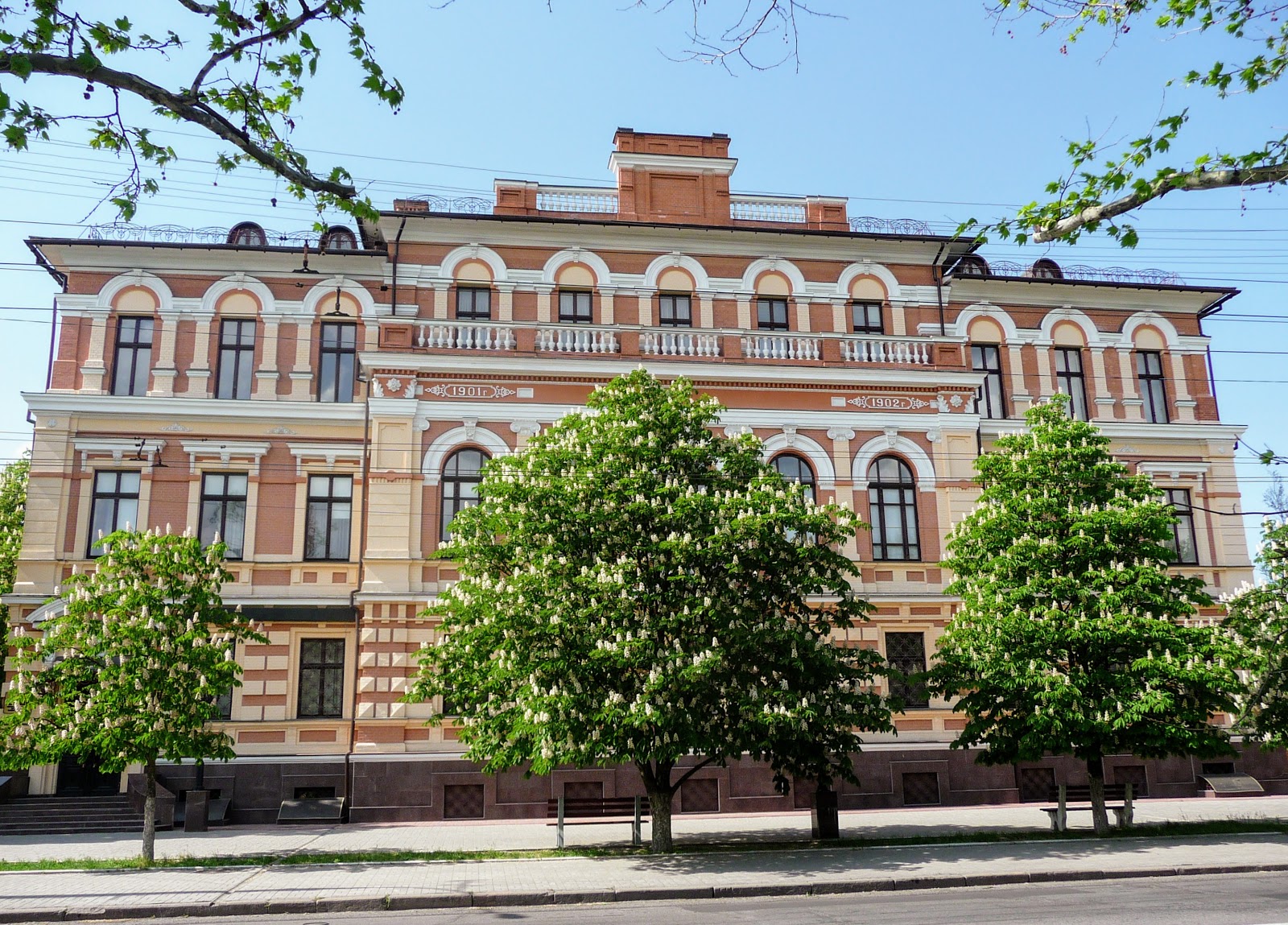
The State Bank building has served its purpose since 1902, as the dates on the facade testify.
 |
| The National Bank. An architectural landmark. 1902 |
In the Church of the Holy Martyr Alexandra, consecrated in 1902, the service is conducted in Ukrainian.
 |
| The Church of the Holy Martyr Alexandra. 1902 |
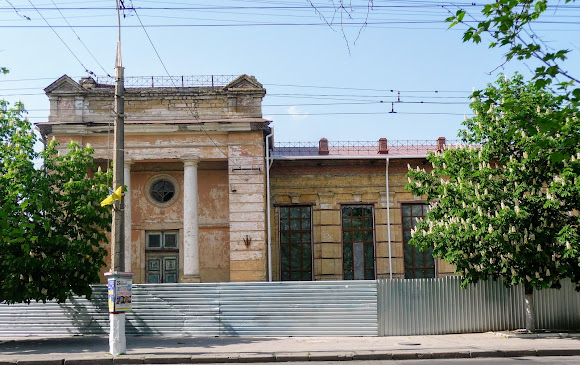
The former People's House, now the Regional Palace of Culture, though adorned with majestic columns, is in a dilapidated state.
 |
| The Palace of Culture. An architectural monument. 1903 |
The 1903 architectural monument continues to serve as a hub of culture, and the doorkeepers conscientiously do their duty, not letting curious people like me into rooms that are dangerous to life.
 |
| The Palace of Culture. An architectural monument. 1903 |
The grounds by the Palace are fenced off and reinforced with stone masonry.
 |
| The grounds of the Palace of Culture. Stone masonry |
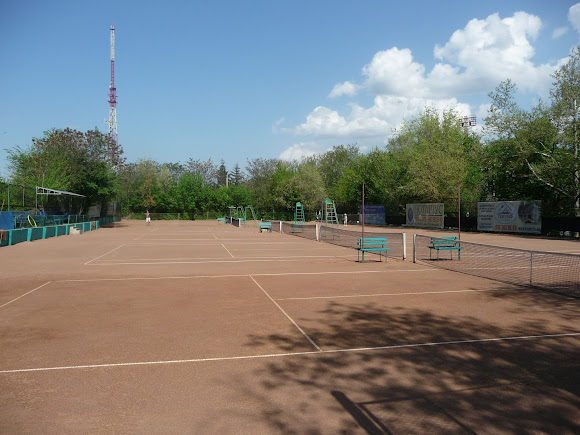
Kherson has decent conditions for playing sports.
 |
| Kherson. The "Spartak" Stadium |
 |
| Tennis courts of the "Ukraina" Sports Society |
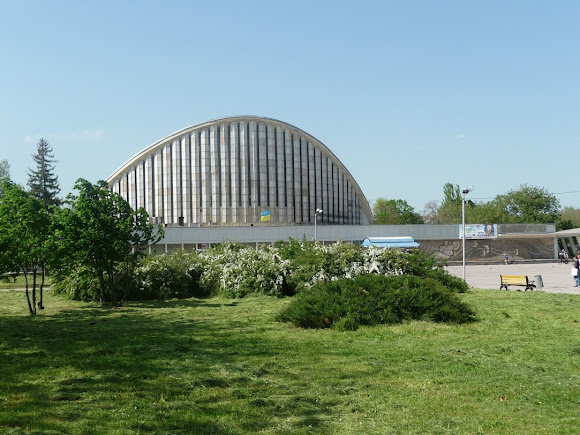
The "Yuvileinyi" cinema and concert hall, seating 1,500, is decorated with a decorative mosaic panel depicting (as I understood it) Lel, and from beneath the strings of his lyre fly either seagulls or swan-geese.
 |
| The "Yuvileinyi" cinema and concert hall |
 |
| The "Yuvileinyi" cinema and concert hall. The mosaic panel |
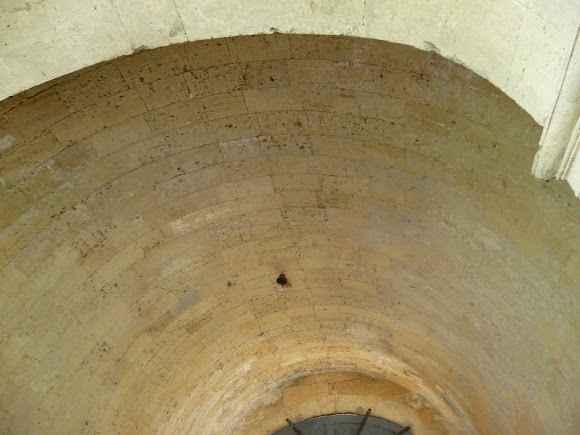
I had already seen the triumphal Ochakiv Gate of the Kherson citadel, erected in 1783.
 |
| The Ochakiv Gate of the fortress. 1783 |
I asked schoolchildren of 7-8 years what they knew about the fortress and where it stood. The boys could tell me nothing.
 |
| The Ochakiv Gate of the fortress. 1783 |
On the board with the layout plan of the fortifications it is noted that almost all the structures have, sadly, been dismantled or destroyed.
 |
| The plan of the Kherson Fortress |
Part of the earthen ramparts has survived, where the ubiquitous lawnmowers had not yet managed to cut the thick grass, and I decided to rest on a blanket of dandelions.
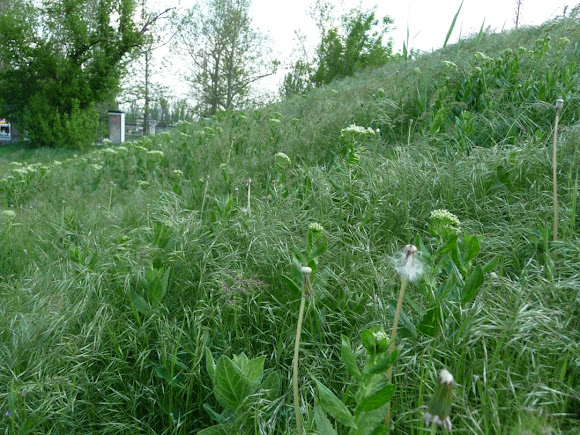 |
| The remains of the earthen ramparts of the Kherson Fortress |
I looked at the blue Kherson sky and at how this sky is propped up by the dome of Kherson's oldest building, St Catherine's Cathedral, and by the 200-metre television tower, which is equipped with modern powerful transmitters.
 |
| St Catherine's Cathedral. 1786. The television tower. 2005 |
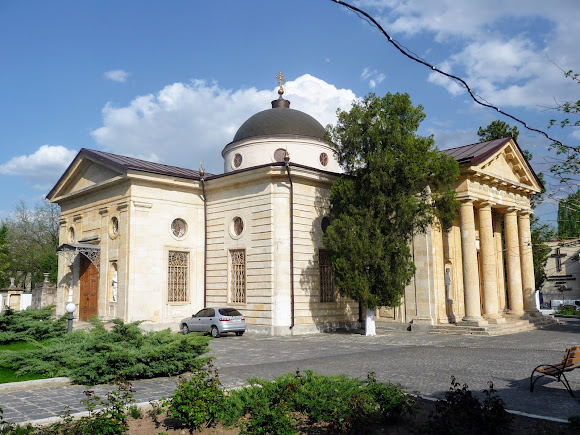
The cathedral was built in 1786 on the initiative of Grigory Potemkin in honour of Empress Catherine the Great, who in 1778 signed a decree on the building of a fortress and a shipyard on the bank of the Dnipro.
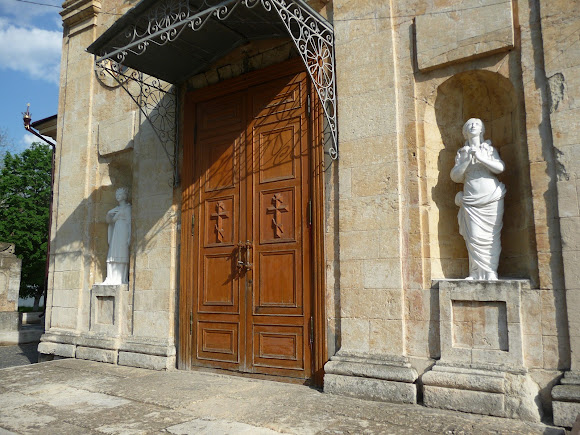 |
| St Catherine's Cathedral. 1786 |
The shrine became the burial vault of the prince.
 |
| The bell tower of St Catherine's Cathedral. 1806 |
 |
| The pump room of St Catherine's Cathedral |
 |
| St Catherine's Cathedral. 1786 |
In the church courtyard there are burials of historical figures.
 |
| Monuments on the grounds of St Catherine's Cathedral. 1786 |
This is the first time I have seen cannons beside churches. Usually they are placed by museums and town halls.
 |
| Cannons on the grounds of St Catherine's Cathedral. 1786 |
The grounds of the television tower are enclosed by a fence painted with scenes of city life.
 |
| The "Kherson Fortress" park. The fence |
The premises of the Kherson Fortress arsenal, built in 1784, have survived, and a correctional colony is now housed in them.
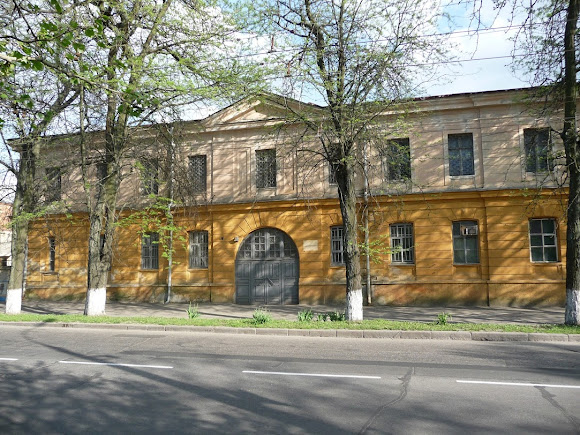 |
| The former arsenal of the Kherson Fortress. 1784. A correctional colony |
Various organisations have filled the pompous buildings with columns.
 |
| Administrative buildings |
In the Park of Glory, memorials and monuments have been erected in honour of the defenders of the Kherson region during World War II and of the internationalist soldiers.
 |
| The Park of Glory. War memorials |
How many steps are on the staircase
 |
| The Park of Glory. The staircase |
that lead from the Eternal Flame
 |
| The Park of Glory. The Eternal Flame |
down to the embankment, the local residents could not answer my question.
 |
| The staircase |
Guests from Dnipro helped to count them.
 |
| The staircase. Guests from Dnipro who counted the steps |
Up to the penultimate upper flight there are 102 steps, but there are a few more up to the Victory Statue.
 |
| The Victory Statue |
Having walked along the embankment, listened to the cry of the seagulls and admired the Dnipro, I continued my promenade through springtime Kherson.
 |
| The embankment. The Dnipro |
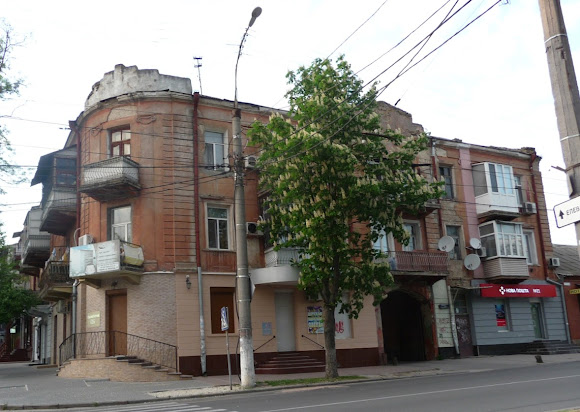
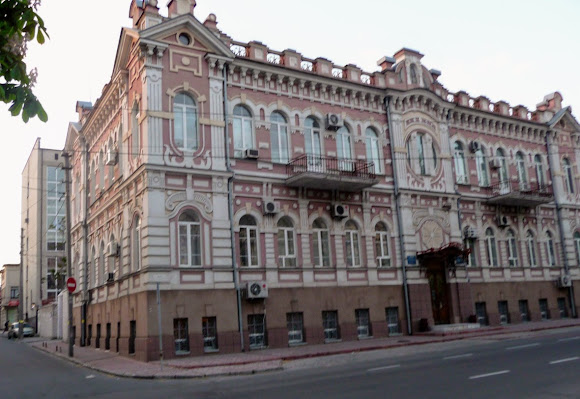
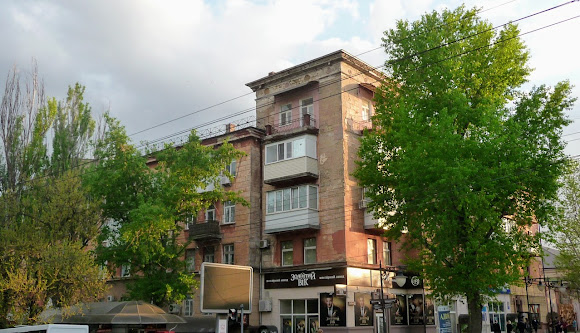
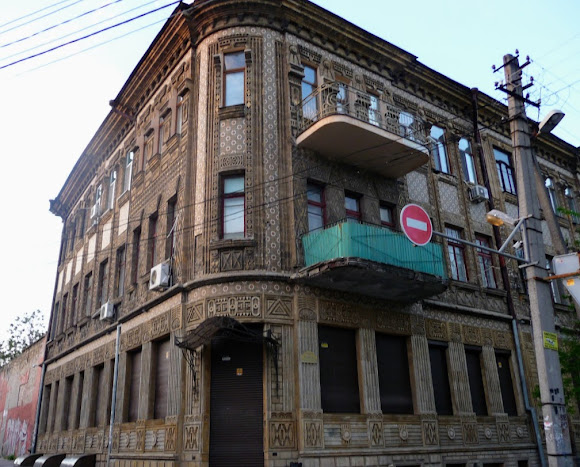
I saw a great many beautiful and unusual buildings on Liuteranska, Soborna and Suvorova streets.
These are buildings of pre-revolutionary and post-war construction.
It is noticeable that in all eras the architects wanted to lend their creations luxury and might, decorating the buildings with various ornamental elements.
Even on a roof one can encounter Kherson's distinctive feature — columns. The architects placed a small rotunda right at the very top.
Modern designers try to decorate the city in their own way.
 |
| The "Suvorivskyi" shopping mall |
 |
| An arch decorated with graffiti |
Future grandmasters are trained in a building constructed in 1905.
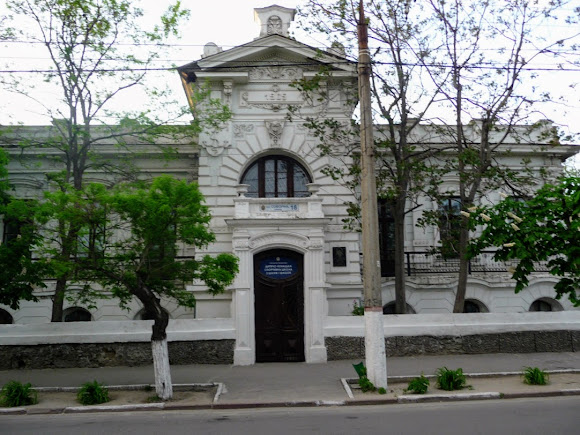 |
| The Draughts and Chess Sports School. An architectural landmark. 1905 |
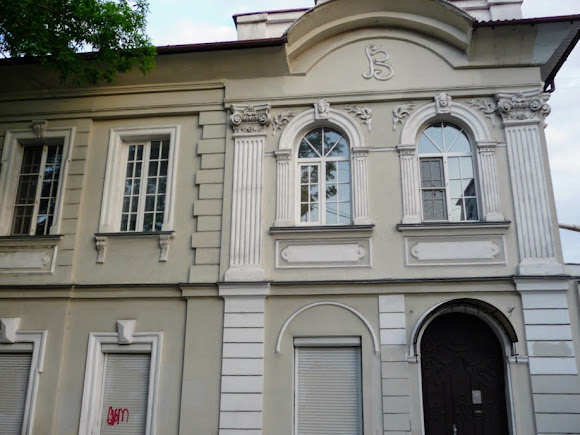
And talented young musical performers hone their skills in the former house of the town mayor Blazhkov, built at the beginning of the 20th century.
 |
| Music School No. 1. An architectural landmark. 1909 |
A monument to the great military commander was erected as a token of gratitude for the fact that he did not give up the lands of Tavrida to the Turks. The bust of A. V. Suvorov stands at the beginning of the street of the same name, next to the house in which he lived at the end of the 18th century during the completion of the fortress's construction. In the photograph it is the green house, and it is called just that — the Suvorov House.
 |
| The monument to A. V. Suvorov and the Suvorov House |
The Russian Bank of Foreign Trade was located in the house of the Falz-Fein nobles.
 |
| The Falz-Fein house |
In the building of the now not very presentable Shipbuilders' Palace of Culture, the great composer M. P. Mussorgsky gave a concert in 1879.
 |
| The Shipbuilders' Palace of Culture. In 1879 the composer M. P. Mussorgsky performed here |
At the end of the 18th century, on the initiative of Kherson merchants, the Holy Dormition Cathedral was built.
 |
| The Holy Dormition Cathedral. 1798 |
A journey to the stars takes place in the oldest building of the 18th century.
 |
| The Planetarium. A former synagogue. The 1780s |
The building of the Registry Office, snow-white like a bride's dress, was built at the end of the 19th century for the Public Library.
 |
| The Registry Office. An architectural landmark. 1897 |
Two houses on Staroobriadnytska Street drew attention with their facing and decorative stucco.
 |
| Residential houses on Staroobriadnytska Street. Architectural landmarks. |
The M. Kulish Kherson Academic Music and Drama Theatre is one of the largest drama theatres in Ukraine.
There are several museums in the city.
 |
| The Natural History Department of the Kherson Regional Local History Museum. 1906 |
The art museum's displays can be viewed in the building of the former City Duma.
 |
| The O. O. Shovkunenko Kherson Regional Art Museum. 1905 |
The clock on the tower showed the exact time and reminded me that my walk was coming to an end and it was time to head back to the railway station.
 |
| The O. O. Shovkunenko Kherson Regional Art Museum. 1905. The clock tower |
The last photograph, taken practically in the dark, was of the monument to Grigory Potemkin. The city's founder is depicted in Roman armour and with a sword in his hand.
 |
| The monument to Grigory Potemkin |
I wish Kherson and its residents that all their efforts, aspirations and hopes help the city to develop and flourish.
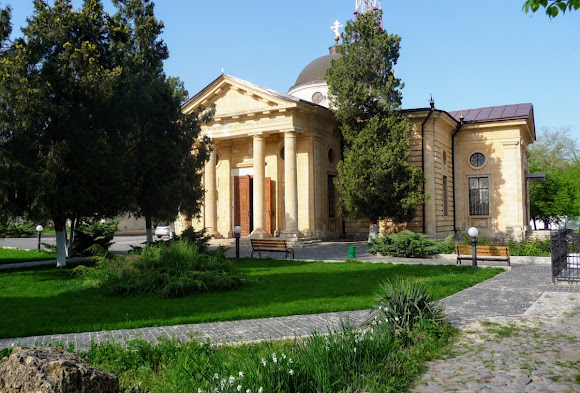 |
| St Catherine's Cathedral. 1786 |





















No comments:
Post a Comment
Leave your impression