There are cities that grow weary of people and their activity. The era of development ends, and a stage of decay sets in — of enterprises, roads, buildings, historical and cultural treasures. In Kostiantynivka, in the Donetsk region, the depressed state of its industrial and social-amenity facilities was evident long before 2014.
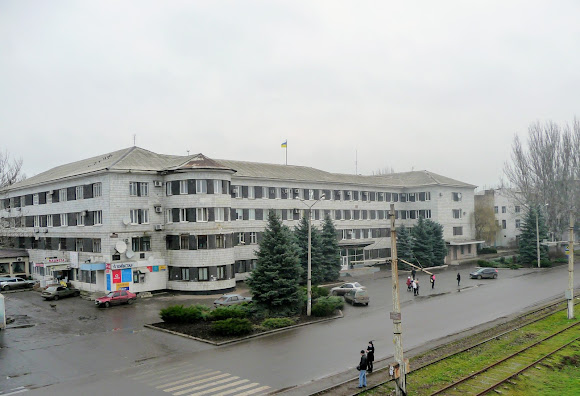 |
| Kostiantynivka. Oleksa Tykhy St. The city council |
Twenty-two factories in a single city of around 100,000 people — who can rival such a concentration of industry?
 |
| Yemelianov St. |
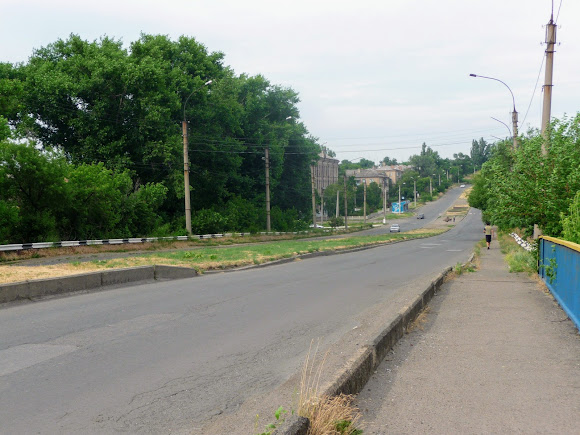 |
| Sobornosti St. |
And that means pipes venting carcinogens, layer upon layer of dust, hazardous emissions, occupational diseases.
 |
| Industrial landscapes |
At the turn of the 19th and 20th centuries the former small town of Santurynivka took shape as an industrial centre.
 |
| The private housing of the Stare Selyshche residential district |
 |
| The private housing of the Ukrainskyi Khutir residential district |
The capital of Belgian shareholders laid the foundations of industrialisation in the rapidly growing city; its peak came in the years of socialist construction, when the great country needed everything, and a very great deal of it. The Kremlin stars were made of ruby glass melted at the Avtosklo plant, and the sand for it was supplied from
Avdiivka.
 |
| The Kremlin stars in Moscow are made from Kostiantynivka ruby glass |
The crystal sarcophagus of the leader of the proletariat, and the coloured glass for the Moscow metro, were the work of Kostiantynivka craftsmen. For the World's Fair in New York the master glassblowers presented a crystal fountain 4.5 metres tall.
 |
| The crystal fountain — a masterpiece of glass craftsmanship by the masters of Kostiantynivka. After the exhibition, the trail of the vanished fountain leads to Saint Petersburg |
During the Second World War, after the city was liberated in 1943, the enterprises were rebuilt and worked for the front. Mirror reflectors for the searchlights used in the storming of Berlin were delivered by special order to Marshal Zhukov from Kostiantynivka. In the years of developed socialism the enterprises expanded and were fitted with new equipment. Residential neighbourhoods, cinemas, educational institutions and stadiums were built.
 |
| Oleksa Tykhy St., 256. A residential building and shops |
 |
| Oleksa Tykhy St., the main post office. 1926. Style: constructivism |
 |
| Toretska St., the Ukraina department store. 1926, 1941. Built for the state bank |
The architects wanted to build a garden city, and they managed a great deal.
 |
| Oleksa Tykhy St., 106. A residential building. 1938 |
 |
| Lomonosov Ave. A palace of culture seating 1,200 and sculptures of lions by the entrance |
 |
| Yuvileinyi Park. 203 hectares. Sculptures of lions by the entrance |
No one could have foreseen the mounting collapse, still less halted it. The railway station in front-line Kostiantynivka is the terminus in the region and links it with the country's other parts.
 |
| The railway station building. 1926, 1955 |
 |
| The railway station |
When you ride the train for 7 kilometres within the city limits, you become a witness to the collapse.
 |
| Kostiantynivka. The industrial zone |
 |
| The elevated walkway onto the grounds of the Avtosklo plant |
 |
| A ruined production building |
 |
| All the elevated walkways on the factory grounds are destroyed |
 |
| A postbox |
The metallurgical and chemical enterprises, the Avtosklo plant, the administrative and production buildings are all sheer ruins.
 |
| The administrative building of the glass plant |
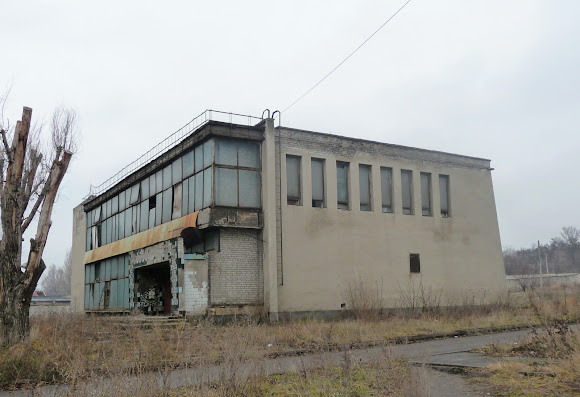 |
| The former canteen of the Avtosklo plant |
 |
| The sign on the plant's administrative building |
Life barely flickers on in the small private workshops.
 |
| The few remaining production workshops |
The crisis of the city-forming enterprises brought problems in the social sphere and a decline in living standards. In recent years the population of Kostiantynivka has fallen by a third; many have left in search of a better fate, and the death rate exceeds the birth rate. Only refugees and displaced people become residents of Kostiantynivka, which lies 17 kilometres from the line of contact. School No. 15 was designed for 800 pupils, but today about 300 study there. Teachers and parents try to do everything they can to keep learning there on a normal footing.
 |
| School No. 15. 1961 |
 |
| School No. 15. Classrooms |
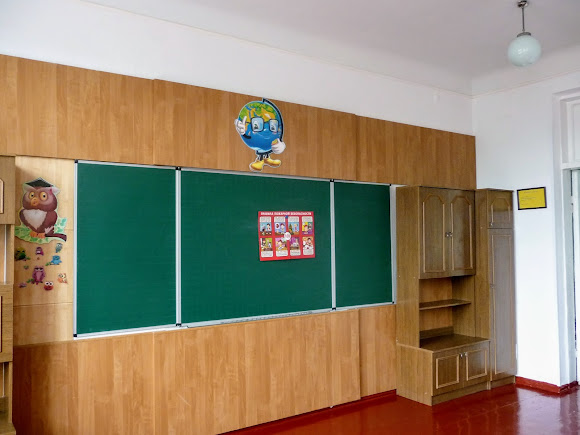 |
| School No. 15. Subject rooms |
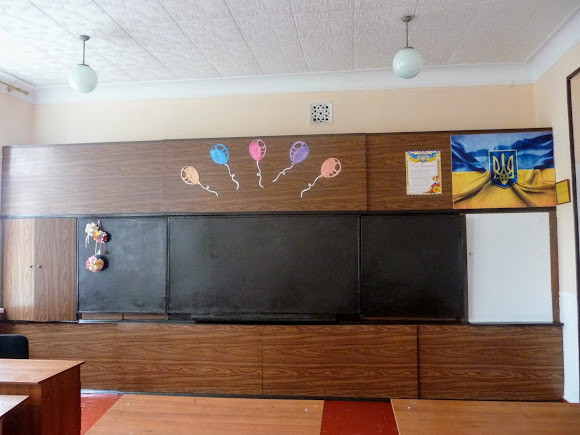 |
| School No. 15. Subject rooms |
School No. 2 was founded in 1900 and, over its more than century-long history, has been the alma mater of several thousand future metallurgists and chemists.
 |
| School No. 2. 1900 |
 |
| School No. 2. 1900 |
Other educational institutions were less fortunate. School No. 3 was once part of a single chain of buildings erected in the classical style.
 |
| School No. 3. 1951 |
 |
| School No. 3. 1951 |
School No. 7, where in the good old days as many as 2,400 pupils studied in two shifts, was quietly closed under the guise of optimisation.
 |
| The closed School No. 7. During the fascist occupation it housed a German infirmary |
Because of the low birth rate, kindergartens have become unnecessary.
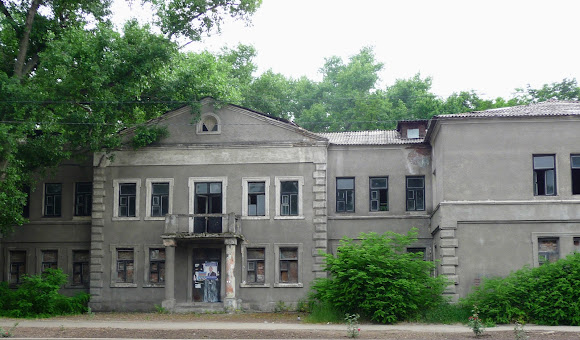 |
| A closed kindergarten on Lomonosov Ave. |
The closure is planned of the inter-school training-and-production complex, where for half a century schoolchildren have not only gained an idea of their future profession but also successfully mastered the skills of driver, fitter, computer typesetter, plasterer, shop assistant and seamstress. One of the few surviving buildings of Belgian architecture is set to share the fate of its abandoned and forgotten fellows.
 |
| A monument of Belgian architecture. The former management building of the anonymous company of the Donetsk and chemical works. At present the MNVK (inter-school complex). Late 19th c. — early 20th c. |
At the dawn of the economic boom it housed the administration of the bottle, chemical and glass plants, whose chief managing director was Valentyn Homon. For its production managers the Belgians, at the end of the 19th century, built a lavish two-storey mansion with round windows and balconies on the bank of the Kryvyi Torets river. A terrace led into the park, and an underground passage to the river.
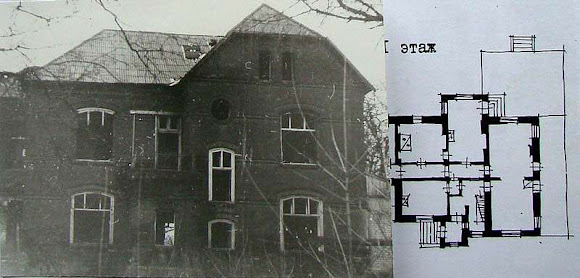 |
| The former Homon house. 1895 |
It was home to Homon, who ended up in exile after the events of 1917 and the nationalisation of the enterprises. In Soviet times the party bosses held informal gatherings at the director's estate, and later, recalling the very slogan they themselves had proclaimed, they nonetheless gave the best to the children.
 |
| The Kryvyi Torets river |
Human greed knows no bounds, and after a while the kindergarten in the city's green zone was closed and the building taken apart brick by brick. Finding the ruins of the once-luxurious villa took no small effort. Not a trace remains of the building and its avenues — thickets, rubbish and oblivion.
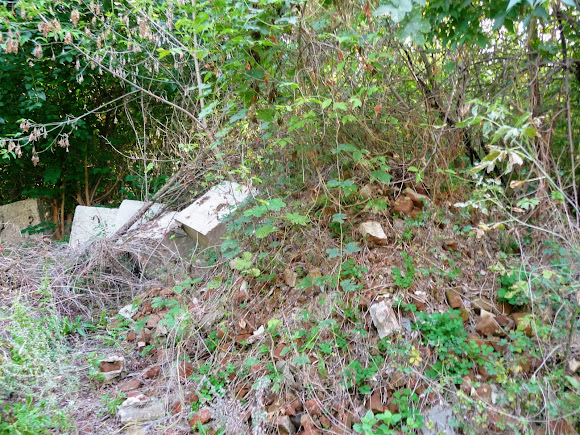 |
| The ruins of the Homon house |
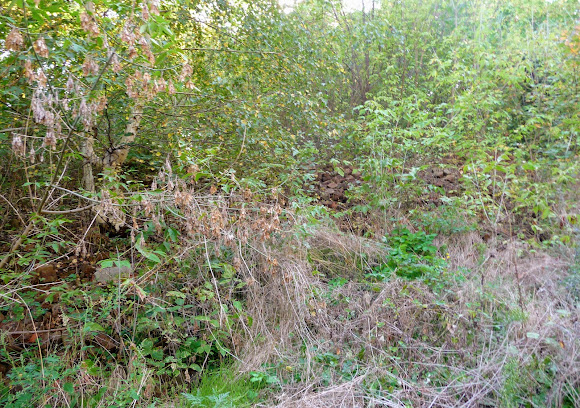 |
| The ruins of the Homon house are almost invisible in the thickets |
According to an old city legend, an underground passage ran from the Homon house to another building of Belgian architecture on the opposite bank of the Torets.
 |
| The Kryvyi Torets river |
The building came to be known as the Gaudi Castle, in honour of the Catalan architect Antoni Gaudi and his famous creation that became the calling card of Barcelona. Later the name mutated into the Broudi Castle, for every castle has its secrets.
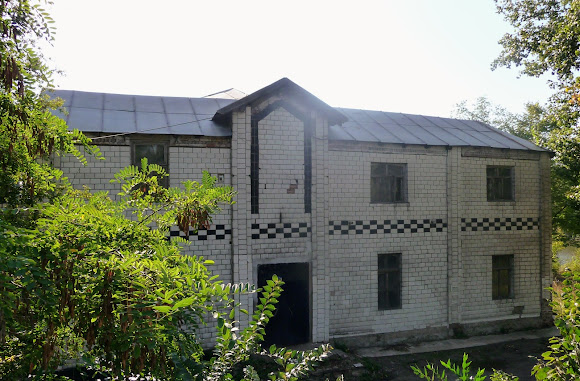 |
| An abandoned building of Belgian architecture. A former maternity hospital. Early 20th c. |
 |
| The "Gaudi-Broudi Castle". Early 20th c. |
For a long time the building housed a maternity hospital, and it is believed that the famous actress Nonna Mordyukova was born in it.
 |
| The "Gaudi-Broudi Castle". The former maternity hospital, with its characteristic inscription on the wall |
But not all the estates in Kostiantynivka look so sad. In Yuvileinyi Park, a place where the townspeople relax, in the green zone of an industrial city, rises the fortress of a certain Zhulii, built in the era of crimson blazers and named after himself — "ZHANZH".
 |
| Yuvileinyi Park. Zhulii's Castle. 1990s |
The tradition of granting company housing to enterprise managers appealed to the Soviet nomenklatura and, having adopted it from the Belgians, in the 1930s they built a two-storey house for the director and chief engineer of the UkrTsynk plant, with two exits — into the park and to the plant. For a time the second floor served as a hotel for high-ranking guests. In the 1970s, in the period of developed socialism, the directorate no longer wished to live in the departmental mansion, and it was occupied by ordinary labourers next in the housing queue.
 |
| Molodizhna St. The former director's house. 1930s |
Residential buildings were constructed for the working class in great numbers.
 |
| Shmidt St., 6. A two-storey residential building |
Probably, in more prosperous times, the colour of the painted walls could have been called sunny, but now they have taken on a poisonous shade.
 |
| Oleksa Tykhy St. A two-storey residential building |
 |
| Bohdan Khmelnytsky St. A two-storey residential building |
 |
| Bohdan Khmelnytsky St. A two-storey residential building |
 |
| Molodizhna St. A two-storey residential building |
 |
| Sobornosti St. A three-storey residential building |
 |
| Kurska St. A two-storey residential building |
For the young workforce arriving from all over the country, dormitories were opened. It is hard to believe, but someone still lives in this dwelling.
 |
| The dormitory of the UkrTsynk plant |
 |
| There are even some replaced windows |
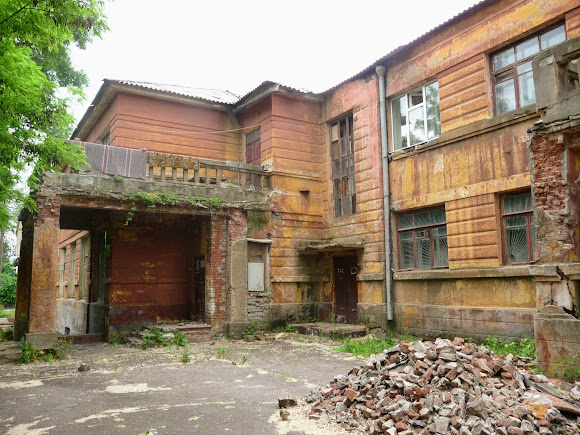 |
| But the building is in a dangerous state |
The dormitory of the glassware plant, built in 1938, was long considered the architectural calling card of the city, and the life-affirming sculptures of athletes installed by its entrance were destroyed neither by Hitler's troops during the occupation nor by the decrees of the moraliser Khrushchev.
 |
| Oleksa Tykhy St. The former dormitory of the glassware plant. 1938 |
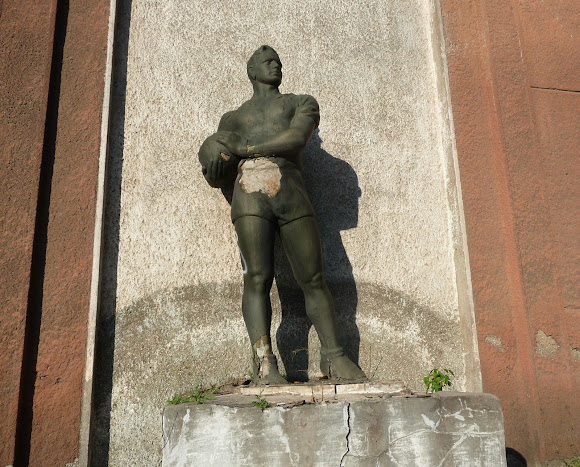 |
| The former dormitory of the glassware plant. 1938. A sculpture of a male athlete; the sculpture of a female athlete has already been destroyed |
Every condition was created to raise the cultural and educational level of the residents of Kostiantynivka. Of 49 libraries, only two have not closed.
 |
| The closed library of the UkrTsynk plant |
Plays by famous authors were staged on the boards of the Drama Theatre from 1926. After the war the temple of Melpomene was rebuilt into the chemists' palace of culture, and the townspeople remembered the performances in its auditorium, with its excellent acoustics, by the singer-songwriter Volodymyr Vysotsky and other stars from the capital.
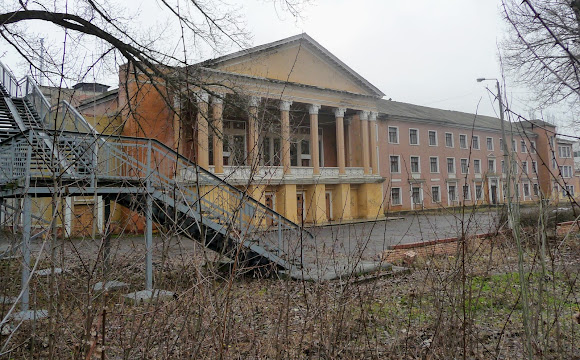 |
| The chemists' palace of culture |
 |
| The chemists' palace of culture |
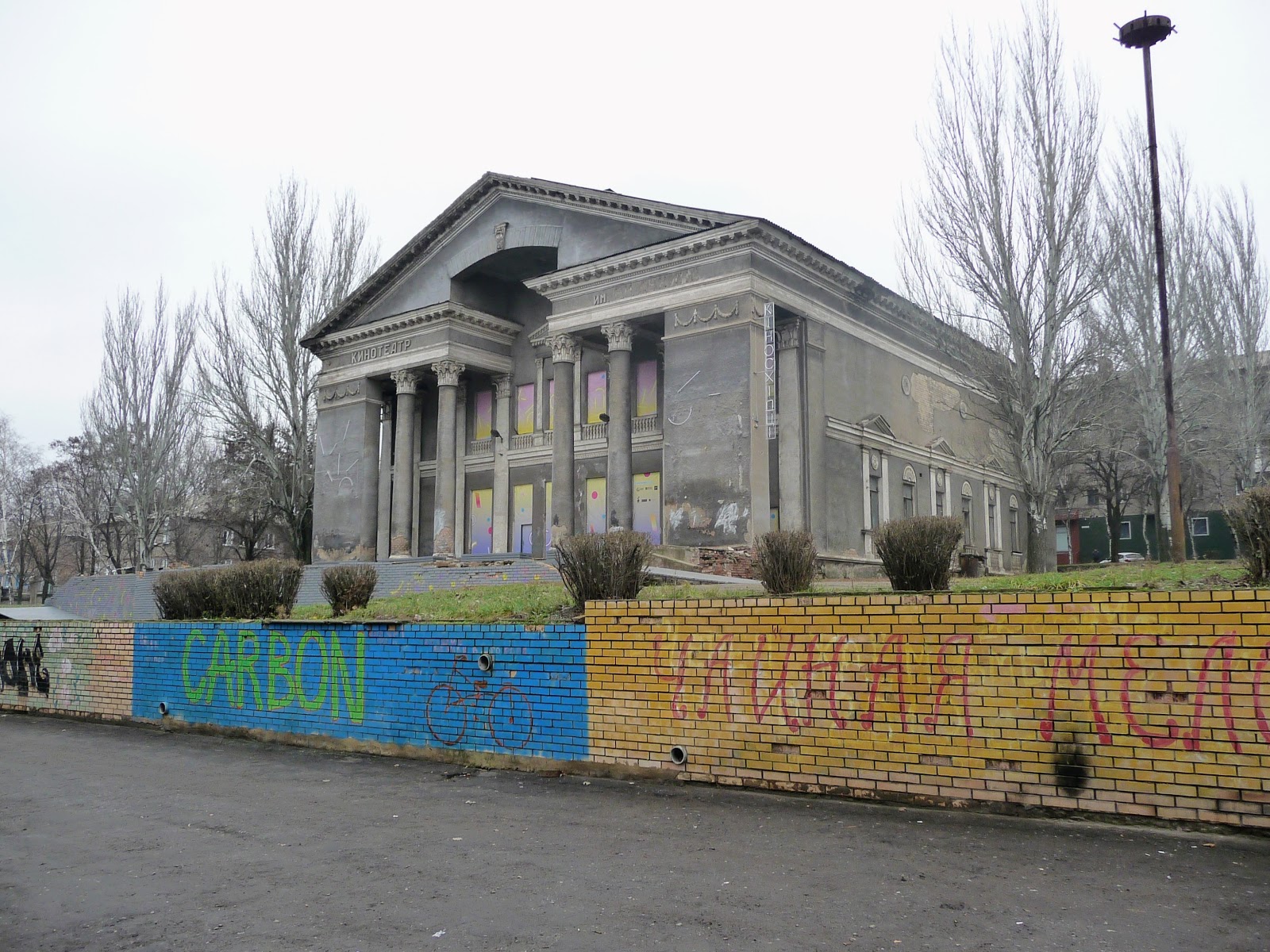
It has been a long time since anyone asked for a spare ticket outside the cinema with its blue and pink auditoriums.
 |
| Toretska St. The closed cinema. 1960 |
 |
| The closed cinema. 1960. A bas-relief on the facade with Soviet symbols |
Very often in Kostiantynivka you can see underground inscriptions carrying peculiar messages to society.
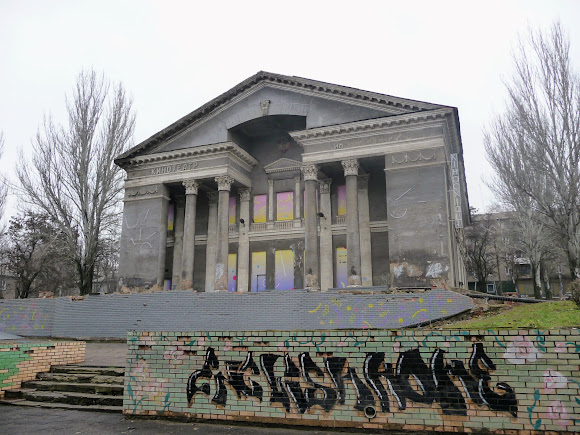 |
| An inscription on the fence beside the closed cinema |
Slogans on the walls once glorified labour and urged people to work.
 |
| Toretska St. The REM (electricity network). Inscription: "Glory to Labour" |
The power shop of the chemical plant, as tall as a five-storey building, is adorned by a street fresco depicting a techno-landscape and a fiery glow.
 |
| The power shop and a street fresco on the theme of industrialisation |
The industrial theme is present in the graffiti at a tram stop that has turned into a stop for minibuses.
 |
| A tram stop where no tram has stopped for 2 years. A mural of an industrial city with elements of romance |
Since 2016 tram traffic in Kostiantynivka has been halted following the theft of the contact wire.
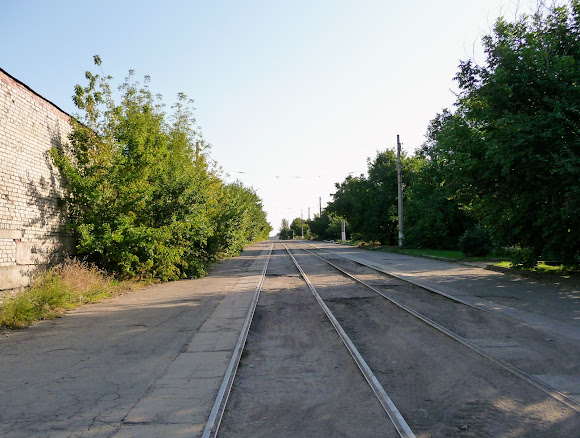 |
| A tram line without trams |
 |
| A tram line 50 km long |
 |
| Grass has grown up where the rails were taken away |
As a reminder of the rail service that ran from 1931 — a 50-kilometre network, 13 cars and two routes — a monument to the tram remains at the former depot on the tram loop, whose rails have already been dismantled.
 |
| A monument to the tram, which was the people's transport from 1931 |
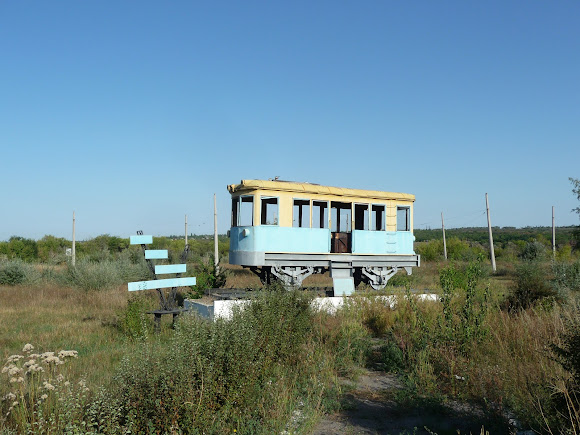 |
| The monument to the tram was installed in 2001 |
Kostiantynivka is a green city, but its parks and squares look neglected and are in need of tidying up.
 |
| Metalurh Park. Laid out in the 1920s. Area — 10 hectares |
 |
| No water flows in the park fountain |
 |
| The park of the UkrTsynk plant. Closed after soil samples exceeded the maximum permissible concentration of heavy metals |
Besides old, abandoned buildings, one comes across quite a few new, long-unfinished constructions.
 |
| A construction unfinished for years |
 |
| Construction frozen for years |
 |
| Houses with broken window panes are no rarity in a city of glass plants |
Perhaps so that the residents would not feel so sad, copies of the landmarks of European capitals were installed near the city hall — though somewhat modestly, in the back yard.
 |
| Big Ben — a copy of the London clock tower |
 |
| A copy of the Eiffel Tower — the symbol of Paris |
One wishes for the people of Kostiantynivka that their city may become prosperous, and that its symbol may be not foreign towers but the masterpieces of Kostiantynivka's own masters.




No comments:
Post a Comment
Leave your impression