Halych is one of the oldest cities in Ukraine and in Eastern Europe, its history reckoned from the year 898. In the 12th century the Galician-Volhynian princes chose Halych as their capital and turned it into a mighty political and spiritual centre. Let us see how modern-day ancient Halych is laid out and what landmarks make this district centre of the Ivano-Frankivsk region so rich.
 |
| Halych. Ivano-Frankivsk region. Nativity Square |
We shall not survey the whole territory of the princely town with its surrounding villages, where the citadel once stood. Let us instead stroll at the foot of Castle Hill and in the place where, in the years of the chronicles, the trading rows and the wharf lay.
The Starostyn Castle, raised in the 14th century on Halych Hill, can be seen at the entrance to the town and from any point in the surrounding area.
The tourist popularity of this early-mediaeval fortress spurred the authorities, to some degree, to revive the historic monument. The restorers rebuilt, literally from ruins, a tower and a stretch of the defensive wall, but a large part of the fortification has not been conserved and stands in a state of complete decay.
As in every town, the main square holds great public and historical significance.
 |
| Halych. Nativity Square |
Scholars believe that a pagan sanctuary and an ancient temple once stood on the site of the central square.
Administrative, residential and commercial buildings stand on Nativity Square.
 |
| Nativity Square, 17. Town hall |
 |
| Nativity Square, 13 |
 |
| Nativity Square. A garage beneath Castle Hill |
 |
| Nativity Square. For the four-legged ones — a siesta |
 |
| Nativity Square, 11a. A modern high-rise |
 |
| Nativity Square. A commercial building |
 |
| Nativity Square. A commercial building |
 |
| Nativity Square. A residential building and a pharmacy |
The People's House, the post office and the shopping complex have the features of palaces and castles, which is characteristic of the architecture of Prykarpattia.
 |
| Nativity Square. The People's House |
 |
| Nativity Square. The post office |
 |
| Nativity Square. The shopping complex |
 |
| Nativity Square. A commercial building |
A few of the townhouses have kept the architectural style of the Austrian and Polish periods.
 |
| Nativity Square, 17 |
 |
| Nativity Square, 18 |
 |
| Nativity Square, 20 |
 |
| Nativity Square, 22 |
 |
| Nativity Square, 33. Military enlistment office |
 |
| Nativity Square, 30 |
The central place on the square is taken by an equestrian statue of the first Ukrainian king. The monument to Danylo Halytskyi was raised in 1998 for the town's 1,100th anniversary. In 1238 the grand prince of Kyiv rode into Halych as a victor, having united the Galician and Volhynian lands. Among the achievements of this commander and diplomat is the appearance of the square and of the merchant quarters, which were laid out at the initiative of the founder of Lviv.
The Church of the Nativity of Christ is part of the 'Ancient Halych' reserve complex.
 |
| Nativity Square. The Church of the Nativity of Christ |
The shrine dates from the 13th-15th centuries, but researchers put forward theories of its earlier existence on the site of a wooden predecessor, which in its turn had replaced a pagan sanctuary.
The church's iconostasis is hewn from sandstone, and the holy images are set out in mosaic.
Over its centuries-long history the church has belonged to various brotherhoods and confessions; today it is used by the Greek Catholics. In 1906 Metropolitan Andrey Sheptytsky of the UGCC consecrated the church after yet another rebuilding.
 |
| The Church of the Nativity of Christ. Monument to Andrey Sheptytsky |
On the church grounds, in 1929, a monument was erected to the victims of the Austrian regime — the prisoners of the Thalerhof concentration camp, one of whom was Father Mykola, the rector of the Church of the Nativity of Christ. Of the 127 arrested Russophiles, residents of Halych, twenty were tortured to death.
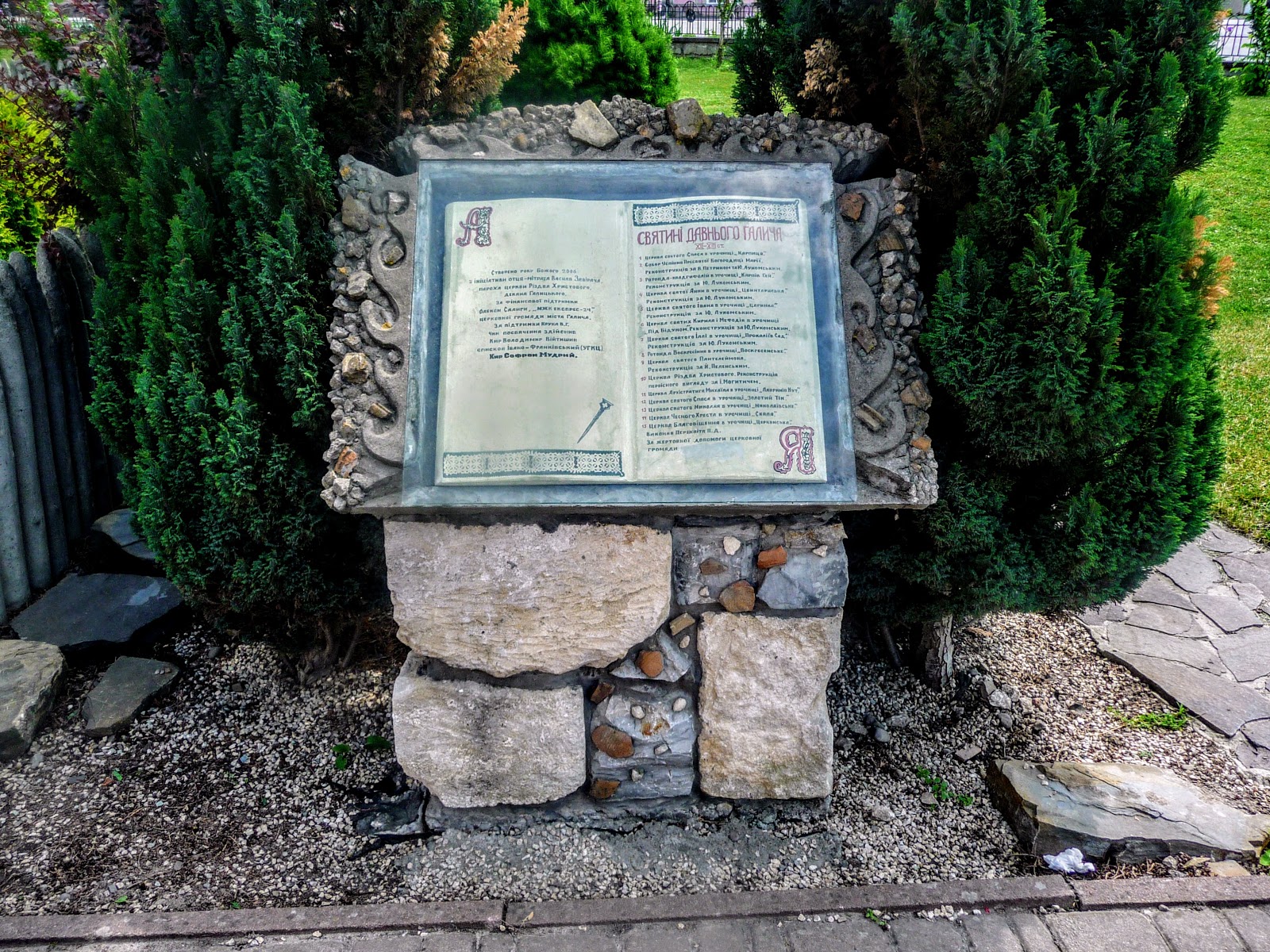
The park of miniature monuments of Ancient Halych lets tourists acquaint themselves with the main sights and plan the further route of their journey.
And we shall carry on our walk across the 312-metre bridge of latticework trusses and admire the beauty of the mighty Dnister.
At this spot its current is calm and free of rapids.
 |
| Halych. The Dnister. The embankment |
The opening of the new Chernivtsi-Stanislav-Lviv transport routes prompted the replacement, at the start of the 20th century, of the outdated wooden bridge with a metal one. Built in 1912, it was repaired more than once after being destroyed in the wars. With the opening in 1984 of a new road bridge, the old one now serves pedestrians, linking the southern and northern parts of Halych.
 |
| The road bridge across the Dnister |
In 1858 a column was unveiled in gratitude to the royal viceroy Goluchowski for his part in building the first permanent wooden bridge. The inscription on the memorial plaque is made in two languages — Ukrainian and German, the state language of the Austrian monarchy.
An anchor found in the Dnister has been set up in memory of the founders of navigation on one of Ukraine's chief blue arteries.
 |
| Monument in honour of the founders of navigation |
The walk on foot passes from the bridge onto the recently opened Alley of the Heavenly Hundred.
 |
| A sculpture of Jesus Christ |
 |
| The Alley of the Heavenly Hundred |
The nondescript fence of the 'Sokil' sports complex has been adorned with bright panels, 250 sq m in all, depicting important events of Ukraine's recent history.
 |
| The 'Sokil' sports complex. The fence with murals |
On the way to the railway station there are a few stops by the mansions and two-storey residential houses built at the turn of the 19th and 20th centuries.
 |
| Lvivska Street. School No. 2 |
 |
| Lvivska Street. School No. 2. The teaching block |
 |
| Koliiova Street, 2 |
 |
| Koliiova Street, 6 |
 |
| Koliiova Street, 39 |
Another place of worship in Halych, on Dmytro Vitovsky Street, the Church of St Demetrius, dates from 1831.
 |
| Dmytro Vitovsky Street. The Church of St Demetrius. 1831 |
The last shot on the station square, by the monument to the victims of the totalitarian Stalinist regime.
You can come to Halych by train from
Kyiv,
Chernivtsi,
Dnipro, Kovel,
Sumy,
Lviv. From
Hodoriv,
Bolekhiv,
Morshyn,
Lysovychi,
Dolyna,
Kalush — by the suburban train Ivano-Frankivsk-
Stryi.
 |
| Halych. The railway station |
Getting there by road is not difficult, since various bus routes linking the Ivano-Frankivsk and Lviv regions pass through Halych.
Coordinates of the centre of Halych: 49°7'25"N 24°43'43"E.




No comments:
Post a Comment
Leave your impression