Druzhkivka is part of the Kramatorsk agglomeration. It occupies an advantageous geographical position in the centre of the Donbas and is linked by a network of roads and railways to the largest industrial cities. What does one of the oldest cities of the Donetsk region, a giant of machine-building and metallurgy, look like today?
 |
| Druzhkivka. Donetsk region. The road sign |
Druzhkivka was founded in the 18th century by Zaporozhian Cossacks. The first settlers established a guard post in the steppe and, together with the Bakhmut Cossacks, fought off the raids of the Turkish-Tatar horde.
 |
| Druzhkivka. Donetsk region. The road sign |
Legend has preserved the name of one of the defenders of the Cossack picket, and the settlement was named after him. The Cossack Druzhko is immortalised in stone, with the date of the first written mention of Druzhkivka noted — 1781.
 |
| The memorial sign to the Cossack Druzhko |
In 1870 a railway station and a trackside settlement were built.
 |
| The railway station |
 |
| The trackside building |
On Pryvokzalna Street the municipal services use a building erected in 1875 that belonged to the landowner Harkushenko.
 |
| Pryvokzalna Street. The 1875 building |
Foreign capital invested by the French and the Belgians helped to open steel-casting and mechanical enterprises. The dwellings of the foreign specialists have been called "the French houses" for a second century now. This home, sunk into the ground, can no longer be called a mansion, but at the beginning of the last century it was the spacious house of a visiting engineer or foreman.
 |
| Yakovlivska Street. The house of a French first settler |
In the Yakovlivka district other houses have also survived, built before the revolution by workers of the hardware and metallurgical plants.
 |
| Druzhkivka. The Yakovlivka settlement. Old buildings |
At the end of the 19th century the settlement was one of the largest in the Donbas and numbered 6 thousand inhabitants.
 |
| Druzhkivka. The Yakovlivka settlement. Old buildings |
To eliminate illiteracy at the beginning of the 20th century, a zemstvo school and a parish school were opened. School No. 1 was built on the site of its predecessor in 1955, in the style characteristic of that time. The old residents always called it "the upper one", because it stands on a rise, as befits a temple — in this case, a temple of learning.
 |
| The Yakovlivka settlement. School No. 1 |
During the Nazi occupation School No. 2 housed a German military hospital. Soldiers who died of their wounds were buried in the school park. The school has been closed for many years; the building stands empty and is falling into ruin. In the school workshops life still faintly flickers — a smithy has taken shelter there.
 |
| The Yakovlivka settlement. School No. 2 |
In this shop the young people of the 1970s dressed in the latest fashion.
 |
| The Yakovlivka settlement. The former youth-fashion shop |
The former cinema bore the name of I. Ya. Franko, which for the cities of the Donbas is a great rarity. The facade of this hearth of culture was decorated with a bas-relief of the national Ukrainian poet, and in the niches posters announced film screenings a month in advance. The centre of culture has been transformed into a Christian spiritual centre.
 |
| The Yakovlivka settlement. The former I. Ya. Franko cinema. Now — a Christian church |
The Orthodox believers of Yakovlivka used an adapted space in an ordinary residential building for services until they built the Church of St John the Warrior.
 |
| The Yakovlivka settlement. The Church of St John the Warrior |
Part of the Kharkiv-
Donetsk, which passes through
Sloviansk,
Kramatorsk, Druzhkivka,
Oleksiievo-Druzhkivka and
Kostiantynivka, is named after the human rights defender Oleksa Tykhy. Near the longest avenue in Europe, 46 kilometres in length, stand a bus station and a motel.
 |
| The bus station and the motel |
But buses stop here not as often as they do beside the "MAN" restaurant-and-hotel complex.
 |
| The "MAN" hotel complex |
A metal bridge over the railway tracks and the motor road carries pedestrians into the western part of Druzhkivka, into the park zone.
 |
| The pedestrian bridge over the tracks |
This fairly large green tract was neglected for many years and lost its status as a site of culture and recreation. In 2018 reconstruction began in the park, with the felling of old trees and the creation of new recreation zones.
 |
| The park. Reconstruction |
A bas-relief on a monumental parallelepiped honours the names of the members of the underground organisation "Leninist Spark", in whose honour the park was named until 2016.
 |
| The memorial sign in honour of the underground organisation "Leninist Spark" |
Druzhkivka has several war memorials, and the annual City Day celebration on 6 September is timed to the liberation of the city from the Nazi occupation in 1943.
 |
| The monument to the machine-plant workers who died during the war |
 |
| The mass grave of Soviet soldiers |
 |
| The monument to the hardware-plant workers who died during the Second World War |
 |
| The monument to the soldiers of the 3rd Guards Army of the South-Western Front |
A frightened deer has leapt out of the park thicket onto the bank of the Kryvyi Torets and gazes at the industrial colossus with alarm — how will industrial growth affect the ecology and the natural environment?
Despite the decline of the economy over the last 20 years, the river has become overgrown with reeds, and it is no longer possible to call it a blue artery.
 |
| The Kryvyi Torets river |
It must be noted that Druzhkivka is a very green city, which is commendable for an industrial settlement in the steppe zone.
 |
| Soborna Street |
A hot summer, insufficient rainfall and dry winds create a heightened fire hazard, which is monitored by the fire-protection service.
 |
| Soborna Street. The fire station |
Strolling along Soborna Street amid the fragrance of blossoming chestnut trees is a pure pleasure, and one can also ride the tram along three scheduled routes.
 |
| Soborna Street. The trams |
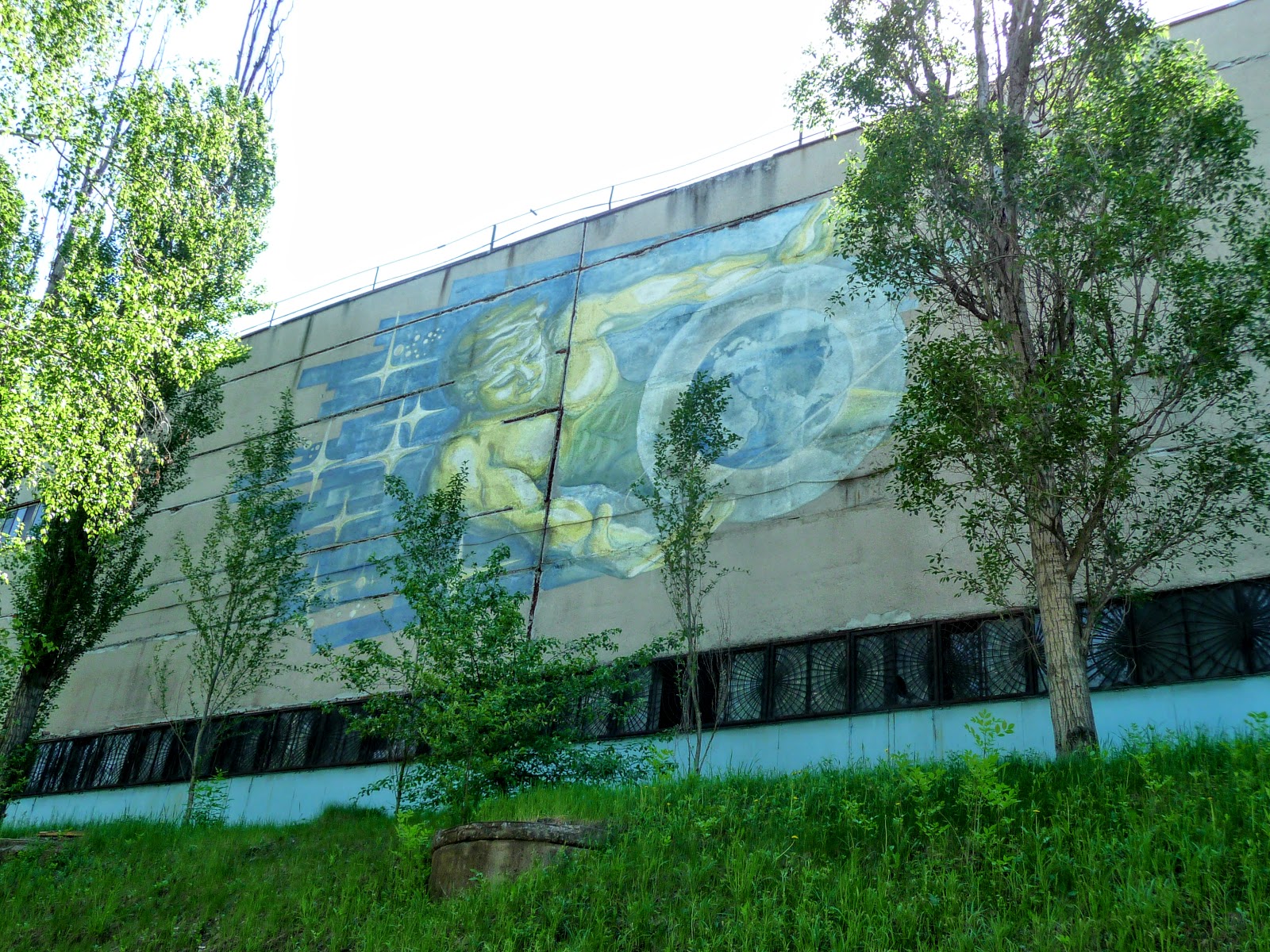
The production buildings of the metal-products plant are decorated with wall paintings in the style of socialist realism.
 |
| Soborna Street. The production buildings of the hardware plant |
The columns on the former entrance gates of the machine-building plant gave them a resemblance to a theatre or a palace.
 |
| Soborna Street. The former entrance gates of the machine-building plant |
On both sides of the colonnade stand sculptures of the workers of this enterprise — restored, it must be said, not very successfully.
 |
| Soborna Street. Sculptures of the machine-building plant workers |
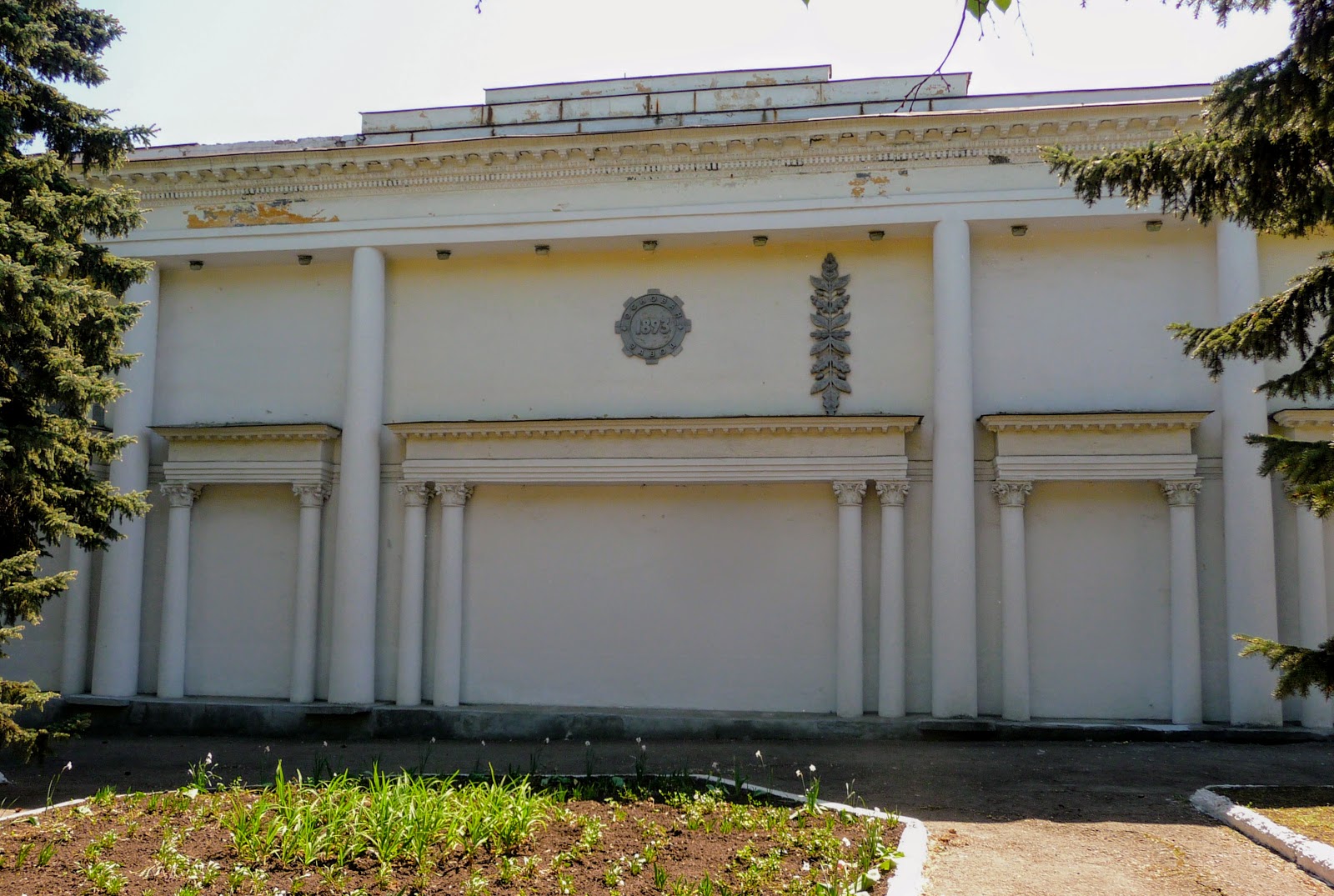
Bas-reliefs of the representatives of the hegemon of the socialist revolution and of the Komsomol movement, as well as the date of the plant's founding, are symbols of a bygone era.
 |
| Soborna Street. Memorial signs on the machine-building plant building |
On the administrative building an un-decommunised memorial plaque still holds firmly in place, recording the awarding of the Order of Lenin in 1971 to the former plant named after the 50th anniversary of Soviet Ukraine.
 |
| Soborna Street. The administrative building of the machine-building plant. The memorial plaque |
The Palace of Sport of the machine-building plant honours the memory of Druzhkivka football over more than a century of history.
 |
| Soborna Street. The Palace of Sport of the machine-building plant. Memorial plaques |
Four pairs of hexagonal columns are crowned by openwork capitals stylised with five-pointed stars and drooping palm branches.
 |
| Soborna Street. The Palace of Sport of the machine-building plant |
The House of Culture for the plant workers was built in 1931, and the sculpture of young Druzhkivka residents has also remained from that era.
 |
| Soborna Street. The House of Culture of the machine-building plant |
 |
| The sculpture near the House of Culture of the machine-building plant |
Modern sculptural compositions have been installed beside the Druzhkivka vocational lyceum, a former factory training school (FZU) built in 1940. There are wooden figures of a Cossack man and a Cossack woman, and bas-reliefs on stone from the Druzhkivka quarries depicting the national poet Taras Shevchenko in the company of the holy Princess Olha of Kyiv and the Hetman of Ukraine Bohdan Khmelnytsky.
 |
| Soborna Street. Sculptural compositions |
The residential buildings in this district are built in the constructivist style.
 |
| Soborna Street. Residential buildings |
The wide part of Soborna Street forms a square of the same name, with 1950s development from the time when the capacity of Druzhkivka's plants was growing.
Among the buildings typical of the post-war period, with their arches and pilasters, a residential building with a tower on its roof stands out. Unfortunately, the frozen hands of the clock on this landmark building have not shown the correct time for several years now.
 |
| Soborna Street. The building with a tower |
The School of Arts occupies two buildings, in which every condition has been created for the development of young talents; exhibitions, creative and themed evenings, concerts and competitions are held there.
 |
| The School of Arts |
In 1900 the Church of St Nicholas was built of white brick by a French-Belgian joint-stock company. With the coming of Soviet power the shrine was plundered, its domes were removed, and it was used as a machine-and-tractor station. During the years of the fascist occupation the church was repaired and services resumed. Shells burst near the place of prayer but did not strike the church itself. After the war the militant atheists again closed the church and set up a cinema in it. After many long years the believers reclaimed the shrine.
 |
| The Church of St Nicholas |
The burials of the pre-revolutionary owners and specialists of the plant can be seen if you go down Paris Commune Street to the so-called French cemetery.
 |
| Paris Commune Street |
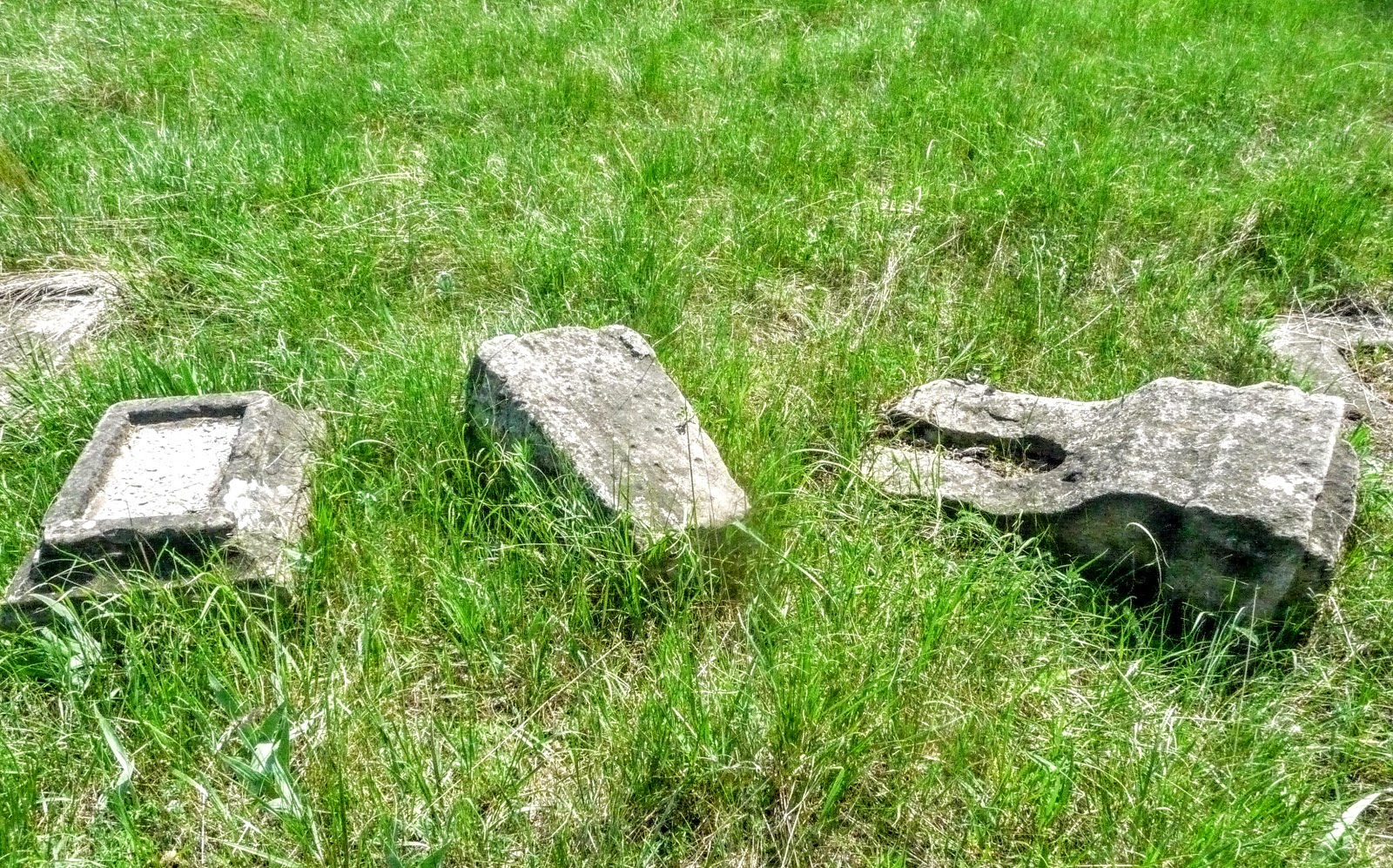
The territory of the cemetery, where foreign workers and local Orthodox residents rest, is densely overgrown with lilac bushes. Among the ruined monuments several stone gravestones with inscriptions have survived. There are burials with crosses and with little stars. There is no fence, and hens scratch about among the barely visible graves.
 |
| The French cemetery |
The building belonging to the central city hospital is probably pre-revolutionary; a recent memorial plaque testified to a communist meeting of Druzhkivka youth held in this house in 1919.
 |
| Soborna Street. The medical department |
The in-patient department of Hospital No. 2 was built in 1953.
 |
| Mashynobudivnykiv Street. The in-patient department of Hospital No. 2 |
The bowl of the fountain in the hospital yard has long ceased to fill with jets of water, and the flower urn has tilted with age.
 |
| Mashynobudivnykiv Street. The in-patient department of Hospital No. 2. The fountain |
A street more than 3 kilometres long is named after the machine-builders.
 |
| Mashynobudivnykiv Street |
The production buildings are surrounded by green oases of spruces and chestnut trees.
 |
| Mashynobudivnykiv Street. The green zone near the DMZ |
Beside the entrance to the gates rises a seven-tier tower with a bas-relief depicting the date of the DMZ's founding, tools and scenes of the plant workers' labour.
 |
| Mashynobudivnykiv Street. The plant sign |
Kosmonavtiv Street is divided in half along its length by a one-and-a-half-kilometre strip of green plantings, with alleys, benches, wrought-iron sculptures, memorial signs and a sundial.
 |
| Kosmonavtiv Street. The wrought-iron rose |
 |
| Kosmonavtiv Street. The memorial sign to the internationalist soldiers |
 |
| Kosmonavtiv Street. The sundial |
The street is notable for the MiG aircraft, installed in honour of the cadets of TSOAVIAKHIM. The monument is called "the little plane", as opposed to "the big one", which was dismantled for scrap metal in 2000.
 |
| Druzhkivka. Kosmonavtiv Street. The MiG aircraft monument |
We turn onto Engels Street, where at house No. 112 the Lesia Ukrainka library, with a sculptural image of the writer, and an art museum with 1,500 items in its collection are located.
 |
| Engels Street |
 |
| Engels Street. The art museum and the Lesia Ukrainka library |
Five cranes have flown away forever — a memorial sign to the victims of the Chernobyl nuclear disaster.
 |
| Engels Street. The memorial sign to the victims of the Chernobyl disaster |
A monument to a plumber and the jocular inscription "Without water, you can't go here or there" remind us of the careful treatment owed to the most precious natural resource on Earth.
 |
| Engels Street. The memorial sign to the plumber |
Engels Street led to the "Sviatohor" park of stone sculptures, where all the compositions were created by Yurii Artemov.
 |
| The "Sviatohor" park of stone sculptures. The cannon |
After a few hours' walk around Druzhkivka, the impression remained of a quiet, peaceful city gradually reviving after many years of stagnation.
 |
| Kosmonavtiv Street. The memorial sign for the 200th anniversary of Druzhkivka |
Reconstruction of the streets and the park is under way. There are unfinished buildings and one comes across neglect, but on the whole the city is clean, with plenty of greenery and well-kept places of mass recreation.
 |
| The construction of a church |
Druzhkivka will not become a tourist city yet, but it does no harm to get an idea of one of the industrial cities of Ukraine.
Coordinates of Soborna Square: 48°37'10"N 37°31'29"E








No comments:
Post a Comment
Leave your impression