If you have been lucky enough to visit Mukachevo in the Zakarpattia region, then one day will not be enough to get acquainted with all its notable sights.
 |
| Mukachevo. Zakarpattia region. Palanok Castle |
The most popular tourist trail leads to Palanok Castle.
 |
| Mukachevo. Zakarpattia region. Palanok Castle |
But you absolutely must see the ensemble of unusual gems and architectural monuments, created at various times, located on the Square of Cyril and Methodius.
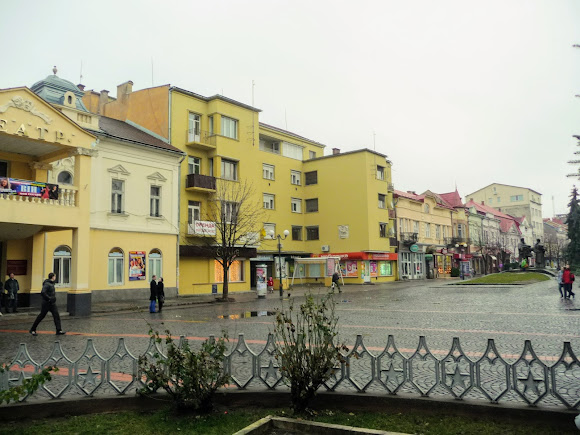 |
| Mukachevo. The Square of Cyril and Methodius |
Three centuries ago the square was lined on two sides with trading rows: on the left were poor sellers who traded in all sorts of odds and ends, on the right wealthy Greeks, and later Jews, traded in fine goods.
 |
| The Square of Cyril and Methodius. Formerly Bazarna, Rynok, Rakoczi, Arpad, Masaryk, Lenin and Myru Square |
The chaotic wooden buildings gave way to stone ones designed by architects in the 19th century. At various times the market square bore the names of leaders: Arpad under Austria-Hungary, Masaryk under Czechoslovak rule, Lenin under Soviet power.
 |
| The Square of Cyril and Methodius. Formerly Bazarna, Rynok, Rakoczi, Arpad, Masaryk, Lenin and Myru Square |
The square received its name in honour of the creators of Slavic writing in 2016. Before that, the wider part of Myru Street was considered a square of the same name. The monument to the enlighteners Cyril and Methodius, especially revered in Zakarpattia, was erected at the beginning of the square in 1996. It is believed that the Thessalonian brothers baptised these lands in the 9th century, about 100 years before the baptism of Rus by Prince Volodymyr. There is no direct evidence of these fateful events, but it is beyond doubt that the Cyrillo-Methodian translations of the Holy Scripture reached Kyiv from Moravia and Bulgaria across the passes of Zakarpattia.
 |
| The monument to Cyril and Methodius on the street of the same name |
Before the Second World War, on this spot there was a monument to O. A. Mytrak, a Ukrainian and Rusyn writer, folklorist and enlightener (1837-1913).
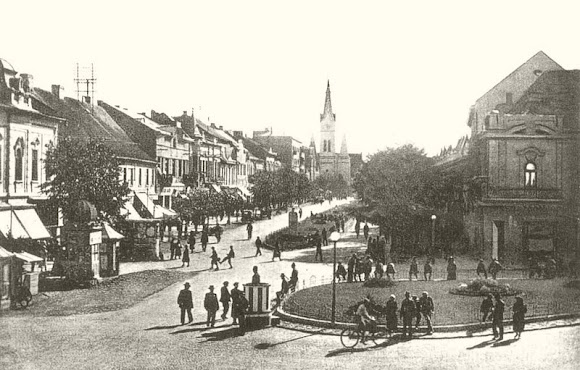 |
| The monuments on the square before the Second World War |
After the war it was demolished to clear the ground for a sculpture of Stalin.
 |
| The monument to Stalin on the square |
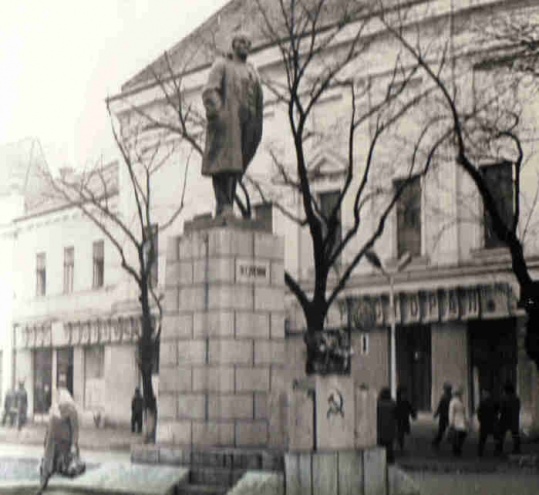
After the debunking of the cult of personality of the "father of the peoples", his statue was removed and a monument to the leader of the proletariat was erected. Lenin was depicted with a raised hand, as if pointing the way home to the drunkards leaving the nearby restaurant. Later the monument was reworked, and "the most humane of men" lowered his hand.
 |
| The monument to Lenin on the former Lenin Square |
The architectural dominant of the square and of the whole city is the Town Hall, built in 1904 in the Secession style with elements of Neo-Gothic.
 |
| Mukachevo. The Town Hall |
One of the finest city-administration buildings in Ukraine, it is shaped like the letter "U", with an inner courtyard.
 |
| Mukachevo. The Town Hall. The city administration |
The clock tower, on which the large bell announces the fleeting nature of time every hour and the small bell every 15 minutes, projects slightly from the walls of the magistrate onto the square. These are the first chimes in Europe able to strike the time every quarter of an hour.
 |
| Mukachevo. The Town Hall. The city administration |
The corner building in the Art Nouveau style (a mixture of styles) once belonged to the Austro-Hungarian von Schonborn dynasty. In the 18th century, on the site of a tavern, the Csillag inn was built, which in Hungarian means "star". The building did not change its purpose or its name, and, with an added third floor, the four-star Star hotel is part of the Premier Hotels chain, offering travellers cosy rooms and a high class of service.
 |
| The Square of Cyril and Methodius. The Star hotel |
It would be hard to imagine a city with such a rich ancient history without a temple of Melpomene. The building for the theatre was built in 1899 on the site of the trading rows at the townsfolk's expense. Its design and its Secession-style elements (a variant of Art Nouveau) are reminiscent of the theatre in Budapest. The founder of the theatrical traditions, before the appearance of its own troupe in 1947, was the artistic company from
Bilhorod-Dnistrovskyi "Novyi Akerman". Today the repertoire of the Mukachevo Drama Theatre includes works by Ukrainian and world authors, and the acting company has maintained a high professional level for decades.
 |
| The Square of Cyril and Methodius. The Drama Theatre |
At the beginning of the 20th century the buildings described above formed Rakoczi Square, named after the ancient Hungarian family. In the centre of the square it was planned to erect a monument to Arpad, the even more ancient founder of the Hungarian ruling dynasty, but after the First World War these lands became part of Czechoslovakia. After the Second World War an obelisk was erected on this spot in honour of the Soviet soldiers who fell in October 1944 during the liberation of Mukachevo from the Hitlerites.
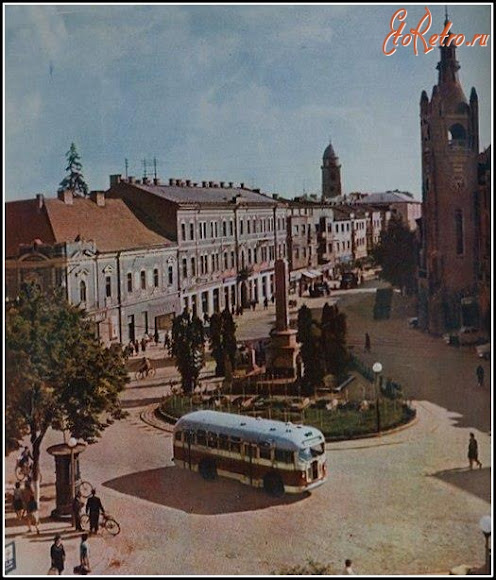 |
| The Square of Cyril and Methodius. The war memorial |
 |
| The Square of Cyril and Methodius. The war memorial |
Many of the houses, dating from the 19th century, have not lost their originality and appeal.
 |
| The Square of Cyril and Methodius |
Mukachevo has its own "white house", so called for the colour of its facade and the status of the building. In the former residence of the Rakoczi princes, laid down in the 17th century in the Baroque style, Emperor Franz Joseph and other titled gentry once stayed. Today, in building no. 15, young Mukachevo talents receive their education at the Mihaly Munkacsy Art School, named after the Hungarian painter, in whose honour a monument stands on the square.
 |
| The Square of Cyril and Methodius. The Mihaly Munkacsy Art School. The former Rakoczi Palace |
Another monument without a pedestal will meet the traveller on the square unexpectedly, as if one of the pedestrians had stopped and was inspecting the chimneys. The chimney sweep is accompanied by a whiskered, four-pawed, tailed companion who knows all about attics and roofs. By local tradition it is considered good luck to meet a chimney sweep in the street, to take hold of his button and make a wish. The monument has a prototype, a representative of a rare profession — a real chimney sweep, a resident of Mukachevo, Bertalon Tovt.
 |
| The Square of Cyril and Methodius. The monument "The Chimney Sweep and the Cat". 2010 |
 |
| The Square of Cyril and Methodius. The monument "The Chimney Sweep and the Cat". 2010. Author — the sculptor I. V. Brovdi |
The promenade ends by the Church of St. Martin, the patron of Mukachevo. In the church, built in 1904, services are held in Ukrainian, Slovak and Hungarian to the accompaniment of the organ.
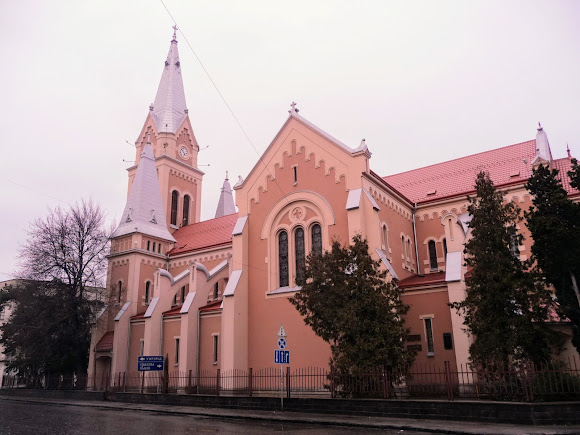 |
| The Cathedral of St. Martin of Tours |
The altar part of the old 14th-century church has survived. The architectural value of the shrine lies in its decorative design, the stone carving of the window frames, the ornaments, the frescoes and the coloured stained-glass windows.
 |
| The Chapel of St. Joseph. 14th century |
The Square of Cyril and Methodius, about 300 metres long and about 30 metres wide, is adorned with flower beds and a fountain. It is the venue for mass festive events and exhibitions. The most popular festival, "Chervene Vyno" (Red Wine), is held annually on the Old New Year, with a tasting of young wine, folk festivities, concerts and prize draws.
Coordinates:
48°26’28"N 22°43’13"E




No comments:
Post a Comment
Leave your impression