The wooden churches at Pyrohiv not only make up the museum's collection but are also functioning churches. They were built in various regions. When new churches appeared there, and it turned out that there was not always anyone to repair and preserve the old ones, they were moved to the largest museum in Ukraine.
 |
| Pyrohiv. The Museum of Folk Architecture and Life. The Church of the Intercession of the Holy Mother of God. 1792 |
The buildings were taken apart into logs, and the clay mixed with straw was separated from the joints. A tag with a serial number was hung on every board and log, and every step was recorded in writing. At the new site the numbered logs were assembled neatly, like parts of a construction set, according to the plan. In the era of atheism and the widespread closing of churches, their conversion into warehouses and stables, the idea of creating a skansen to preserve monuments of sacred architecture was far from pleasing to everyone. There were fierce opponents of exhibiting "junk" and of spending state funds on transporting the creations of wooden architecture.
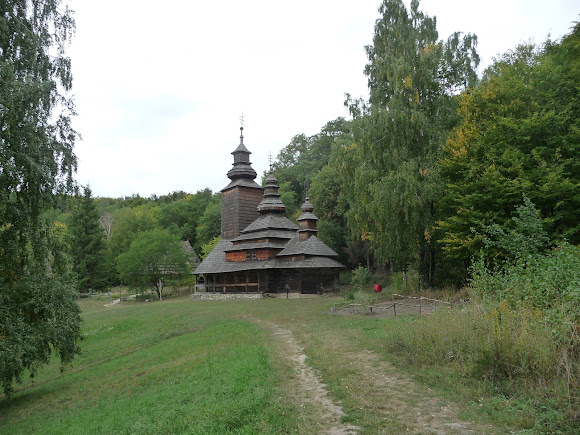 |
| Pyrohiv. The Museum of Folk Architecture and Life. The Church of the Intercession of the Holy Mother of God. 1792 |
The Church of the Intercession of the Most Holy Mother of God in the village of
Ploske in the Svaliava district of the Zakarpattia region was built in 1792. In times past, communities could sell their churches. In 1925-1928 a stone church was built in Ploske, and the wooden one was moved to the village of Kanora in the Volovets district.
 |
| The Church of the Intercession of the Holy Mother of God. 1792. The village of Ploske, Svaliava district. Photograph of the 1920s |
Later it moved to a more suitable spot in Volovets. But this too was not the last relocation of this monument of the Lemko school of monumental architecture. Since 1976 the three-domed church with its two-tier bell tower has risen in the historical-ethnographic zone "Zakarpattia" of the Museum of Folk Architecture and Life at Pyrohiv.
 |
| Pyrohiv. The Museum of Folk Architecture and Life. The Church of the Intercession of the Holy Mother of God. 1792 |
It has not lost its purpose; services are held in the church. On the day of the Intercession of the Most Holy Mother of God, cultural and festive events are held after the liturgy. The second patronal feast is on Easter Monday.
 |
| Pyrohiv. The Museum of Folk Architecture and Life. The Church of the Intercession of the Holy Mother of God. 1792 |
Coordinates:
50°21'38"N 30°31'3"E
Looking at the wooden churches at Pyrohiv, one can learn much about the sacred architecture of past centuries, folk art, calendars, language and customs. Nothing is beyond the power of time, and the wooden churches served as the prototype for their stone successors.
 |
| Pyrohiv. The Museum of Folk Architecture and Life. The Church of St. Nicholas. 1817 |
The historical-geographical region of Ukraine "Podillia" is represented by the Church of St. Nicholas from the village of Zelene, Husiatyn district, Ternopil region.
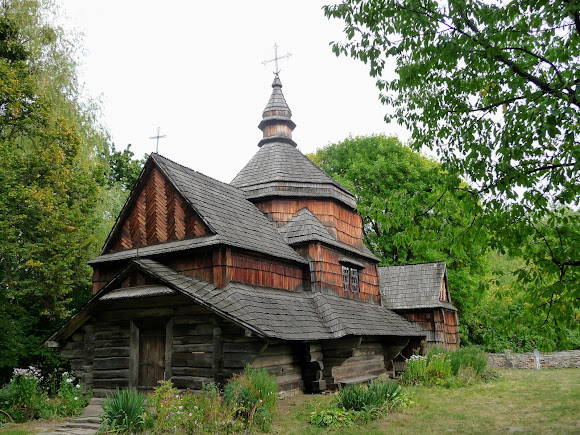 |
| Pyrohiv. The Museum of Folk Architecture and Life. The Church of St. Nicholas. 1817 |
It was built in 1817 from four-sided beams and covered with shingle — a roofing material in the form of small plates.
 |
| Pyrohiv. The Museum of Folk Architecture and Life. The Church of St. Nicholas. 1817 |
The masters of this religious building were Yatsentiy Tkhoryk and Petro Hrukalivsky.
 |
| Pyrohiv. The Museum of Folk Architecture and Life. The Church of St. Nicholas. 1817 |
The bell tower dates from 1830, and its place of construction was the village of Kut-Tovste in the same district. The bell tower is assembled on an oak frame and a stone foundation.
 |
| Pyrohiv. The Museum of Folk Architecture and Life. The Church of St. Nicholas. The bell tower. 1830 |
In the church courtyard there is an exhibition of stone crosses, on which the inscriptions are done in Old Slavonic ligature script; there are depictions of the crucifixion of Christ and church symbols.
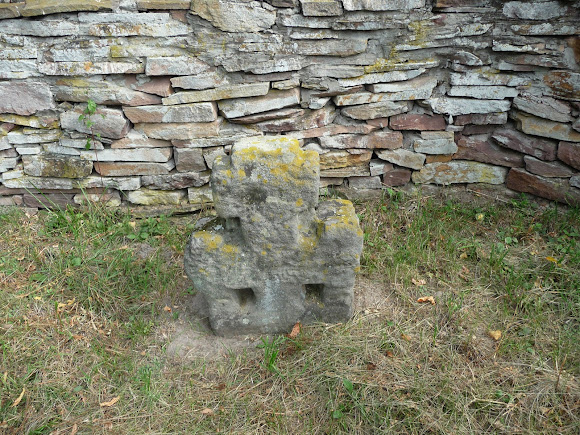 |
| Pyrohiv. The Museum of Folk Architecture and Life. Stone crosses |
Coordinates:
50°21’25"N 30°30’53"E
The chronicle sources say that wooden churches existed as far back as pagan times. With the baptism of Kyivan Rus the need for religious buildings grew, and the availability of the material led to the widespread proliferation of churches made of wood.
 |
| Pyrohiv. The Museum of Folk Architecture and Life. The Holy Ascension Church. 1789 |
The Holy Ascension Church from the village of Kysorychi, Rokytne district, Rivne region, was built in 1789 from round pine logs in the style of the Polissia school of wooden church-building.
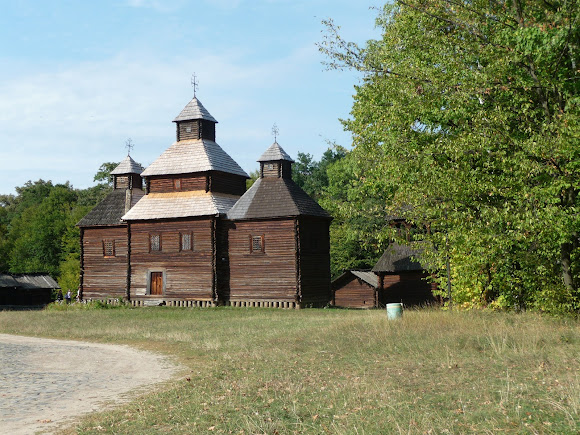 |
| Pyrohiv. The Museum of Folk Architecture and Life. The Holy Ascension Church. 1789 |
In this church services are held only on feast days. Inside, an exhibition of wooden sculptures of saints and of ancient church implements has been arranged.
 |
| Pyrohiv. The Museum of Folk Architecture and Life. The Holy Ascension Church. 1789 |
Together with the bell tower from the village of Velykyi Zholudsk, Volodymyrets district, the church is the ornament of the architectural exhibition "Polissia".
 |
| Pyrohiv. The Museum of Folk Architecture and Life. The Holy Ascension Church. 1789 |
Coordinates:
50°21’16"N 30°31’12"E
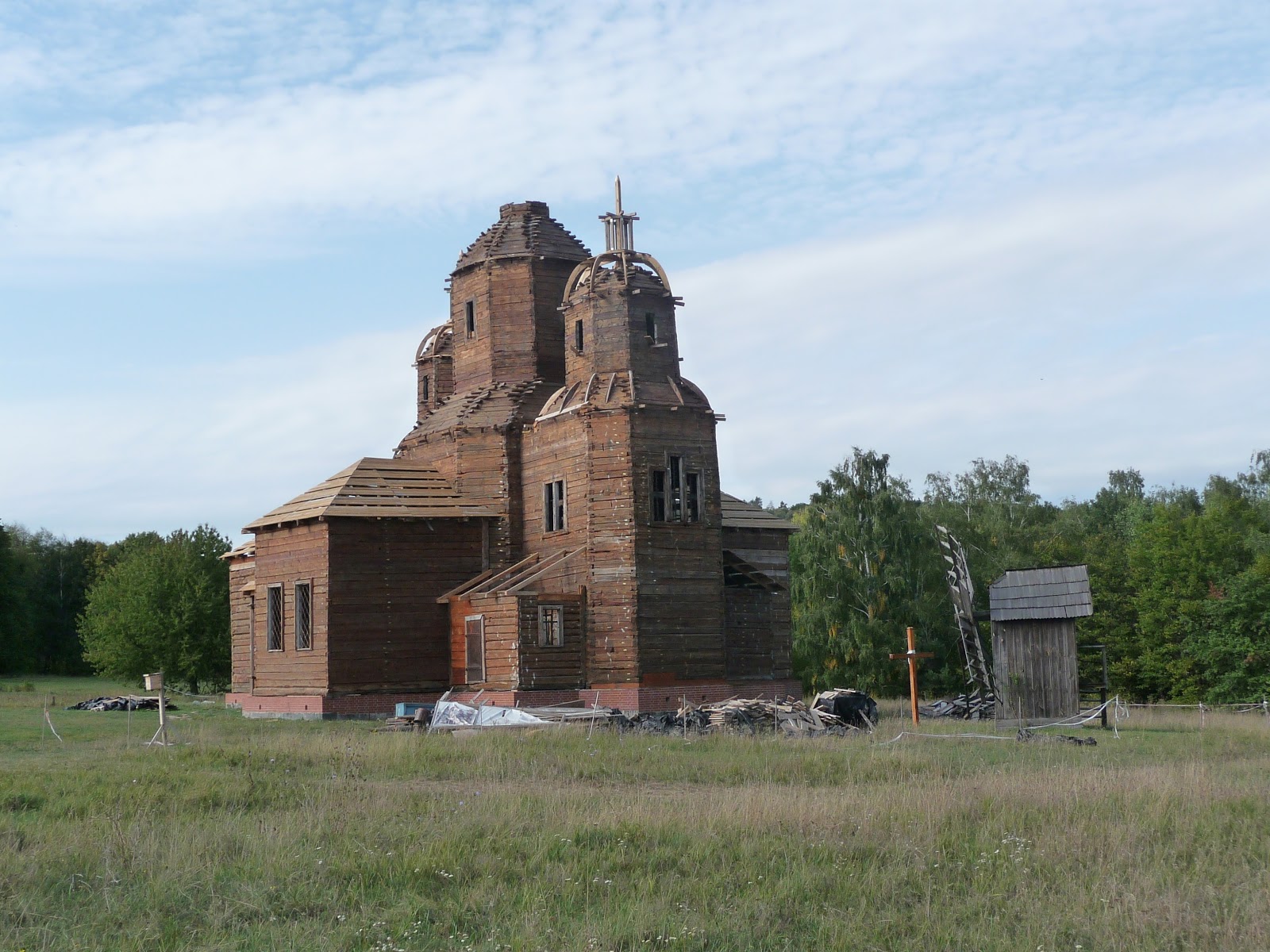
In 2017 this museum region was augmented by the Church of St. Nicholas from the village of Horodyshche, Mena district, Chernihiv region. The church was built in 1763 in the Ukrainian Baroque style.
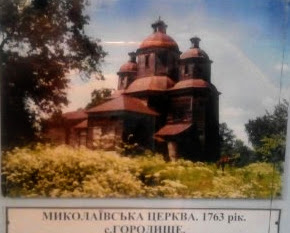 |
| The Church of St. Nicholas from the village of Horodyshche, Mena district, Chernihiv region. |
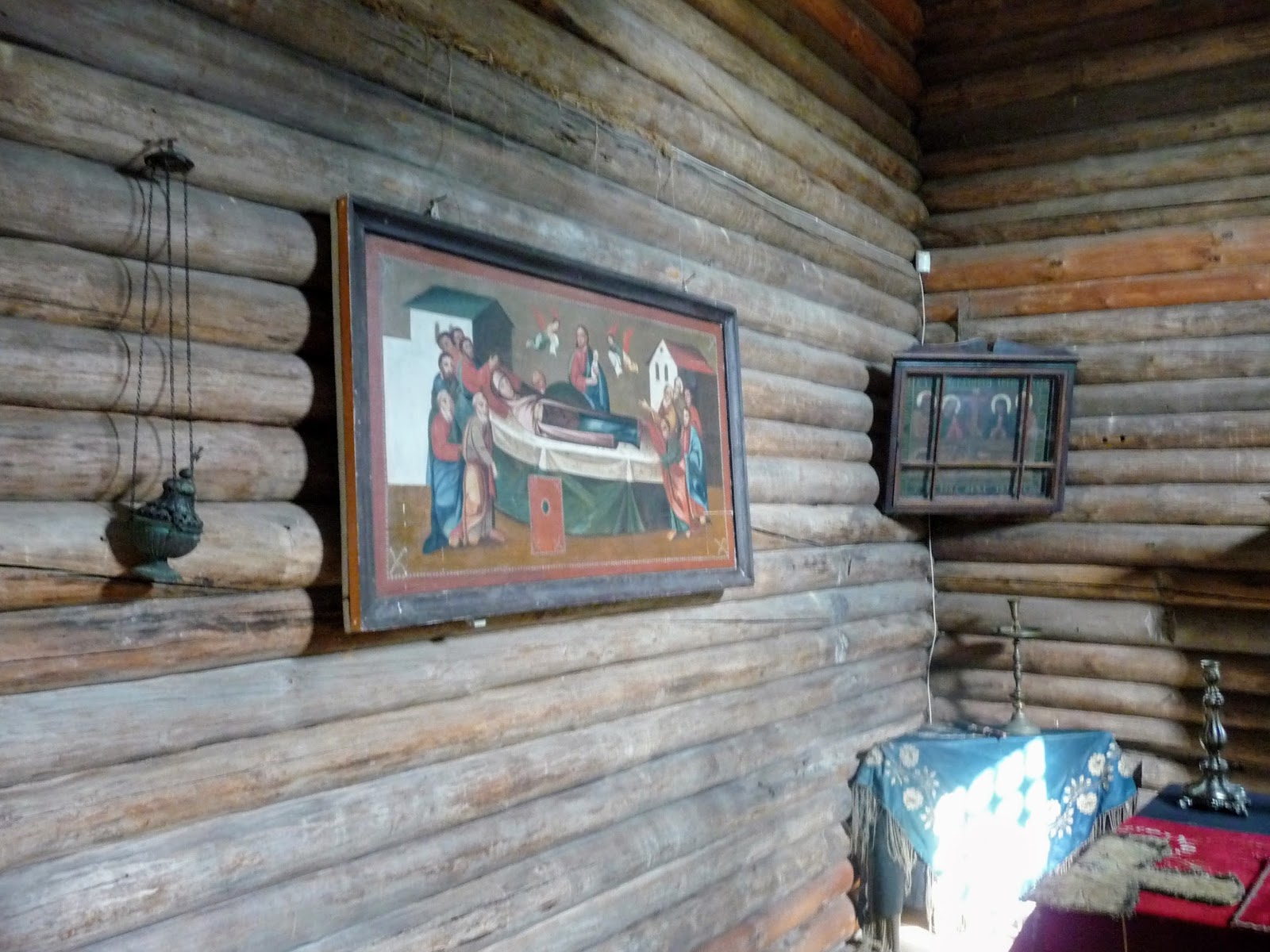
Despite the fact that the shrine ceased to be in use half a century ago, when it was turned into a granary, the wall paintings have nonetheless miraculously survived. Sorry as the villagers were to part with the church, in recent times it had turned into a ruin, and its salvation came in being moved to the open-air museum.
 |
| Pyrohiv. The Museum of Folk Architecture and Life. The assembly of the Church of St. Nicholas. 1763. Photo: September 2017 |
Coordinates:
50°21’20"N 30°31’4"E
The masterpieces of wooden church architecture are distinguished by the perfection of their construction. The carpenters and roofers used mainly the axe, and the log-frame technology made it possible to do without nails. The materials were oak, larch, pine and hornbeam. The ornament of the Middle Dnipro exhibition is the Church of St. Paraskeva from the village of Zarubyntsi, Monastyryshche district, Cherkasy region.
 |
| Pyrohiv. The Museum of Folk Architecture and Life. The Church of St. Paraskeva. 1742 |
It was built in 1742 from oak in the Baroque style at the expense of the last representative of the Vyshnevetsky family, Ursula Radziwill, a writer and artist. The church, more than 20 metres high, is considered the best example of the Kyiv school of church-building. The church holds a miracle-working image of the Mother of God, made in the style of a Ukrainian home icon. The iconostases in the wooden churches were adorned with carving and colourful painting, with red predominating.
 |
| Pyrohiv. The Museum of Folk Architecture and Life. The Church of St. Paraskeva. 1742 |
Candlesticks, shelves for holy images, candle chests and other implements were made of wood.
Coordinates:
50°21’12"N 30°30’36"E
The museum is open from 10:00 to 18:00. Closed on Wednesdays.
You can get there by the following transport:
from the "Lybidska" metro station — trolleybus no. 11
from the Bessarabian Market — marshrutka no. 156
from Leningradska Square, "Druzhby Narodiv" metro station — marshrutka no. 172
from the "Akademmistechko" metro station — marshrutka no. 576
from the "Lukianivska" metro station — marshrutka no. 496






No comments:
Post a Comment
Leave your impression