Kalush is an industrial and cultural centre of Prykarpattia, set 30 kilometres from Ivano-Frankivsk. The town is associated with a zone of ecological disaster and the harmful influence of chemical production on the surrounding environment. Despite the intensive industrialisation and the dangerous ecological situation, the atmosphere of this old town of the Boiko region and its national colour can still be felt on its streets.
 |
| Kalush. Ivano-Frankivsk region. Heroes' Square |
Let us begin our acquaintance with the town in the Central district, in the historic centre, on the very oldest streets.
 |
| Kalush. Taras Shevchenko Street |
 |
| Kalush. The streets are adorned with flower planters |
 |
| Kalush. Kovzhun Street. A residential building |
 |
| Kalush. Dzvonarska Street. School No. 3 |
 |
| Kalush. Dzvonarska Street. The 'Akvatoria' sports complex |
Dzvonarska Street already featured on a map of 1787 and took its name from the foundry of the Felczynski brothers, which lasted a century and a half and made Kalush famous for the making of church bells.
 |
| Dzvonarska Street. A trade complex |
 |
| Dzvonarska Street. An administrative building |
 |
| The administrative building from the side of Sheptytsky Square |
 |
| Dzvonarska Street. A residential building |
 |
| The residential building from the side of Sheptytsky Square |
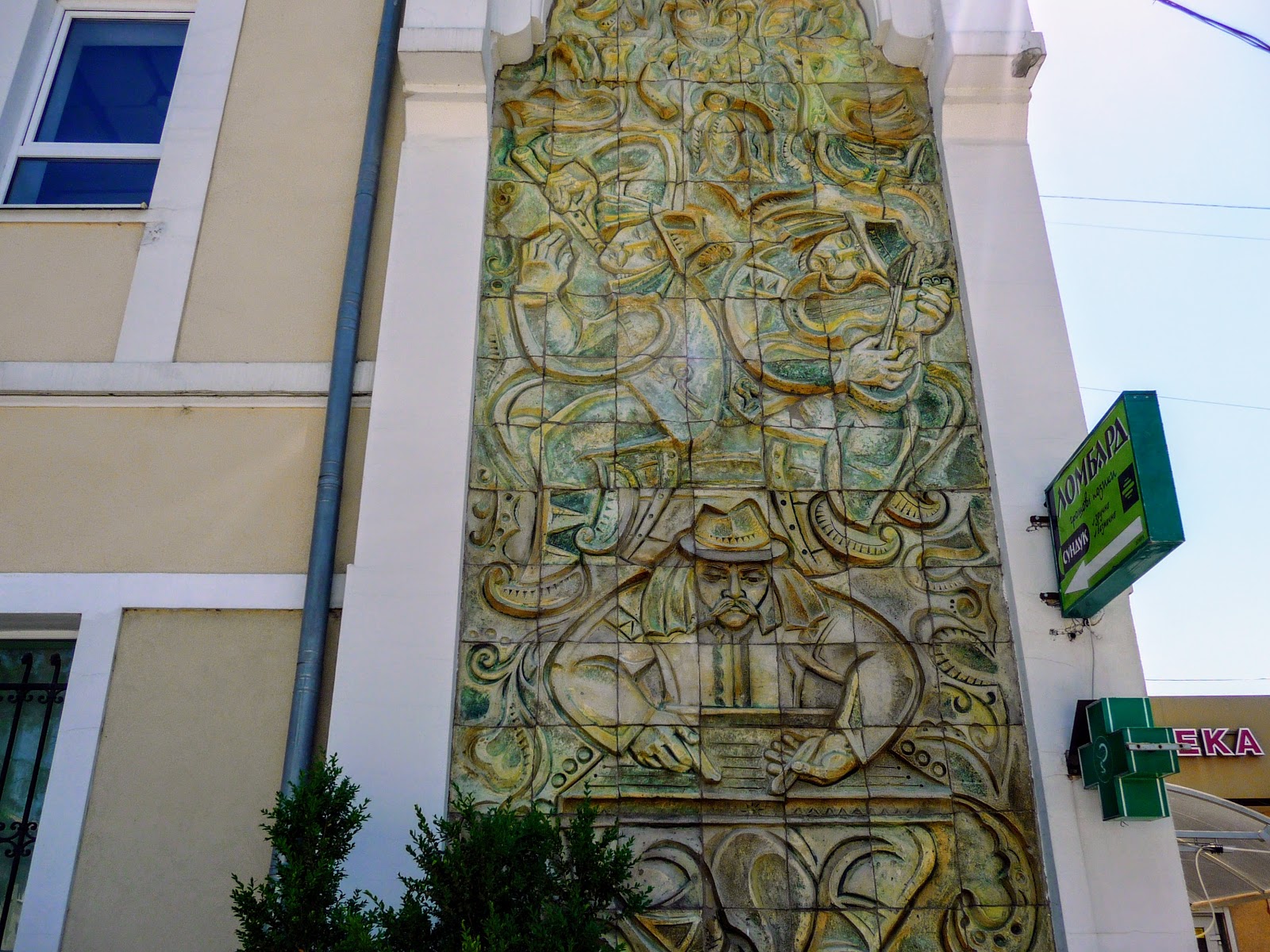
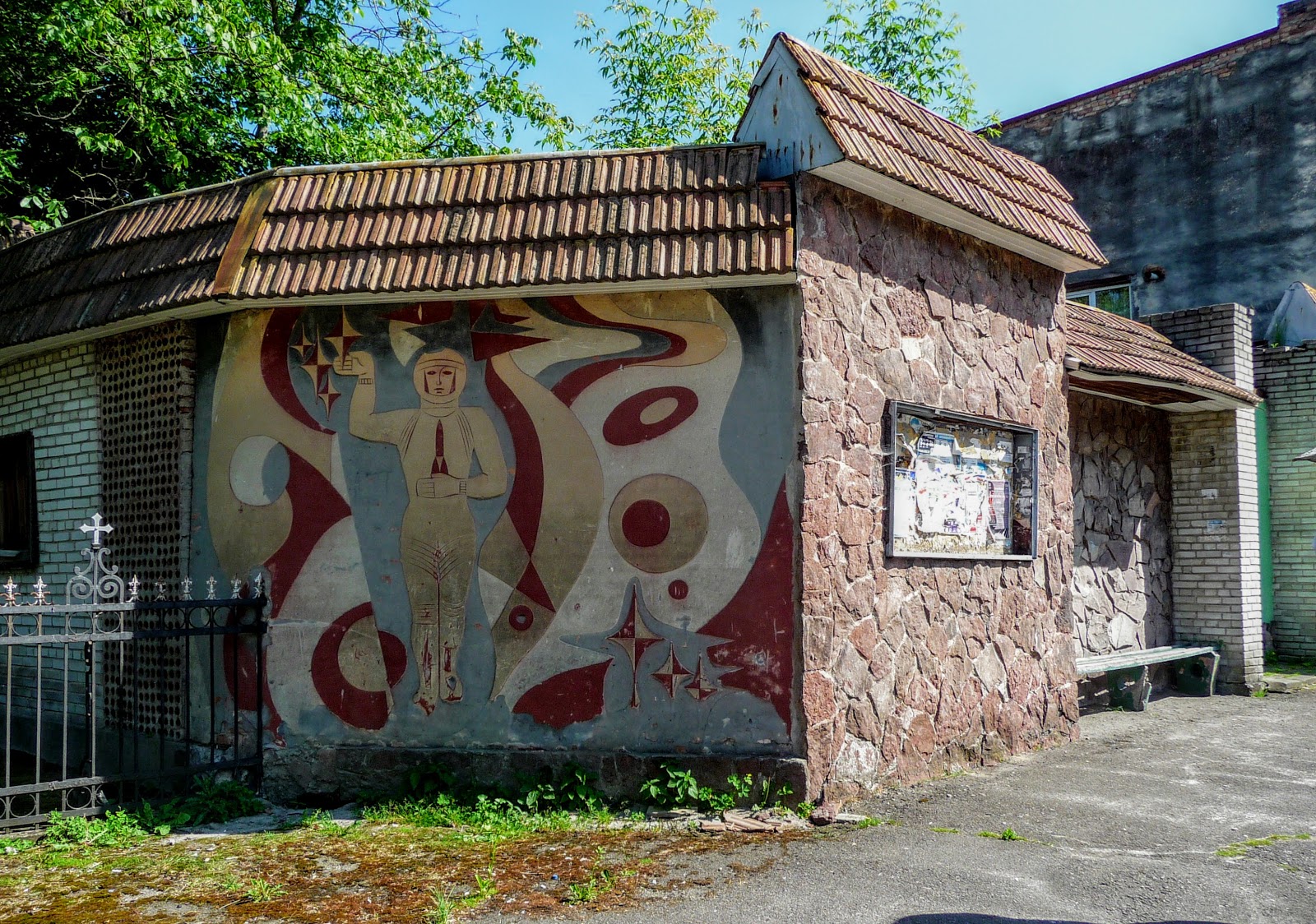
The facades of the commercial and administrative buildings are decorated with mosaics, stained glass and wall panels, lending a special appeal and individuality to the developments.
 |
| Dzvonarska Street. A commercial building |
 |
| Dzvonarska Street. A wall panel |
 |
| Heroes' Square. A residential building |
 |
| Heroes' Square. A wall panel |
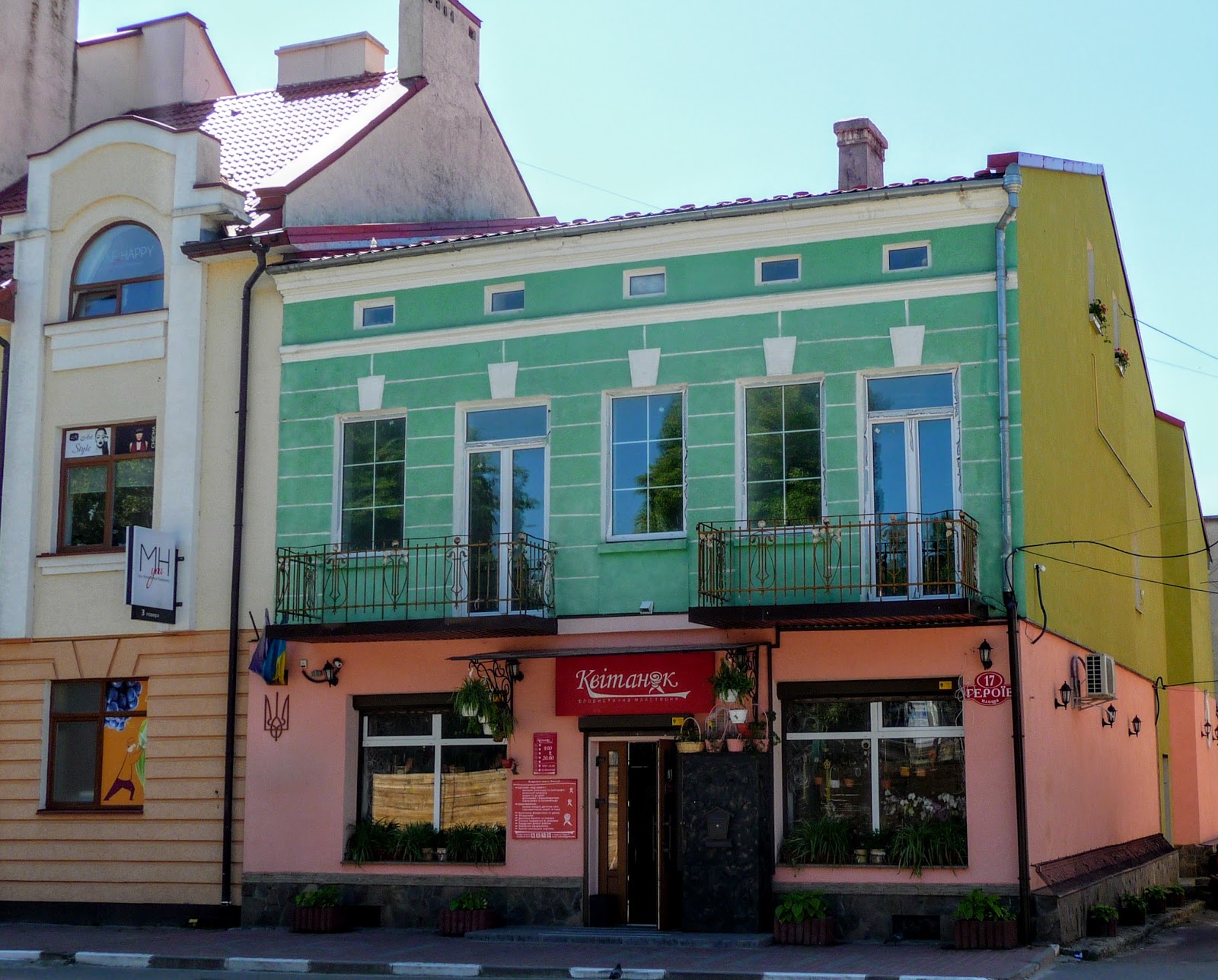
From Dzvonarska we turn onto the historic town square, the former Market Square, now named in honour of all the heroes who died for the freedom and independence of Ukraine.
 |
| Heroes' Square, 19-21 |
 |
| Heroes' Square, 19-21 |
 |
| Heroes' Square, 17 |
The planned building-up of the perimeter of the central square with stone houses was carried out during the rule of the Habsburg dynasty.
 |
| Heroes' Square, 2, and a sundial on the facade |
 |
| Kalush. Heroes' Square, a cafe and a restaurant |
 |
| Heroes' Square, a trade complex |
 |
| Heroes' Square, 14 |
House No. 22 is considered the oldest building of Kalush, dating to the 18th century. In house No. 3 was the very first town pharmacy, mentioned in 1877.
 |
| Kalush. Heroes' Square, 3, 4, 5 |
In the Middle Ages Kalush was part of the defensive system of Prykarpattia, but of the defensive castle that stood for almost 5 centuries, sadly, neither a plan, nor a stone, nor any image has remained. Perhaps this improvised wall, screening the car park, symbolises the ancient residence.
In 2018 the square, where mass and festive events are held, gained an additional charm after restoration.
 |
| Heroes' Square. A memorial sign to the pupils of the trade school, shot by the Hitlerites in 1943 |
From the square the main town thoroughfares begin and adjoin it.
 |
| Tsehlynsky Street. Residential buildings |
Mykhailo Hrushevsky Street, the former Dolynska, which runs in the direction of another important administrative centre of the Ivano-Frankivsk region — Dolyna — is announced by a bas-relief image of this political and public figure of Ukraine.
 |
| Hrushevsky Street, 1 |
 |
| A bas-relief of Mykhailo Hrushevsky |
It is characterised by pre-war building, the presence of small shops in old houses and places of worship of various denominations.
 |
| Hrushevsky Street, 3 |
 |
| Hrushevsky Street, 25 |
 |
| Hrushevsky Street, 29 |
 |
| Hrushevsky Street, 31 |
The 19th-century hospital complex has not lost its purpose, and now an ambulance station is housed in the building.
 |
| Hrushevsky Street, 37-39 |
It should be noted that in Kalush there are quite a few highly artistic memorial signs in honour of well-known and outstanding personalities. One of them is set on house No. 33 on Hrushevsky Street, in memory of the political prisoner Oleksa Hirnyk, a resident of Kalush, who spoke out in 1978 against the Russification of the Ukrainian people and, as a sign of protest, committed an act of self-immolation by the grave of Taras Shevchenko.
 |
| Hrushevsky Street, 33 |
 |
| Hrushevsky Street, 33. A memorial sign to Oleksa Hirnyk |
A memorial plaque to the poet and pedagogue Yosyp Popadiuk is on the facade of the editorial office of the newspaper 'Dzvony Pidhiria' on Pidvalna Street.
 |
| Pidvalna Street. A memorial plaque to Yosyp Popadiuk |
The name of the old street recalls the location of a former fortification. On this same street the 'Astoria' hotel-restaurant, built in the 1960s and resembling a workers' dormitory, may be useful to tourists and visitors.
 |
| Pidvalna Street. The 'Astoria' hotel-restaurant |
The mirror-like jets of the fountain dried up long ago, but the life-affirming sculpture still adorns the courtyard of the 'Astoria'.
Stepan Bandera Street is part of the ancient Halych trade route of the 16th century.
 |
| Stepan Bandera Street. A memorial sign to Stepan Bandera |
Even now the 2-3-storey buildings of Austrian construction are stuffed with little shops and commercial enterprises.
 |
| Stepan Bandera Street, 1 |
 |
| Stepan Bandera Street, 3 |
In house No. 9, where the private hotel 'Kindrat' has now opened, the well-known general-practice physician Ivan Kurovets (1863-1932) lived until 1918. The doctor held an active civic stance, was an enlightener and the founder of the Folk House and of the church of the Holy Archangel Michael, which we shall see during our walk.
 |
| Stepan Bandera Street, 9 |
From the windows of house No. 11 sounds a polyphony of various musical exercises and pieces. The vestibule of Music School No. 1 is decorated with bas-reliefs of composers and musical instruments.
 |
| Stepan Bandera Street, 11. Music School No. 1 |
 |
| Music School No. 1. A bas-relief of P. I. Tchaikovsky |
 |
| Music School No. 1. A bas-relief of M. V. Lysenko |
 |
| Music School No. 1 |
But the red-brick building did not always serve the functions of an educational institution. Until 1956, in the dungeons of the NKVD, undesirable Kalush residents were tortured to death.
 |
| Music School No. 1. A memorial sign to the victims of the NKVD |
The Ivano-Frankivsk region is the leader in the erection of monuments to I. Ya. Franko. Since 1956 the Stonecutter has been immortalised in a small, cosy square at the start of the street named after him. Much bound the poet to Kalush, and on Ivano-Frankivska Street, 22, in the house-museum of the Franko family, exhibits devoted to the classic's work are kept.
 |
| Ivan Franko Street. A bust of I. Ya. Franko |
The white-and-blue two-storey building at the corner of Ivan Franko and Sichynsky Streets is occupied by the town administration.
 |
| Ivan Franko Street. The town administration |
The facade is adorned with a bas-relief memorial sign about the granting of Magdeburg rights to Kalush, and the ornate portico bears a street clock that does not show the exact time.
 |
| The town administration. A memorial sign about the granting of Magdeburg rights |
 |
| Ivan Franko Street. The town administration. The clock |
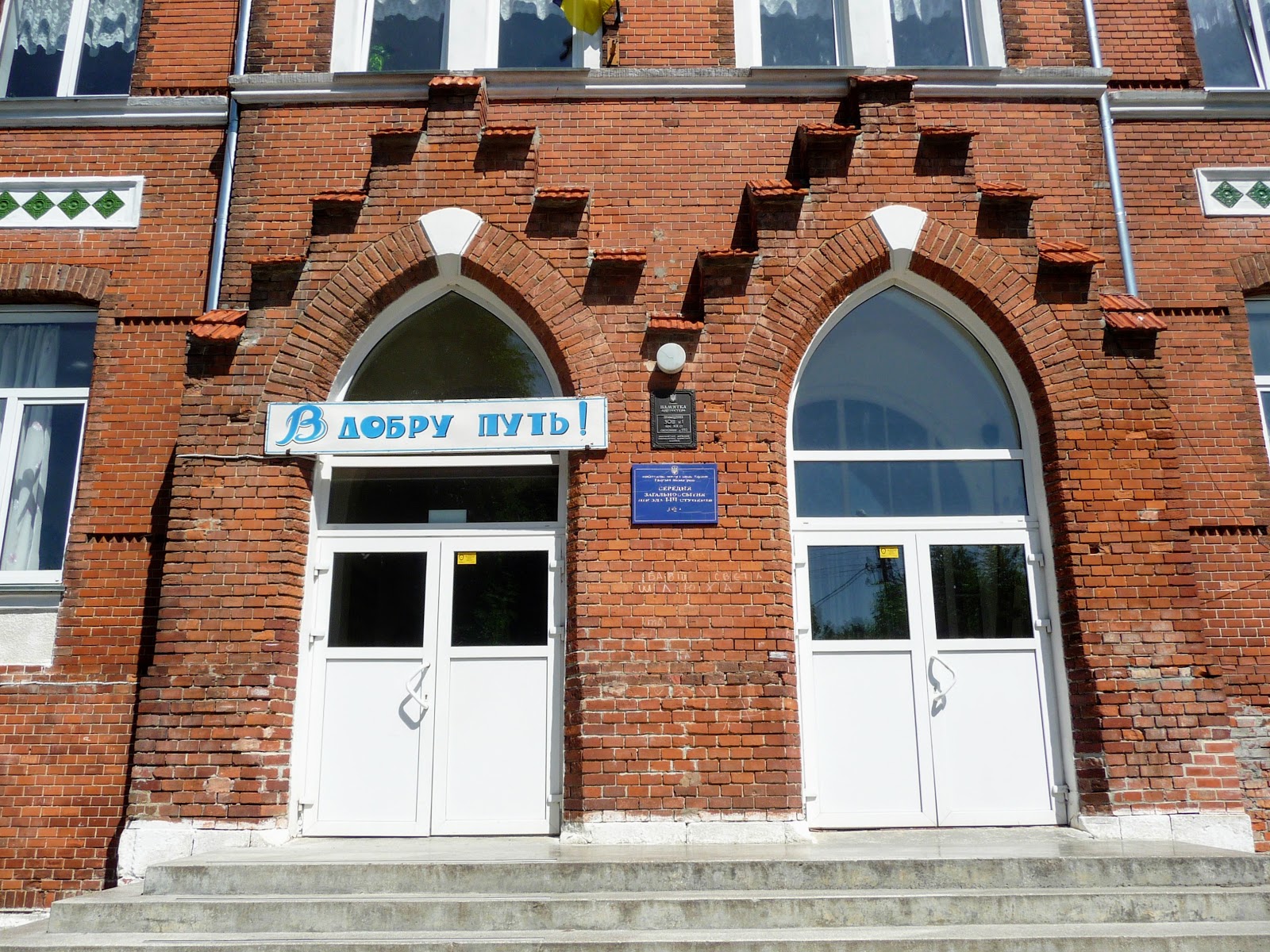
School No. 1, built in the 19th century of red brick, holds the status of an architectural monument and is one of the oldest educational institutions of Kalush.
 |
| Kalush. Ivan Franko Street. School No. 1 |
Sadly, not all the historic buildings have been preserved. The former presbytery at the corner of Ivan Franko and Korzhun Streets is in a neglected state, and the oldest structure of Kalush, the former Austrian gendarmerie, is in ruins.
 |
| Ivan Franko Street. The former presbytery |
There is no hope for the restoration of the town Town Hall, which burned down in 2013, whose ruins disfigure Taras Shevchenko Street.
 |
| Taras Shevchenko Street. The former Town Hall, an architectural monument |
Nearby stands the former building of the 'Sokil' society, and in the recent past — the concert hall of the college of culture; it is now out of use and awaits restoration after the fire.
 |
| Taras Shevchenko Street. The concert hall of the college of culture |
 |
| The concert hall of the college of culture. Busts of artists |
Between the two streets named in honour of the national poets I. Ya. Franko and T. H. Shevchenko, a square with a monument to the Kobzar has been laid out. The residents of Kalush also gave sculptural images of Shevchenko to other towns — to Simferopol and to Novohrodivka in Donetsk region.
 |
| A monument to T. H. Shevchenko |
The town's cultural heritage includes the Folk House, built in 1880.
 |
| Taras Shevchenko Street. The Folk House |
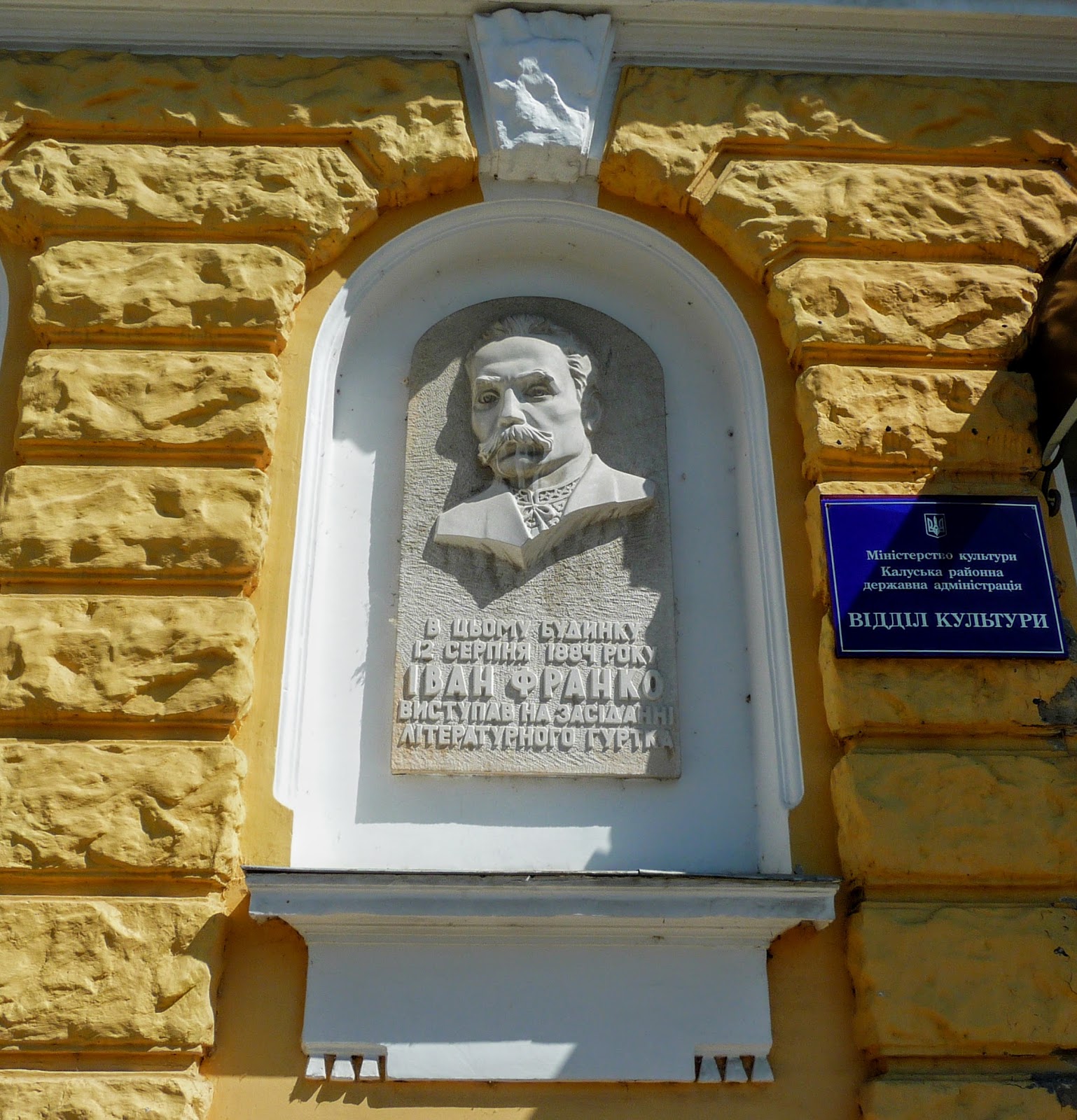
The conical tower is crowned with a spire; inside the premises — stained-glass windows and high-reliefs in the niches; on the facade — memorial plaques to I. Ya. Franko and to the doctor Ivan Kurivets.
 |
| The Folk House. A memorial sign to I. Ya. Franko |
 |
| The Folk House. A memorial sign to Ivan Kurivets |
The exposition of the Historical and Local-Lore Museum of the Kalush area numbers more than 1,000 items and is housed in the historic building of a former Jewish synagogue. In the museum, exhibitions on various themes are constantly renewed. I always pay attention to the professionalism of the museum staff. In Kalush I was met by an erudite, courteous young historian, whose name, sadly, I do not know. The museologist told me about the exhibition of bells, for the making of which Kalush was already famous back in the 18th century. In the collection 50 bells are gathered — historical, ancient and souvenir ones.
 |
| The Historical and Local-Lore Museum of the Kalush area |
With the help of a plan-scheme of the popular tourist sites and street signs, it is very easy to find one's way in the historic centre.
 |
| Taras Shevchenko Street. A signpost to the landmarks of Kalush |
 |
| A street signpost of Kalush |
The Roman Catholic church of Saint Valentine was raised in 1845 on the site of a wooden one, consecrated in the 15th century.
 |
| Taras Shevchenko Street. The Roman Catholic church of St Valentine |
The church of the Holy Archangel Michael was built in 1913 to the design of the well-known architect V. S. Nahirny. The church is crowned with five domes, and the two columns at the entrance with two more in addition.
 |
| Viacheslav Chornovil Street. The church of the Holy Archangel Michael |
Viacheslav Chornovil Street links the central core of the town with the district where the mines and the potassium-salt extraction enterprises were located.
 |
| Viacheslav Chornovil Street. A bus stop |
 |
| Viacheslav Chornovil Street. A monument to the deported Ukrainians |
On both sides of the road the houses were raised at the beginning of the 20th century, in the Austro-Polish period.
 |
| Viacheslav Chornovil Street. Residential buildings |
By the restored bridge over the river Sivka a 19th-century chapel has survived.
 |
| Viacheslav Chornovil Street. The bridge over the Sivka and a chapel of the 19th c. |
In the post-war time, with the development of Kalush's industry, the street was augmented by the opening of the 'Khimik' stadium, seating 7 thousand, and the 'Merkurii' hotel.
 |
| Viacheslav Chornovil Street. The 'Khimik' stadium |
 |
| Viacheslav Chornovil Street. The 'Merkurii' hotel |
In 1953, on Miner's Day, the Club of the Potash Works was ceremonially opened, adorned with sculptures of Kalush workers of the main professions.
 |
| Viacheslav Chornovil Street. The 'Mineral' Palace of Culture |
In the present-day 'Mineral' Palace of Culture, exemplary and folk ensembles — participants in numerous domestic and foreign competitions and festivals — continue to work successfully.
 |
| Viacheslav Chornovil Street. The 'Mineral' Palace of Culture |
On the corner of the building a memorial sign to the Hero of Ukraine Viacheslav Chornovil has been set up.
 |
| The 'Mineral' Palace of Culture. A memorial sign to Viacheslav Chornovil |
The production buildings of the salt mines that gave rise to the founding of Kalush are in a neglected state.
 |
| Viacheslav Chornovil Street. Production buildings |
Somewhere here, on the grounds of the potash-fertiliser plant, there ought to be a vanishing landmark — an industrial town hall, a symbol of the town-forming industry. In the thickets of trees and behind a high fence, a clock tower with frozen hands is barely visible. There was no way to get closer; I had to enter the grounds of the 'Merkurii' restaurant. The fate of the elegant little tower under its pyramidal dome, with clock faces on all four sides, is decided, and it will be the same as that of the fading enterprise.
 |
| Viacheslav Chornovil Street. The industrial town hall |
 |
| The clock tower of the industrial town hall |
A few more touches on the way back to the bus station.
 |
| Yevshan Street. A lyceum |
 |
| Kalush. Yevshan Street. A fire station |
 |
| Bohdan Khmelnytsky Street. The Polytechnic College |
 |
| Bohdan Khmelnytsky Street. The Polytechnic College and a bust of D. I. Mendeleev |
There is no bus terminal as such in Kalush, which is extremely inconvenient. Suburban buses stop on Pushkin Street by the high-rise blocks, without any passenger platforms or dispatcher announcements. It is impossible to leave for Dolyna from this station, which not all townspeople know, and so they misdirected me. At the station by the railway terminal stop the buses and minibuses Ivano-Frankivsk-
Lviv, but there may be no free seats. From
Stryi,
Dolyna,
Morshyn,
Bolekhiv, Ivano-Frankivsk, one can reach Kalush by the suburban train, which runs 3 times a day there and back.
 |
| Kalush. The railway terminal |
Kalush unexpectedly gave the impression of an attractive tourist town with unique landmarks that absolutely must be preserved and seen.
Coordinates of Heroes' Square: 49°1'24"N 24°22'8"E












No comments:
Post a Comment
Leave your impression