Every city has its own main square, and the history of the city is bound up with the story of how that square came to be. These squares are known for their monuments and are always beloved of townsfolk and tourists alike. It is here that momentous events take place, festive occasions are held and guests are welcomed.
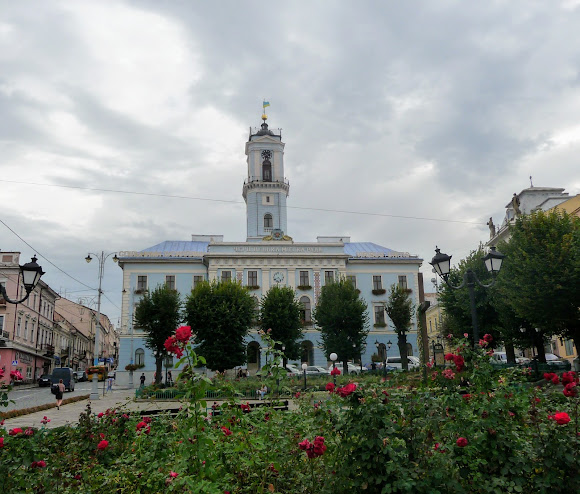 |
| Chernivtsi. The Central Square. The Town Hall |
For two centuries now the heart of the city of Chernivtsi has been the Central Square, from which, like arteries, the seven main city thoroughfares run off in different directions. The core of the historic centre is formed by Holovna Street, Poshtova Street, Universytetska Street, Ivan Franko Street, Mykhailo Eminescu Street, Ruska Street and
Olha Kobylianska Street, which is what led me to the Central Square.
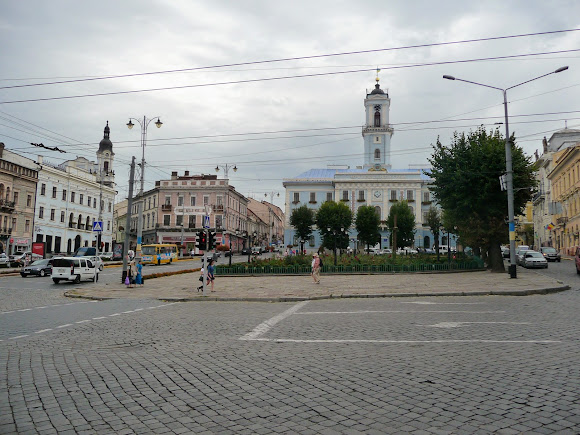 |
| The Central Square — the historic core of the city |
In 1775, when Austria annexed Chernivtsi, the town of three hundred wooden houses resembled a village that turned into a swamp after rain. Hens, goats and rats ran through the streets. So that Emperor Joseph II would not drown in the mud during his stay in the capital of Bukovina in 1786, the road in front of his house was strewn with gravel. The monarch proposed creating a market square in the southern part of the town for holding fairs and, to that end, demolishing the scattered buildings. The area was partly inhabited, and the town authorities spent several years buying up the plots of land. While the matter dragged on, trading had been going on in the square since the end of the 18th century, which determined its status and name — Market Square. Such was how Emperor Franz I saw it in 1817. The improvement of the Ringplatz proceeded according to a plan, and the construction of stone houses was exempted from duty.
 |
| The Central Square. The Ringplatz in the Austrian period |
The square acquired its European charm with the erection in 1847 of the Town Hall, built to a standard design in the late Classicist style.
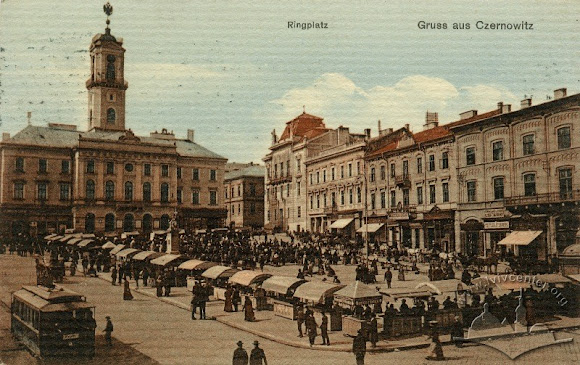 |
| The Central Square. The Town Hall in the Austrian period |
Square in plan and crowned with a fifty-metre clock tower, the building became the architectural dominant of the city.
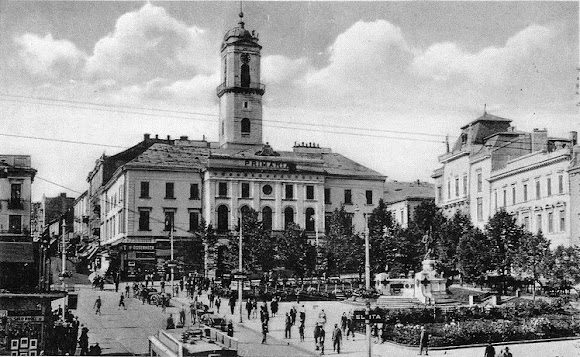 |
| The Central Square. 1918-1940 — Union Square (Piata Unirii) (in the Romanian period) |
From the balcony a watch used to be kept for fire safety, and now every day at 12 o'clock, in any weather, a trumpeter in national costume plays the melody of the well-known song "Marichka", which has become the anthem of Chernivtsi.
 |
| The Central Square. The Town Hall |
The coats of arms on the facade of the magistrate changed, as did the flags and the inscriptions, but the building's purpose did not change, and the city authorities were always housed here. Notably, on Sundays at 12 o'clock those wishing to take a stroll around the city gather by the Town Hall, and after "Marichka" is played they set off on a free tour to get acquainted with the notable sights in the company of the best guides.
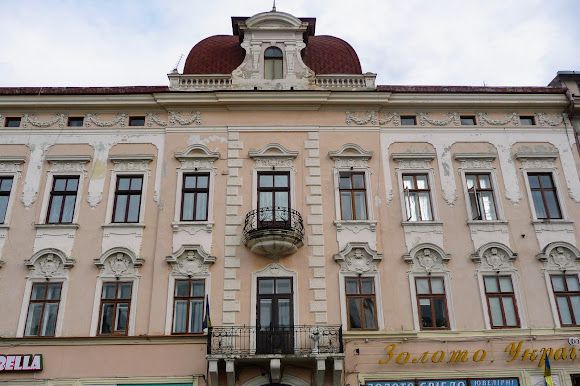 |
| Central Square, 5. 1828. An architectural monument |
A promenade around the Central Square brings enormous pleasure and takes 20-30 minutes.
 |
| Central Square, 6. 1816. An architectural monument |
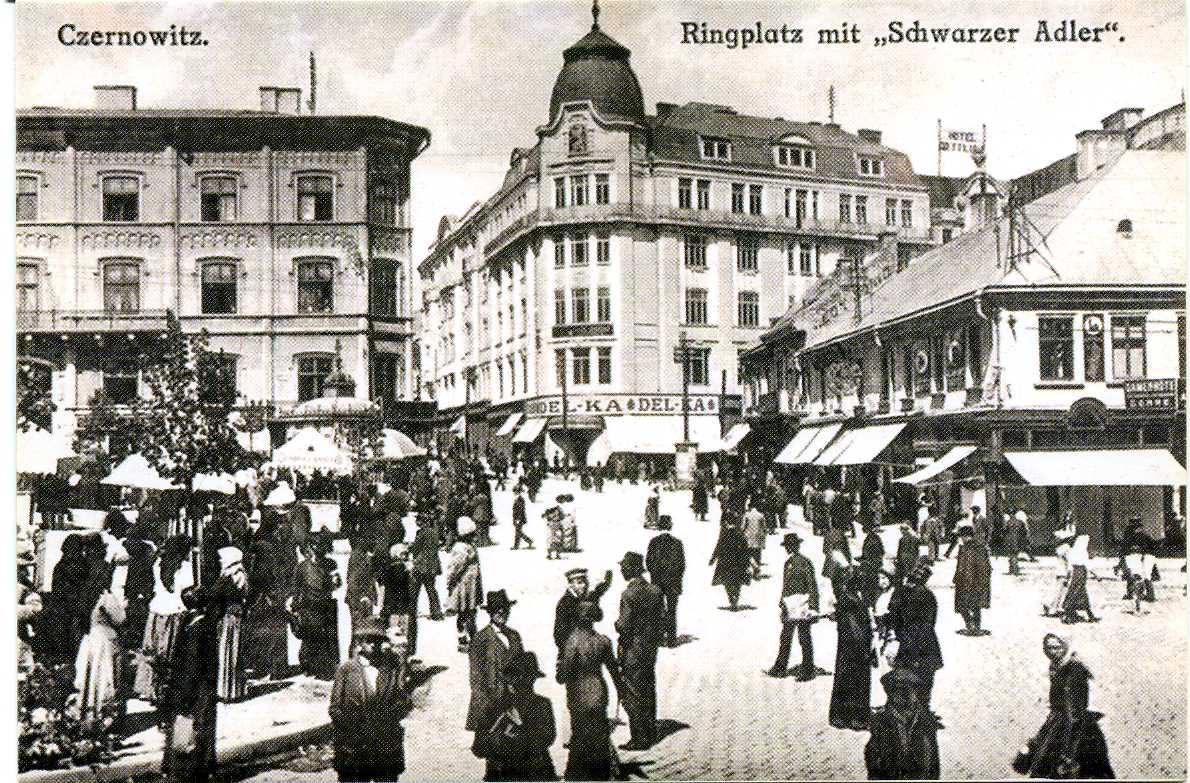
In the Austrian period the Ringplatz was called "the square of seven hotels" for the hotels arranged around its perimeter, where the government, celebrities and merchant folk would stay.
 |
| The Central Square |
In the most prestigious hotel, the "Black Eagle" (Schwarz Adler), gala evenings and performances were held, at which the beau monde gathered.
 |
| The Central Square. The former "Black Eagle" (Schwarz Adler) hotel |
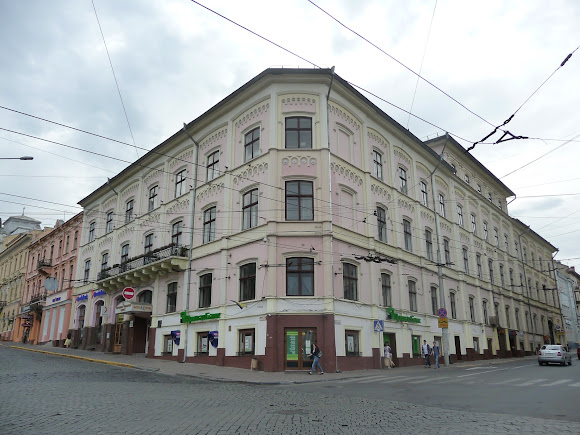 |
| The Central Square. The former "Black Eagle" (Schwarz Adler) hotel. The Institute of Trade and Economics |
Today the building serves as a teaching block for the Institute of Trade and Economics.
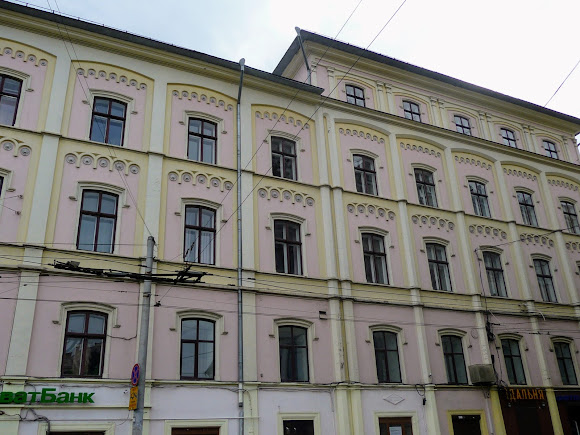 |
| The Central Square. The former "Black Eagle" (Schwarz Adler) hotel. The Institute of Trade and Economics |
The former "Golden Lion" hotel welcomed guests from 1910. The five-storey building is adorned with a bas-relief of a lion, a symbol of might and strength.
 |
| The Central Square. The former "Golden Lion" hotel |
Emperor Franz Joseph stayed at the mansion of the Governor of Bukovina (Landespräsident), built in 1850, which later housed the "Weiss" hotel. At present it houses the court of appeal and the Romanian People's House.
 |
| The Central Square |
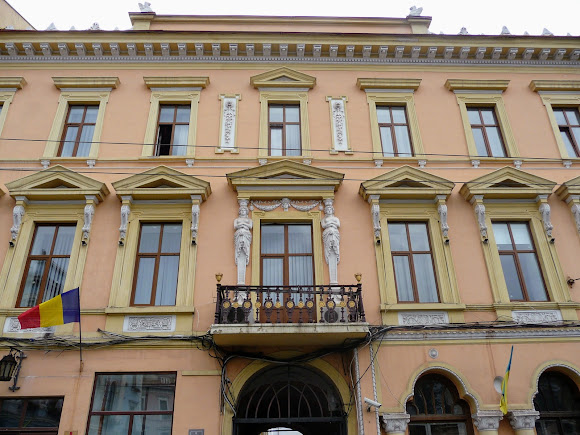 |
| Central Square, 9. The former governor's house, the "Weiss" hotel. The court of appeal and the Romanian People's House |
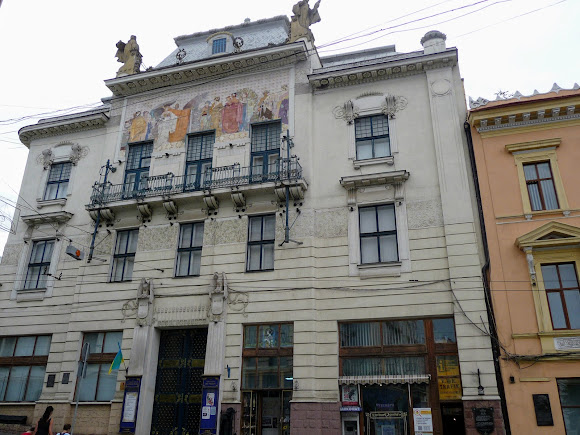
The Art Museum was set up in the former "Russie" hotel, built in the Art Nouveau style by the architect Hubert Gessner. The symmetrical facade is adorned with sculptures and a majolica panel depicting 12 gods symbolising the 12 provinces of Austria-Hungary. The museum holds 8,500 artistic exhibits from the 17th-20th centuries, unique works of art and the works of masters who created on the territory of Bukovina.
 |
| Central Square, 10. The former "Russie" hotel. The Art Museum |
The first cup of coffee was offered to guests at the "Three Crowns" hotel, where the city's first coffee house opened.
 |
| Central Square, 3. The former "Three Crowns" hotel (on the left) |
 |
| Central Square, 3. The former "Three Crowns" hotel (on the left) |
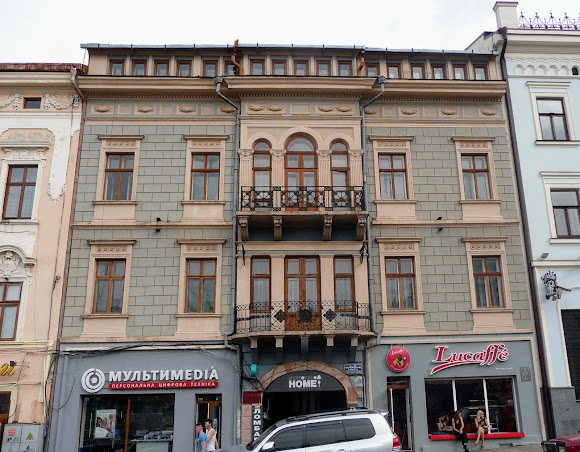
On the Market Square not only did trade flourish, but the townsfolk always loved to stroll here among the refined public.
 |
| Central Square, 4. 1891. An architectural monument |
For almost a century, in the Austrian period, a sculpture of the Mother of God towered over the Ringplatz; in 1924 the Romanian authorities replaced it with the "Union" monument (Unirii) and named the square accordingly.
 |
| The Central Square. The "Union" monument (Unirii) |
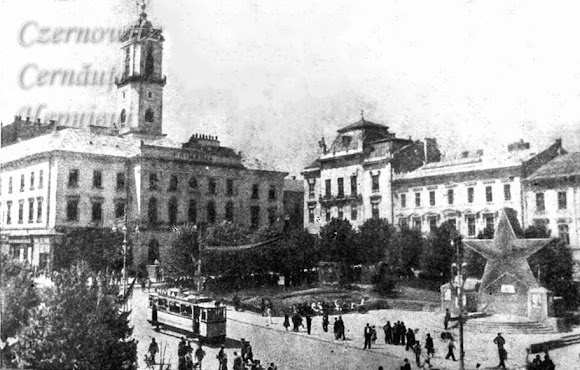
In 1940 the Bolsheviks demolished it and set up a red star on what was now Red Square, adding to it after the Second World War a wooden obelisk listing the fifteen Soviet republics.
 |
| The Central Square. The red star on Red Square |
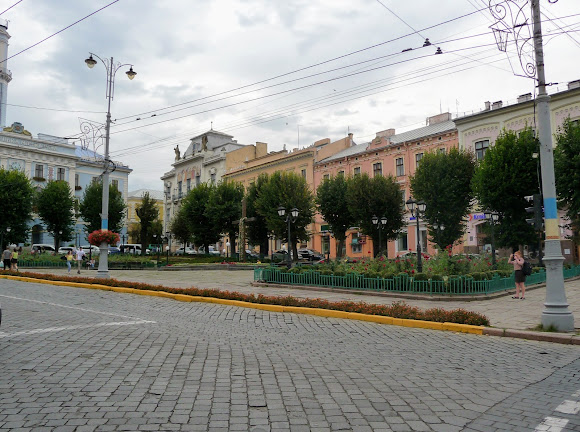
After that, for forty years the bronze figure of the leader of the world proletariat stood here. At present, on the site of the many monuments of all eras and peoples, a flower bed has been laid out.
 |
| The Central Square. The flower bed |
The monument to the Kobzar was erected on the second half of the square in 1999. It has been given the jocular nickname "three in one" for its resemblance to the poet I. Ya. Franko and the Bukovinian Romantic writer Yu. A. Fedkovych. Behind the sculpture of the prophet a blank wall is covered by a huge stand with information about the history of the city.
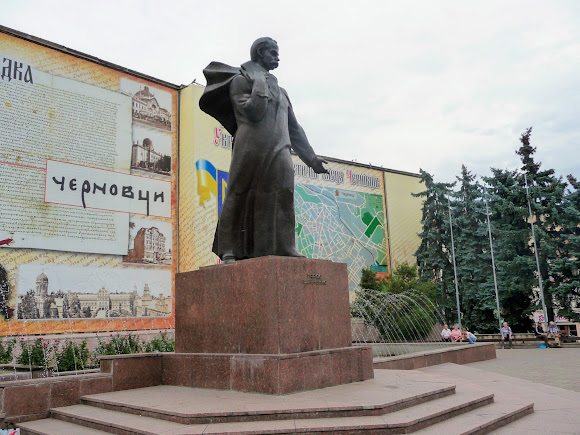 |
| The Central Square. The monument to T. H. Shevchenko. The fountain |
From 1897 a tram ran across the square, made at Gaiser's carriage factory.
 |
| The Central Square. A tram. Early 20th century |
Since 1966 tram traffic on the square has been halted, and you can reach it by trolleybus routes nos. 1, 2, 3, 4, 5 and by marshrutkas. Today the Central Square remains a favourite place of rest for the townsfolk and of pilgrimage for tourists.
Coordinates:48°17'32"N 25°56'6"E




No comments:
Post a Comment
Leave your impression