For four centuries the Krekhiv Monastery of St Nicholas of the Basilian Order has been one of the largest spiritual centres and a place of pilgrimage for the faithful from all over Ukraine and abroad.
 |
| Krekhiv. The Monastery of St Nicholas of the Basilian Order |
This monument of history and architecture of national significance stands near the village of Krekhiv, Zhovkva district, Lviv region, at the foot of the picturesque Carpathian hills of Ukrainian Roztochia.
 |
| Krekhiv. Zhovkva district. Lviv region |
The beginning of the monastery's history is taken to be the founding, at the end of the 16th century, of rock caves by the monks Joel and Silvester of the Kyiv-Pechersk Lavra. In time the monks grew more numerous, and on the top of the cliff — later named after Joel — they built two chapels: in honour of the Intercession of the Most Holy Mother of God and of the holy apostles Peter and Paul. At the start of the 17th century, the Ruthenian voivode and Hetman of the Polish-Lithuanian Commonwealth Stanislav Zholkevsky donated land for the building of a monastery, which at first was wooden. There is a belief that the spot where the shrine was destined to stand was pointed out by the blind elder Herasym. He walked the grounds and tapped with his staff where building was needed. Later the residents led water from a spring along wooden troughs and raised defensive walls to save themselves and the people of the nearest villages during the war of the Tsardom of Russia with the Ottoman Empire and its vassal, the Crimean Khanate.
 |
| Krekhiv. The Monastery of St Nicholas. The upper tower and defensive walls, 17th c. |
But the fortress walls did not save the monastery from enemy invasion. A monk kills, with a cannon, the nephew of Khan Selim Giray, who led the Turkish-Tatar army, and the vengeful khan orders the Christian monastery destroyed. Hetman Petro Doroshenko took a diplomatic decision, condemning the monks and thereby saving the shrine.
 |
| Krekhiv. The Monastery of St Nicholas. The entrance gate |
The monks paid a contribution of 40 thousand thalers; for this they even had to take down the bells. The khan's kinsman was buried on the spot of the killing, next to the monastery. Later someone set up a monument to him in the form of a column.
 |
| Krekhiv. The Monastery of St Nicholas. The tower and defensive walls, 17th c. |
During the enemy siege the young Ivan Mazepa was gaining his hetman's experience. In 1698, on the eve of the Northern War, Emperor Peter I came to the monastery several times for talks with his ally against the Swedes, the Polish king Augustus II. It is known that Hetman Bohdan Khmelnytsky and Metropolitan Petro Mohyla also stayed at the monastery.
 |
| Krekhiv. The Monastery of St Nicholas. The upper tower and defensive walls, 17th c. |
In the 18th century the monks, having come to their senses after the enemy raids, built a stone church, a tower with a clock, a monks' residence and a new bridge.
 |
| Krekhiv. The Monastery of St Nicholas. The gate tower and the Church of St Nicholas |
The artist D. Senkevych depicted in his engravings the layout of the four churches, the cells and the corner towers at the turn of the 17th and 18th centuries. In 1721 the monastery became Greek Catholic. The Order of the Basilian Fathers lived by a rule from the 4th century, whose regulations were laid down by the Church Father Basil the Great.
 |
| Krekhiv. The Monastery of St Nicholas. The cells. The third building. 1898-1902. |
The monastery held around 400 ancient folios, dating from the 15th century onwards. From this time the monastery became a major religious centre.
 |
| Krekhiv. The Monastery of St Nicholas. The upper tower |
The turbulent events of the 20th century once again brought the shrine misfortune. Representatives of the Polish authorities did not recognise the Ukrainian monastery and took away its ancient books, its 12th-century chronicles and its archive. A great part of the Krekhiv treasures was lost forever. In 1919 the monks were deported to the Dobve concentration camp.
 |
| Krekhiv. The Monastery of St Nicholas. The cells. 1755. |
In 1939 the Bolshevik authorities came to the lands of Subcarpathia and set up the headquarters of a fortified district in the shrine. In 1946, at the Lviv Council, the Union of Brest was abrogated and the Greek Catholic Church in Ukraine was liquidated.
 |
| Krekhiv. The Monastery of St Nicholas |
Priests and monks were persecuted and sent into exile. The residents of the Krekhiv Monastery were forcibly removed to the Univ Monastery, 35 kilometres from Lviv. They managed to save from plunder the miraculous icon of the Mother of God from Verkhrata, and until 1991 it was kept in Lviv, in the Church of St Paraskeva. This ancient holy image was solemnly handed over to the Krekhiv Monastery in 1810 by the monks of the Verkhrata Monastery, which had been liquidated as unprofitable in the course of the reforms of Emperor Joseph II.
 |
| The icon of the Krekhiv Mother of God from the Verkhrata Monastery |
The monastery was renowned for three miraculous icons, to which believers flocked from every corner of the country, from Russia and from Europe. One of them — sadly lost after the Second World War — the Krekhiv Mother of God, was gifted to the monastery in 1660 by a devout family from
Lviv.
 |
| Krekhiv. The Monastery of St Nicholas |
In Soviet times the monastery housed a Young Pioneer camp and a school for children with intellectual disabilities. In 1990 the restoration of the shrine began. Basilian monks gathered from all over Ukraine and set about recreating the monastery.
 |
| Krekhiv. The Monastery of St Nicholas |
For the novitiate, from the
Hoshiv Monastery novices arrived. Much effort was put in by skilled masters to restore the iconostasis, the altar, the stained-glass windows and the murals. The entrance gates, the walls and the cells were reconstructed.
 |
| Krekhiv. The Monastery of St Nicholas |
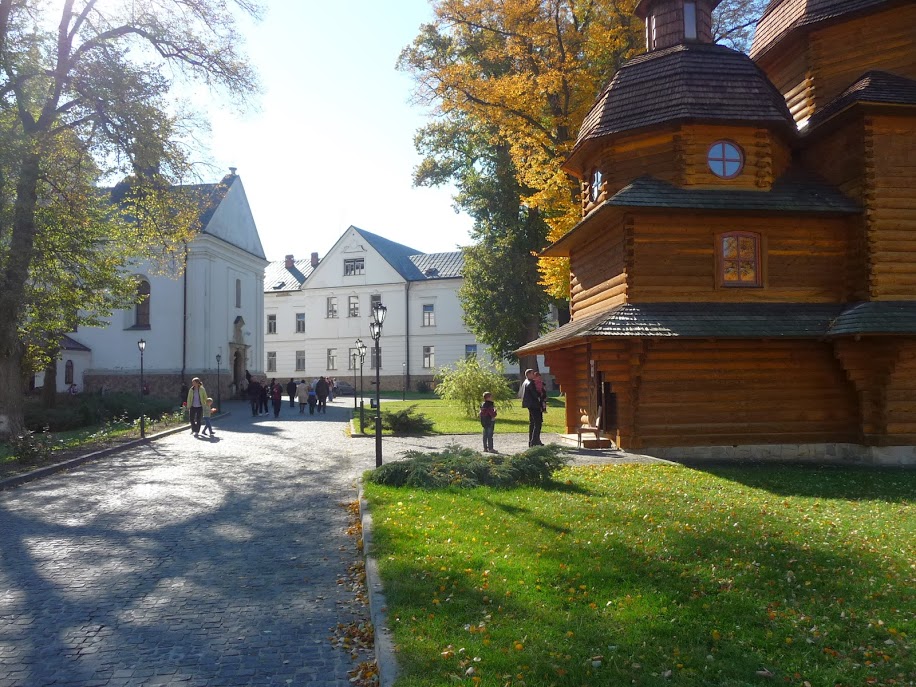
The main church is the Church of St Nicholas, dating from 1737. In 2004 a wooden Church of the Intercession of the Most Holy Mother of God was built in the Ukrainian baroque style.
 |
| Krekhiv. The Monastery of St Nicholas. The Church of the Intercession of the Most Holy Mother of God. 2004. |
The garden, laid out in the 18th century, was revived. Vegetable plots took up a large area. An apiary appeared; Carpathian bees are the most productive of all, and their honey is incredibly tasty and healing.
 |
| Krekhiv. The Monastery of St Nicholas. The bell tower |
From the foot of Mount Pidboina the Way of the Cross has been restored, leading up to the summit to the chapel of the Holy Sepulchre (1938). Pilgrims and the faithful always draw holy water from the Mother of God's spring near the monastery and climb up to the rock caves where the history of the Krekhiv Monastery began.
Coordinates:
50°1’59"N 23°47’57"E




No comments:
Post a Comment
Leave your impression