The Stradch cave church is a unique historical monument that has survived unchanged since the 11th century.
 |
| Stradch. Lviv region. The cave monastery. The church of the Mother of God the Indestructible Wall |
About a thousand years ago, by monks who came from
Kyiv, on the bank of the river Vereshchytsia, amid beech-and-pine forests, in a mountain 359 metres high, a skete was founded. Using the mountain's natural tectonic fissures, the monks widened them by hand and dug caves in the sandstone monoliths, in which they spent their lives in prayer and fasting.
 |
| Stradch. The cave monastery of the 11th-13th centuries. The church of the Mother of God the Indestructible Wall |
It is known that the monastery existed from the 11th century to the middle of the 13th. In 1243 an enemy army, returning to the east, destroyed the Christian retreat. Khan Batu ordered the whole population to be driven into the cave, the entrance to be closed, piled with branches and set alight. Despite the hegumen's plea to spare the children and the elderly, the nomad conquerors carried out their leader's order, and the people perished from the fire and smoke.
 |
| Stradch. The cave monastery of the 11th-13th c. The entrance |
After these tragic events, repeatedly over the centuries and down to our own day, an apparition of the Most Holy Mother of God has been observed on Stradch Hill. The village that arose on the hillfort burned by the horde received an unusual name for Ukrainian villages — Stradch, from the words 'to suffer', 'loss', 'execution'. And the memory of the innocently killed and defenceless ancestors is alive to this day.
The chroniclers left few details about the monastery, but it already existed at a time when not even
Lviv, to which it is 20 kilometres, had yet been mentioned by anyone in the chronicles. In the 1930s the priest Mykola Voiakivsky and Dr Yaroslav Pasternak carried out archaeological studies of the cave labyrinth. The war that began in 1939 prevented their completion, but the enthusiasts' study of the Christian sanctuary served its further revival and the restoration of the cave church of the Mother of God the Indestructible Wall.
 |
| Stradch. The cave monastery of the 11th-13th c. |
In 1936 Pope Pius XI blessed the establishment of a Way of the Cross by the monastery and the granting to it of Jerusalem status, which means the same spiritual benefits during a pilgrimage as when walking the Way of the Cross of the Son of God. Around Church Hill are sculptural compositions reproducing the 14 stations — the path of Jesus Christ to Golgotha.
 |
| Stradch. The cave monastery of the 11th-13th c. The Way of the Cross |
In Western Ukraine there are many pilgrimage places with a Way of the Cross, for example,
Hoshiv and
Krekhiv monasteries. But the most ancient cave complex, in the Yavoriv district of the Lviv region, is one of a kind. It can be compared with the Kyiv-Pechersk caves and
the Sviatohirsk Holy Dormition Monastery. And although the underground monastic dwelling has survived unchanged, part of it has been lost through the working of the sand quarries of a brick factory located nearby. The underground passages are narrow, branching corridors 270 metres long, with niche-cells. The height of the vaults reaches one metre.
In a grotto by the entrance, set on the steep northern slope of Stradch Hill, a chapel has been arranged.
 |
| Stradch. The cave monastery of the 11th-13th c. The chapel |
In the ancient cave church, a stone seat for confession and an altar of oblation for preparing the Holy Gifts are hewn into the stone mass. In a recess an eternal flame burned.
 |
| Stradch. The cave monastery of the 11th-13th c. The church of the Mother of God the Indestructible Wall |
In the gallery the ascetics lived in small cells. The recluse received the Holy Communion and modest food through a small opening. The most precious relic is a stone cross of the 11th century.
 |
| A stone cross of the 11th century on the table |
At the end of the corridor, down the stone wall, drops trickle — 'the tears of the Mother of God'.
In the depths of the cave there is a steep ledge up to 2 metres high, with several steps cut between the tiers. After this the winding corridor narrows into a tight passage 3 metres long, through which one can crawl into a small grotto. After a few metres the man-made construction ends in a dead end. According to an old legend, the underground passages led to
Kyiv into the hermits' caves.
 |
| Stradch. The cave monastery of the 11th-13th c. The church of the Mother of God the Indestructible Wall |
On Church Hill, in 1420, the king built a wooden church of the Assumption of the Virgin Mary to the design of the architect Bernard. In 1795, on the site of the burned-down predecessor, a stone church was built. During the First World War the village was half burned down; the church could not be repaired, but the holy image of the Mother of God the Indestructible Wall remained unharmed, and services were held. In 1927 the sanctuary was reconstructed to the design of Ye. Nahirny.
 |
| Stradch. The church of the Dormition of the Most Holy Mother of God on Church Hill. 1795. |
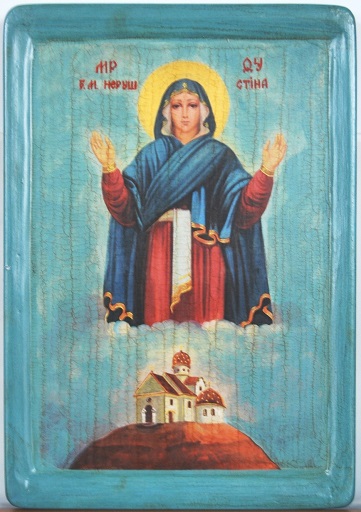
Sadly, during the Second World War the icon was lost, and now a copy of it is displayed in the church.
 |
| Stradch. The holy image of the Mother of God the Indestructible Wall |
In the church cemetery is buried the Blessed Mykola Konrad — a professor, Catholic theologian, philosopher and spiritual guardian of youth. He was killed by NKVD men in Stradch in 1941, together with the deacon who stood up for the priest as he hurried to a sick woman with the Holy Gifts.
 |
| Stradch. The grave of the Blessed Mykola Konrad and a monument to him |
The Stradch cave monastery is a place of monastic feat and of numerous pilgrimages, a monument of the Ukrainian church and people.
 |
| Stradch. The chapel on Church Hill and the image of the Mother of God the Indestructible Wall |
You can reach Stradch by the Lviv-Yavoriv and Lviv-Novoiavorivsk minibuses in 30 minutes.
Coordinates: 49°53'51"N 23°45'25"E




No comments:
Post a Comment
Leave your impression