The first station is in the chapel beside the cemetery where the priests are buried.
 |
| Hoshiv Monastery. The Way of the Cross. The 1st station. The chapel. |
 |
| Hoshiv Monastery. The cemetery where the priests are buried. |
Each station takes the form of a cross with reliefs depicting the sufferings of Jesus Christ.
The next ones stand 40 — 50 metres apart from one another.
You have to climb a steep ascent.
They say that many pilgrims climb on their knees with prayers and lit candles, and if a candle goes out they turn back and begin the ascent again in penance.
In
Morshyn I once saw a pilgrimage procession, when believers from all around would gather into a single column and, with prayer books and holy icons, walk forty kilometres and more to the shrine.
These were thousands upon thousands of people, many of them young, who walked not the way one walks on a hike or an outing. I know that no one compelled them to it.
 |
| Hoshiv Monastery. The chapel and the sculpture of Saint Thaddeus. |
Everyone went on the pilgrimage at the bidding of conscience and their own inner convictions, reciting prayers for peace in Ukraine along the way.
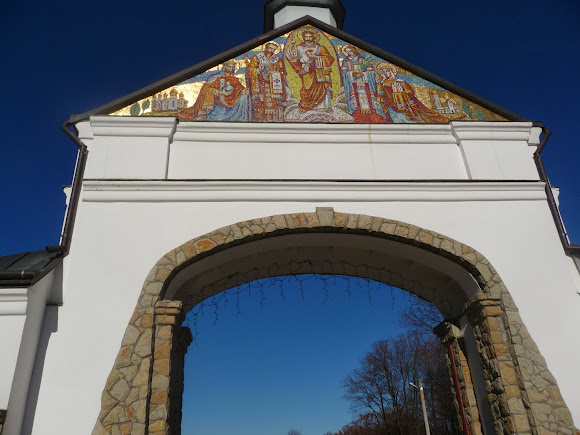 |
| Hoshiv Monastery. The entrance gate. |
The first time I visited the Hoshiv Monastery it was on a tour led by Nataliia Fedorivna — a fascinating storyteller, a philologist from
Lviv.
 |
| Hoshiv Monastery. The Way of the Cross. |
The Holy Transfiguration Monastery was founded in 1509, at a time when the Ukrainian land was subjected to enemy raids. The monks had to move their cloister from place to place, hiding from the infidels in the remote tracts.
 |
| Hoshiv Monastery. The spring pavilion with healing water. |
The foundations of the first monastery were uncovered in 2016 during excavations. According to legend, the Ukrainian nobleman Shumliansky turned to God with the question of where to build the monastery. The clouds parted and the sun blazed out over Yasna Hora, where the shrine now stands.
 |
| The Hoshiv Holy Transfiguration Monastery |
This Greek Catholic monastery of the Basilian Fathers, a monastic order that venerates Basil the Great, is better known as the Hoshiv Monastery, named after its patron Mykola Hoshovsky.
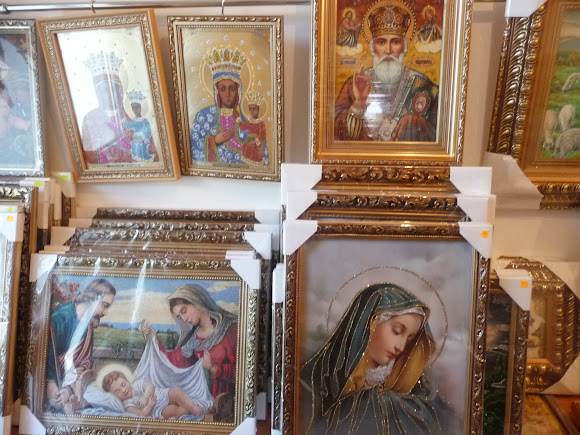 |
| The Hoshiv Holy Transfiguration Monastery. The church shop. |
The chief relic of the cloister, and one of the most venerated among the faithful, is the icon of the Hoshiv Mother of God.
The first owner of this copy of the icon of the Czestochowa Mother of God was the standard-bearer Andrii Shuhai from the Ternopil region. Together with his daughters he was staying at the Hoshovskys' estate in a time of misfortune. When Shuhai's house burned down, the one wall left standing was the one on which the holy image hung. After the family departed, the image of the Most Pure One remained with the nobleman. A second miracle is recorded, when the face of the Mother of God shone out with an extraordinarily bright light. After this, with the blessing of Metropolitan Lev Sheptytsky, Hoshovsky handed the holy image over to the monastery.
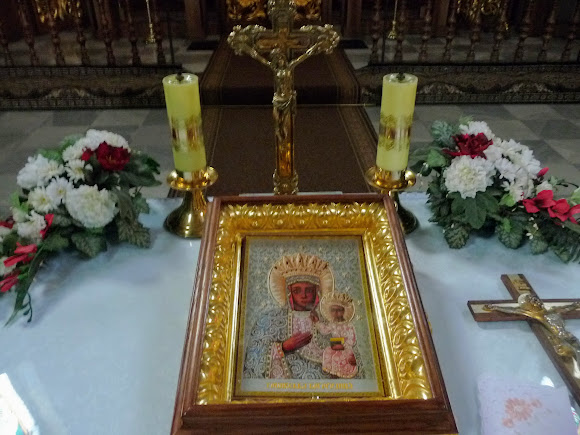 |
| The image of the Hoshiv Mother of God |
The icon has been crowned twice — in 1746 by Metropolitan Andrey Sheptytsky and in 2009 by Pope Benedict XVI. The miraculous image is famed for numerous cases of healing. From the middle of the 19th century and for almost a hundred years the cloister grew and flourished.
With the coming of Soviet rule the Greek Catholic Church was shut down, the monks exiled to Siberia, the church furnishings plundered, and the premises of the church were given over in turn to a warehouse, a holiday base and a boarding school.
The miraculous icon was lost as well. Today the faithful turn to the face of a surviving copy, painted at the end of the 19th century. In 1990 the monastery was returned to the faithful. The church is always open, even when there is no service or tour.
To reach the image of the Mother of God you have to climb a wooden staircase.
There is no candle shop in the church. The candles lie by the stairs, and you can place your offering for them in a special box. But no one keeps watch over this. Nor will anyone reproach you for actions that some old ladies consider "wrong".
 |
| An artificial waterfall beside the church |
During services all the parishioners and pilgrims cannot fit inside the church, and so they pray in the churchyard.
 |
| The "Stone of Love" sculpture |
For bad weather there are canopies.
 |
| The Hoshiv Holy Transfiguration Monastery |
Coming here every year, I notice significant changes.
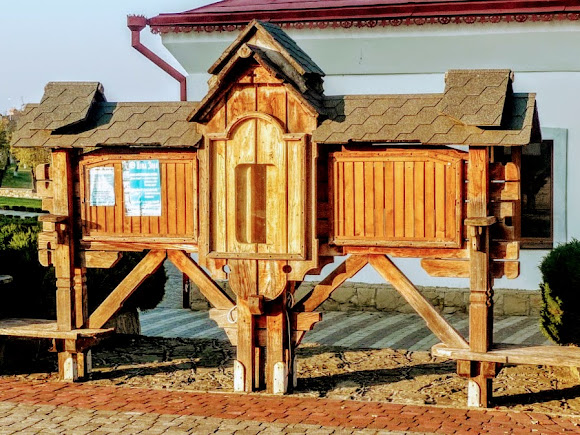 |
| The notice board |
Electronic bells have been installed in the belfry. For holding services, a rotunda with an image of the Queen of the Carpathians has been built on the square.
From here a wonderful view opens out over the Subcarpathian region.
The sculpture of the Mother of God is always in flowers. Streams of an artificial waterfall run down from the pedestal. The icon lamps here never go out.
 |
| The sculpture of the Mother of God |
The Way of the Cross ends at a symbolic Golgotha.
 |
| The 14th station of the Way of the Cross |
Steps lead up the hill and down into the underground part.
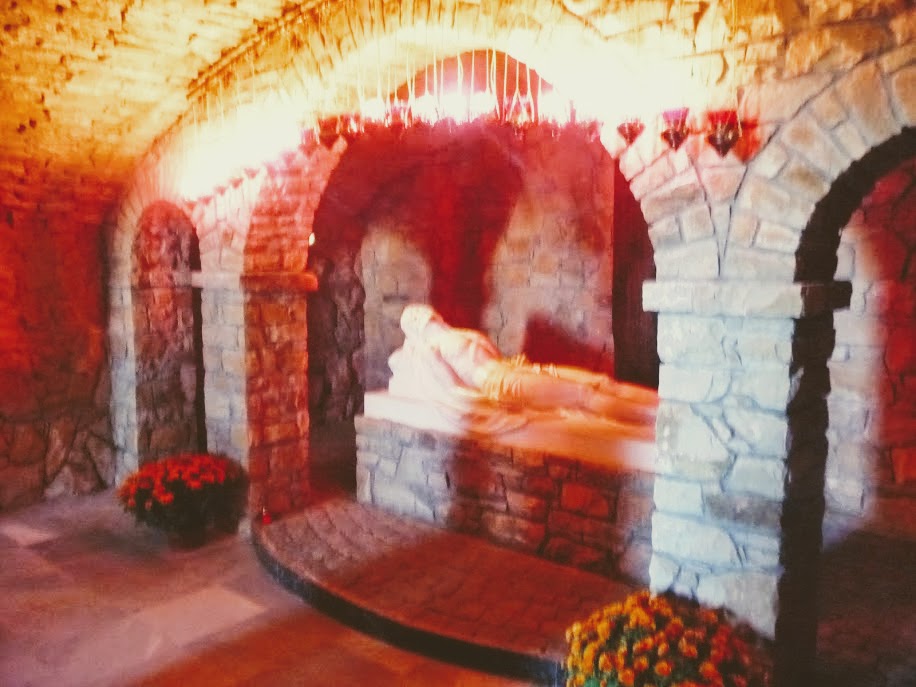
In the basilica stands a white marble sculpture of the crucified Jesus Christ, and fragments of the Life-Giving Cross of the Lord are kept there.
The monastery grounds are well tended, with many evergreen shrubs and roses.
A large area is set aside for a car park, and there are wooden gazebos.
 |
| The car park and the wooden gazebos |
A large new hotel of unusual design is now under construction. Its original appearance reminded me of cave-like monastic cells.
 |
| The construction of a hotel for pilgrims |
As you walk back down the steep asphalt descent, a panorama of Hoshiv opens out from the hillside.
The village, in the Dolyna district of the Ivano-Frankivsk region, was founded in the 14th century.
It lies in the picturesque valley of the Luzhanka River, a left tributary of the Svicha.
 |
| The bridge over the Luzhanka River |
Around 2,000 people live here.
 |
| The bus stop |
I spotted the school and the library right by the road.
 |
| Hoshiv, Dolyna district, Ivano-Frankivsk region. The school. |
 |
| Hoshiv, Dolyna district, Ivano-Frankivsk region. The library. |
The village has its own church.
Beside the village council stands a monument to the soldiers of the Second World War.
In the southern part of Hoshiv, at the foot of Yasna Hora, stands the convent of the Congregation of the Sisters of the Holy Family.
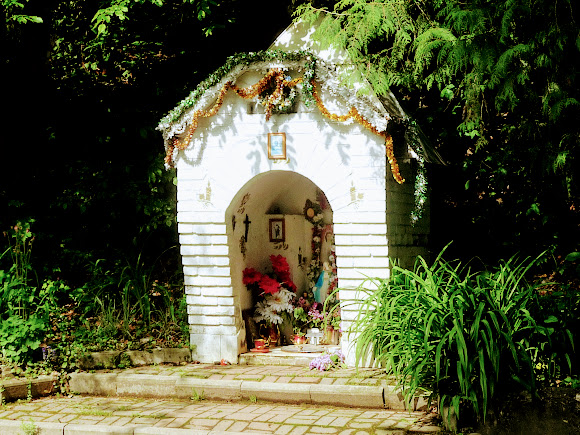 |
| The chapel by Yasna Hora |
From the village council you have to walk or drive about 3 kilometres. The gate and the door were open.
 |
| Hoshiv. The convent of the Congregation of the Sisters of the Holy Family. |
The resident sisters were working in the vegetable garden and busy with household chores.
I went into the church, where there was no one; that is, anyone here who feels the need can be alone.
The cloister was founded in the 1990s by Zenovii Krasovsky, a writer and public figure.
 |
| The memorial marker to Zenovii Krasovsky, the monastery's founder |
The monastery is a spiritual centre and provides substantial charitable aid to children from the ATO zone.
The Hoshiv Monastery sits right by the
Lviv — Ivano-Frankivsk highway: from
Bolekhiv it is 4 km to the south, and from
Dolyna 6 km to the north-west. Buses come every 15 minutes, so it is easy to get here. The trip always leaves the fondest impressions, which I share with you.
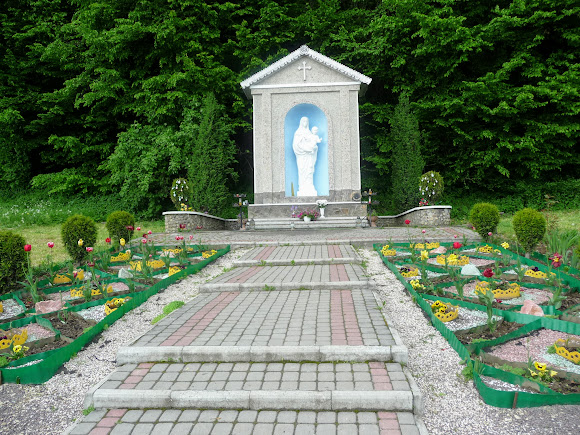 |
| The sculpture of the Mother of God at the foot of Yasna Hora |




No comments:
Post a Comment
Leave your impression