The cave monastery of the 13th-15th centuries in the village of Rozhirche, Lviv region, is a unique example of sacred building in the rock.
Rozhirche. Stryi district, Lviv region. The cave monastery
The place of worship was used as far back as pagan times; later it became a spiritual retreat and a place of pilgrimage. Now the unusual monastic complex draws visitors more and more, and tourists include a walk to it in their route.
Travellers reach the ancient sanctuary by the Lviv-Mukachevo suburban train as far as the Stynava Nyzhnia railway platform and then walk 3.5 kilometres to their destination. Rafters float down the river Stryi to the bridge and cover the distance of 2.8 kilometres on foot. I reached Rozhirche by scheduled buses from the Stryi turn near the village of Myrtiuky. In the afternoon the buses to the remote villages do not run often — roughly once every one or two hours. The first to come was the bus to the village of Semyhyniv, 5.5 kilometres from Rozhirche. I decided to ride to Semyhyniv, look over its landmarks and only then wait for the bus to Rozhirche. Semyhyniv is one of the oldest villages of the Stryi district, founded in the 11th century.
Semyhyniv. Stryi district, Lviv region.
Ancient legends about the death of seven brothers in resisting enemy raids gave the settlement its name. Now about 1,500 people live in the village, and its foremost landmark is the wooden church of the Exaltation of the Holy Cross, of 1941. The sanctuary was raised on the site of its predecessor and holds the status of an architectural monument of local significance.
The centre of the village — the village council, the school, the folk house.
Semyhyniv. The village council
Semyhyniv. The school
Semyhyniv. The shop
Semyhyniv. The folk house
The awaited bus to Rozhirche, which, in the words of the locals, absolutely had to run, still failed to appear. Despair was creeping up on me, and I was already pondering how I might get back out of Semyhyniv.
Semyhyniv. The bus stop
Suddenly a school bus arrived, from which several pupils got out, and the teacher accompanying the schoolchildren offered me a ride. Oh, what happiness! More than once I have had occasion to become convinced that in the sub-Carpathian villages a traveller will not be left stranded alone. Having reached Rozhirche, the driver told me the location of the stop for the scheduled bus and the departure time for Stryi — 19:30. I had 3.5 hours in reserve, and there was much to manage. A little more than a kilometre remained to walk to the cliffs, and the signposts pointed the direction correctly.
The monument of history and nature is set on the south-eastern edge of the village, in the protected 'Rozhirche' tract. In this place the mountain ridges rise sharply out of the plain, without any gentle, hilly ascent beforehand.
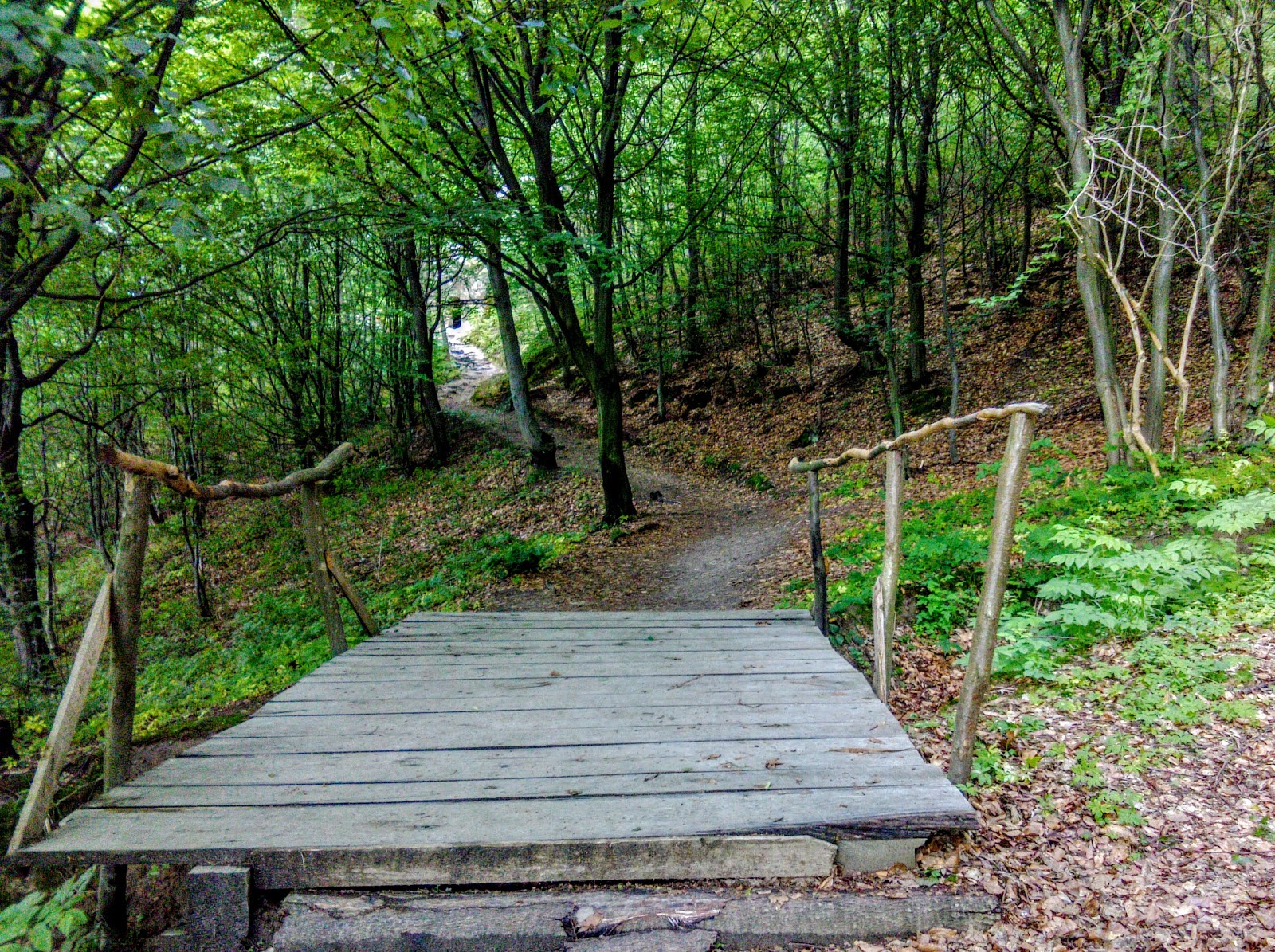
The foothills of the Ukrainian Carpathians are covered with a dense forest massif, dominated by beeches — trees with smooth, straight trunks and a spreading crown.
A narrow path over sharp stones, with interlaced roots and stumps, leads to the ancient sacred structure.
The foothills of the Ukrainian Carpathians. The 'Rozhirche' tract
The rock formations, with their outcrop of sandstone, stretch about 400 metres within the protected zone.
The main rock massif is on the northern slope of the ridge. The first written mentions of the monastery appeared in the 15th century, but in the historians' opinion it already existed in the 13th.
The latest archaeological studies have made substantial corrections to the dates of the caves' origin. Probably, in the 8th-7th centuries pagans used them for rituals.
There is a version that the monastery was founded by monks who had fled from Kyiv during the destruction of Orthodox sanctuaries by enemy hordes from the east. In this hard-to-reach terrain the hermits established their retreat in the caves.
On the lower level lay the cells; the upper one, with its arched vault, was the church. Eighteen steps hewn into the stone monolith lead up to it.
In the 14th-16th centuries the monastery belonged to the order of Saint Father Basil; this was the time of the flourishing of the remote monastic centre.
The old church consisted of a narthex and an altar part. In the niches, vestments and church utensils could have been kept.
At a distance of 50 metres from the main massif rise two cliffs. The narrow opening between them was the gate into the retreat.
The inhabitants kept an apiary and sold honey. Local people could come to the spiritual retreat for a sermon.
The present interior furnishing of the church is made up of a sculpture of the crucified Jesus Christ and holy images of the Saviour and of the Hoshiv Mother of God.
The faithful leave votive lamps and flowers.
From here a panorama of Rozhirche and the Carpathian foothills opens up.
Sadly, visitors to this historical and spiritual monument often leave traces of their stay. The ancient inscriptions and images of saints, carved many centuries ago, are overlaid with the autographs of tourists.
Visitors try to chip off pieces of the walls in the caves and leave litter. A request to those who wish to visit the cave monastery: treat this sacred monument of the Boiko region with care.
I went back along the now-familiar path and came down into the village well before the arrival of the scheduled bus.
Rozhirche. A memorial cross for the abolition of serfdom in 1848.
In the village I saw the school bus in which I had ridden to Rozhirche. Tomorrow morning it will carry the village children to their lessons.
Rozhirche. Stryi district. Lviv region.
Coordinates of the cave monastery: 49°6'52"N 23°42'2"E




No comments:
Post a Comment
Leave your impression