A New Year's table is hard to imagine without a bottle of sparkling wine, which creates a wonderful sense of celebration. With a glass of champagne we make a wish. How is it born, in what conditions is it made, and do we know how to drink the magical beverage? About this and much else you can learn by visiting the sparkling-wine factory in Bakhmut, in the Donetsk region.
 |
| Bakhmut, the sparkling-wine factory. Dionysus with the maenads in the tasting hall |
I do not name the company, since my visit to the enterprise and my account of it are of no commercial nature, and the cultural outing took place purely for my own pleasure.
 |
| The sparkling-wine factory. The administrative building |
The largest enterprise in Eastern Europe for the production of sparkling wines is situated on the territory of worked-out gypsum mines, in which the useful raw material began to be extracted in the 18th century. The empty adits were handed over by Stalin's government to the Ministry of the Food Industry, and in 1950 the mass production of 'Soviet Champagne' began. The Association Agreement with the EU stipulates that only the Champagne province in France, the birthplace of the wine with bubbles, may use the term 'champagne', and the decommunisation law put an end entirely to the 'Soviet' past and changed the names of the varieties — but they have not become any the worse for it.
 |
| The products of the sparkling-wine factory. |
The entrance to the fantastic world of champagne is a portal with a bas-relief image of Dionysus, the god of winemaking and of the productive forces of nature (or Bacchus, whichever you prefer), who offers a cup of wine to Demeter, the goddess of fertility, in a bower of grapevines.
 |
| The sparkling-wine factory. The entrance to the wine store |
 |
| The bas-relief at the entrance to the wine store |
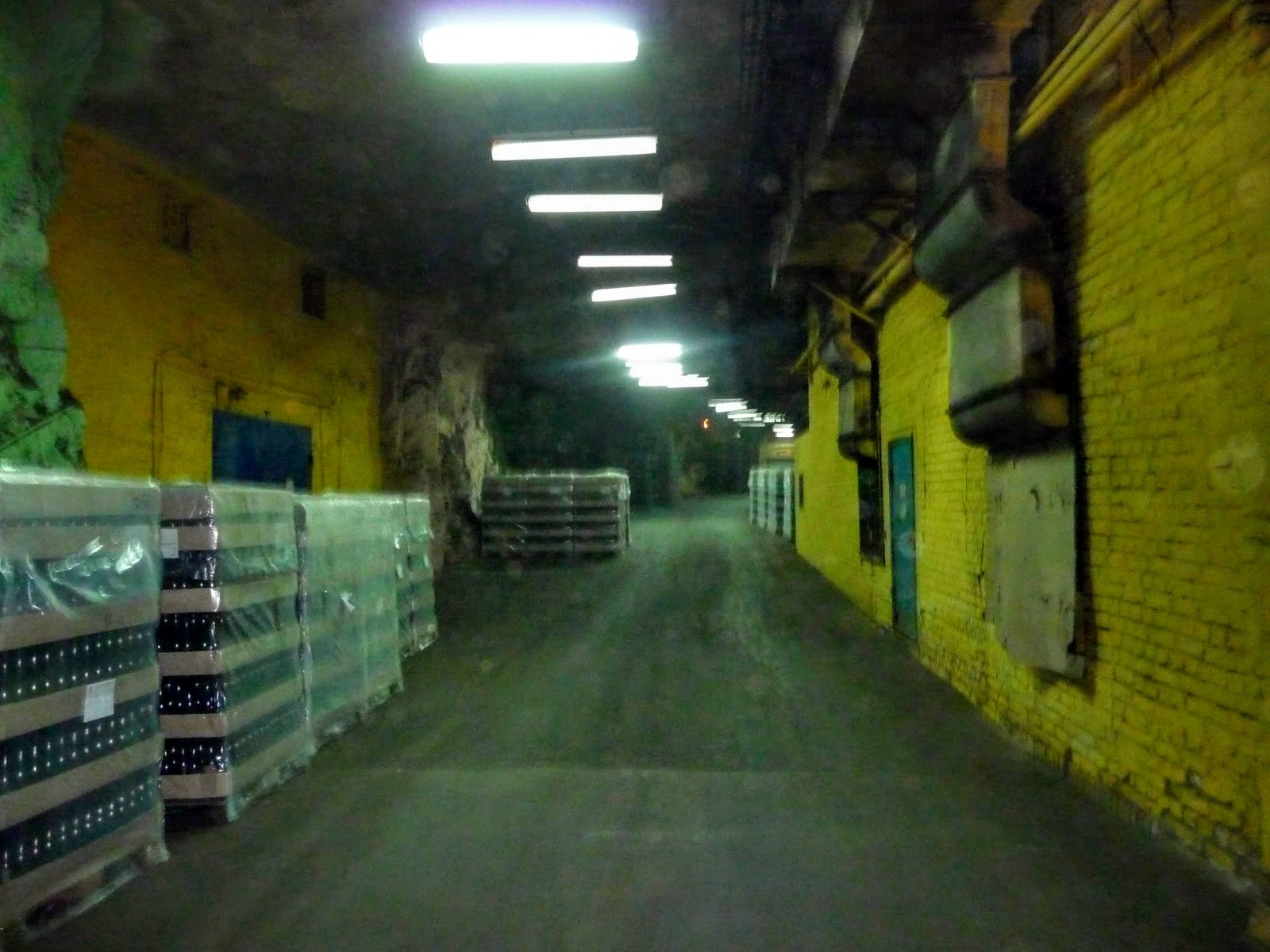
The factory occupies 26 hectares of alabaster workings, where nature herself has created ideal conditions for the production of Dionysus's beverage, with a constant temperature of 13-14°C and a humidity of 85-90%. A tunnel with multicoloured lamps, resembling New Year garlands, leads down to a depth of 70 metres.
 |
| The underground labyrinths |
You feel as if you have entered a fairy-tale underground kingdom, which is nothing at all like a mine face.
The galleries are adorned with mosaic panels, paintings and quotations from poets.
The verses of Omar Khayyam recall the four conditions that forbid the drinking of the beverage of the gods. Whether we know how to drink it properly and remember the conditions voiced by the Eastern sage, I observed in the final part of the excursion, of which I shall write below.
 |
| The sparkling-wine factory. The verses of Omar Khayyam |
Stands with information about the enterprise's achievements and a map of the sales of sparkling wine in twenty countries of the world demonstrate the high figures of the Bakhmut winery.
 |
| Stands with information on the factory's history |
 |
| A map of the sales of the factory's products |
But it was not always so. In creating the production shops, it was first necessary to pump out tonnes of underground water, remove the slag and lay the utilities.
 |
| The underground wine store |
The enterprise expanded, was reconstructed, and new technologies were introduced.
For its excellent quality the factory's products have been awarded grands prix and gold and silver medals at all manner of international exhibitions, professional competitions and specialised fairs.
At present the factory produces 25 million bottles a year, and I will note, without exaggeration, that the most popular champagne in the mining region is Artemivske.
The monoliths of gypsum rock are painted in caramel tones, and this too adds colour to the former mine faces and drifts, since gypsum in nature is mostly grey.
A walk through the adits is like a trip to a picture gallery.
 |
| The underground picture gallery |
Swarthy girls at the gathering of ripe berries in the lands of Sontsedar.
A little squirrel is already approaching the three merry bear cubs.
What happens if you don't know your limit. Scenes from the life of the feathered ones.
The aksakals admire the fruits of their labour.
The factory in Bakhmut is renowned for making wine by the classic method, which combines high technology with the use of manual labour.
The wine stock is supplied from Ukraine's traditional grape-growing granaries — the Odesa, Kherson and Mykolaiv regions. The winemakers produce white, red and rosé wine, which differs in its ageing period from 9 months to 3 years and more.
In the gypsum grottoes the sacrament of the birth of the beverage of the gods takes place. The wine stock is placed in vessels and left to settle there for a strictly allotted time.
The sediment, called Prussian blue, is loaded into special vats and sent for processing.
Interesting facts and figures. The inner surface of the tank is washed with hot soda water by slender girls whose figures allow them to slip through the narrow hatch. There must be two of them, since after a short time the alcohol content in the blood of the slender Cinderella reaches 0.7 per mille, equal to 100 grams of vodka, and her partner takes over.
 |
| The inner surface of a vessel |
Without tender women's hands the process of making the magical beverage would be impossible.
In the bottling shop, covering 9 hectares, 19 million bottles are stored.
The workers, whose employment record reads 'champagne preparer', shift 4,000 bottles per shift — 8 tonnes in all.
In each hand is a bottle weighing 1,700 g, which must be shaken several times like a rattle and carefully put back in its place.
During the shaking the atmospheric pressure inside the bottle rises to 17 atmospheres. Sometimes the glass cannot bear the load, and the bottles burst in the hands of the champagne preparer. Mechanised shaking is also used, in which 510 bottles are shaken at once in containers, but manual labour is more reliable and of better quality.
The passage along the technological chain takes place in a kind of factory pinacotheca, for the production of champagne is an art of the highest order.
 |
| The underground picture gallery |
The vine-growers pass on their knowledge and skills as an inheritance.
Do not drink water, if you can drink wine!
The technology requires that the cuvée be aged in special wine cellars. The yeast added to the must along with the syrup is unique to each company. It is important to wait for the bouquet to open, after which the wine, temporarily stopped with a little skirt-shaped cap, is sent for champagnisation. By secondary fermentation the drink is saturated with carbon dioxide. Designers and artists complete the process of making the sparkling wines, working on the labels and the appearance of the final product, which we then see in the shops. All the subtleties of the technological process are best heard from a professional guide and seen with your own eyes; for this it is better to book an excursion on a working day.
The enterprise has a kind guardian angel, whose image is carved into a block of gypsum. In 2000, for the winery's 50th anniversary, the stone Bacchus was given a few aesthetic touches to emphasise his might and strength.
The enterprise's workers remember the tragedy known as the Bakhmut Babyn Yar. In 1942 the Hitlerites drove more than 3,000 civilians into an alabaster mine and walled them up alive. After the liberation of Bakhmut the chambers were opened, and the bodies were identified and buried. In 1999 the 'Wailing Wall' memorial was opened in the adit.
In the grotto hall with its round table, delegations, partners and inspection commissions are received. The visitors too can feel like heroes of chivalric romances and guests at banquets, sitting for a few minutes in the Gothic-style armchairs.
The vintage wines in the bar are there as decor, but to truly understand champagne by means of sight, smell and touch, the guide invites everyone into the so-called 'Greek hall', where Dionysus, together with the maenads, delights in the wonderful beverage.
Before appraising the quality of the sparkling wines, the guide warns that a tasting is not toasts with the clinking of glasses, but an assessment of the wine by its colour, sparkle, flow, smell and taste. Over the course of an hour, 9 kinds of wine are offered, among them still dry wines, brut labels, and semi-dry and semi-sweet sparkling wines.
The guide tells in detail about the bouquet, the interaction of the components, the variety of aromas of the winery's main product line, and the secrets of tasting.
To feel a little like a sommelier and to hear the interesting account in full did not, alas, come off. The group of visitors to the winery paid no heed to all the visual aids, the quotations of the great on the refinement of the art of winemaking and of drinking wine. After the first glass a tamada appeared, toasts with clinking began, as at an ordinary drinking bout, with noise and shouting over the guide. The tasting of the beautiful wines was, in essence, wrecked. I have written about this so that future visitors may have an idea of the content of the event and show the utmost respect to the factory's workers and to their fellow travellers on the outing.
It should be remembered that persons under 18 are forbidden to visit the factory. Excursions are held from Monday to Friday; on Saturday — by prior booking.
 |
| Bakhmut. The sparkling-wine factory. The excursion department and the factory entrance |
The address of the winery: the town of Bakhmut, Donetsk region, Patrice Lumumba Street, 87.
Coordinates: 48°35'57"N 38°1'51"E




No comments:
Post a Comment
Leave your impression