The 14th-century Halych Castle — a mighty stronghold at the centre of the early-mediaeval Galician-Volhynian Principality, an architectural monument of national significance.
 |
| Halych. Castle Hill. The Starostyn Castle, 14th c. |
To see the ancient fort, you have to climb Castle Hill.
The steps lead up to the heights by gentle slopes.
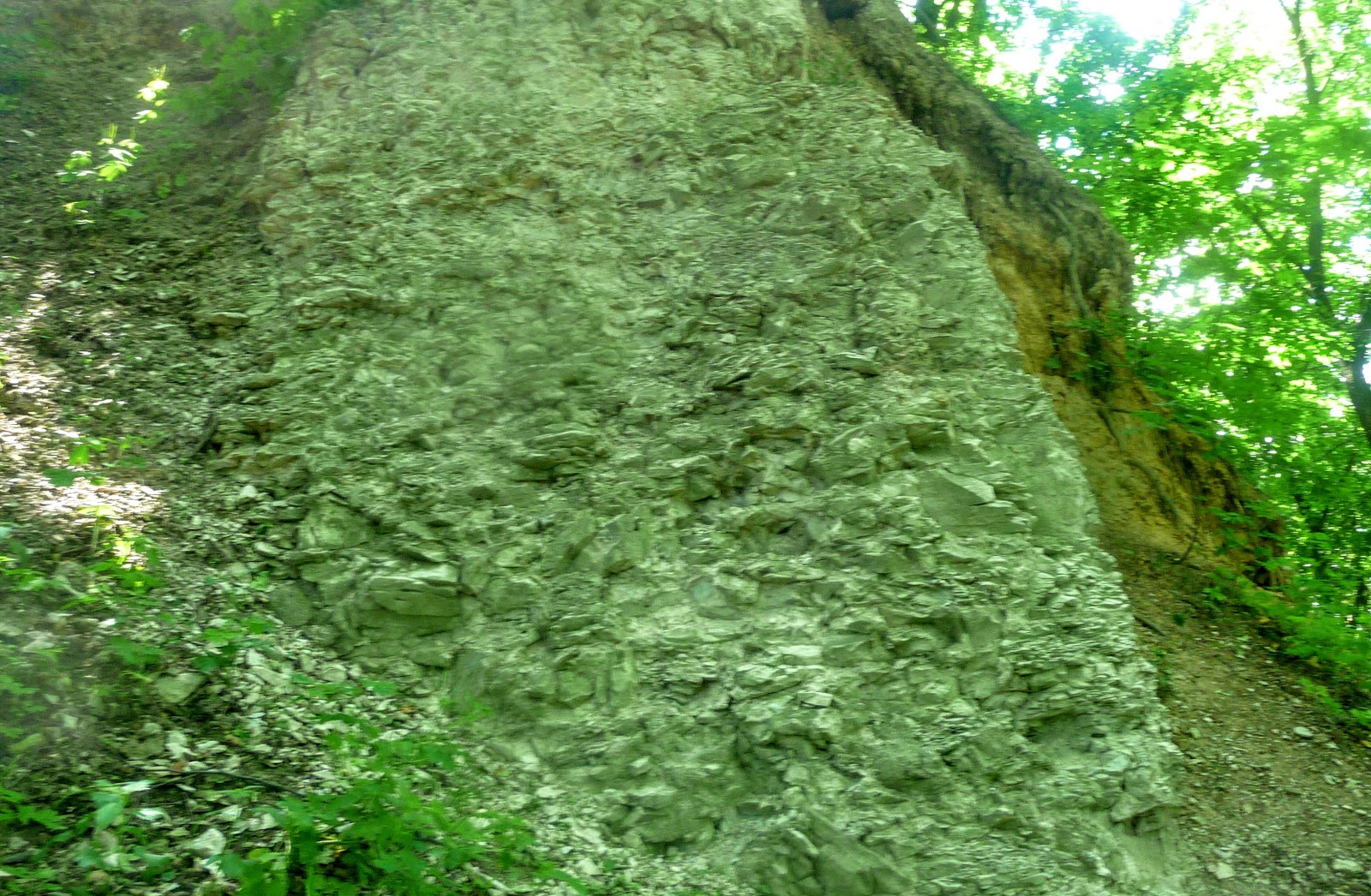
The outcrops of sandstone are covered with dense vegetation, and beneath them are hidden the underground galleries of the ancient fort.
Historians believe that in the times of the chronicles an ancient hillfort stood on Halych Hill, on which rose the Volodymyrivka palace and the Church of the Saviour.
Scholars suppose that the princely capital was a trading wharf on the Dnister, and that the castle on Halych Hill served as a well-fortified fort.
 |
| Halych. The Dnister. The embankment |
The first written mentions of one of the oldest fortresses date from 1114.
At first the fortification was of wood, but no one knows when it arose, or who destroyed it.
The revival of the citadel began in the 14th century, with the passing of Galicia and Western Volhynia to Poland, and lasted a whole century.
 |
| Halych. Castle Hill. The Starostyn Castle, 14th c. |
The largest fortress in the district numbered about 1,000 defenders and had a powerful arsenal. The castle, irregular in plan and close to a triangle, was built of sandstone and stone.
The fortress walls had three gates and were strengthened by five towers. Deep moats and high earthen ramparts added to the stronghold's impregnability.
Over the centuries the castle survived fires and the devastating attacks of the Turks, the Tatars and the rebels.
In the 17th century, under the leadership and at the expense of the starosta Andrzej Potocki, the citadel was restored to the design of an Italian fortification engineer, who added new walls and redoubts to the fortress.
On an area of 1.7 hectares stood three corner towers, outbuildings, an archive, a chancellery and the chapel of St Katarzyna (Catherine).
The irreparable blow to the Starostyn Castle was dealt by the Turks, who plundered it and blew it up during the war with the Poles, who ran up the white flag in 1676. Gradually the fortress lost its defensive significance, fell into desolation and remained in a state of ruin until the end of the 20th century.
The 'Ancient Halych' National Reserve inherited the remains of the five-sided western tower up to the level of the second tier and fragments of the fortress wall with its loopholes.
 |
| Photo by M. Rosenbaum. 1930s. |
What we see today on the site of the lost castle is practically a new build, risen from the ashes.
The restorers plan to rebuild the ecumenical chapel of St Catherine and the defensive wall with its fighting platform. But it seems that such labour-intensive projects are for now impossible.
No measures to conserve the remains of the ruins of this historic monument are to be seen. The foundations of the fortress walls are crumbling before your eyes and becoming overgrown with rampant greenery.
An exhibition has been arranged in the tower, but I could not see it — everything was locked, and no notices of the gallery's opening hours were to be found.
On the restorers' cabin a price list of excursions and photography services is posted.
And that was all. There was nothing left but to admire the beauties of ancient Halych from the height of Castle Hill and turn back.
It is impossible not to notice that the slopes of Halych Hill are strewn all over with bottles and other rubbish. A depressing sight, and a wholly spoilt historical excursion into the Middle Ages.
You can get to Halych by long-distance trains from
Lviv,
Kyiv,
Mykolaiv and by the suburban train Hodoriv-Ivano-Frankivsk. Through the town runs the highway
Mukachevo-Ivano-Frankivsk-Lviv, and the road connections between the towns of the Lviv, Ivano-Frankivsk and Zakarpattia regions are fairly well established.
Coordinates of the Halych Castle: 49°7'18"N 24°43'49"E




No comments:
Post a Comment
Leave your impression