Some of Ukraine's wine-making estates that I have managed to visit are very worthy agrotechnical enterprises, and I greatly enjoyed the excursions to these amazing wineries. But after the incomparable excursion to the Shabo Centre of Wine Culture, I place this super-class wine-making complex first by many measures, and what I saw and remembered I will try to recount in my own words.
 |
| Shabo. The Centre of Wine Culture |
The village of Shabo, in the Bilhorod-Dnistrovskyi district, is located 70 km from
Odesa.
 |
| Shabo. The Centre of Wine Culture |
Along Shveitsarska Street, which leads to the complex, billboards have been set up that acquaint you with the company's activities.
 |
| The Centre of Wine Culture. Shveitsarska Street |
The street's name is in honour of the settlers from Switzerland, who arrived in these blessed parts 200 years ago and reworked in their own manner the settlement's former Turkish name, Asha-Abaga, which means lower gardens, that is, vineyards.
Nowadays the village is pronounced with the stress on the first syllable.
 |
| The Centre of Wine Culture |
If the theatre begins with the coat-rack, then the Centre of Wine Culture begins with the toilet. And who would argue with that? From the very first minutes the company demonstrates a respectful attitude towards its visitors and a high culture. There is no extra charge for using the toilet, but the quality of the service is no worse than in fashionable hotels.
 |
| The Centre of Wine Culture. The toilet |
Excursions are held every day in any weather at 10, 13 and 16 o'clock, even if there is only one visitor, as I was this time.
 |
| The Centre of Wine Culture. The ticket office |
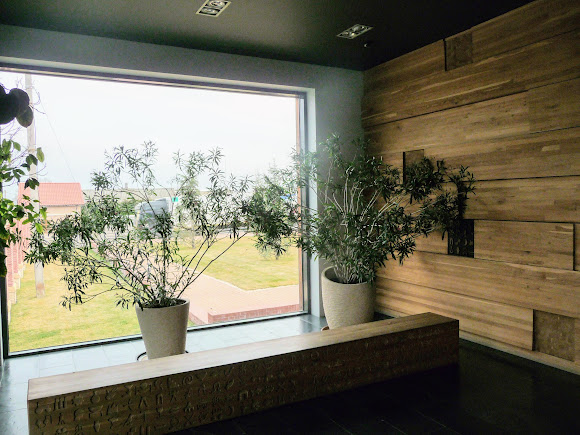 |
| The Centre of Wine Culture. The ticket office |
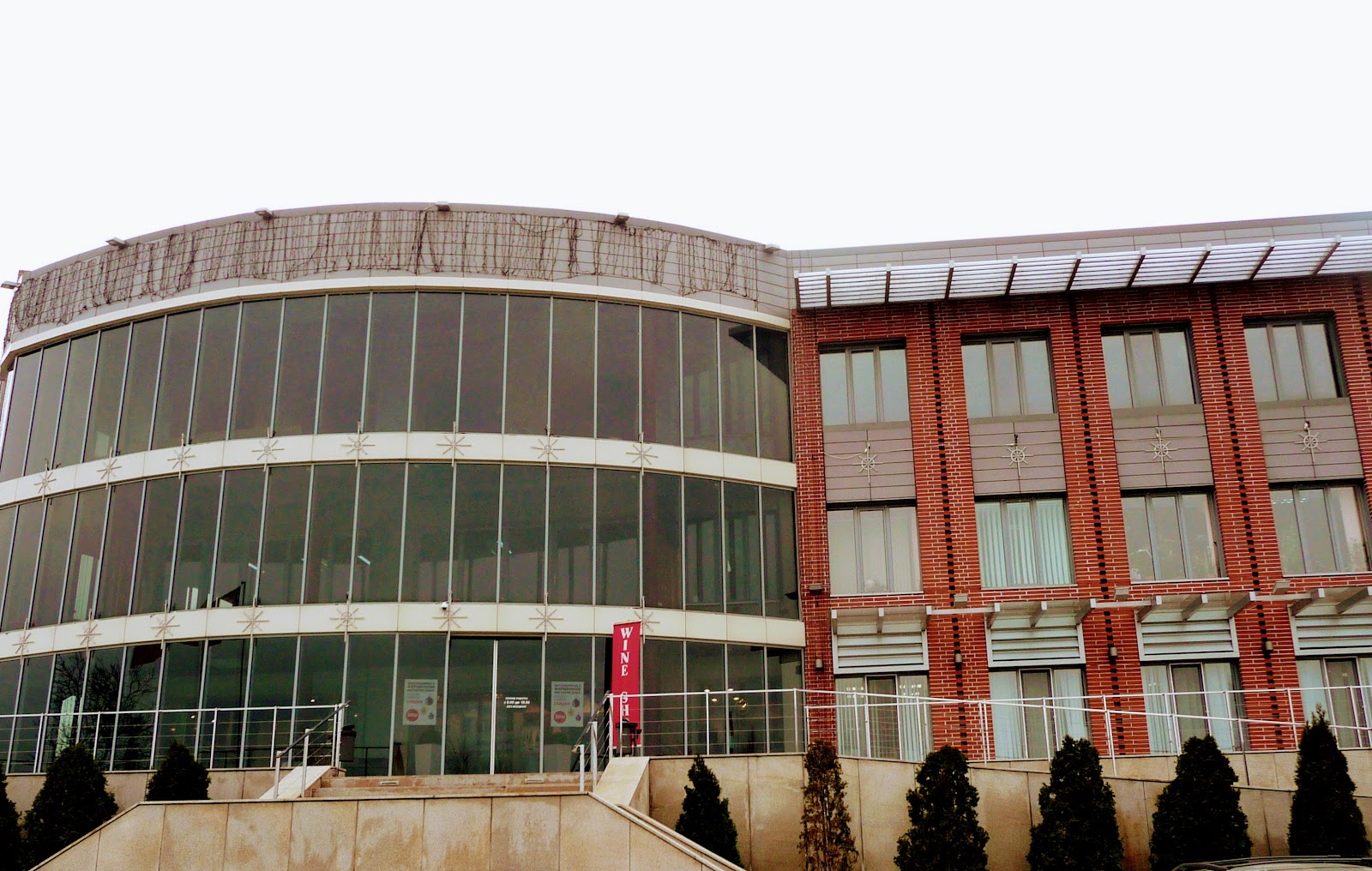
The wine-making complex combines a modern enterprise with high-tech equipment, ancient wine cellars, a museum and a tasting hall.
 |
| The Centre of Wine Culture. The entrance gate. The start of the excursion |
The technical equipment of the plant is one of the best in Europe and meets all the quality standards in this field.
 |
| Shabo. The Centre of Wine Culture |
The grapes arrive without delay straight from the plantations, of which the estate has 1,200 ha — and that means 4 million elite grapevines and 100 million bunches with 10 billion berries.
 |
| The Centre of Wine Culture. The grape reception and processing section |
 |
| The Centre of Wine Culture. The grape reception and processing section |
Paying tribute to the old traditions laid down in antiquity, the newest technologies are being introduced.
 |
| The Centre of Wine Culture. The grape reception and processing section |
 |
| The Centre of Wine Culture. The grape reception and processing section |
 |
| The Centre of Wine Culture. The grape reception and processing section |
The cycle includes the cultivation of elite grape varieties, their processing, the production of base wine, the distillation of spirits, ageing and bottling.
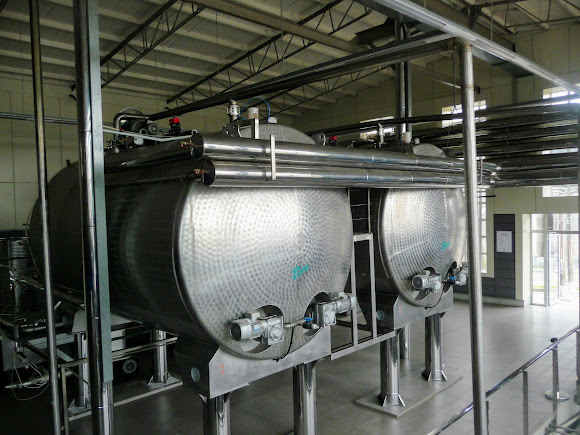 |
| The Centre of Wine Culture. The grape reception and processing section |
 |
| The Centre of Wine Culture. The grape reception and processing section |
 |
| The Centre of Wine Culture. The grape reception and processing section |
You can even sit at the software console and imagine yourself managing the process of receiving and processing the berries.
 |
| The Centre of Wine Culture. The grape reception and processing section |
 |
| The Centre of Wine Culture. The grape reception and processing section |
During the harvest season, whose weight exceeds 12,000 tonnes of various varieties, visitors by the conveyor watch the berries being carefully separated from the stalks.
 |
| The Centre of Wine Culture. The grape reception and processing section |
 |
| The Centre of Wine Culture. The grape reception and processing section |
The white fruit is pressed in a delicate manner without crushing the seeds and skins, while the red is crushed.
 |
| The Centre of Wine Culture. The grape reception and processing section |
The stages of the technological process are demonstrated step by step on a monitor.
 |
| The Centre of Wine Culture. The grape reception and processing section |
 |
| The Centre of Wine Culture. The grape reception and processing section |
In the workshop there is not only sterile, ideal cleanliness, but a constant air temperature is also maintained.
 |
| The Centre of Wine Culture. The premium wines section |
The raw material ferments in oak vats fitted with a control system.
 |
| The Centre of Wine Culture. The premium wines section |
In enormous stainless-steel reservoirs with a heat-carrier jacket, the wonderful drink matures.
 |
| Shabo. The Centre of Wine Culture. Wine storage |
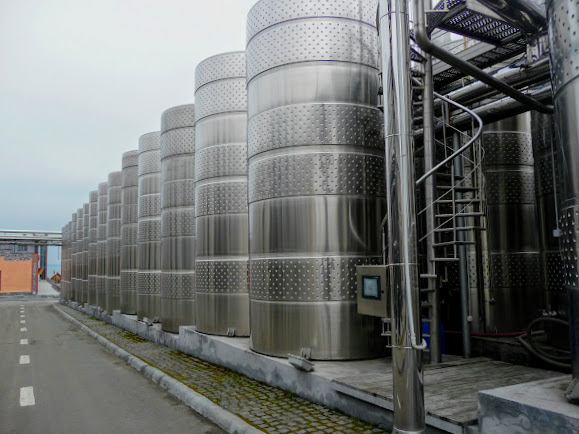 |
| The Centre of Wine Culture. Wine storage |
By means of a distillation unit, spirits of a special quality and an unsurpassed aroma are obtained.
 |
| The Centre of Wine Culture. The distillation unit |
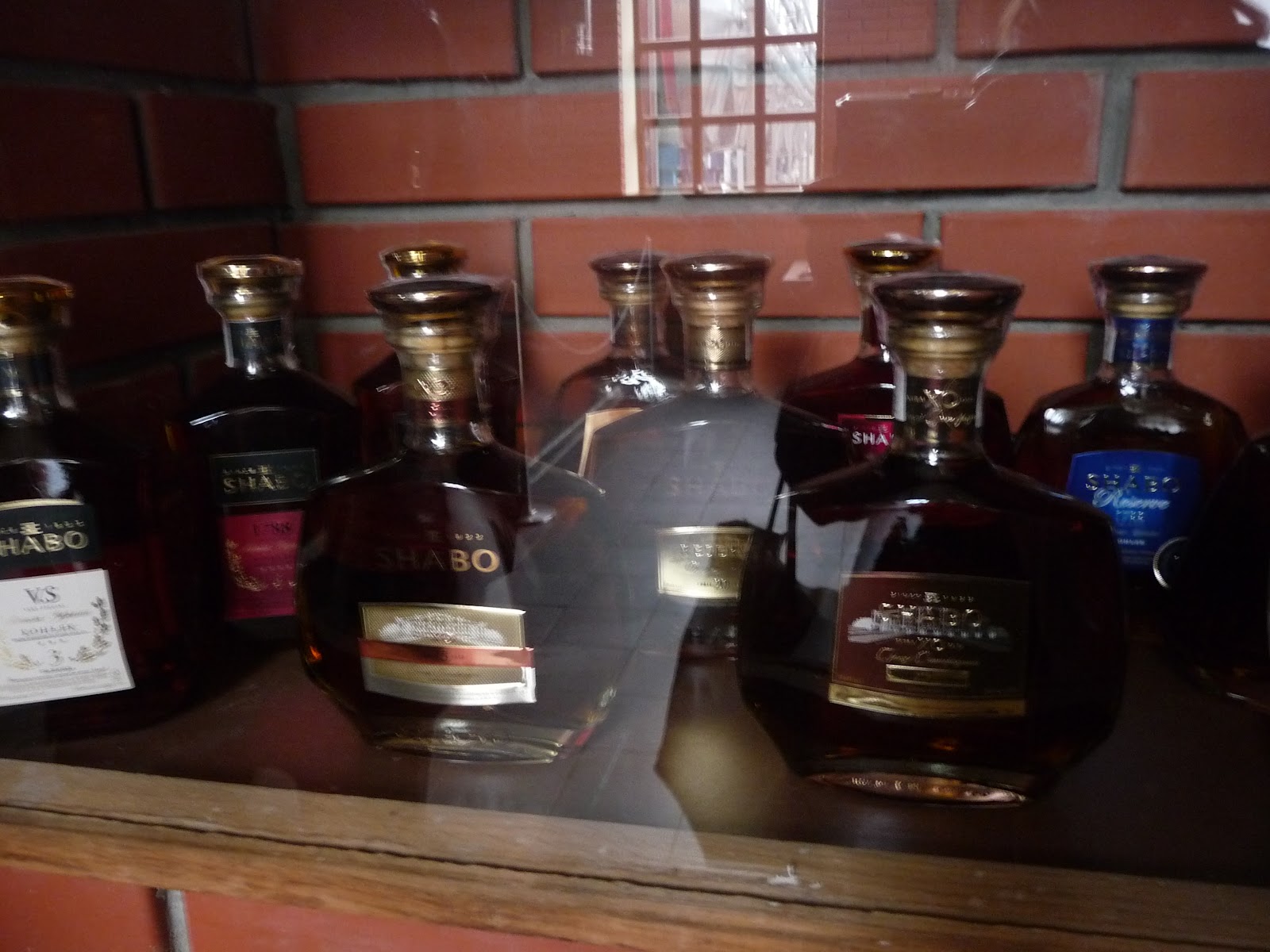
Right here, behind glass, a collection of premium products is displayed.
 |
| The Centre of Wine Culture. A collection of premium products |
The wine store is not only on the surface but also underground, at levels of 5 and 9 metres, and is one of the largest in Ukraine.
 |
| The Centre of Wine Culture. The underground cellars. Wine storage |
The refinement of the drinks grows in oak barrels, the wood of which is selected for each grape variety according to the region of origin.
 |
| The Centre of Wine Culture. The underground cellars. Wine storage |
The walls of the underground store are painted with red symbols.
 |
| The Centre of Wine Culture. The underground cellars. Wine storage |
Small graphic drawings tell of the benefits of wine and its effect on a person when the sunny drink is consumed to excess.
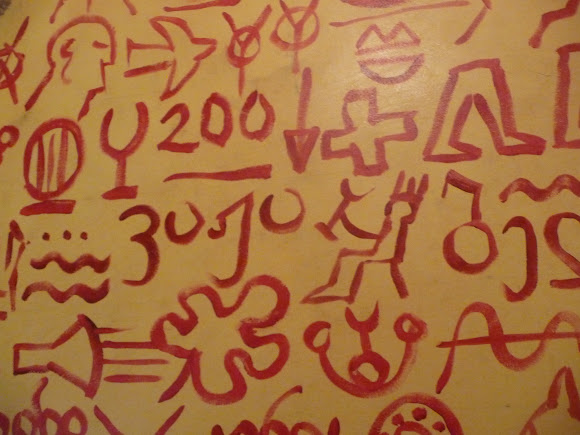 |
| The Centre of Wine Culture. The underground cellars. Graphic symbols |
The same signs and symbols are carved on a fountain structure made in the shape of a reservoir.
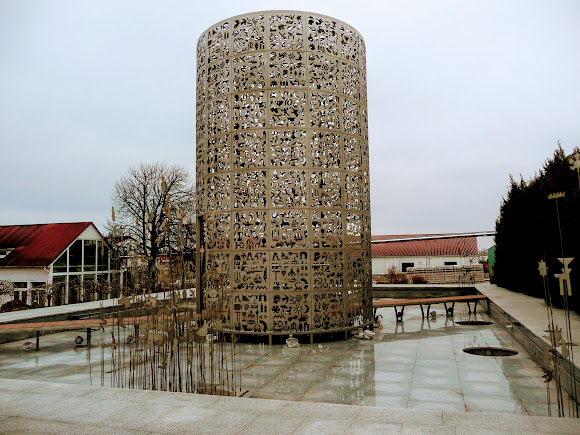 |
| Shabo. The Centre of Wine Culture. The fountain — the calling card of the Centre |
Dry sherry "comes of age" in the ancient sherry cellar.
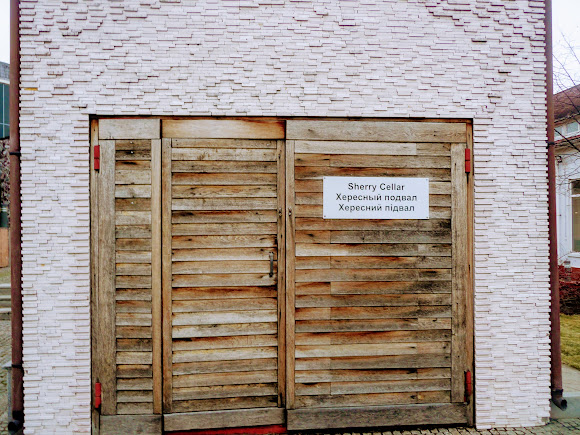 |
| The Centre of Wine Culture. The sherry cellar |
Each year the enterprise bottles over 50 million units of more than 80 product names under the "Shabo" trademark.
 |
| The Centre of Wine Culture. Wine storage |
The vineyard on the grounds of the complex is a tiny part of the vast areas and was created to acquaint visitors with the varieties of this wonderful gift of nature.
 |
| The Centre of Wine Culture. The vineyard |
 |
| Shabo. The Centre of Wine Culture. The vineyard |
Cabernet Sauvignon is an early variety of red grape with the most saturated flavour. From Chardonnay, the most popular variety of white grape, sparkling wines are produced. Muscat Ottonel is used for making semi-sweet wines. Pinot Noir — for strong sparkling ones. Next to the neatly pruned and tied-up vines, rose bushes are planted. It turns out that they serve as indicators of disease, since the reaction to the effect of viruses in the queen of flowers is noticeable 2 weeks earlier than in the grapes, and the specialists have time to take agrotechnical protective measures.
 |
| Shabo. The Centre of Wine Culture. The vineyard |
Free of production buildings, the territory is well tended; here you can sit a while, admire the beauty of the arboretum and take a selfie as a keepsake.
 |
| Shabo. The Centre of Wine Culture |
A sculptural depiction of a vine, with the miracle of the birth and ripening of a bunch, and with an inscription on the pedestal: "Wine is culture".
 |
| The Centre of Wine Culture. The sculptural depiction of a grapevine |
Far from every enterprise has its own museum.
 |
| Shabo. The Centre of Wine Culture. The museum |
Five columns by the entrance lend solemnity and grandeur to the unusual museum labyrinth, whose exhibits hold legends, myths and astonishing stories. The first column is in honour of Georgia, a country with rich wine-making traditions, made in the shape of a vessel for wine. The second recalls the Greeks who founded the settlement. The Turks held sway over this land for more than three centuries, and the third column is dedicated to them. The greatest role in the development of Shabo was played by the settlers from Switzerland, and in gratitude the fourth column was set up. It is clear to everyone that the fifth, faced with tiles, symbolises the Soviet era.
 |
| The Centre of Wine Culture. The museum. The entrance with columns |
Dionysus, the god of winemaking, greets you in a good mood and with vessels for wine in his hands.
 |
| The Centre of Wine Culture. The museum. A sculpture of Dionysus — the god of winemaking |
The ancient Greeks tasted wine diluted with water, half-reclining over friendly conversation.
 |
| The Centre of Wine Culture. The museum. The Greeks — founders of settlements in antiquity |
 |
| The Centre of Wine Culture. The museum. The Greeks — founders of settlements in antiquity |
On the walls are portraits of famous figures who visited Shabo. Lesia Ukrainka rested and took the cure in the healing sea and steppe air.
 |
| The Centre of Wine Culture. The museum. Portraits of famous people who visited Shabo |
Alexander Pushkin was right there in the wine cellars and, undoubtedly, delighted in the magical drinks.
 |
| The Centre of Wine Culture. The museum. Portraits of famous people who visited Shabo |
In 1937 King Carol II of Romania honoured the place with his visit and highly praised the Shabo wines, leaving his signature on fresh plaster.
 |
| The Centre of Wine Culture. The museum. The autograph of King Carol II of Romania |
The cellar is now called the Royal one.
 |
| The Centre of Wine Culture. The museum. The Royal cellar |
In the Georgian wine corner, interesting exhibits are kept that tell of the wine-making culture of the land of eternal spring.
 |
| The Centre of Wine Culture. The museum. An exhibition of wine-making objects from Georgia |
 |
| The Centre of Wine Culture. The museum. An exhibition of wine-making objects from Georgia |
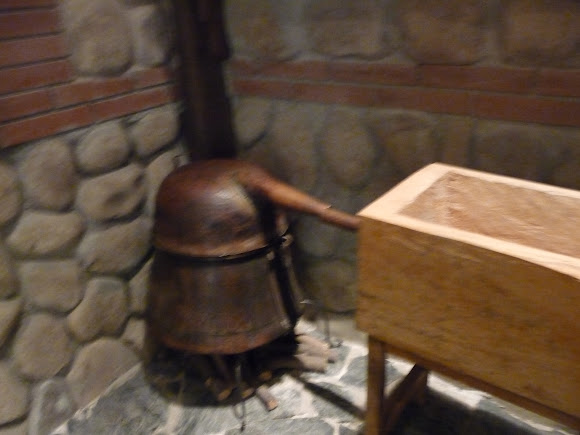 |
| The museum. An exhibition of wine-making objects from Georgia. A moonshine still |
 |
| The museum. An exhibition of wine-making objects from Georgia. A display of jugs |
But a special feeling of gratitude is evoked by the exhibition dedicated to the colonists from Switzerland, who covered 2,649 km in the 1820s.
 |
| The Centre of Wine Culture. The museum. The exhibition dedicated to the colonists from Switzerland |
It was necessary to take a Bible and a rifle, but the connoisseurs of the wisdom of viticulture brought with them all their treasure, in order to begin a new life in unknown lands.
 |
| The Centre of Wine Culture. The museum. The exhibition dedicated to the colonists from Switzerland. A rifle |
 |
| The Centre of Wine Culture. The museum. The exhibition dedicated to the colonists from Switzerland |
 |
| The Centre of Wine Culture. The museum. The exhibition dedicated to the colonists from Switzerland |
The economic miracle came only with difficulty.
 |
| The Centre of Wine Culture. The museum. The exhibition dedicated to the colonists from Switzerland |
Farmhands from the local population received wages a little higher than on other estates of Bessarabia, but it was not possible to avoid conflicts.
 |
| The exhibition dedicated to the colonists from Switzerland |
The settlers had their own school, church and doctor, and lived apart.
 |
| The exhibition dedicated to the colonists from Switzerland. The settlers' house |
 |
| The exhibition dedicated to the colonists from Switzerland. The settlers' house |
They engaged not only in growing grapes but also other crops, as well as in cattle raising.
 |
| The settlers' house |
 |
| The settlers' house. Household items |
At the end of the 19th century there were 3 million bushes in the vineyards. With the arrival of Soviet power before World War II, the Swiss were forced to leave their long-settled places, and those who for various reasons did not do so paid for it with a bitter coin.
 |
| The Centre of Wine Culture. The museum. The exhibition dedicated to the colonists from Switzerland |
Those who returned to their homeland always remembered Shabo with love and once a year held a celebration in memory of those places, those events and their forefathers, the first settlers.
 |
| The museum. The exhibition dedicated to the colonists from Switzerland. A well |
Irony and bitterness are felt in the improvised office of the plant director in Soviet times, when the decisions of the numerous CPSU congresses, Gorbachev's anti-alcohol decrees, red tape and procrastination had a ruinous effect on the development of viticulture and winemaking.
 |
| The Centre of Wine Culture. The museum. The plant director's office in Soviet times |
 |
| The Centre of Wine Culture. The museum. The plant director's office in Soviet times |
The little donkey was immortalised not without reason. The tethered animal would eat away part of the green mass, and afterwards larger bunches grew on the bush. Thus people noticed that a vine must not be overloaded with fruit.
 |
| The Centre of Wine Culture. The museum. A little donkey by a grape bush |
Special tools were used for pruning. Caring for a vineyard is very painstaking work.
 |
| The Centre of Wine Culture. The museum. Tools for tending grapes |
I heard the name of the grape "Fox's Tail" for the first time. Probably it was so named because the young shoots have a down with pink edges, while the ripened bunch has the shape of a little fox's tail.
 |
| The Centre of Wine Culture. The museum. The "Fox's Tail" grape |
The wine from this grape turns out wonderful.
 |
| The Centre of Wine Culture. The museum. Wine from the "Fox's Tail" grape |
In the cinema hall I watched with pleasure a film about the history of Shabo, in which much attention is given to Louis-Vincent Tardent, a Swiss botanist and educator, winemaker and initiator of the resettlement of his compatriots, masters of viticulture.
 |
| The Centre of Wine Culture. The museum. The cinema hall and the film about the history of Shabo |
 |
| The Centre of Wine Culture. The museum. The cinema hall and the film about the history of Shabo |
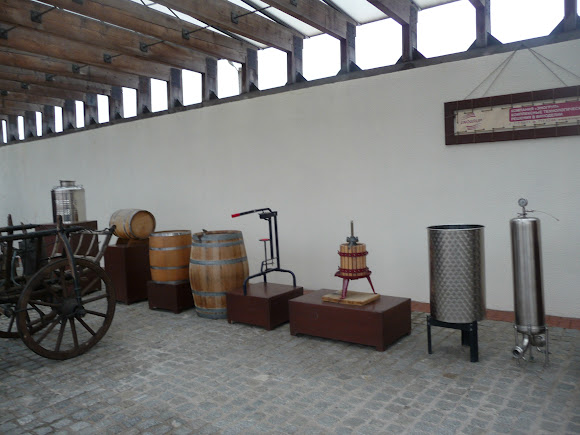
Part of the exhibition is located in an open pavilion.
 |
| The Centre of Wine Culture. The exhibition in the open pavilion |
The excursion ends in a wine cellar at a level of 5 metres underground, among the wine barrels, in the Crystal Hall, with a tasting of vermouth, cognacs and wines: dry white and red, semi-sweet white and red.
 |
| The Centre of Wine Culture. The tasting hall |
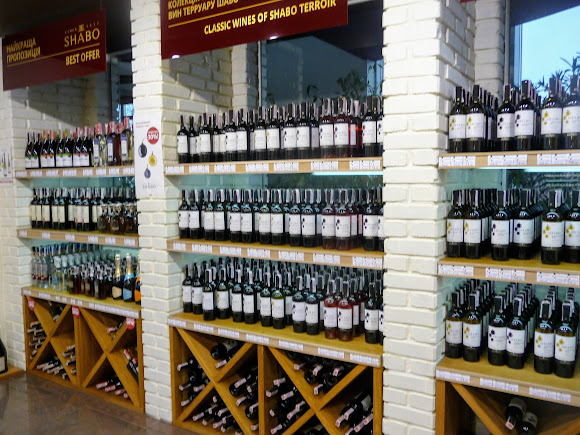
I thank the guide Anton for the brilliant excursion. I could kick myself for forgetting my voice recorder. You are invited to buy "Shabo" trademark products in the company store.
 |
| The Centre of Wine Culture. The "Shabo" TM store |
And the guests do not refuse to continue their appreciation of the wonderful and luxurious drinks in the nearby restaurant, styled after a little house in a village provençal.
 |
| The Centre of Wine Culture. The "Shabskyi Dvoryk" restaurant |
The Centre of Wine Culture is located in the village of Shabo, Bilhorod-Dnistrovskyi district, Odesa region. You can get there by the suburban train
Odesa-Bilhorod-Dnistrovskyi to Shabo station, and by bus from the bus station near the railway station in
Odesa every 30 minutes.
Coordinates:
46°8’32"N 30°22’22"E












No comments:
Post a Comment
Leave your impression