Nizhyn — our ancient Nizhyn, known since the times of Kyivan Rus, which has not become a tasty morsel for the pilgrimage of travellers. And in vain. Nizhyn is that town where you can not only touch the history of the state but also feel its atmosphere — quiet, calm and cosy.
 |
| Nizhyn. Chernihiv region. The Cathedral of St. Nicholas the Wonderworker. 1653. |
The historic centre surprises you with the presence of preserved buildings of the 17th-19th centuries. There are about 300 of them in all. Let us begin with the holy places. The Holy St. Nicholas Cathedral was built in the 1650s in the Ukrainian Baroque style and holds the status of an architectural monument of national significance. 55 metres high, with five domes, the church is one of the oldest stone structures of the Left Bank.
 |
| The Cathedral of St. Nicholas the Wonderworker. 1653. |
One of the fateful pages of our state is bound up with it. In 1663, in the St. Nicholas church, the Zaporozhian otaman Ivan Briukhovetsky took his oath, having been elected hetman at the Black Council near Nizhyn, in which rank-and-file Cossacks and peasants took part. After the Council, one of the candidates for the hetman's regalia, the Nizhyn colonel Vasyl Zolotarenko, at whose expense the church had been built, was arrested and executed. And it was here that Hetman Bohdan Khmelnytsky was married to his sister Hanna.
 |
| The Cathedral of St. Nicholas the Wonderworker. 1653. |
They say that Nizhyn is a town where the churches are crowded together. If you look at the locality from a bird's-eye view, you can see that the arrangement of the holy places resembles a cross. According to the research of local historians, in times past the town numbered about 40 places of worship at once, including Roman Catholic churches and synagogues.
 |
| The Annunciation Cathedral. 1716. |
The Holy Annunciation Monastery was consecrated in 1716 and has a second name, the Nazareth of the Mother of God.
 |
| The Annunciation Cathedral. 1716. |
Three times it was damaged by fire, but the greatest harm was done by the Bolshevik authorities, when a warehouse was set up in the cathedral. The iconostasis was plundered, and a rubbish heap formed in the holy place.
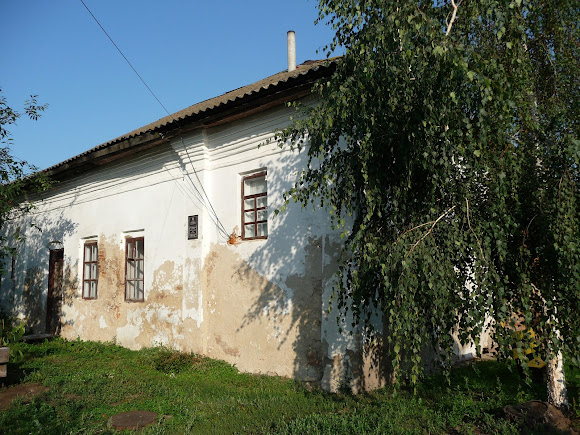 |
| The Holy Annunciation Monastery. The cells' building. 1750. |
In the years of Ukraine's Independence the shrine was returned to the believers.
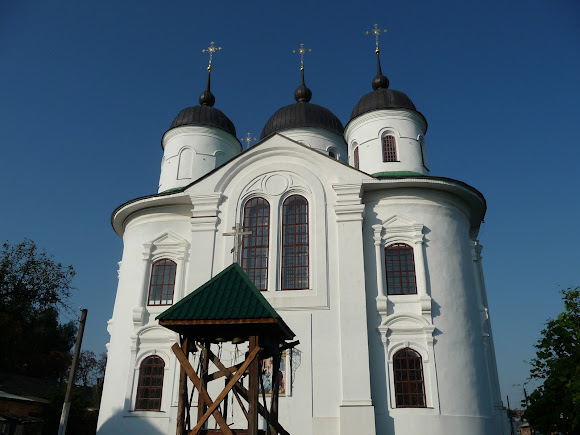 |
| The Annunciation Monastery |
The Holy Intercession Church was erected in 1765 and is of a rare type of structure — the tetraconch, which spread during the Renaissance but on the territory of Ukraine was used for only about 50 years, and precisely in the Chernihiv region.
 |
| The Holy Intercession Church. 1765. |
To the church, square in plan, semicircular vaulted structures (conchs) are attached on all four sides.
 |
| The Holy Intercession Church. 1765. |
Next to the Intercession Church, in 1873, the winter St. Nicholas church was built.
 |
| The Holy St. Nicholas Church. 1873. |
The Church of St. Basil the Great, of the 18th century, stands on Vasylivska Street.
 |
| The Church of St. Basil the Great. 18th c. |
 |
| The Church of St. Basil the Great. 18th c. |
Its advantageous position at the crossing of trade routes and its annual fairs promoted the economic development of Nizhyn. The most enterprising traders from Greece, who enjoyed the privileges granted to them in the trading craft, built their own quarter with a hospital, a school, a library and churches. With the support of Hetman Ivan Mazepa, in 1782 the Greek Church of All Saints was built on the site of its wooden predecessor.
 |
| The Church of All Saints. 1782. |
Porticoes and columns lend the building grandeur and solemnity. The iconostasis and the holy images were made by Greek craftsmen.
 |
| The Church of All Saints. 1782. |
In the cellars of the church the merchants from Hellas kept their goods. The church is active and is under the protection of the state as an architectural monument.
 |
| The Church of All Saints. 1782. |
Still earlier, at the beginning of the 18th century, the Greek community, with the consent of Hetman Ivan Skoropadsky, set about building a stone Church of St. Michael in place of the wooden one.
 |
| The Church of St. Michael. 1729. |
This is an example of a single-domed church, the walls of which are about 2 metres thick. Over its three-hundred-year history the shrine has never once been rebuilt, preserving its authenticity and the features of Balkan architecture.
 |
| The Church of St. Michael. 1729. |
 |
| The Church of St. Michael. 1729. Behind it — the Church of All Saints |
God loves a trinity, and the third church, consecrated in honour of the Holy Trinity in 1733, stands next to those described above, at a distance of 15-30 metres, but it does not belong to the Greek complex of buildings.
 |
| Nizhyn. The Church of the Holy Trinity. 1733. |
 |
| The Church of the Holy Trinity. 1733. |
 |
| The Church of the Holy Trinity, the Church of St. Michael and the Church of All Saints |
Nizhyn was called the Ukrainian capital of the Hellenes. Thanks to the Greeks, Nizhyn has its own vegetable brand — the cucumber and its exclusive pickling recipes. The lightly salted little cucumber has been immortalised in the form of a sculpture. The Greek shop, an 18th-century building, has not changed its purpose.
 |
| The Greek shop. End of the 18th c. |
But the Greek magistrate, where seals and documents were kept, has, alas, retained only the outlines and a few details of the autonomy's administrative building.
 |
| The Greek magistrate. 1785. |
The 1785 governing body was long ago rebuilt into a residential house, in which the steps of the wooden staircase will not let you enter unheard.
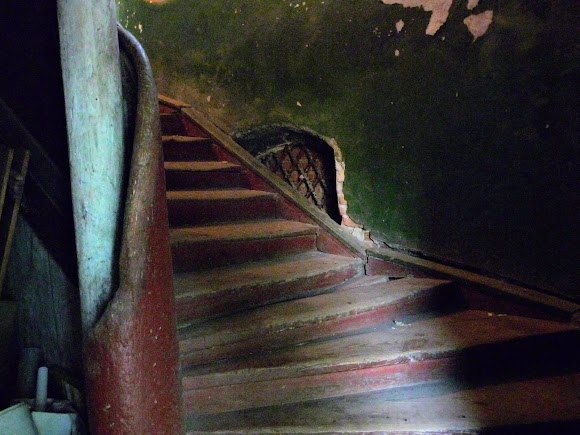 |
| The Greek magistrate. 1785. The staircase |
Recently a lorry fell through near the building, as a result of which cellars were discovered that await study by historians and local experts.
 |
| The Greek magistrate. 1785. |
And in the yard I recorded an old announcement board and the ubiquitous old tyres used as decoration and fencing.
 |
| The Greek magistrate. 1785. The courtyard |
In the 19th century Nizhyn became a centre of education. In 1805-1817, on the grounds of the estate of Count I. A. Bezborodko and at his expense, the Gymnasium of Higher Sciences was built, equal in status to a university.
 |
| Monument to I. A. Bezborodko by the university |
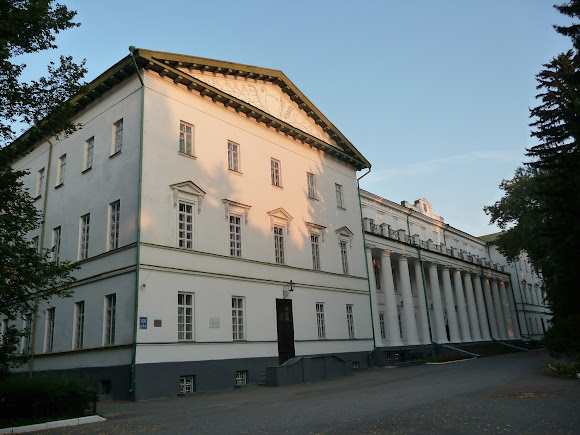 |
| The university. 1820. |
Great and famous writers, humanists and enlighteners studied here, among them M. V. Gogol, Ye. P. Hrebinka, L. I. Hlibov. The Nizhyn M. V. Gogol Pedagogical University became the alma mater for those whose calling is "to sow the reasonable, the good, the eternal" and who then meet each of us in the schoolyard.
 |
| The university. 1820. The colonnade |
In honour of its graduate-teachers, a monument to a woman teacher pointing a pupil the way to knowledge has been erected beside the new university building.
 |
| Monument to the teacher by the university |
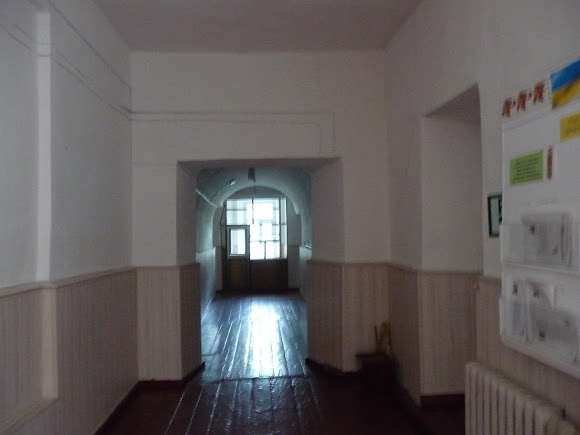
I have no doubt that the teachers of Nizhyn's schools received their professional education in this very prestigious educational institution. I visited two schools in Nizhyn. In School No. 12, in the corridor, you could hear a teacher acquainting the first-graders with the alphabet.
 |
| School No. 12 on Vasylkivska St |
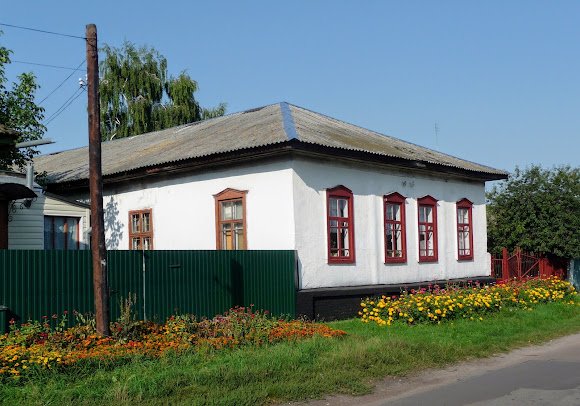
This small school, with its carved window frames and marigolds in the yard, looked like a family home.
 |
| School No. 12 on Vasylkivska St |
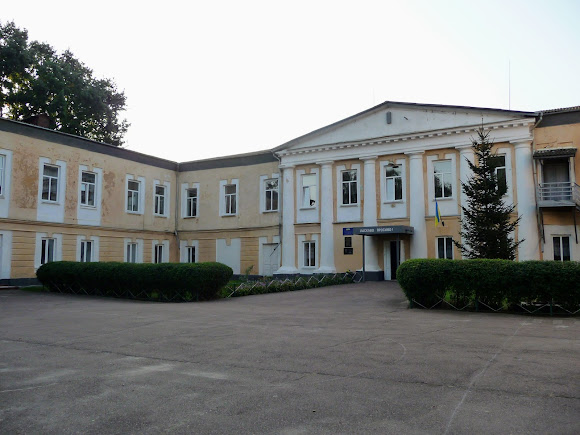
Secondary school No. 1 is housed in a building that in the 18th century contained a public school, and later the district court.
 |
| School No. 1 on Hrebinka St. 18th c. |
 |
| School No. 1 on Hrebinka St. 18th c. An architectural monument |
 |
| School No. 1. The washstand |
 |
| The school corridor |
The school workshops occupied the former Peleponov house, an 18th-century building.
 |
| School No. 1. The teaching block. 18th c. |
The second teaching block is known for the fact that in 1827 M. V. Gogol read his first works in it.
 |
| School No. 1. The teaching block. 19th c. |
 |
| School No. 1. The historic building in which M. V. Gogol read his works |
 |
| School No. 1. The teaching block. 19th c. The classroom |
 |
| School No. 1. The teaching block. 19th c. The sports hall |
The very first monument in the world to the classic was unveiled in Nizhyn in 1881. Its author — the Nizhyn-born sculptor P. P. Zabila, whose self-portrait can be seen on the cut of the bronze bust, in the folds of Gogol's cloak.
 |
| Monument to M. V. Gogol in the public garden that bears his name |
The second bust is set up in the Count's Park by the university.
 |
| Monument to M. V. Gogol by the university. 1975. |
A characteristic detail: beside all the monuments and on the walls of historic buildings, plaques are set with dates and information about them. I am seeing such a thing for the first time, and for this good initiative, thanks to all the people of Nizhyn who preserve the town's history.
 |
| Information plaques beside the monuments |
The monuments in Nizhyn are of the most varied kinds. In 1993 a sculpture appeared of the Ukrainian dramatic actress Maria Zankovetska, who was born in the Nizhyn county and did not lose her connection with her native places.
 |
| Monument to the actress Maria Zankovetska in the public garden of her memory |
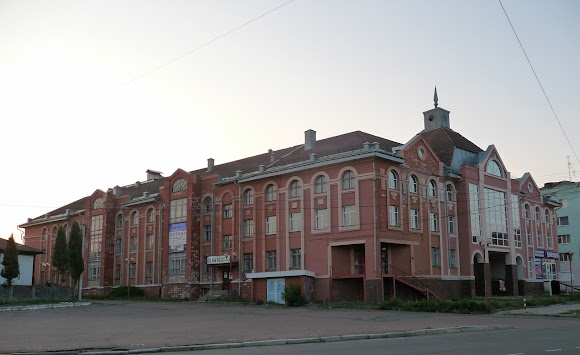
Wherever you cast your eye — historic buildings everywhere.
 |
| The "Passage" trade and office complex |
 |
| A historic building of the 19th c., in which the Latvian artist Yu. Ya. Fedders lived |
Shops,
 |
| Trade stalls of the 19th c. |
 |
| Commercial building on Pokrovska St |
banks,
 |
| Bank on Pokrovska St |
pharmacies, a hospital.
 |
| Polyclinic on Pokrovska St |
You can obtain a medical education at the medical college, the former house of the honorary citizen Levchenko.
 |
| The former girls' gymnasium. Early 20th c. The medical college |
Several museums have been created in Nizhyn, holding an enormous number of most interesting exhibits. The Postal Station Museum surprises you with a preserved rare collection of postal objects, beginning from the times of Kyivan Rus.
 |
| The "Postal Station" museum complex of buildings. 1750. |
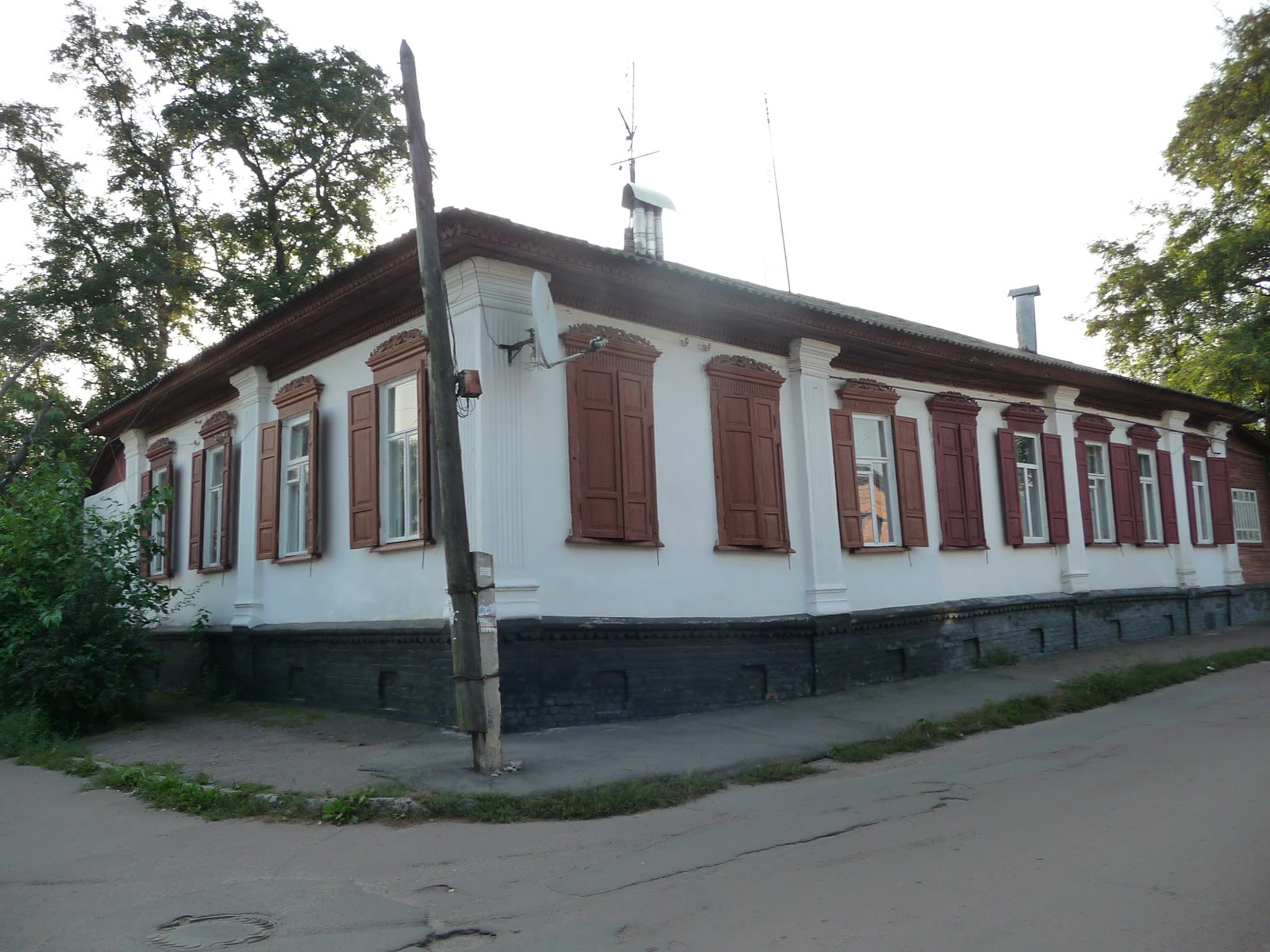
The atmosphere of the quiet little streets, where the windows of the houses are still closed with wooden shutters, is full of measured, unhurried calm.
 |
| Residential building on Heavenly Hundred St |
 |
| 1880. The former house of Spassky — a public and religious figure |
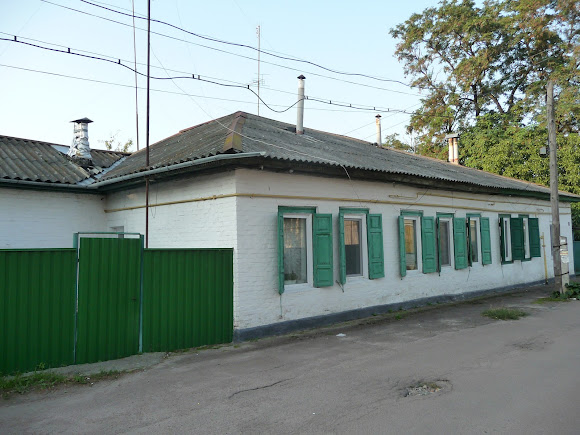 |
| Residential building on Hrebinka St |
 |
| Residential building on Hrebinka St |
It comes to mind that Gogol based the plot of his tale "Viy" on real events that took place in Nizhyn itself. And, of course, every house conceals within it many secrets and legends.
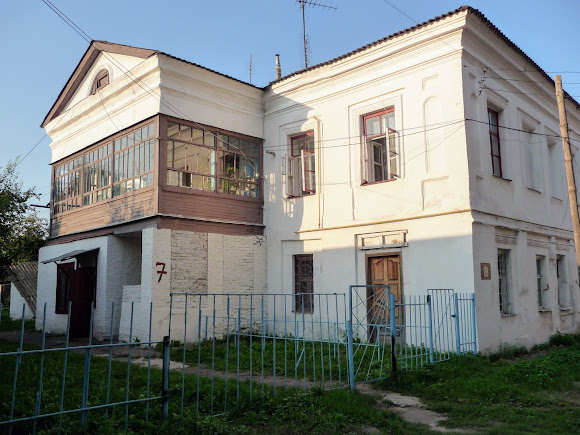 |
| Residential building on Hrebinka St. The former Samoilovych house. 19th c. |
 |
| Gogol St. The veterans' choir |
A convenient and informative map with tourist information has been set up beside the Cathedral of St. Nicholas the Wonderworker on Gogol Street.
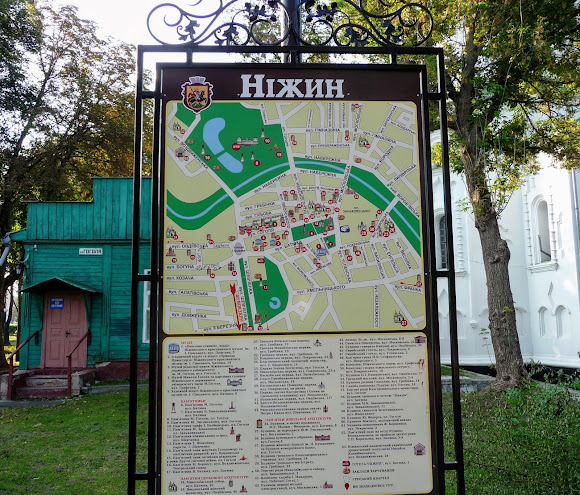 |
| Gogol St. Information map of Nizhyn |
You can come to Nizhyn by a suburban train from
Kyiv.
 |
| The railway station. 1868. |
The journey takes 3 hours. By bus it is faster but more expensive. The expenditure of time and money is small, but you will gather many impressions.
 |
| The Oster River |




No comments:
Post a Comment
Leave your impression