In
the first publication about Vasylkivka the talk was of its southern part, the so-called "lower part", where the buildings with columns and the great number of goats at pasture stuck in my memory. What does the north of Vasylkivka look like? What else can one see in this urban-type settlement in the Dnipro region, which arose from a Cossack winter camp in 1707?
 |
| Vasylkivka, Dnipropetrovsk region. The Holy Ascension Church |
Let us continue our acquaintance with the district centre by the building of the district administration.
 |
| Vasylkivka. Dnipropetrovsk region. The district administration |
Judging by the size of the four-storey building, things in the district were going very well indeed.
Contrary to the proverb, a holy place does stand empty. The pedestal with the red trim is so far occupied by no one. On the board of honour the portraits of honorary citizens and production leaders are absent.
 |
| The pedestal of the monument to Lenin and the empty board of honour |
On the grounds of the Zaporozhian guard post there were no castles or fortresses, but the descendants of the glorious Cossacks fenced off their domain with a wall in the form of a fortification structure.
 |
| Sportyvna Street. A residential building |
In Vasylkivka the five-storey buildings are unusual, made of white brick and girdled with a cornice of red brick. The pattern is made in the form of an oblique cross, with small crosses inset in the rhombuses. There are quite a few such buildings in the settlement; they were built in the 1980s during the economic growth of this agrarian district.
 |
| Partyzanska Street. A residential building |
In the yard of a residential building a retro car pulled up, a gift from the Ihnatenko brothers from the neighbouring Pokrovske district.
 |
| Partyzanska Street. The retro car |
Someone, in a creative impulse, named this hotel, which resembles a dormitory, the "Chaika". Despite the emblem at the entrance, very much like the calling card of the Moscow Art Theatre, the building is rented by firms with an earthly purpose.
 |
| Partyzanska Street. The "Chaika" hotel |
The hotel building and the laundry located next to it are faced with the same tiles. With the rise of the population's prosperity, the unneeded consumer-services enterprise closed and is rapidly falling into ruin.
 |
| The former laundry |
We continue our blitz-hike along Partyzanska Street.
 |
| Partyzanska Street. The shops |
 |
| Partyzanska Street. An administrative building |
In a settlement with a population of about 12 thousand, its own printing house functioned. Now the two-storey building with a repaired roof gapes with broken windows.
 |
| Partyzanska Street. The abandoned printing house |
The housing stock is represented by modern brick multi-storey buildings and by a private sector with four-pitched roofs and an entrance through a veranda.
 |
| Partyzanska Street. A residential building |
The old homes are already almost a hundred years old, but their walls, canonically for Ukrainian cottages, are whitewashed with lime. The carved window frames, shutters and corner projections are painted in bright colours.
 |
| Partyzanska Street. A residential building |
 |
| Shevchenko Street. An old cottage |
We cross by Shevchenko Street onto Pershotravneva Street. The hospitable hosts offer the traveller cold kvass and shashlik, which has become traditional for Ukrainian cuisine.
 |
| Shevchenko Street. Kvass, beer, shashlik |
The rusted agricultural machinery and equipment have served their time.
 |
| Shevchenko Street. A site with agricultural machinery |
The small vehicle fleet of the DOSAAF school.
 |
| Pershotravneva Street. The driving school |
A little star on the facade means that a war veteran lived in the house.
 |
| Pershotravneva Street. A residential building |
The first church in Vasylkivka was erected in 1781. In 1870 the wooden church was replaced with a stone one, which served until 1933. On the site of the shrine destroyed by the Bolsheviks a memorial cross has been installed. In 1942 the believers acquired a homestead and held services in it until 2012, when the new church was consecrated.
The Holy Ascension Church was built with the funds of parishioners and benefactors.
 |
| Pershotravneva Street. The Holy Ascension Church |
In my view, it is presumptuous to list the surnames of donors on the memorial plaque at the entrance. In a church there should be only holy images. The church territory is well kept, there are benches, planted flowers and trees, and water can be drawn from the well.
 |
| Pershotravneva Street. The territory of the Holy Ascension Church |
Across the road is a house with an ornamental brick inset in the form of rhomboid patterns. Such geometric designs were used by our ancestors in the embroidery of towels and clothing. The rhombus is a symbol of fertility, protects from misfortune and brings harmony, while the dot in the centre personifies the seed and the sown field.
A private house is faced with tiles depicting a maple leaf that resembles a human palm; even the veins can be seen, like the lines of fate that run in a little net across the palms.
And here too are the rhombus-fields and the dot-seeds.
 |
| Pershotravneva Street. A residential building |
This house is adorned with brick poppies — a symbol of fertility and of the fulfilment of dreams.
 |
| Pershotravneva Street. A residential building |
The typical building of a Soviet department store is decorated with a plant pattern of tiles.
 |
| Pershotravneva Street. The department store |
In honour of three countrymen who died in Afghanistan, a memorial sign has been installed.
 |
| Pershotravneva Street. The monument to the internationalist soldiers |
The district House of Culture, with musical and dramatic symbols on its facade, marks the 95th anniversary of the creation of the Vasylkivka district.
 |
| Pershotravneva Street. The House of Culture |
Mykhailivska Street, formerly Krupska Street, led to the district central hospital.
 |
| Mykhailivska Street. A residential building decorated in cornflower blue |
 |
| Bohdan Khmelnytsky Street. The district central hospital |
For the first time I came across stray dogs, but these were not hungry.
 |
| Bohdan Khmelnytsky Street. A shop |
On Shevchenko Street is the archaeological monument, the burial mound Liubachyna Mohyla.
 |
| Shevchenko Street. The Liubachyna Mohyla burial mound |
Once there were two burial mounds on the outskirts of Vasylkivka. The settlement expanded, a road was laid, destroying the smaller burial monument and cutting away the slope of the larger one. The top of the hill serves as a triangulation point; from here a panorama of the northern part of the settlement opens up.
 |
| Shevchenko Street |
It was not possible to learn more about the tomb of the ancestors from the local population, apart from the name and the memory of some researchers' visit. The people of Vasylkivka regard the burial mounds without interest, and besides, there are plenty of such rises all around.
 |
| Shevchenko Street. The Liubachyna Mohyla burial mound |
The streets of Vasylkivka are straight and perpendicular to one another.
 |
| Osinnia Street |
 |
| Soborna Street |
 |
| Sportyvna Street |
After decommunisation, not all the homeowners changed their signs.
 |
| The old signs |
On Soborna Street a solid brick building stands empty.
 |
| Soborna Street. An abandoned building |
The largest school in the district is School No. 1 named after M. M. Kotsiubynsky. Founded more than 120 years ago, it was at first a zemstvo school, and after the revolution a seven-year labour school. In 1980 the doors of a new teaching building opened, girdled with a cornice of red brick.
 |
| Soborna Street. School No. 1 |
The climate in Vasylkivka has not changed towards harsher winters, but the time has come for new construction technologies. It was decided to dress the school in a new skin of insulation, under which the Vasylkivka decorative motif was walled up.
Look, this ornament no longer exists — it is under a layer of glass wool.
 |
| Soborna Street. School No. 1 |
It is sad when old schools become unneeded and no use is found for the buildings.
 |
| Soborna Street. The old school building |
On the neighbouring Sportyvna Street, 150 metres from School No. 1, is School No. 2.
 |
| Sportyvna Street. School No. 2 |
In the school yard a use was found for the pedestal, by installing the trident — the heraldic figure of the coat of arms of Ukraine.
 |
| Sportyvna Street. School No. 2. The trident |
Not every district centre has sports complexes capable of holding competitions of regional scale.
 |
| The "Olimpiiets" sports complex |
The spectator stands are designed for 1,200 seats.
If the central gates of the complex are closed, those who wish to train get in through a hole between the old and the new fence, formed by a misalignment during construction.
 |
| The "Olimpiiets" sports complex. The two fences did not meet |
Young athletes train in the children's sports school and show high results at regional and all-Ukrainian tournaments.
 |
| Sportyvna Street. The children's and youth sports school |
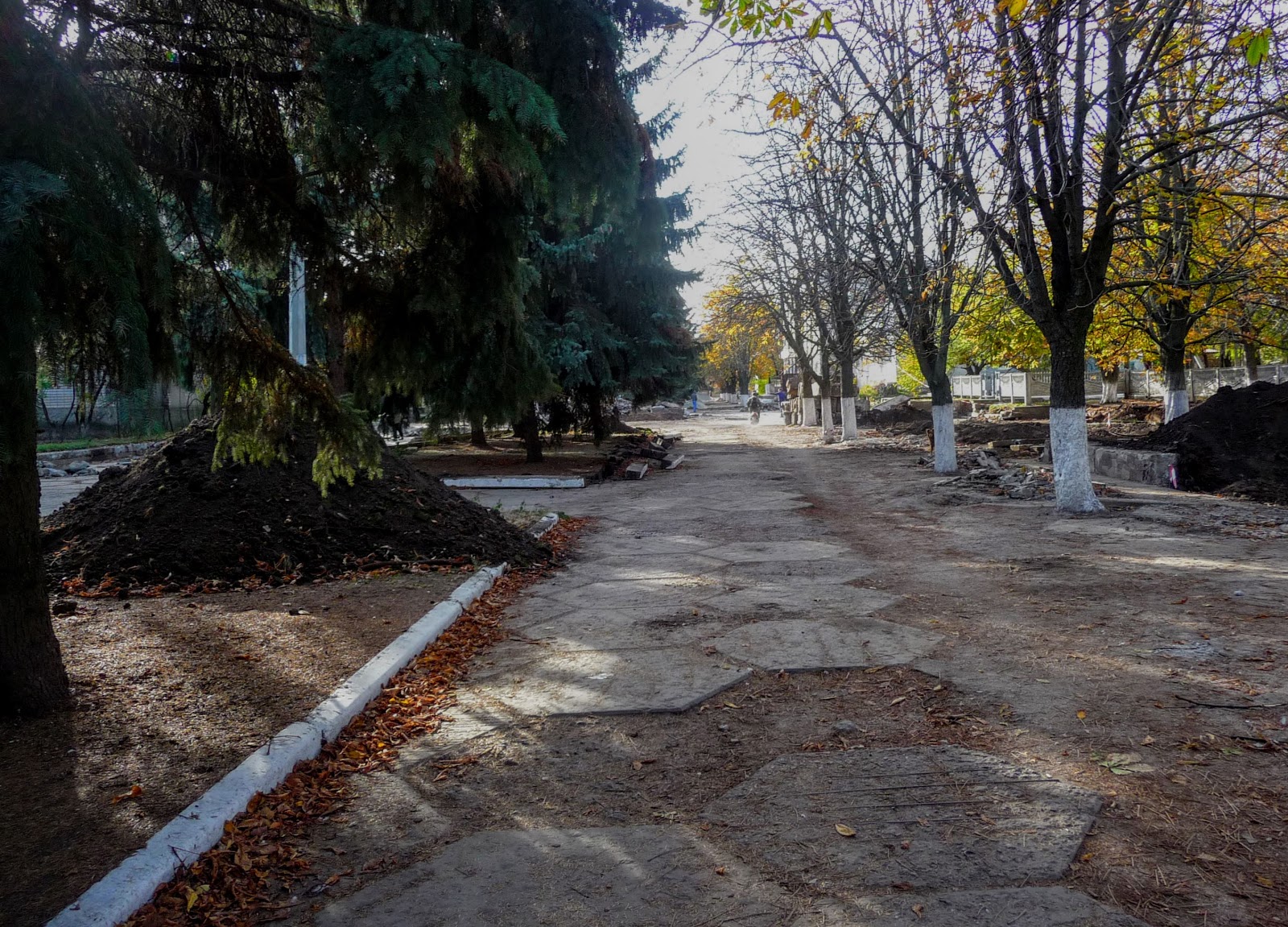
Sportyvna Street has finally seen its reconstruction.
 |
| Sportyvna Street. Reconstruction |
The residents of some houses on this street cover the original Vasylkivka ornament with layers of thermal insulation.
 |
| Sportyvna Street. Residential buildings |
Cornflower blue is a favourite among the people of Vasylkivka.
 |
| Abrykosova Street. Residential buildings |
The legal practice occupies premises in a building that has seen much in its time.
 |
| Abrykosova Street. The lawyer's office |
Pryvokzalna Street, paved with stone, leads to the Vasylkivka (Nerodivka) stopping point.
 |
| Pryvokzalna Street |
Here suburban trains stop from
Dnipro, Chaplyne,
Mezhova.
 |
| The stopping point Nerodivka (Vasylkivka) |
From all that I saw, one can conclude that the settlement has beautiful houses, but the residents do not always cherish the unique appearance of their dwellings. There are many abandoned buildings and closed enterprises, but order is maintained on the streets. Two Orthodox churches have been built. There is a bus station, shops and two houses of culture. Children play sports and study music. A pity that the museum was closed. The district has a good hospital, which the medical reforms may shut down. Once this was one of the finest district centres of the Dnipro region. I wish the settlement with the beautiful name Vasylkivka a revival of its former glory!




No comments:
Post a Comment
Leave your impression