Dnipro is a city of a million, an industrial, administrative, cultural, financial, scientific and political centre.
 |
| Dnipro. The Khrennikov Building (the "Ukraina" hotel). Korolenka Street, 2. An architectural landmark |
It really is located in the very centre of Ukraine, on the banks of the mightiest river with the very same name — the Dnipro.
There was no need to get used to the new shortened name, because until the recent renaming we called the city just that — Dnipro, associating it with the country's main water artery.
The city on three hills is a transport hub with rail, road, river and air connections to all the regions of Ukraine, as well as abroad.
I began my acquaintance with the city at the bus station, an overly large building with a great many cafes and shops.
From here it is a stone's throw to Yavornytskoho Avenue, the city's main thoroughfare, 5 kilometres long, and you immediately find yourself in the whirl of traffic and human streams and feel the dynamism of the metropolis.
 |
| Vokzalna Square, 19 |
In order to feel the atmosphere of Katerynoslav-Dnipro, founded in the 18th century, I walked more than 10 km along the avenue and the streets adjoining it, which took shape over 200 years ago.
 |
| Yavornytskoho Ave. An architectural monument. 1912. A branch of the National Bank |
Soborna Square and the Ivan Starov public garden are part of the city's historical heritage.
 |
| Soborna Sq. The Ivan Starov public garden. The Holy Transfiguration Cathedral. 1835 |
The Holy Transfiguration Cathedral, built in 1835 in the Classicist style, is an architectural monument of national significance.
 |
| Soborna Sq. The Ivan Starov public garden. The Holy Transfiguration Cathedral. 1835 |
Walking two blocks along Yavornytskoho Street,
 |
| Yavornytskoho St. The Regional Children's Hospital |
you come into the Shevchenko Park — a monument of landscape gardening art, founded in the 18th century.
 |
| The T. H. Shevchenko Park. The colonnade of the central entrance |
The architectural dominant of its riverside part is the DNU Palace of Students, the former Potemkin Palace, built in 1780, an architectural monument of national significance.
 |
| The DNU Palace of Students, the former Potemkin Palace, 1780 |
In this favourite spot for the townspeople's recreation there are ten thousand trees and shrubs, and among the fauna I came across almost tame squirrels.
 |
| Dnipro. The T. H. Shevchenko Park |
The king of beasts, though he is resting, has a wary look, and outwardly he differs from his sculptural brothers, whom I saw in
Odesa,
Lviv and
Mykolaiv.
 |
| The T. H. Shevchenko Park. A sculpture of a lion |
Across the pedestrian bridge I walked to the island part of the park.
 |
| The pedestrian bridge across the Dnipro |
Monastyrskyi Island got its name from the monastery founded here in ancient times by the Byzantines.
 |
| Monastyrskyi Island |
Now various attractions, a water station and a zoo operate on the island.
 |
| Monastyrskyi Island |
Alongside the entertainment life of the holidaymakers stands the St Nicholas Church, built in 1999 on the site of an ancient church, in which Prince Volodymyr once stopped.
 |
| Monastyrskyi Island. The St Nicholas Church. 1999. UOC-MP |
From here a wonderful view opens onto the city and the river, whose water seemed transparent.
 |
| Monastyrskyi Island |
Another monument of engineering architecture — the Merefa-Kherson Bridge — has a curvilinear trajectory, passes through the island and links the Left Bank and the Right Bank. It is the longest arch bridge in Europe.
 |
| The Merefa-Kherson Bridge |
The sculpture of T. H. Shevchenko, who dedicated a famous poem to the Dnipro, is one of the largest monuments erected to the Kobzar. In the gaze of the prophet and poet I noticed bitterness and reproach.
 |
| Monastyrskyi Island. The monument to T. H. Shevchenko |
To the longest embankment in Europe, over 30 kilometres, special stairs lead down from the pedestrian bridge.
 |
| Monastyrskyi Island. The pedestrian bridge |
Here there are very many romantic nooks, cafes, unusual sculptures and installations.
 |
| Dnipro. The embankment |
The pyramid with a sphere is a place for meetings and for admiring the Dnipro views, for making wishes and for photo shoots.
 |
| The embankment. The pyramid with a sphere |
The uniqueness of Dnipro City is that here, on a single street, skyscrapers stand side by side with old merchant houses.
 |
| The "Festyvalnyi" residential complex |
 |
| Lyvarna Street, 13 |
The twin towers rise above the pre-revolutionary housing.
 |
| The "Most-City-Center" shopping and entertainment complex |
 |
| Uspenska Sq., 15 |
The world's largest Jewish cultural and educational centre, "Menorah", the purpose of whose existence is a tolerant attitude towards all nations, is built in the shape of a temple seven-branched candelabrum.
 |
| The "Menorah" Jewish cultural and educational centre |
The two- and three-storey buildings of the end of the 19th and the beginning of the 20th century are distinguished by the refinement of their architectural decorations.
The architects strove to find their own individual direction, so here the fruits of the creation of famous architects show off, built in the styles of Classicism, neo-Renaissance and neo-Gothic.
One cannot help but admire the virtuoso work of the masters, who made cornices, pylons, attics and sculptures out of brick.
The former Anteregg mansion, built in 1890, with a bevelled corner, a hip-roofed turret and niches for sculptures, is in the process of restoration. It is important that the appearance of reconstructed old buildings should resemble the original as much as possible.
 |
| The Anteregg mansion, 1890 |
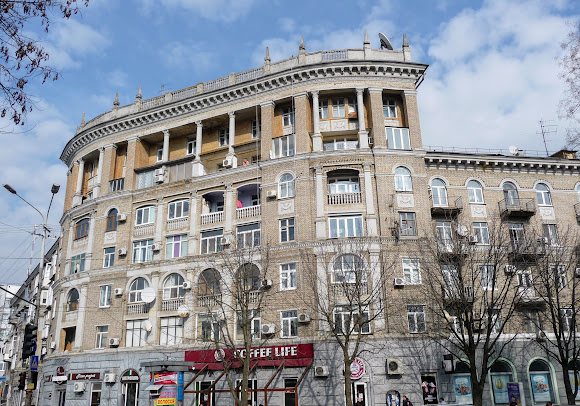
The "Ukraina" Grand Hotel, a former apartment building of 1913, was restored after being destroyed during World War II.
 |
| The "Ukraina" Grand Hotel. 1913 |
The trading core of Katerynoslav was housed in the building of the merchant Shyshman. The lavish building has not lost its purpose; it now houses a large shopping centre.
 |
| The house of the merchant Shyshman. A shopping centre |
Like a real star, the Governor's House, which dates from 1830, has known its ups and downs. Thanks to the public, the mansion was saved from destruction.
 |
| The Governor's House. 1830 |
The restored town-planning monument of 1905, and now the building of the main post office, was the last "hotbed of counter-revolution", crushed by the Red Guards in 1917, as a bas-relief plaque testifies.
 |
| The main post office |
On many roofs rise original domes and towers.
The post-war buildings increased the number of storeys, and the decor became ideological and propagandistic.
The colonnade in the Hloba Park, the oldest green massif, was built in 1949 in the "Stalinist Empire" style.
 |
| The colonnade in the Hloba Park. The central entrance |
The bas-reliefs at that time were made in the form of slogans and social appeals.
 |
| Add a caption |
I liked the green ornament in the form of daisies more.
The monumentalism of the buildings is emphasised by the built-in columns on the facades.
Some details of the structures do not withstand the test of time and are in a dilapidated state.
Dnipro is a city of theatrical traditions. The building of the drama and comedy theatre has been granted the status of an architectural monument of national significance.
 |
| The Academic Drama and Comedy Theatre |
One of the city's main shrines is the Holy Trinity Cathedral, built in the middle of the 19th century.
 |
| The Holy Trinity Cathedral. 19th c. UOC-MP |
The sculpture of St Catherine is installed on the facade of the largest diocesan Orthodox centre in Ukraine.
 |
| The diocesan Orthodox centre |
The Roman Catholic Church of St Joseph was built in 1877.
 |
| The Roman Catholic Church of St Joseph. 1877 |
Despite the kaleidoscope of impressions that remained after a short walk through a very large city with intensive traffic, I remained satisfied with the excursion.
 |
| Yavornytskoho Avenue. The construction of the metro |




No comments:
Post a Comment
Leave your impression