Pysmenna Railway Station and the Village of Pysmenne
The Pysmenna railway station is located in the village of Pysmenne, Vasylkivka district, Dnipropetrovsk region, which was founded with the opening of the station in 1884.
The Pysmenna railway station. Vasylkivka district, Dnipropetrovsk region
Pysmenna lies on the Synelnykove I-Chaplyne line, between the stations of Rozdory and Ulianivka of the Prydniprovska Railway.
Suburban trains stop at the station on the routes Dnipro-Chaplyne, Dnipro-Mezhova, Chaplyne-Synelnykove.
The distance by road to the regional centre is 83 kilometres; as the crow flies, 20 kilometres less.
The halt was named at the end of the 19th century after the surname of the estate's owner, Pysemsky, a descendant of a St Petersburg lieutenant who received these lands after Catherine II's decree abolishing the Zaporizhian Sich.
In 1886 the German colonist Kielmann built ten houses beside the railway branch. At first, and until 1946, the settlement was called Kielmannsthal. In the 1880s the German entrepreneur Andrii Petrovych Fast established grain farming on the fertile Ukrainian lands, building a mill where flour was ground and semolina and groats were produced.
During the Second World War the flour-milling enterprise was damaged, but it was restored, and its millstones served the good of the people under the "Batkivshchyna" (Motherland) collective farm.
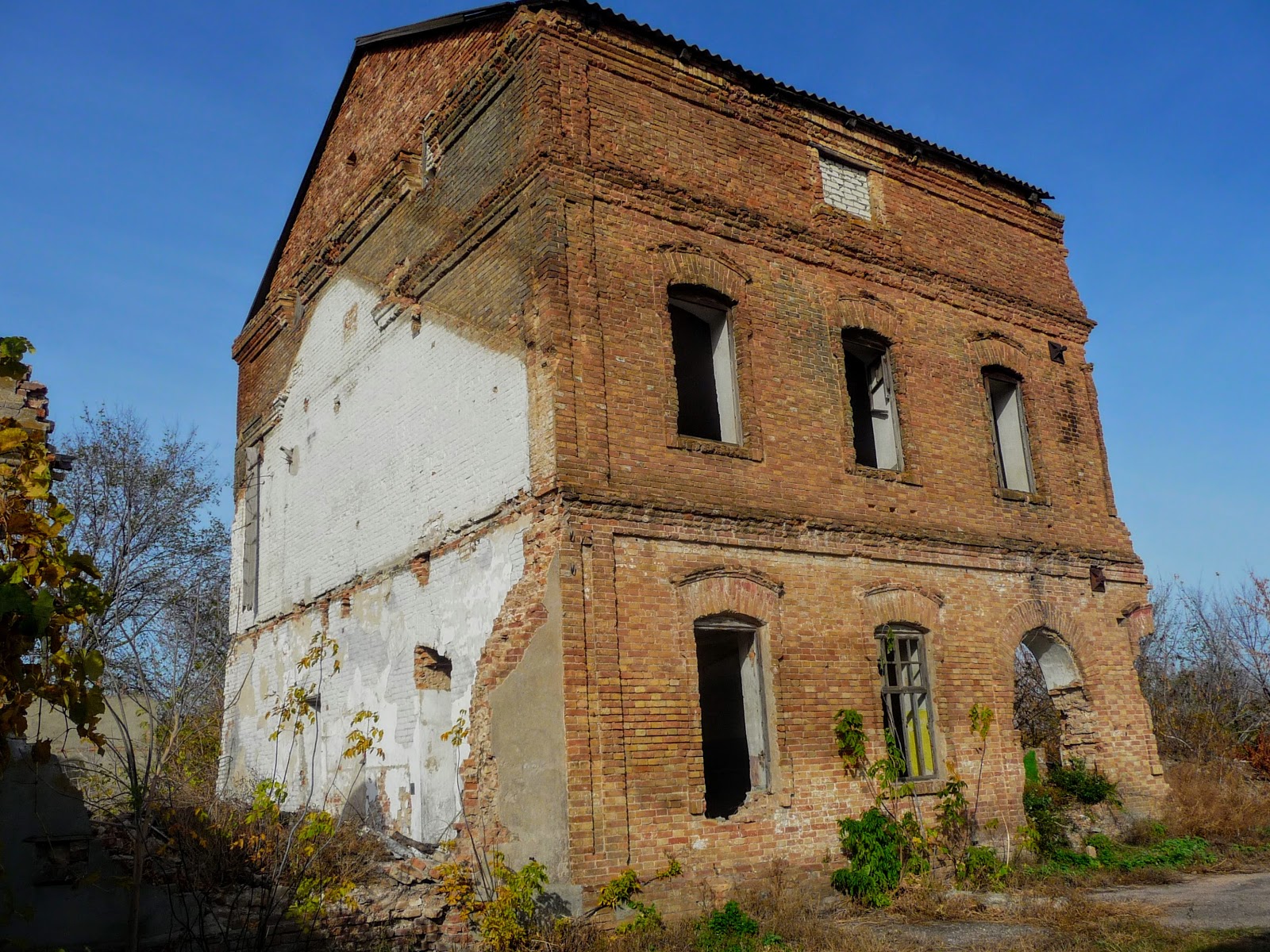
With the collapse of the collective farms, the mill turned out to be needed by no one, except those who dismantle abandoned buildings for bricks. The battered breadwinner, with its broken windows and doors, can be seen from the windows of the commuter train.
The Pysmenna railway station. Fast's mill
Growing cereal crops has always been the most important sector of the agrarian Left Bank region. Beside the station stretch the warehouses of a grain-receiving enterprise.
The Pysmenna railway station. The grain-receiving enterprise
The village's coat of arms depicts a train, a golden ear of grain and three church cupolas.
The church in the village was probably built at the turn of the 19th and 20th centuries, but it was destroyed by the Bolshevik authorities, and nothing is known about the shrine. In 2008 the premises of a former shop were handed over to the Orthodox community for setting up a church in honour of St John the Merciful, at which a Sunday school was organised. In the churchyard a cross has been erected in memory of the destroyed church.
For more than two years the Vasylkivka area was under Nazi occupation. In September 1943 the district was liberated over 12 days. In a common grave rest the soldiers of the Red Army who died in Pysmenne in the fighting on the approaches to the Dnipro.
A few more facilities in the centre of the village — the local administration, a post office, shops, a market, a hospital.
The village council
The post office
A shop
A shop. The market. A bar
For house calls to the sick there is one old ambulance.
The outpatient clinic
A small house with a sign reading "Household Services" is locked up.
Household services
The village has a gas supply. In 2018 statistics counted 1,196 residents.
Shops
A cafe
There is a school and a House of Culture. Bus service with Vasylkivka has long since disappeared.




No comments:
Post a Comment
Leave your impression