Chasiv Yar. The Shukhov Water Tower: Demolish or Save?
The year 2019 in the town of Chasiv Yar, Donetsk region, was marked by a fateful decision concerning a unique monument of engineering architecture — the water tower of V. H. Shukhov. After many years of neglect and oblivion, this avant-garde architectural masterpiece faced demolition, but thanks to the efforts of the public the tower was saved from being cut up for scrap metal.
Chasiv Yar. Donetsk region. The water tower of the engineer V. H. Shukhov
In a difficult time for the country, when both in the capital and in the big cities less and less attention is paid to preserving architectural monuments, the caring residents of a small industrial town located just 25 kilometres from the line of contact performed a true civic feat in saving the only hyperboloid structure by the engineer Shukhov in eastern Ukraine.
To see how frontline Chasiv Yar is faring and what its newly discovered landmark looks like, I travelled by bus from Kostiantynivka towards Bakhmut, to the turn-off for Chasiv Yar.
Chasiv Yar. A signpost on the H-2 highway
It is about 5 kilometres to the town boundary along a paved road, and in all the walk came to 12 kilometres through slushy snow.
The road from the H-2 highway to the town
In the south-east the December sun was barely visible, and the sounds of the nearby war could be heard.
A view from the H-2 highway to the south-east
Here everything reminds you that fighting is close by — signs marking mined fields, and military medical vehicles hurrying to the Chasiv Yar military hospital.
Chasiv Yar. A sign marking a dangerous place
Open pit mines and waste rock heaps alternate with ploughed farmland. The Donbas land, rich in minerals, has not ceased to be a breadbasket.
A farm field
Refractory clay has been mined in this area since the end of the 18th century. The settlement arose in 1876, and with the building of the railway its refractory products and clay were delivered to all the metallurgical works of Ukraine, Rostov and St Petersburg. Around 40 worked-out and reclaimed quarries are filled with water and form picturesque ponds fringed with sparse ravine woodland.
Worked-out quarries, gullies, ponds and waste rock heaps
After the railway crossing, a little more than two kilometres remained to walk to the town's residential blocks.
The road to the town after the railway crossing
Behind a concrete fence are the remains of a locomotive depot, a hexagonal chimney and one of the surviving lime kilns of Workshop No. 1. The production buildings of the former pre-revolutionary works of M. O. Kovalevsky could well be added to the list of industrial-tourism sites and monuments of industrial architecture of the late 19th and early 20th centuries. After the Second World War the plant workshops merged into a single enterprise — the Chasiv Yar Refractory Plant.
Workshop No. 1 of the Chasiv Yar Refractory Plant
The first street, with three-storey brick houses, is named after the founder of the joint-stock company of refractory works, the collegiate assessor Mykhailo Oleksiiovych Kovalevsky.
Mykhailo Kovalevsky Street. Residential buildings
In 2017 the town had a population of 13,000. The fall in output of the town-forming enterprise has taken its toll on the upkeep of the housing stock. Half-ruined and abandoned buildings are not uncommon.
Chasiv Yar. Shkilna Street. Abandoned buildings
The four-storey building of the town hospital houses a mobile military hospital.
The town hospital and the military hospital
In the centre of the town stand the management building of PJSC "Chasiv Yar Refractory Plant" and a board of honour for the plant's leading workers.
The management of PJSC "Chasiv Yar Refractory Plant". The board of honour
Beside the administrative building, the "Nich" (Night) fountain astonished me with its pomp, decorated with sculptures of ancient Greek gods surrounded by cupids and enormous fish. The author of this decorative structure was the amateur sculptor A. M. Litvinov.
The "Nich" (Night) fountain
The entrance to the park is strikingly designed as a colonnade of two semicircular wings, with an electronic clock showing the date, time and air temperature.
The colonnade
Entering this green oasis, you involuntarily sink into the 1950s and 60s of the last century. The park sculptures of a bandura player and a battered accordionist are in urgent need of restoration.
The paired colonnade of the dance floor has lost its capitals and its festive look. But judging by the graffiti on the stage, the spot still serves disco lovers.
The park. The dance floor
For sports there is the "Avanhard" stadium, with 5,000 spectator seats.
The "Avanhard" stadium
Clearly the town's architects wanted to give the buildings a sense of grandeur and whimsy, decorating their creations with triumphal ornaments in the form of columns.
Nedohybchenko Street. A guest house
A portico and columns lent expressiveness to the single-storey building of the town administration.
The town administration
There are several war memorials in the town. The figures of the defenders are painted in somewhat unexpected colours.
A monument to the teachers and pupils of School No. 15 who died in the Second World War
A cannon-monument in the Square of Glory
The war memorial in the Square of Glory
A monument to the heroes of the Civil War and the Second World War in the Square of Glory
A memorial sign to fallen fellow-townsman soldiers on the fronts of the Second World War in the Square of Glory
A memorial sign to fallen miners on the fronts of the Second World War, by the Mining Administration
The pedestals of the dismantled monuments to the leaders of the proletariat have a gloomy, unkempt look. Their place should probably be taken by sculptures of famous figures.
Pedestals of dismantled monuments
The housing consists of two- to five-storey buildings 50 to 60 years old. On the walls of many of them an arrow indicates the location of a shelter.
Nedohybchenko Street. Residential buildings
Horkoho Street. A residential building
The boarded-up gates recall the demolished "Skhid" (East) health centre, which had been crumbling for many years.
The Palace of Culture is a structural unit of PJSC "Chasiv Yar Refractory Plant" and, despite all manner of difficulties, remains an unquenchable hearth of education, enlightenment and culture.
The two-storey, sky-blue building is built in the Empire style.
The Palace of Culture
Townspeople, mainly the younger generation, take part in amateur art groups and learn the basics of fine art in creative studios.
The Palace of Culture. A wall image of the town of Chasiv Yar
In the foyer there is an interesting exhibition of pictures made of straw and of vytynanky — openwork patterns cut from paper.
The Palace of Culture. An exhibition of pictures made of straw and vytynanky
Children and young people are taught, and experience is shared, by highly professional instructors, masters of their craft.
The Palace of Culture. A gallery of pictures depicting classic writers
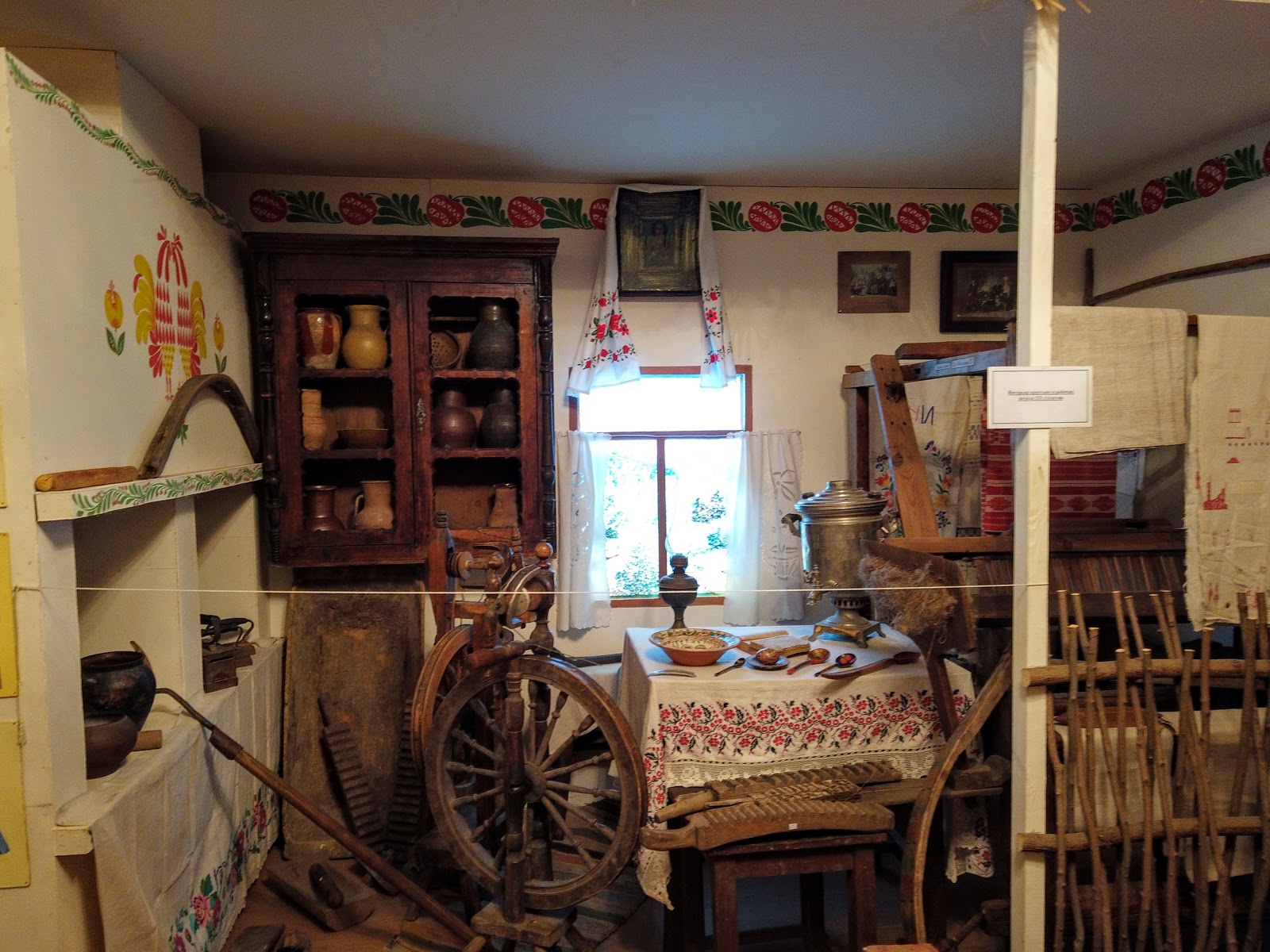
The Chasiv Yar Industrial Museum of History and Local Lore, opened in 2001 for the 125th anniversary of the refractory plant, deserves special attention. Nine displays are devoted to the history of the enterprise and the origin of the settlement, to the plant's workers and to war heroes.
A display has been created of the flora and fauna typical of this area. On show are a mineralogical collection, fragments of petrified araucarias, a set of ceramic tableware, samples of refractory-clay products, and production machinery and tools.
The Palace of Culture. The Chasiv Yar Industrial Museum of History and Local Lore
The museum is open on Fridays and Saturdays. I thank the keeper of the collections of the Chasiv Yar Industrial Museum of History and Local Lore, Valerii Bohunenko, for his hospitality, an interesting and instructive tour, and information about the water tower.
On the way to the newly discovered Chasiv Yar landmark, it is impossible not to notice the geodetic marker set on the Scythian kurgan Mohyla Hruzka — the highest point of the town, at 247.5 metres above sea level. In 1966, during the construction of residential buildings, the archaeological site was disturbed and a two-handled amphora of the 3rd century BC was found. The artefact is kept in the Bakhmut Local History Museum.
The Scythian kurgan Mohyla Hruzka and the geodetic marker
From this ground landmark, to reach the water tower you must head north-west towards the railway station. There has been no passenger service at the station for more than 10 years, and the doors and windows of the station building have been bricked up.
The abandoned railway station
The former railway service building of 1878 houses a funeral-services office.
The former railway service building. 1878
Alongside the railway track is the site of Workshop No. 4 of the Chasiv Yar Refractory Plant, the former pre-revolutionary refractories works of V. V. Shtertser.
Workshop No. 4 of the refractory plant
The production and administrative buildings are decorated with columns, so popular in this industrial town.
Workshop No. 4 of the refractory plant. A memorial sign to the workshop's workers who died on the fronts of the Second World War
Workshop No. 4 of the refractory plant and the water tower of the engineer Shukhov
Workshop No. 4 of the refractory plant and the water tower of the engineer Shukhov
With the development of the socialist economy, in its modernised workshops the "10th Anniversary of October" plant produced its first output in 1927. The years 1927-1928 are considered the date the water tower was erected, designed by the inventor-engineer Volodymyr Hryhorovych Shukhov.
The water tower of the engineer Shukhov
This openwork steel beauty was put into operation during the lifetime of the brilliant creator of hyperboloid structures, which, despite their curvature, are built from straight beams.
Reliability, strength and low metal consumption are the main features of these latticed metal stalactites. The Shukhov tower stands 22 metres high to the bottom of its reservoir, and it weighs less than the contents of the tank.
The 92-year-old lacy high-rise is well preserved, and now it is very important to save it as a monument of industrial architecture. About 10 such towers remain, and almost all of them are no longer used for their original purpose. In November 2019, after inspection by a special commission, the Chasiv Yar tower was added to the List of Objects of National Significance as a newly discovered object of science and technology.
It is the only creation of the engineer Shukhov in eastern Ukraine. Let us hope that the water tower in Chasiv Yar will receive the status of a monument of industrial architecture and be placed under reliable protection.
To see this newly minted landmark of Chasiv Yar and the whole of Donbas, you can come from Kostiantynivka or Bakhmut by bus to the terminus, located beside the abandoned railway station. Then walk about 250 metres north.




No comments:
Post a Comment
Leave your impression