Novomoskovsk — a district centre and railway junction of the Dnipropetrovsk region. The most famous landmark of this industrial city is a masterpiece of 18th-century wooden architecture,
the Holy Trinity Cathedral, which survived the years of hardship and persecution. Looking at photographs of the sacred structure of unearthly beauty, I very much wanted to see the shrine, which is counted among the hundred best wooden buildings in the whole world. But the city has many other iconic places and beautiful buildings, for the viewing of which I had only two hours.
 |
| Novomoskovsk. Dnipropetrovsk region. The Holy Trinity Cathedral |
What did I manage to see on a lightning walk through the historic centre of Novomoskovsk? The settlement was founded by Zaporozhian Cossacks in the 17th century, and to defend against enemy raids they built the Novo-Bohorodytska fortress. In memory of the first settlers of the Samara land and the events of 300 years ago, a memorial stone has been set up.
 |
| The memorial stone for the 300th anniversary of the city |
The city is located on the right bank of the Samara. The floodplain landscape of this left tributary of the mighty Dnipro, with its numerous oxbow lakes and backwaters, is a popular recreation spot for townspeople and lovers of kayak trips.
The humpbacked bridge over the Samara is called the Bridge of Lovers.
 |
| The wooden pedestrian bridge over the Samara |
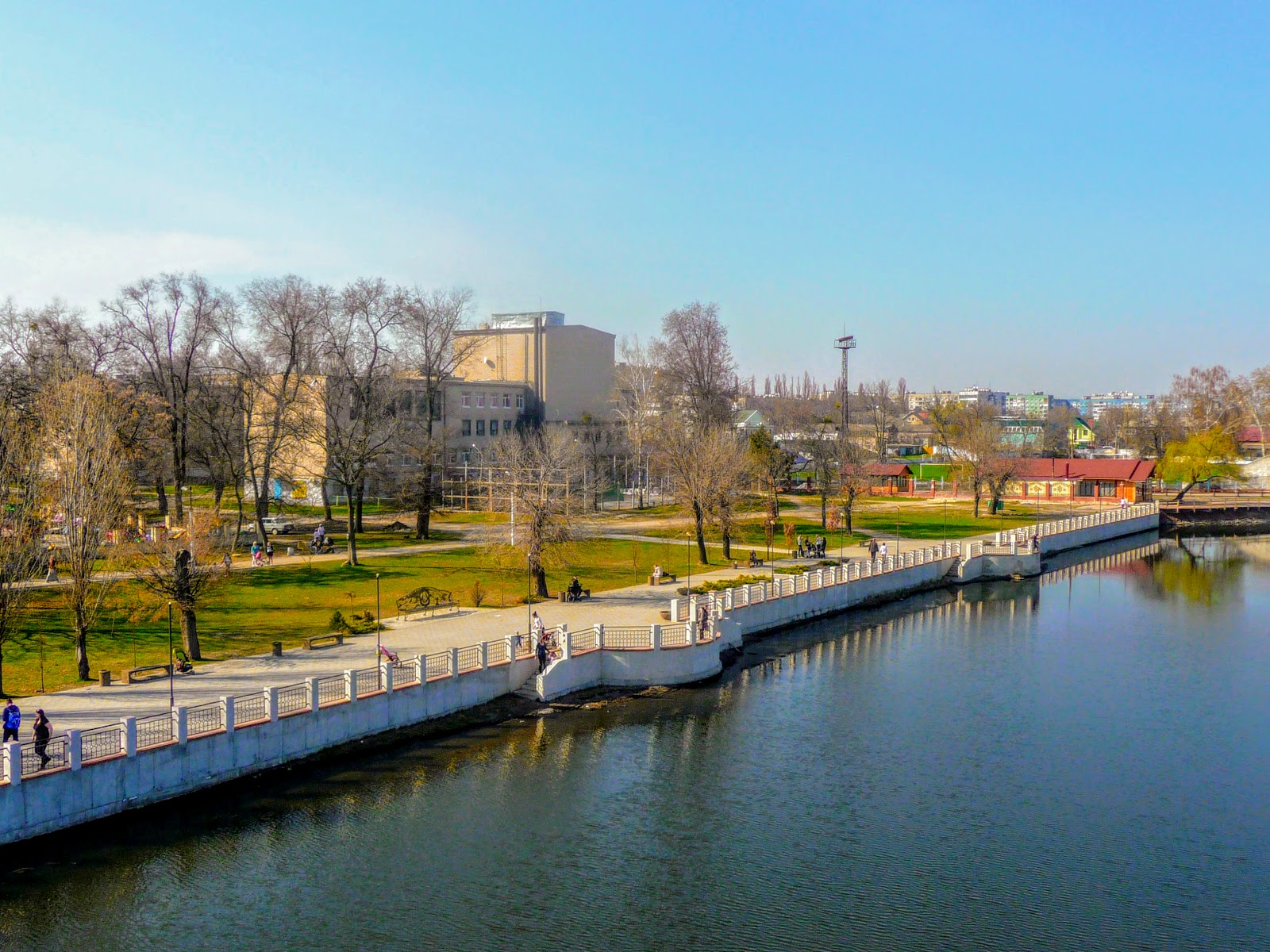
The wooden crossing, connecting two green areas — one natural, one artificial — has a curved shape. From here a panorama opens onto the forest, the river's shoreline and the residential districts.
 |
| The Samara embankment |
On the left bank, gradually recovering from oblivion and plunder, is
the Samara St Nicholas Hermitage Monastery,
 |
| The Samara St Nicholas Hermitage Monastery |
which in the 17th-18th centuries was a veritable Zaporozhian Palestine. Continuing the romantic theme, atmospheric nooks have been arranged on the embankment.
 |
| Suchkov Park. The bench "Happiness, harmony, love" |
In Suchkov Park a children's town with rides, gazebos and a cafe has been created.
 |
| Suchkov Park. The fountain |
 |
| Suchkov Park. The rides |
In spring, on the eve of the Christian holidays, Victory Square turned into a continuous market selling artificial flowers. The priests warn their flock that synthetic bouquets carry no religious symbolism, are harmful to the environment and, together with burning candles, create a fire hazard in the cemeteries.
 |
| The blossoming Victory Square |
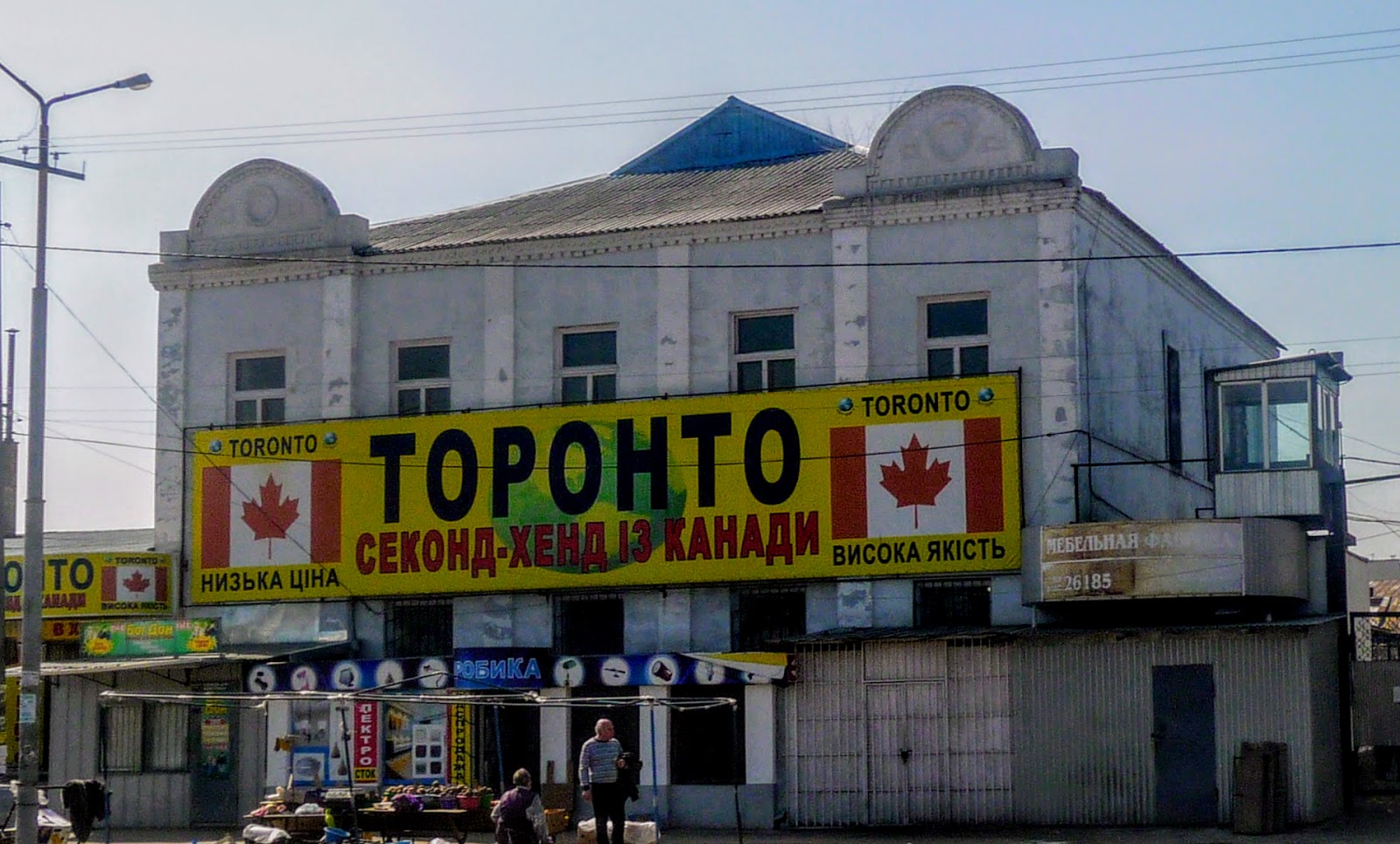
The city's central square is framed by commercial and administrative-office buildings of pre-revolutionary construction. Many of them have preserved their original stucco moulding, arches, pilasters and attics, but the people of Novomoskovsk did not appreciate the beauty of the rich decor and found no better place to put up banners and sheets of announcements.
 |
| Victory Square, 8 |
The "France" hotel appeared in the provincial city in 1880. Now the premises of this historic landmark are rented out to tenants.
 |
| Victory Square, 14. The former "France" hotel. 1880 |
The salesman of a shop with star-bright advertising thought I was photographing the goods he was selling. In Soviet times carpet products were considered a luxury and were in short supply. Demand for them has fallen, but the Soviet mindset in the minds of ordinary folk is ineradicable.
 |
| Star advertising on the facade of a historic building |
We move on along Shevchenko Street towards the monument to the Kobzar, whose location the 2nd-3rd year pupils we met on the square do not know.
 |
| Shevchenko Street. The shopping complex |
The former "Avanhard" cinema became unneeded by the townspeople and was converted into a nightclub, but after complaints from residents of the neighbouring houses about noise and drunken brawls the entertainment venue was closed; the building stands empty and is falling into ruin.
 |
| Shevchenko Street. The former "Avanhard" cinema |
A mansion decorated with brick ornament is occupied by a bank branch.
 |
| Shevchenko Street. The bank branch |
The poet-prophet, in the neighbourhood of a shopping complex, has fenced himself off from the goods-and-money objects with two steles.
 |
| Shevchenko Street. The monument to the Kobzar |
We turn onto Hetmanska Street and examine the snow-white buildings numbered 12 and 14, which house departments of the district and city administrations.
 |
| Hetmanska Street. The district administration |
 |
| Hetmanska Street. The city administration |
The teaching building of the Novomoskovsk College of Economics and Law dates from the 19th century. Until 1952 teachers were educated in it; until 1917 — in a seminary; in Soviet times — in a vocational school.
 |
| Hetmanska Street. The Novomoskovsk College of Economics and Law |
The former men's gymnasium, built in 1890, opened its doors to homeless children after the revolution. Later a pedagogical institute was housed within its walls. Over its 130-year history the collegium building changed its purpose as an educational institution only once, when during the years of the Hitlerite occupation it was taken over by the Gestapo.
 |
| Collegium No. 11 |
On Heroes' Square, 521 soldiers are buried in mass graves, among them the known names of 96 defenders who died on the approaches to the Dnipro. Novomoskovsk is one of the few cities in Ukraine where the memorial Eternal Flame, a symbol of remembrance for the fallen, never goes out, and the gas service monitors the soundness of the mechanism.
 |
| The war memorial. The Eternal Flame |
The MiG-21PF fighter was set up in honour of the 295th Fighter Aviation Division, which liberated the Novomoskovsk area in 1943.
 |
| The MiG-21PF fighter |
The city's day is celebrated annually on 22 September, the day of the liberation of Novomoskovsk from the fascist invaders. In the 1930s-1950s large industrial enterprises were commissioned in Novomoskovsk, new residential quarters were built, and the population grew.
 |
| The roundabout. Suchkov and Hetmanska Streets |
There are quite a few buildings of the Stalin era in the city, which impress with their architectural features. Some of them have the status of an architectural monument.
 |
| Hetmanska Street, 33 |
 |
| Kalnyshevsky Street, 7. School No. 1. 1948 |
Several buildings, painted in colours popular 70 years ago, are actually called "the red houses".
The streets in this city of Cossack glory are straight and green; some have names connected with the Zaporozhians.
 |
| Heroes' Square |
On Palanochna Street there is another church, consecrated in the name of the Holy Trinity. It was not possible to establish when the religious building was erected, and the plastic cladding after the repair made the church resemble new builds in cheap 'euro-wrapping'.
 |
| Palanochna Street. The Church of the Holy Trinity |
Since 1974 the "Metalurh" stadium has held 6 thousand sports lovers. A reconstruction of the main city sports arena is planned.
 |
| The "Metalurh" stadium |
 |
| A playbill of the "Metalurh" stadium |
The history of the city on the Samara, beginning with the times of the Polovtsian idols, can be learnt at the Petro Kalnyshevsky Museum of History and Local Lore. The museum is housed in a former mansion built in 1901 in the style of Ukrainian Architectural Modern (UAM). Until 1942 it belonged to doctor Dubrovsky, who was shot by the Hitlerites.
 |
| The Petro Kalnyshevsky Museum of History and Local Lore |
 |
| The Museum of History and Local Lore. The exhibition of Polovtsian warriors |
After the excursion around the city it is pleasant to rest for a few minutes on a bench made of wrought iron.
 |
| Palanochna Street. The bench |
You can reach Novomoskovsk by suburban trains from
Dnipro,
Pavlohrad to the Novomoskovsk-Dniprovskyi railway station, or by bus from these same cities to the bus station, which is located near the Holy Trinity Cathedral.
Coordinates of the central square of Novomoskovsk: 48°37'39"N 3515'43"E






No comments:
Post a Comment
Leave your impression