Lviv. Autumn at the Shevchenkivskyi Hai Open-Air Museum
The Klymentiy Sheptytskyi Museum of Folk Architecture and Rural Life in Lviv is a treasury of wooden-architecture landmarks and a place you want to return to. One or two visits are not enough to examine every exhibit in detail, and a walk here in the autumn season heightens the impression: paired with the golden magic of the season, it lets you hear your own thoughts, rest from the city's troubles and revel in the beauty of nature.
Lviv. Museum of Folk Architecture and Rural Life. Church of Sts. Olha and Volodymyr
At the entrance to the skansen you are met by Taras Hryhorovych, since this open-air museum is popularly known as Shevchenkivskyi Hai, the Shevchenko Grove.
Lviv. Museum of Folk Architecture and Rural Life. Monument to the Kobzar
Stands recounting the skansen's history tell of its founders, the restoration work and the exhibitions held here. At the ticket office, along with the ticket, visitors are handed a map of the museum marking the exhibits that have been carefully relocated from the regions of Western Ukraine onto the slopes of this landscape park. The open-air museum covers about 36 hectares, and signposts help you find your way along the routes.
At a fork in the path stands a chapel from the 1870s, brought from the village of Yalynkuvate in the Skole district of Lviv region. This small shrine was assembled from the timber of a church destroyed in a storm.
Lviv. Museum of Folk Architecture and Rural Life. Chapel from the village of Yalynkuvate, Lviv region
From the village of Tukholka in the same district comes the dwelling of a village prince (the starosta, or headman). This richly decorated house of 1910, with its gabled shingle roof, was the finest in the Boiko village. The caretaker, Ms. Maria, like a true mistress of the homestead, warmly invites you inside to look over the interiors. The mirror, the chests and the clock once served real owners at the start of the 20th century.
Lviv. Museum of Folk Architecture and Rural Life. Cottage from the village of Tukholka, Lviv region
The Skole area has shared its masterpieces of wooden architecture generously, and can take particular pride in a model of Boiko sacred building - the Church of the Holy Archangel Michael of 1863. The church is active and open to the faithful. A three-tiered bell tower, square in plan, completes the architectural ensemble.
Lviv. Museum of Folk Architecture and Rural Life. Church of St. Michael. 1863
Another representative of the Skole district is an 1860 cottage from the village of Oriavchyk, built for a large family. Once, children were raised here, carols were sung, Easter was prepared for.
Lviv. Museum of Folk Architecture and Rural Life. Cottage from the village of Oriavchyk, Lviv region. 1860
The Church of St. Nicholas was the first object at the skansen to be turned into a museum piece. This 1763 church was moved in 1930 from the village of Kryvky near Turka, where the villagers had decided to build a new church and to dismantle the old shrine or sell it off to smaller communities. A hundred years ago, when the finest examples of folk architecture rose in every village, few gave any thought to cultural heritage. It was the Sheptytskyi brothers who initiated the rescue of the sanctuary. With funds from Metropolitan Andrey Sheptytskyi the church was moved to the grounds of St. John's Lavra, where Klymentiy Sheptytskyi was serving as abbot at the time. The interiors were furnished using the holdings of the Lviv National Museum and church furnishings from the village of Volia Zhovtanetska.
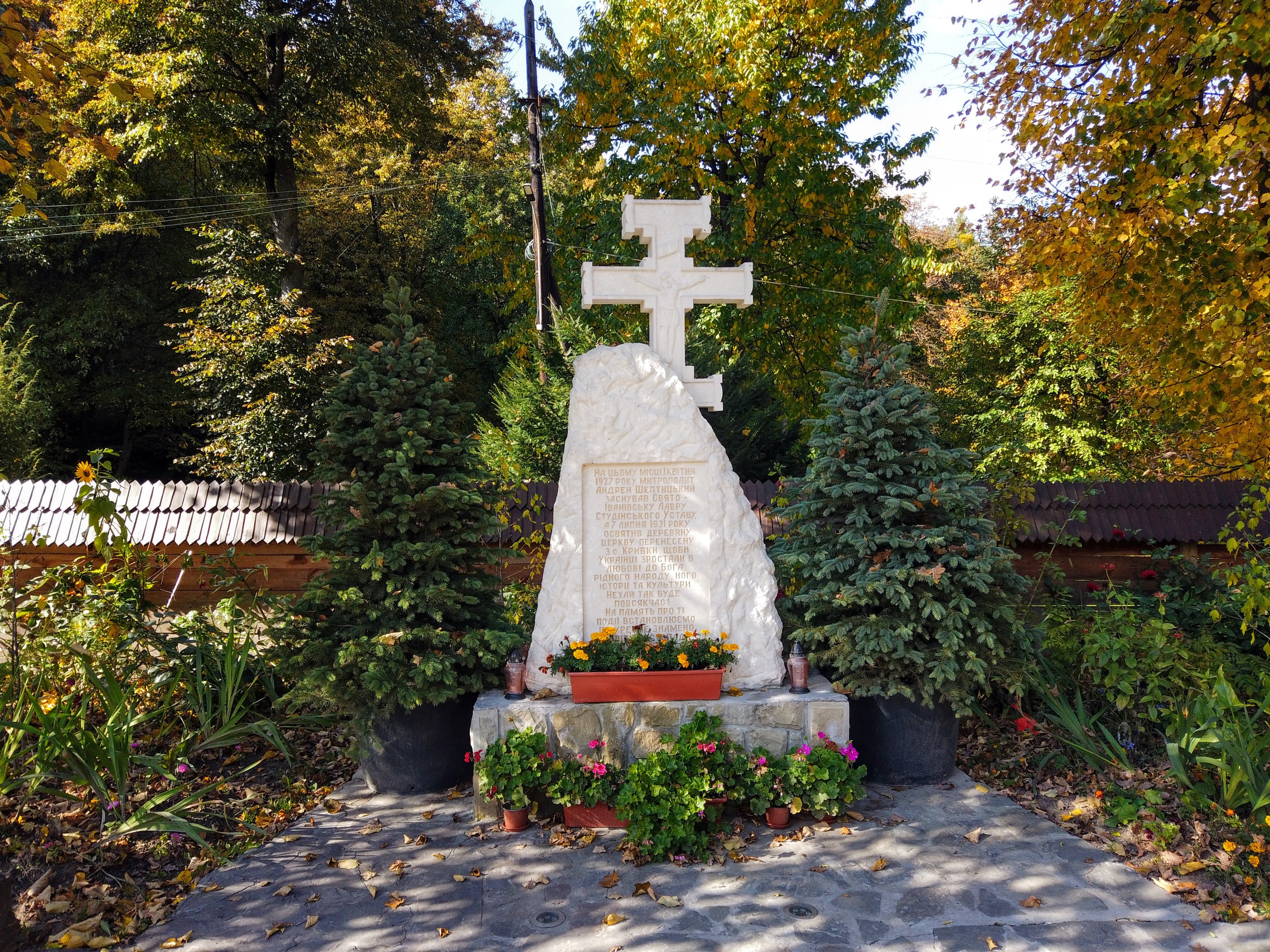
Lviv. Museum of Folk Architecture and Rural Life. Memorial cross on the site where St. John's Lavra was consecrated and the Church of St. Nicholas was erected
Lviv. Museum of Folk Architecture and Rural Life. Church of St. Nicholas
The enchanting beauty of the autumn park sketches ever-new crimson-and-yellow studies and tempts you to stroll on along the museum paths.
Lviv. Museum of Folk Architecture and Rural Life
The autumn mood stirs memories of school days, and you long to sit at a desk, hear the teacher's lesson, meet your classmates again. The open-air museum has a school from the village of Busovysko in the Staryi Sambir district of Lviv region. It feels as though the school bell is about to ring across that yard at any moment. Built in 1880, one of the finest rural schools of its kind, it served as a model for the construction of other schools in the region. The cupboard still holds all the supplies for lessons. In the other half, where the teacher lived, the atmosphere of a rural intellectual's home has been recreated.
Lviv. Museum of Folk Architecture and Rural Life. School from the village of Busovysko, Lviv region. 1880
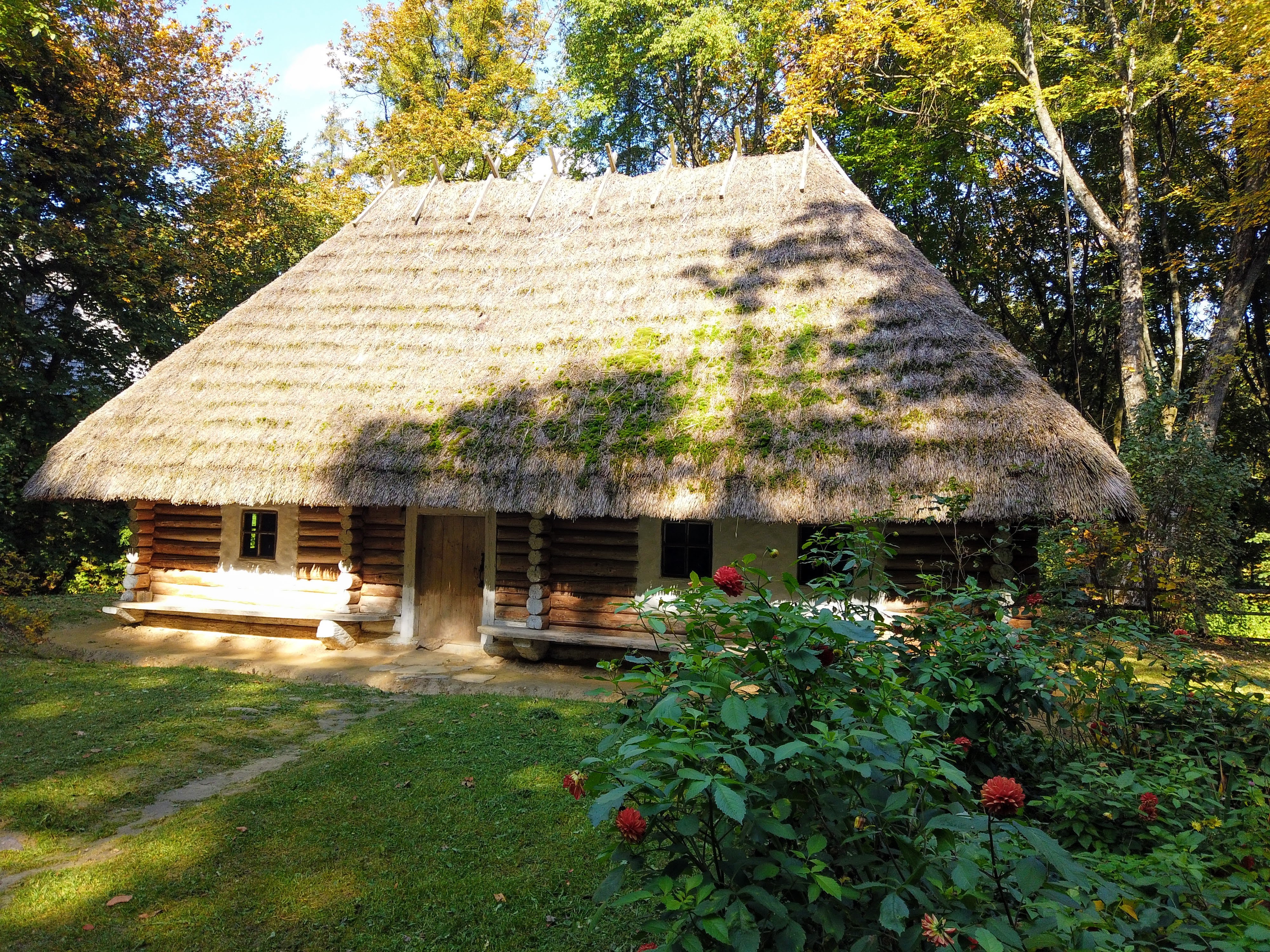
From that same Staryi Sambir district came the cottage of a poor peasant. This early-20th-century dwelling has the finish typical of the western Carpathians, where moss was packed between the beams and daubed over with white clay.
Lviv. Museum of Folk Architecture and Rural Life. Cottage from the village of Mshanets, Lviv region
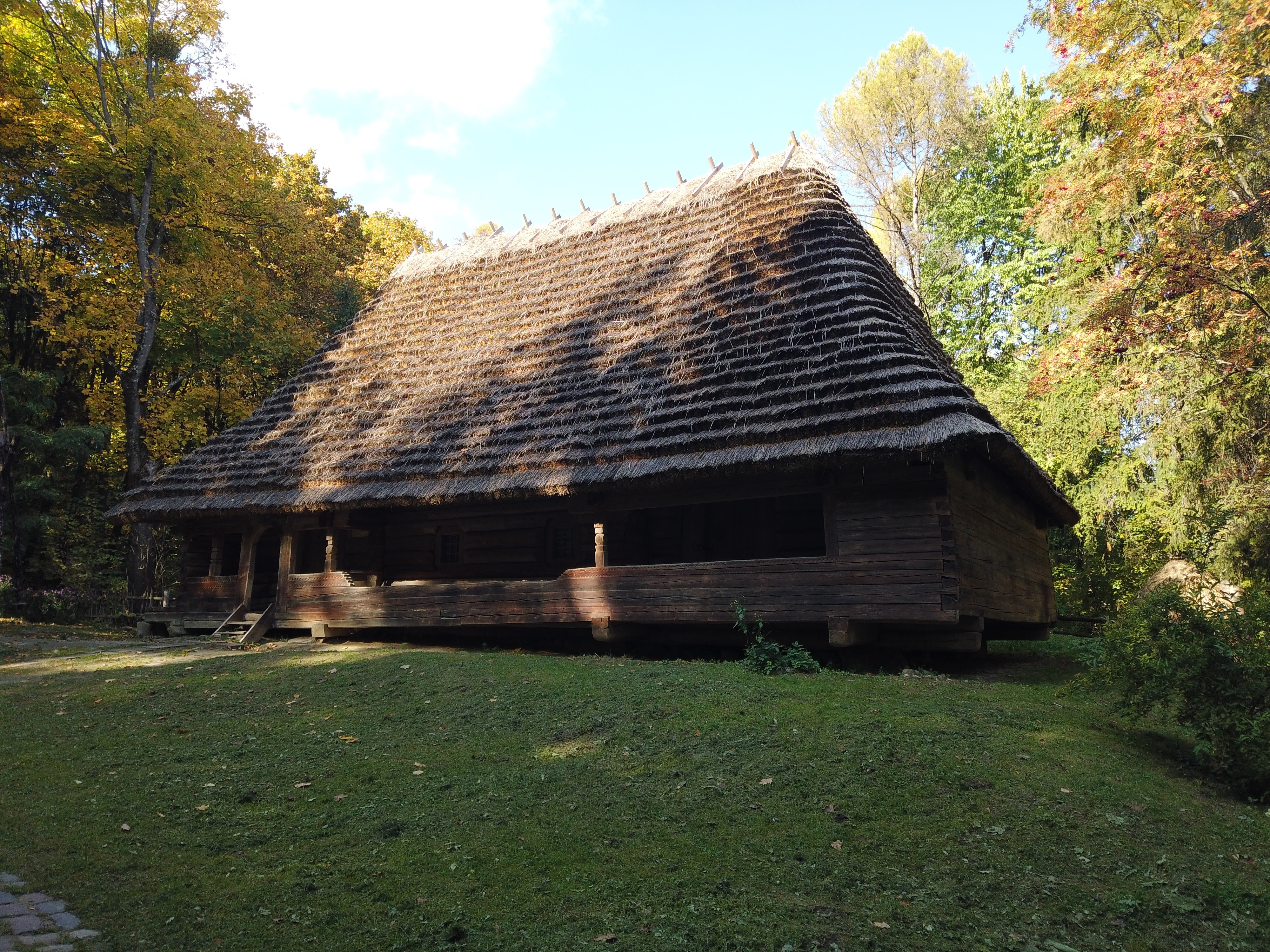
A long cottage of 1909 arrived from the village of Shandrovets in the Sambir district of Lviv region. Its peculiarity is that the living quarters and the outbuildings sit under one common roof, so that in bad weather the owner could pass along the length of the building on a boardwalk, from the room to the byre or the storeroom.
Lviv. Museum of Folk Architecture and Rural Life. Cottage from the village of Shandrovets, Lviv region
To get a sense of an early-20th-century rural homestead from Zakarpattia, it is enough to wander over to the Carpathian khutir with its pasture, orchard, outbuildings, a shed-kitchen, a shed for the cart, a summer stove and a mill. In May the spreading crown of a sweet-cherry tree bears a great many bright fruits, and visitors can treat themselves to this fruitful old variety.
Lviv. Museum of Folk Architecture and Rural Life. Homestead from the village of Krainykovo, Zakarpattia region
The house of a local master, M. Pekar, from the village of Zarichovo in the Perechyn district of Zakarpattia region, has been preserved. In 1973 the builder restored his own creation at the Shevchenkivskyi Hai museum. Under a single roof the living part, the pantry and the shed are joined together. On the yard stand a byre, a cellar, a well and a hay-drying rack.
Lviv. Museum of Folk Architecture and Rural Life. Cottage from the village of Zarichovo, Zakarpattia region
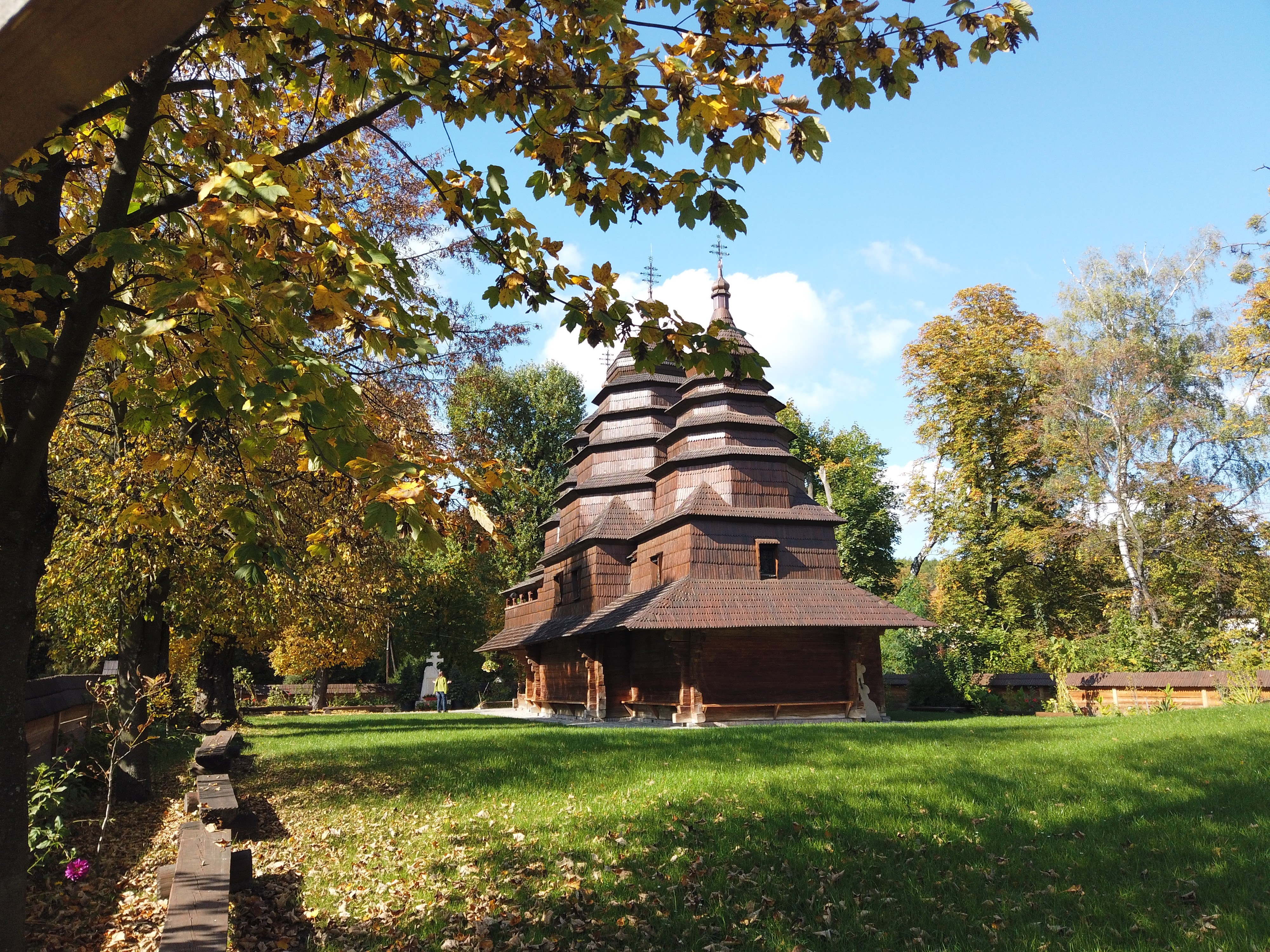
In 1992, to mark the thousandth anniversary of the reunion of the Lemko land with Kyivan Rus, a copy was made of a church in the former Ukrainian village of Kotan in Poland, built in 1841 and a landmark of the history and architecture of the Subcarpathian Voivodeship. The church at the skansen is consecrated to Sts. Olha and Volodymyr and is active, serving a Greek Catholic community. A two-tiered bell tower from Kotan completes the architectural ensemble.
Lviv. Museum of Folk Architecture and Rural Life. Church of Sts. Olha and Volodymyr
Autumn the painter transforms this ensemble of nature and architecture, inspiring artists and creative souls to new works. In various corners of the museum grounds, the picturesque beauty of Shevchenkivskyi Hai takes shape in canvases and oil studies, in watercolour, in music and in eloquent words.
Lviv. Museum of Folk Architecture and Rural Life. Cottage from the village of Triytsia, Ivano-Frankivsk region. 1886
Lviv. Museum of Folk Architecture and Rural Life. Cottage from the village of Vyznytsia, Zakarpattia region. 1870
The museum's collection comprises 110 architectural objects, grouped into mini-villages and arranged by region: Lviv region, lowland Zakarpattia, Boikivshchyna, Lemkivshchyna, Podillia, Bukovyna, Pokuttia. The examples of wooden architecture were brought from 54 settlements across Western Ukraine. The longest journey was made by the exhibits from the village of Shyrivtsi in Chernivtsi region. Gathered in the ethnographic displays, the household objects, clothing, tableware, furniture and photographs conjure up the atmosphere of rural life more than a hundred years ago.
Lviv. Museum of Folk Architecture and Rural Life. Exhibits
The Ivano-Frankivsk region is represented by the yard of a well-to-do farmer from the village of Verbovets in the Kosiv district of Ivano-Frankivsk region. The outbuilding displays a collection of farming implements, a winter sledge, a cart and other tools. Wonders happen at this Hutsul homestead. During the workshops held here, anyone can feel like a potter, make a toy from straw, paint on glass, improvise on folk instruments.
Lviv. Museum of Folk Architecture and Rural Life. Cottage from the village of Verbovets, Ivano-Frankivsk region
From the village of Berezhonka in the Vyzhnytsia district of Chernivtsi region came a cottage built of spruce logs at the start of the 20th century. The homestead complex includes a barn and a pigsty.
Lviv. Museum of Folk Architecture and Rural Life. Cottage from the village of Berezhonka, Chernivtsi region
The museum preserves examples of sacred buildings - six churches, one Roman Catholic church and one chapel. The Holy Trinity Church dates from 1774 and was brought from the outskirts of Chernivtsi. It is one of the oldest and earliest exhibits in the museum.
Lviv. Museum of Folk Architecture and Rural Life. Holy Trinity Church. 1774
The main occupation and chief goal of the museum's staff is to preserve the authentic appearance of the exhibits. The builders, restorers and homestead caretakers study old techniques and follow them as they renew and maintain the displays. The roofs and coverings demand particular attention, since they suffer most from the outside effects of the weather. To thatch a single square metre of straw roof, for instance, takes 30 to 35 sheaves of straw. Restoring the cottage from the village of Oriavchyk required nearly 11 thousand straw sheaves harvested from four hectares.
Lviv. Museum of Folk Architecture and Rural Life. Exhibits
The work of the ethnographers, architects, restorers and all those who strive to preserve this layer of folk architecture deserves enormous respect. Sadly, not everything can be saved. On 6 February 2022 a fire cost the museum a unique exhibit - the grazhda from the village of Kryvorivnia in the Verkhovyna district of Ivano-Frankivsk region. This enclosed courtyard with its living quarters and outbuildings is lost forever. There is now practically nowhere left to find another example of such a Hutsul dwelling. It was not the first fire tragedy: over the museum's 50 years of existence, around ten landmarks of folk architecture have perished in flames.
Lviv. Museum of Folk Architecture and Rural Life. The burned-down grazhda
Ukrainians have long practised farming, woodworking and animal husbandry. On the grounds of the skansen you can see a mill, an oil press, a fulling mill and a smithy.
Lviv. Museum of Folk Architecture and Rural Life. Oil press from the village of Holovetsko, Lviv region
Lviv. Museum of Folk Architecture and Rural Life. Windmill from the village of Shyrivtsi, Chernivtsi region
Lviv. Museum of Folk Architecture and Rural Life. Water mill from the village of Lybokhora, Lviv region
Various beehives, made of wood, are on display. Beekeeping and wild-hive honey gathering are ancient crafts on the territory of Ukraine.
Lviv. Museum of Folk Architecture and Rural Life. Apiary
The tour does not end here; you can wander the museum routes for a long time yet, taking your fill of both the natural and the man-made landmarks. I want to wish the staff of one of Ukraine's finest museums new projects, so that the collections keep growing and are kept safe in peace.
Lviv. Museum of Folk Architecture and Rural Life. The lake
Address of the Klymentiy Sheptytskyi Museum of Folk Architecture and Rural Life: 1 Chernecha Hora St., Lviv. On the grounds of the "Znesinnia" landscape park.








No comments:
Post a Comment
Leave your impression