 |
| Lviv. Stryiskyi Park |
This picturesque, clean, colourful corner of nature may be called a people's park.
People of all ages come here from every district of the city — schoolchildren and students, mothers with children, married couples and young pairs, older people. Here everyone finds what they came to the green island for — to break away from urbanisation and admire the landscaped views, to go for a run and breathe in the phytoncides, to stroll calmly along the terraces of the park and dream, to rest on a bench and talk with a companion, to get acquainted with the flora and fauna.


Chess players come to this green friend to do battle over the board, musicians to show their performing art, painters to make their sketches. Every walk through the park brings incredible impressions and is tinged with new colours.


The central entrance to the green oasis, from the side of Parkova Street, is made in the form of a ceremonial arch, built in 1952.
 |
| Lviv. Stryiskyi Park. The central entrance |
The gate from the side of Ulas Samchuk Street, into this territory of good cheer, is decorated with ceramic panels depicting a plan, with bas-reliefs of the landmarks and with the history of this Lviv pearl.

 |
| Lviv. Stryiskyi Park. The ceramic panel on the entrance gate |
The park ensemble was designed in 1877 by the chief gardener of Lviv, Arnold Rering, who managed to combine in his brainchild various traditions of landscape-garden art. The botanical stock of Stryiskyi Park is made up of plants that in a natural environment never all occur together. The plane, the beech, the oak, the birch, the maple, the sycamore, the acacia, the fir, the Canadian hemlock, the thuja, the larch, the spruce, the pine, the alder and the guelder rose head the collection of this woodland, which is being replenished with new kinds of plantings.

 |
| Lviv. Stryiskyi Park. Young plantings |
The botanical garden of the Lviv Forestry University shared with the park exotic specimens of tropical plants, and now agaves, palms, ficuses, a banana tree and a fig make up the greenhouse's supernumerary assortment.


 |
| Lviv. Stryiskyi Park. The greenhouse |
In 1961, for the 100th anniversary of the burial of the Kobzar in Kaniv, Ukrainian writers planted a willow sprig brought from the Kazakh land where Taras Hryhorovych served his exile and planted a tree. Now the mighty memorial willow shares planting material with other green estates, and the Shevchenko relic spreads through the parks of Ukraine.

Fountains, a lake with a pair of swans and a cascading pond lend the recreation zone charm, allure and an added aesthetic.


Before the Second World War the park bore the name of the insurgent and patriot of Poland Jan Kilinski, whose sculptural image has risen here since 1895.
 |
| Lviv. Stryiskyi Park. The monument to Jan Kilinski |
The romantic ruins of an ancient castle were raised in keeping with the fashionable trends for creating park structures.
 |
| Lviv. Stryiskyi Park. The "Romantic Ruins" |
From 1894 the Provincial Exhibition of the achievements of Galicia was held on the grounds of the city park, and numerous pavilions were built for the displays. Some have survived, yet are not used by the park administration.
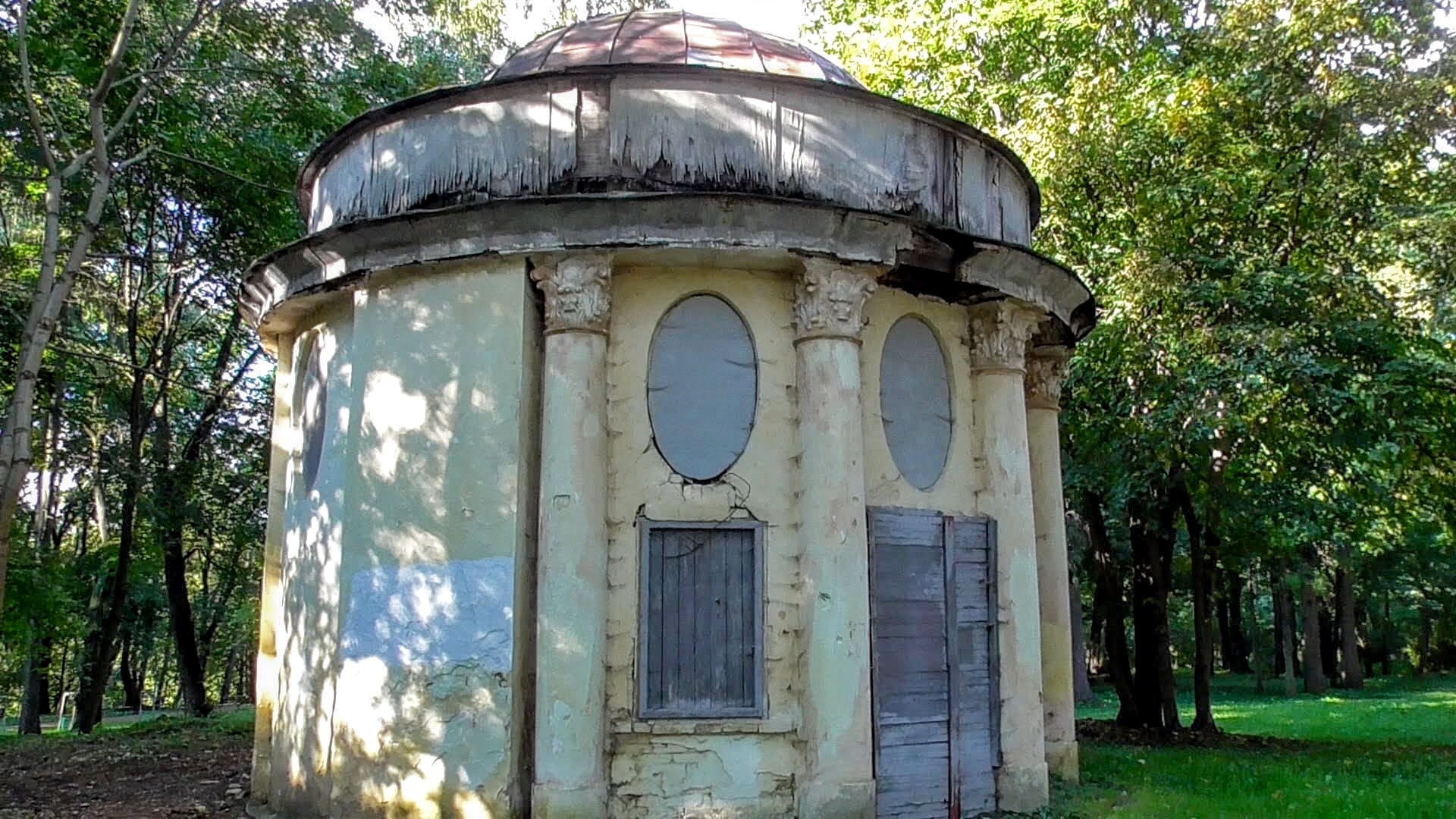 |
| Lviv. Stryiskyi Park. The Scarotti rotunda pavilion. 1925 |
For the water supply of the largest fair, at the end of the 19th century a stylised 18-metre tower was built of stone and brick. Now this architectural dominant of the green expanse has been converted into a restaurant.
 |
| Lviv. Stryiskyi Park. The water tower. 1894 |
From the main avenue, winding paths and flights of steps lead to the parterres and terraces.


On one of the tiers a spring of water breaks to the surface, adorned with a relief image of the fairy-tale hero Kotyhoroshko fighting the Serpent.
 |
| Lviv. Stryiskyi Park. The spring |
On the basis of the narrow-gauge railway laid to bring in the exhibits of the Provincial Exhibition, in 1951 a children's railway 1.2 kilometres long was opened. The four carriages of the "Viterets" train run between the "Parkova" and "Soniachna" stations.
 |
| Lviv. Stryiskyi Park. The children's railway |
Stryiskyi Park is known for its sporting achievements. A monument in the form of a falcon sitting on a ball is dedicated to Ukrainian football and was erected for the 110th anniversary of the first football match in Ukraine, played at the "Sokil" stadium in Stryiskyi Park.
 |
| Lviv. Stryiskyi Park. The memorial sign to Ukrainian football |
Besides its entertaining, aesthetic and health-giving function, the park has an educational character. Information stands introduce the variety of the feathered and other secret dwellers of the woodland park.

 |
| Lviv. Stryiskyi Park. The information stands |
Stryiskyi Park is located to the south of Rynok Square and the City Hall; a walk to it on foot takes 20 minutes along the streets of the historic centre of Lviv.
 |
| Lviv. Stryiskyi Park. The viewing platform |
Beside the park run the routes of buses No. 26, 27, 30, 54 and tram No. 4.

This story is also available in Ukrainian: Львів. Стрийський парк. Гуляти і гуляти

No comments:
Post a Comment
Leave your impression